Introduction
Audiovisual consult (AVC) is a consultation between paramedics on site and an emergency physician located in a distant health care facility over a device transferring both audio and video signals. The use of AVC in prehospital emergency care (PHEC) is an interesting and current topic in telemedicine, as reflected by the number of recently published studies. Reference Winburn, Brixey, Langabeer and Champagne-Langabeer1 The use of AVC by paramedics with a specialist enables more accurate diagnosis in the field, an earlier and more accurate direction of the patient towards an appropriate facility, and level of care in patients with stroke Reference Ehntholt, Parasram, Mir and Lerario2-Reference Fassbender, Grotta, Walter, Grunwald, Ragoschke-Schumm and Saver4 or acute coronary syndrome. Reference Nam, Caners, Bowen, Welsford and O’Reilly5-Reference Bosson7 However, ambiguous results were reported for AVC, remote supervision, or assistance for a range of procedures in severe trauma. Reference Eder, Reime, Wurmb, Kippnich, Shammas and Rashid8 The use of AVC appears to be suitable for less-severe conditions not requiring an urgent and algorithmic approach. In less-severe cases, the use of AVC with a physician improved service efficacy by shortening “back in service” time of the paramedic crew and led to more frequent decisions, either not to transfer to hospital or advice to use an alternative way of transport. Reference Langabeer, Gonzalez and Alqusairi9 No compromise to patient safety and good patient satisfaction rate were also reported and were reproduced by a large study in the US. Reference Champagne-Langabeer, Langabeer and Roberts10 Yet, the role of AVC in the physician-based PHEC system Reference Seblova, Cimpoesu, Khoury, Revue and Trenkler11 (so-called rendezvous system) Reference Tintinalli, Cameron, Holliman, Mencl and Puppala12 remains unclear. Indeed, in such PHEC systems, paramedics have less competence to provide procedures Reference Timmermann, Russo and Hollmann13 or to make some decisions (for instance, the need to consult a physician over the phone before leaving the patient after treatment at home). Reference Wilson, Habig, Wright, Hughes, Davies and Imray14
Therefore, researchers aimed to evaluate the safety and efficacy of AVC in less-severe cases in the context of a PHEC system, which is routinely used in the Czech Republic. Another study question addressed how paramedics and consulting physicians accept AVC.
The primary objective of the study was to evaluate the rate of patients treated on site without the need of hospital transfer after using AVC. The co-primary safety outcome was the frequency of repeated ambulance trips within 48 hours to the same patient, after the patient had been treated and left on site. Secondarily, the qualitative analysis of subjective perception of the AVC compared to consultation over the phone by the paramedic and consulting physician was performed.
Methods
Study Design
The protocol of the trial was conducted according to CONSORT guidelines and retrospectively registered at clinicaltrials.com (NCT04312321). The study protocol and conduction of the study were approved by the Emergency Medical Service (EMS) of Karlovy Vary Region institutional ethical committee on September 6, 2019 (protocol submission number 2176/ZZS/2019).
In accordance with Article 38 of the Declaration of Helsinki (version 2008), which the study is fully compliant to, and after explicit approval by the Research Ethics Board, the need for prospective informed consent has been waived. The main reason being that that randomization had to occur before the patients were physically seen, and care that included the study intervention had to be prioritized over conversations about the study. Nonetheless, as soon as practical and feasible, but always before filling the subjective evaluation questionnaire, all patients or their legal representatives were informed about the study by paramedics and given the option to consent or withdraw from the study and their decision documented in the notes.
This was a single-center, randomized controlled trial with three parallel groups. Low-urgency EMS events were randomized into three groups: (1) routine operation of the paramedic crew with optional consultation with a physician over the phone; (2) in the PHONE group; and (3) in the VIDEO group. There was a mandatory consult of a physician over the phone or by AVC, respectively. The allocation ratio of events was 1:1:1.
Eligibility Criteria
Eligible events were the low-urgency events of the EMS. Each call to the emergency line at a pre-specified location was assessed for eligibility by the dispatching operator. Inclusion criteria of the event were: (1) the emergency call was evaluated as a low-urgency event (by criteria in call-taker’s and dispatcher’s manual); Reference Franěk15 (2) the decision taken to send over the paramedic crew only; and (3) the physician of EMS of Karlovy Vary Region participating in the study was available for consult. Exclusion criteria were: (1) need for escalation of care: paramedic’s requirement for the doctor to arrive at the scene of intervention; (2) consultation with other physicians than the trained one involved in the study; (3) patient-crew language barrier; and (4) technical, logistic, or other (ie, aggressive patient, patient detained by police) problems which would make the conduct of the study not feasible as determined by paramedic crew on site.
Data from patients who met exclusion criteria after randomization or if protocol violation occurred were treated as if no study was conducted. They were included for safety (intention-to-treat [ITT]), but not to efficacy (per-protocol) analysis (PPA).
Location and Study Setting
The study was conducted in EMS Karlovy Vary Region, Czech Republic, from October 17, 2019, six weeks onwards. Karlovy Vary Region is a rural part of the Czech Republic with 297 thousand inhabitants and with over 36,333 total number of EMS events of all levels of urgency per year (2019). The personnel of 11 paramedic crews (out of 19 in continuous operation on EMS Karlovy Vary) and 11 physicians were chosen, consented, and trained to participate in this study. Pre-selected paramedic crews serve the peripheral or rural or mountain regions, without the physician crew at the same base, and without hospital in the town where the crew is originally situated. The consulting physicians were available for consults during the study period 7:00 am. to 11:00 pm, and only if they were not engaged in another trip. There was at least one physician available for study consults per study day. Physician participation on study consults was a voluntary addition to his/her daily routine in EMS work.
Interventions
The dispatching center randomized the eligible low-urgency events to receive a mandatory phone call consult (PHONE), AVC (VIDEO), or to be performed by the paramedic crew in a routine manner, when phone call consultation is for the paramedic crew optional (CONTROL). In a routine operation, the paramedic crews consult the doctor for three main reasons: the need for medication, non-transport of patient, and at a certain level of deterioration of vital function. In patients randomized to the PHONE group, the case was always consulted by paramedics with the base physician. Phone call consults were performed by the usually used phone calls via the dispatching center. For the AVC (VIDEO) group, the same smartphone was used (Xiaomi Redmi Note 8 T with Android; Xiaomi; Haiten, Beijing, China) with Bluetooth handsfree headset (Jabra Talk; Jabra GN; Copenhagen, Denmark) with application for video conference (VSee Messenger; VSee Lab, Inc.; Sunnyvale, California USA). The data transfer was via the public network provider (O2 mobile network; Czech Republic). The equipment of consulting physician was personal computer (various types) connected to Internet with Windows 10 (Microsoft Corp.; Redmond, Washington USA) and desktop application of VSee Messenger for Windows, web camera (Logitech C922 PRO; Logitech International; Lausanne, Switzerland), and headset (Jabra Evolve 20; Jabra GN; Copenhagen, Denmark). All communication was recorded and stored as medical documentation according to Czech law. To obtain the evaluation of subjective perception of consult, the surveys were filled out by paramedics at the end of the trip and by the consulting physician at the end of the consult.
Primary and Secondary Outcome Measures
The primary outcome was to evaluate the proportion of patients left on site after AVC with physicians. Moreover, the number of repeated ambulance trips within 48 hours to patients who were treated and left on site was rated.
Secondarily, the qualitative analysis of subjective perception of consultation in both mandatorily consulted events by the paramedic and by the consulting physician was performed. Paramedics filled the survey (Supplementary Appendix; available online only) at the end of the trip and physicians at the end of consultation. The survey consisted of questions with options on a four-point Likert scale (excellent, good, bad, and insufficient). Paramedics and physicians assessed the transfer of clinical information by the consult (how they think the information was passed about the patient condition to the physician regarding the way of consultation, or how they received the information, respectively). The second question was about the safety of care (how they subjectively perceived the safety of provided care for the patient). Moreover, the physicians evaluated how they perceived the transfer of situational context during consultation. Paramedics, physicians, and patients were asked to respond how they were satisfied with the provided care on the same scale at the end of the trip, care, or consultation, respectively. Technical aspects of the consultation were also evaluated: type of network and strength of the signal, connection failure (need for repeated calls or finding a better signal), or notes for consultation, if applicable.
Sample Size and Data Analysis
Based on available internal data prior to the initiation of the study, 10% of patients after low-acuity calls were treated on site. The hypothesis was that the AVC could lead to doubling this percentage. The study was powered to yield 80% probability to confirm this at P <.05; 200 subjects per group were needed. An interim analysis was a priori planned after the fourth week of the study.
Randomization
The events were assigned to the study groups sequentially as emergency calls arrived in this order: CONTROL, PHONE, VIDEO. Responsible for assignment were the dispatchers of the dispatching center if the eligible criteria of the event were met. There was no stratification. After the interim data analysis, the randomization into the PHONE group was stopped to increase the number of subjects randomized into the AVC and CONTROL groups.
Statistical Methods
Baseline characteristics among study groups were tested by one-way ANOVA for ordinal and Chi-square test for nominal variables. Primary and co-primary outcomes: odds ratios were used to compare the proportion of patients treated and left on site and for repeated trips comparison. Secondary outcomes: there were used Likert scales visualized in graphs and one-tailed Mann Whitney U tests to compare subjective perception of mandatory consultations between groups. Statistical software STATISTICA 7.0 (StatSoft, Inc.; Tulsa, Oklahoma USA) was used to statistical analysis and calculations.
Results
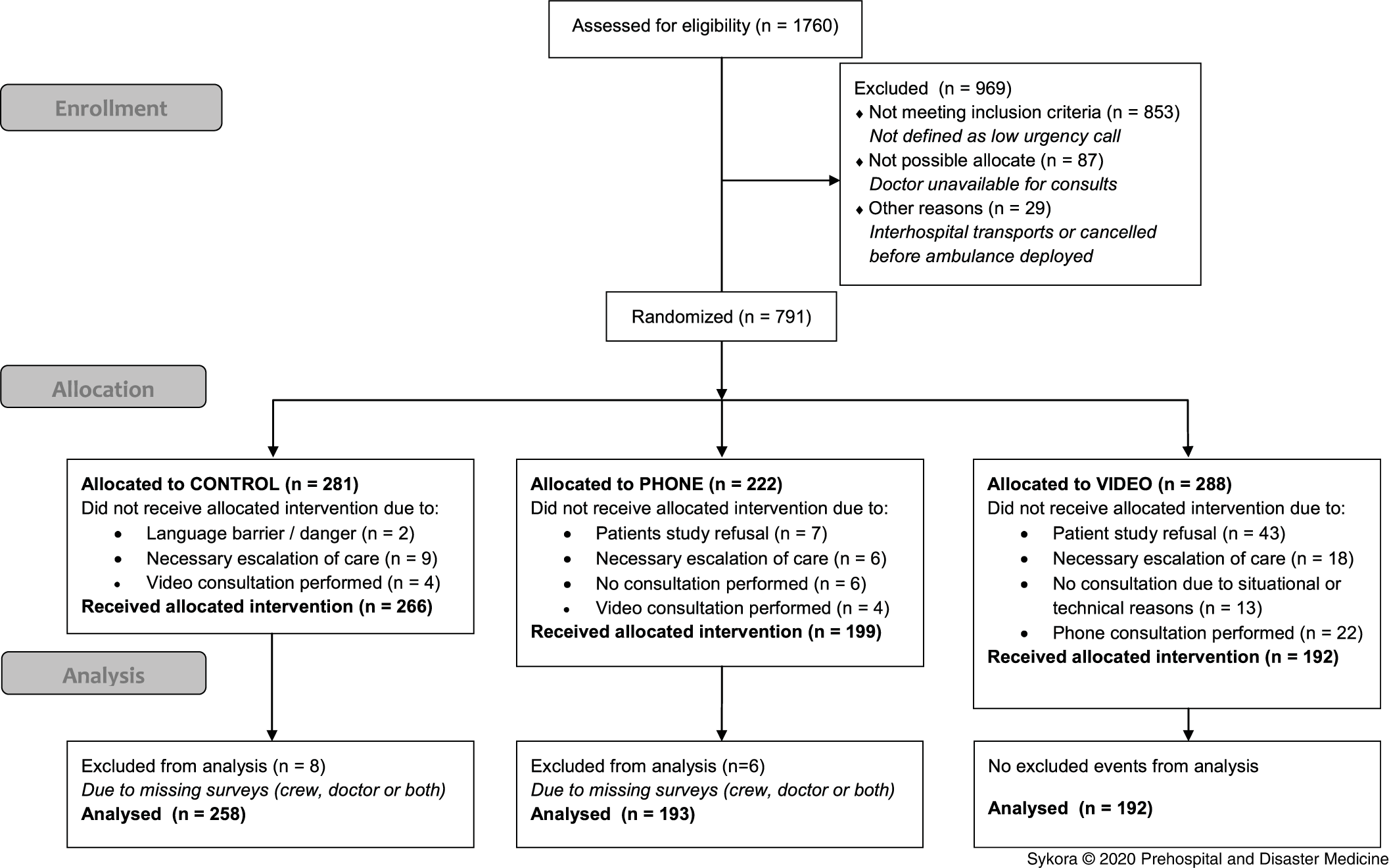
Flow of events through the study with detailed description of protocol deviation in each group is presented in Figure 1.
Study Flow Diagram.

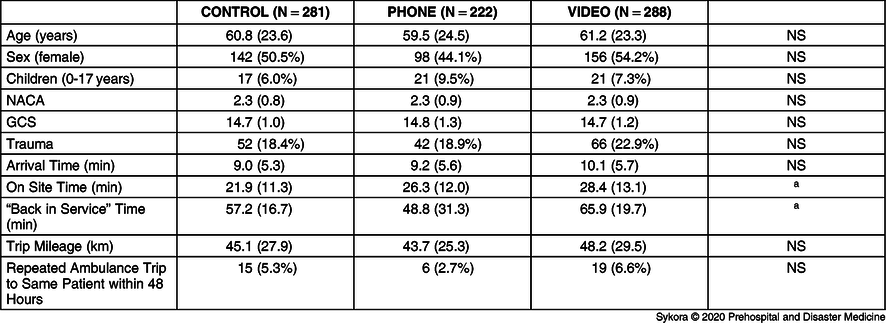
Out of 1,760 screened calls from pre-specified areas, 791 calls were randomized, of which baseline characteristics are described in Table 1 and the ITT analysis was performed. Subsequently, the PPA was performed and involved 643 events.
Baseline Demographic, Clinical, and Operating Characteristics

Note: Data are means (SD) or numbers (%); NS, not significant.
Abbreviations: GCS, Glasgow Coma Scale; NACA, National Advisory Committee for Aeronautics Score.
a P <.05.
Intention-to-Treat Analysis
Primarily in ITT analysis (n = 791), patients assigned to consulted groups (PHONE or VIDEO) were not more frequently treated and left on site compared to routine operations (PHONE: OR = 1.46; 95% CI, 0.87 to 2.44; P = .15 or VIDEO: OR = 1.48; 95% CI, 0.91 to 2.40; P = .11). Repeated trips to patients treated and left on site in 48 hours occurred in three (8.6%) of 35 cases in the PHONE group and in nine (19.6%) of 46 cases in the VIDEO group (Table 2).
Primary Outcome: Intention-to-Treat Analysis

Note: Data are numbers (%); NS, not significant.
Per-Protocol Analysis
Regarding the deviations from the protocol and few non-completions of the study documentation, due to operational, technical, and logistic reasons, there were 643 events left for PPA (CONTROL, n = 258; PHONE, n = 193; and VIDEO, n = 192).
In detail, out of 281 events allocated to the CONTROL group, two cases were excluded due to the language barrier and dangerous interaction of the crew with patient on scene; in nine cases, the presence of a physician due to the high severity of the case was demanded; and in four cases, there was an incorrectly performed AVC by paramedics. The study documentation (surveys) was missing in eight cases. Out of the 222 events allocated to the PHONE group, seven patients refused to participate in the study, in six cases the physician was called on site, in six cases no consult was performed, and in four cases the AVC was incorrectly performed by paramedics. Missing surveys were in four events. From the 288 events allocated to the VIDEO group, the following were excluded: patients decided to withdraw from the study (n = 43), a physician arrived at the scene due to higher urgency case (n = 18), no AVC consult was performed due to technical reasons (such as low signal or flat battery) or due to human errors (n = 13), and the consult over the phone was incorrectly performed (n = 22). No surveys were missing from those events which received allocated intervention (AVC).
Patients in both mandatory consulted groups were twice as likely to be treated and left on site compared to routine operation (PHONE: OR = 2.07; 95% CI, 1.19 to 3.58; P = .01 or VIDEO: OR = 2.01; 95% CI, 1.15 to 3.49; P = .01). Repeated trips to patients treated and left on site in 48 hours occurred in three (8.6%) of 35 cases in the PHONE group and in eight (23.5%) of 34 cases in the VIDEO group (Table 3).
Primary Outcome: Per-Protocol Analysis

Note: Data are numbers (%); NS, not significant.
a P <.05.
Secondary Outcomes
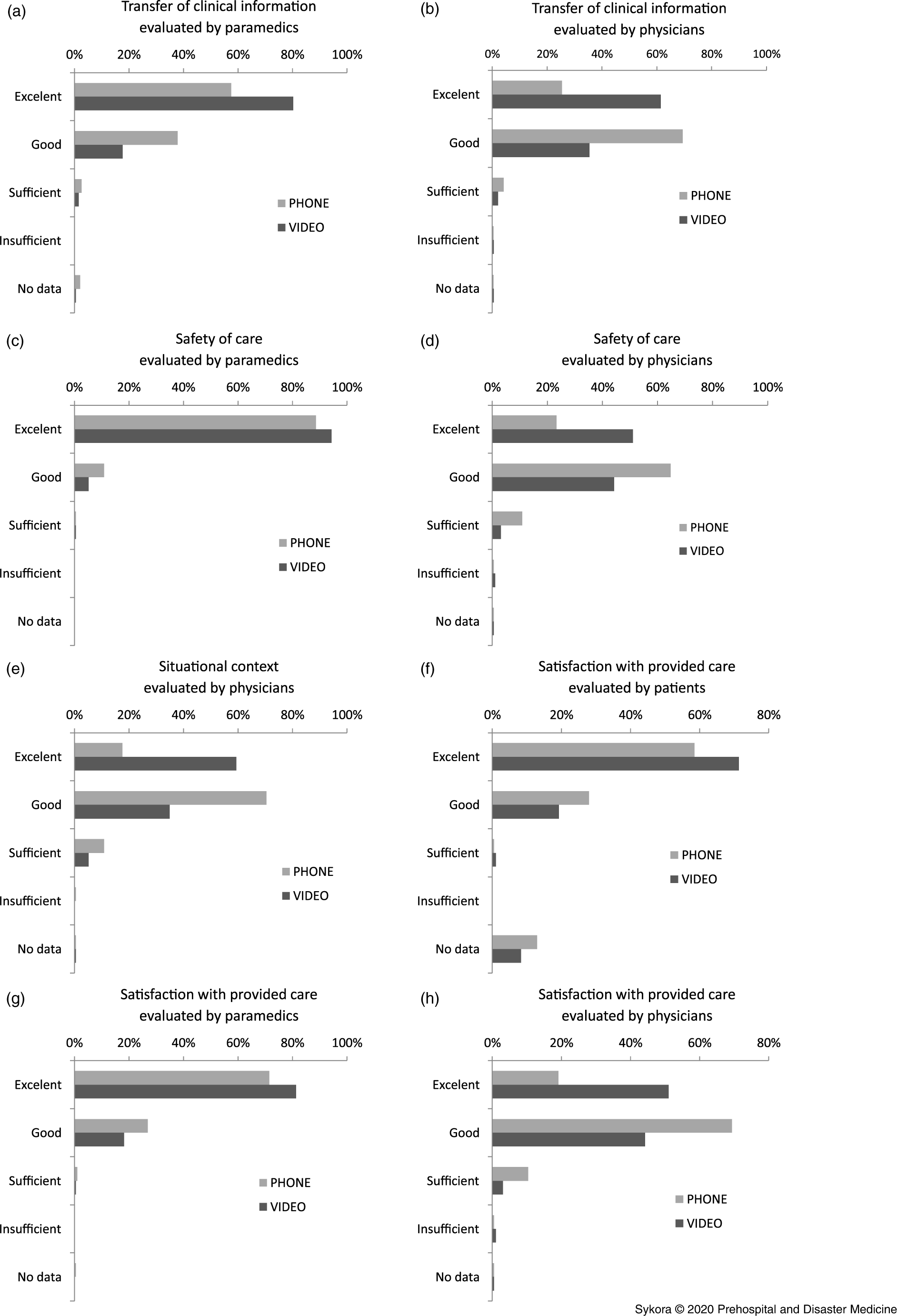
Secondary outcomes are presented in Figure 2. Secondary outcomes were evaluated from per-protocol populations in both groups with mandatory consultations (PHONE and VIDEO). The qualitative analysis of a four-point Likert scale revealed that AVCs were subjectively better perceived than phone call consultations with respect to clinical information transfer by both paramedics (U = 14122, Z = 3.66; P <.01; r = 0.01) and physicians (U = 11719, Z = 6.11; P <.01; r = 0.02; Figure 2 A and B). The safety of provided care was evaluated by paramedics as identical to PHONE and VIDEO groups (U = 17483, Z = 0.95; P = .33; r = 0.002) and better in VIDEO by physicians (U = 12809, Z = 5.10; P <.01; r = 0.01; Figure 2 C and D). The situational context was rated better by physicians during AVC (U = 10577, Z = 7.16; P <.01; r = 0.02; Figure 2 E). The use of AVC did not lead to a higher satisfaction rate compared to the use of phone consultation during trips, neither for patients (U = 13256, Z = 1.66; P = .09, r = 0.004) nor for paramedics (U = 16695, Z = 1.60; P = .11; r = 0.004; Figure 2 F and G). However, physicians were significantly more satisfied with AVC than with a phone consultation (U = 12122, Z = 5.74; P <.01; r = 0.01; Figure 2 H).
Qualitative Analysis of Subjective Perception of Consultations.

Discussion
The main finding of this study is that AVC is no better than mandatory consults of emergency physicians by paramedics over the phone regarding the proportion of patients treated and left at home. Yet, AVC increases the subjective feeling of confidence of physicians with the decision they made. Apparently, if it is left up to paramedics whether to call a doctor or not, more patients are being transferred to hospitals, but among those treated and left at home, much fewer require repeated trip. This confirms the intuitive and obvious tendency of paramedics to prioritize the patient’s safety and execute the “scoop and run” approach. Mandatory consult of a doctor (shall it be over the phone or AVC) changes this and increases the proportion of patients treated at home, but at the price of a slightly increased need of repeated calls.
The trend to increased repeated trips within 48 hours in AVC group is difficult to explain, but it is clear that it occurs in both patients transferred to the hospital and quickly discharged as well as in patients treated and left at home. It can be a small number effect occurring by chance or a psychological phenomenon that is yet to be explored (eg, patients feeling the easiness of seeing a doctor without actually bothering him or similarly making them more likely to call emergency services). Yet, without further study, this remains speculative.
In the context of this study, AVC does not change patient outcomes, but does improve doctor’s subjective feelings and is likely to reduce work-related stress and improve job satisfaction. Staff behavior on site is influenced by AVC the same way as it is by mandatory consult over the conventional means (ie, the phone), and there is no additional benefit of transferring images in the quality of decision making as reflected by the frequency of repeated calls. In fact, AVC can make this aspect worse.
On the other hand, doctors and paramedics often stated in the notes that AVC is very helpful, for example in neurological examination, electrocardiogram evaluation, or reassessment of the patient’s direction to another medical facility. They also appreciated the possibility to have a direct videocall with patients in this and other studies. Reference Champagne-Langabeer, Langabeer and Roberts10,Reference Han, Lim, Noh, Shin, Kim and Lee16
On the other hand and contrary to studies conducted in urban areas, Reference Langabeer, Gonzalez and Alqusairi9,Reference Champagne-Langabeer, Langabeer and Roberts10 AVC in the presented study in rural areas prolonged the “back in service” time of ambulances. Therefore, AVC probably will not lead to economic savings in the Czech health care insurance system (based on reimbursement according to the length of the trip and mileage), as already demonstrated in US. Reference Langabeer, Champagne-Langabeer and Alqusairi17
Moreover, essential is the fact that in the video group, 43 patients refused to participate in the study (30 of them explicitly for the reasons of privacy violation by video transfer), which is almost 15% and corresponds to some unclear concerns among patients, especially those with mild- and low-acuity difficulties. The same phenomenon was observed in previous AVC testing (unpublished). Therefore, the condition of the mobile network, connection failures, and staff errors are the common limitation of otherwise feasible and easy methods. Reference Felzen, Brokmann and Beckers18-Reference Cho, Kwon and Jeong20
Limitations
Indeed, the main limitation of this study is its limited generalizability, as the results are very much dependent on the context in which they were obtained: the case mix, level of staff training and competence, setting, and working habits. The main demonstrated benefit of AVC (ie, staff satisfaction with it) might have been subjected to selection bias, as doctors and paramedics outside this study may feel differently about it. In particular, a mandatory consult may significantly increase the workload of emergency doctors, a phenomenon which was not addressed in this study.
Lastly, this study does not and cannot answer the question to what extend it is beneficial to various stakeholders (patients, EMS crew, or hospital crew) to accept an increased rate of repeated calls for the sake of increased proportion of patients treated at home.
Before any recommendations regarding the clinical use of AVC in PHEC are made, the phenomenon of increased repeated calls needs to be analyzed in detail. Ironically, an alternative explanation of the results this study is that AVC makes doctors happy with their decisions, which are wrong.
Conclusion
In this randomized controlled trial, the AVC of the emergency physician by paramedics was not superior to the mandatory conventional phone call in increasing the proportion of patients treated and left at home after a low-urgency call. Audiovisual consult improved the subjective feelings of safety by emergency physicians, but not of patients or paramedics, and may lead to an increased need of repeated trips.
Acknowledgments
The authors thank all the employees of the EMS of Karlovy Vary Region who participated in the study, especially to: Mr. Vaclav Kucera, EMS ICT specialist for technical support and improvement of commercially available software; and Mr. Radek Hes, the dispatcher team leader of Karlovy Vary EMS for educating and motivating dispatchers to include the conduct of this study into their daily routine.
Conflicts of interest/funding
The work has been supported by “Progres Q37 Program” of Charles University and Institutional Grants of FNKV University Hospital (Prague, Czech Republic).
Supplementary Material
To view supplementary material for this article, please visit https://doi.org/10.1017/S1049023X2000117X