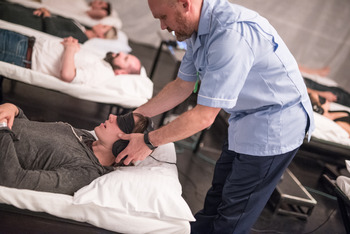
A participant at a performance of Reassembled, Slightly Askew at Summerworks Performance Festival, Toronto, Canada, 2017. Photograph by Dahlia Katz.

Shannon Yee (Sickels), Playwright and Producer
In December 2008, I had a sinus infection that progressed into a life-threatening subdural empyema, a rare brain infection. Upon my admission to the acute Neurosurgical Ward of the Royal Victoria Hospital (Belfast, Northern Ireland), I had a 10 per cent chance of survival. During my first craniotomy, my neurosurgeon removed approximately forty millilitres of thick pus from the surface of my swollen brain, and placed a section of my skull in my abdomen to keep it alive. I remained on the acute neurosurgical ward for nine weeks, during which I was paralysed down the left side of my body for three weeks, and underwent a second craniotomy when the infection returned. After a total of five months of antibiotics, my brain infection cleared, and I had a third surgery to return the bone flap to my skull. I looked the same on the outside; however, my brain felt different – I had an acquired brain injury.
As a playwright, I always knew I would create an artistic piece about this, primarily as a way to understand it myself. In 2010, in collaboration with an interdisciplinary team of artists, we began exploring how dramatic narrative, sonic arts and movement could interweave to articulate my process of being disassembled, and reassembled, slightly askew. After five years, we created Reassembled, Slightly Askew and we invite the reader to visit the project's homepage to get a sense of the performance experience: http://reassembled.co.uk/media.
Anna Newell, Director
When Shannon first talked about wanting to make a piece about her experience, she thought it could be predominantly aural as, for a good bit of her experience, that was her primary sense. I was working as the artistic director of the Centre for Excellence in Teaching and Learning at Queen's University Belfast (QUB) at the time, setting up experimental, practical, interdisciplinary projects. I had been lucky enough to work with Paul Stapleton at the QUB Sonic Arts Research Centre and discover the immersive magic that is binaural technology. Though binaural technology had been around for years, it was not being used in theatre at that point; this was very much pre-The Encounter (2015), Simon McBurney's extraordinary binaural piece for Complicité.Footnote 1 I knew that the viscerality and the sense of complete immersion that dimensional audio provides was the perfect form to tell Shannon's complicated and deeply personal story, and I knew who I wanted to be in the room as we worked out how we might tell it. It is often the way for me – I have a gut feeling about the ingredients although I do not know the detail of the recipe. Increasingly, my practice has been getting those hunches together, and embarking on a dynamic and iterative process that Paul Kleiman calls ‘stumbling with confidence’, which encourages practitioners to reach ‘towards not only whatever lies around the next bend but beyond the horizon’.Footnote 2 That initial decision about form was key. I feel Reassembled, Slightly Askew is a perfect marriage of form and content – the dimensional audio puts each audience member at the centre of Shannon's story in a way that enables them to inhabit and understand this deeply visceral, life-changing journey beyond the possibilities of any other format – and, returning to her initial comment about how hearing was her primary sense throughout her experience, makes beautiful dramaturgical sense.
Paul Stapleton, Sound Designer and Composer
I was approached by Anna to get involved with a new project based on Shannon's extraordinary experience. From our first artistic team meeting, it was clear that in order to tell this story we would be required to think differently. We developed a collaborative language that would allow us to move beyond conventional forms of audio-based dramatic narratives (e.g. radio drama), as well as musical forms typically more concerned with sound spatialization than with storytelling (e.g. electro-acoustic composition). The body's role was key, as both the multi-layered site of the narrative (i.e. Shannon) and the vehicle through which our piece would be experienced via the audience's bodies. While one could say that most theatre requires audiences with bodies, in Reassembled, Slightly Askew this demand is particularly active – we aimed less for ‘a play about brain injury’ and more for ‘my brain-injury ride’. Anyone who has danced along to a beat is familiar with the physical reactions that sound can provoke. The challenge we addressed here was how to harness the multimodal sensations produced by music (in the widest sense of the word) to provide audiences with empathetic and embodied understandings of Shannon's life-threatening illness, the trauma of rehabilitation, and her subsequent invisible disability.
Hanna Slättne, Dramaturg
We took a decision for the audience to remain within the perspective of Shannon at all times. The dramaturgy of the visceral, sensory and emotional experience is structured and moulded around this decision. As our main protagonist loses consciousness and is under anaesthetic, we accepted a certain amount of fictionalizing, which also allowed for more artistic impressions and representations of those sections. The three-dimensional dramaturgy consists of three layers of Shannon's world: the realm of unconsciousness from Shannon's point of view, the internal world of Shannon – how she hears the world and her own conscious thoughts – and the external world as her embodied self perceives it via all the senses. My role as the dramaturg was to keep an eye on our transitions from one layer to the other and ensure that there were sonic footholds for an audience to orient themselves before the next section of the experience began. In order to capture the visceral experience, we abandoned a traditional script as our main communication tool and created a visual score which connected the body with the space, Shannon's emotional experience with the sounds Paul created, and aspects of the story that were crucial to the audience journey.
Stevie Prickett, Choreographer
As the choreographer, the initial challenge was the lack of physical bodies in space. This meant a reconsideration of the role and possibilities of movement within the work. The use of the binaural microphones afforded the opportunity for the movement of sound within a 360-degree virtual environment, where movement was signified aurally rather than visually. The following choreographic processes were then developed:
• Static microphoness located in the space recording the sounds of performers moving through the space performing choreographed movement.
• Recorded sound choreographed to move around and across a rig of forty-eight speakers to create a three-dimensional soundscape that was recorded by a static microphone in the centre of the space.
• Binaural microphones worn by performers moving through real-world spaces including busy streets, shops and cafés.
• Specific choreography created that was performed by performers wearing the binaural microphones.
• The choreography of sound in the edit to place sounds in relation to the audience to create depth, space, distance, dynamics and focus. This included transitioning the source of sounds, the distortion and manipulation of qualities of sound, and the multi-layering of sound. The audience's perception of Shannon's relation to people and place, and her emotional state, was key to the choices made.
These choreographic techniques allowed the capture of sound with a variety of textures and qualities. As mentioned by Hanna earlier, the piece created sound existing in three planes, allowing me to choreograph the movement of sound across and within these planes to create points of focus or lack of focus, the flexibility of time passing, and transitions between the aural worlds of the performance. The choreography used in Reassembled, Slightly Askew facilitated, for an audience immersed in a three-dimensional aural environment with no visual points of reference, Shannon's perception of movement and engagement with her internal and external worlds.
Coda
The expression of multimodal sensations through sound in Reassembled, Slightly Askew allows the audience to partake of a very complex personal experience. Its innovative approach to corporeal dimensions of sound rigorously placed the site of the body at the heart of its dramaturgy: Shannon's experience over time as felt through her changing body, the creation of a three-dimensional story world based on the subjectively experienced body, the body of the participants as they receive/perceive the experience, and finally an aural choreography of the lived corporeal experience. The multimodal harnessing of the sensory expertise of each artist and art form discovered through the innovative process provides new insight into the artistic possibilities of communicating traumatic medical experiences and invisible disabilities.