Introduction
Investigation on the interaction of ion beam with matter has always been a classical topic of atomic physics and nuclear physics (Bohr, Reference Bohr1913; Bethe, Reference Bethe1930; Bloch, Reference Bloch1933; Grande & Schiwietz, Reference Grande and Schiwietz1998; Sigmund & Schinner, Reference Sigmund and Schinner2000). There is a still growing need for a deeper understanding of the physical processes (Sigmund & Schinner, Reference Sigmund and Schinner2016). Especially the energy deposition in the low-energy range as well as interaction with degenerate matter is of importance for very intense heavy ion beams which eventually deliver a high-power-density deposition of energy to drive an inertial fusion target (Keefe Reference Keefe1982; Bock et al., Reference Bock, Hofmann and Arnold1984; Hoffmann et al., Reference Hoffmann, Dietrich, Laux, Boggasch, Mahrt-Olt, Heimrich, Wahl, Golubev and Dubenkov1991; Dietrich et al., Reference Dietrich, Hoffmann, Boggasch, Jacoby, Wahl, Elfers, Haas, Dubenkov and Golubev1992; Renk et al., Reference Renk, Mann and Torres2008; Sharkov et al., Reference Sharkov, Hoffmann, Golubev and Zhao2016). The energy loss and charge exchange reactions of ion beams with hot, ionized matter play an important role in the researches of heavy-ion beam-driven high-energy-density physics in matter and inertial confinement fusion (ICF) (Deutsch, Reference Deutsch1986; Hoffmann et al., Reference Hoffmann, Weyrich, Wahl, Gardes, Bimbot and Fleurier1990, Reference Hoffmann, Jacoby, Laux, Magistris, Boggasch, Spiller, Stoeckl, Tauschwitz, Weyrich, Chabot and Gardes1994; Servajean et al., Reference Servajean, Gardes, Bimbot, Dumail, Kubica, Richard, Rivet, Fleurier, Hong, Deutsch and Maynard1992; Deutsch & Fromy, Reference Deutsch and Fromy1995; Deutsch & Maynard, Reference Deutsch and Maynard2016).
Although interaction processes of ion beams with solid and gaseous matter have been studied for many decades, the interaction with ionized matter is still difficult to address experimentally, due to the transient nature of plasma targets. Important initiatives to this field came initially from theoretical and numerical efforts (Mehlhorn, Reference Mehlhorn1981; Nardi & Zinamon, Reference Nardi and Zinamon1982; Deutsch et al., Reference Deutsch, Maynard, Bimbot, Gardes, Della-Negra, Dumail, Kubica, Richard, Rivet and Servajean1989; Peter & Meyer-ter-Vehn, Reference Peter and Meyer-Ter-Vehn1991a,Reference Peter and Meyer-Ter-Vehnb; Nersisyan & Deutsch Reference Nersisyan and Deutsch2011). These theoretical predictions have in common that based on the specific features of the ion beam–plasma interaction: the free electrons are expected to provide the largest stopping effect, as well as an enhanced effective charge state of heavy ions due to the low recombination cross-section in plasma. As a result, the enhanced energy loss in plasma compared with that in neutral matter is predicted and finally also observed. So far, many models have been proposed to calculate the energy loss of ions in plasma, for instance: the most universal Bethe model represents the binary encounter between ions and free electrons (Bethe, Reference Bethe1930); the Standard Stopping Model (SSM) is an extension of the Bethe formula adding the Bloch and Barkas contributions to the Coulomb logarithm (Gardes et al., Reference Gardes, Servajean, Kubica, Fleurier, Hong, Deutsch and Maynard1992); the Li–Petrasso stopping model is originally derived from the frame of a Fokker–Planck kinetic equation on the level of the Landau approximation and adds both a close collision term and a collective term (Li & Petrasso, Reference Li and Petrasso1993); the Vlasov dielectric stopping theory is originating from the Vlasov equation which is a simplified version of the Lenard–Balescu stopping power and the plasma collisions are not considered (Peter & Meyer-ter-Vehn, Reference Peter and Meyer-Ter-Vehn1991a,Reference Peter and Meyer-Ter-Vehnb). Whatever, all the theoretical models require to be experimentally tested.
In the early 1990s, the investigation of ion beam–plasma interaction started to be carried out through the experimental measurements (Young et al., Reference Young, Mosher, Stephanakis, Goldstein and Mehlhorn1982). Weyrich et al. and Hoffmann et al. found the enhanced energy loss in hot hydrogen plasma produced by a linear electric discharge column in Z-pinch geometry, and several species of heavy ions (40Ca, 74Ge, 84Kr, 110Pd, 208Pb, and 238U) with energy of 1.4 MeV/u were utilized (Hoffmann et al., Reference Hoffmann, Weyrich, Wahl, Gardes, Bimbot and Fleurier1990; Weyrich et al., Reference Weyrich, Hoffmann, Jacoby, Wahl, Noll, Haas, Kunze, Bimbot, Gardes, Rivet, Deutsch and Fleurier1989). Jacoby et al. investigated the energy loss of 84Kr in a fully ionized hydrogen plasma and the enhancement stopping power by a large factor of 35 was found in the case of energy about 40 keV/u (Jacoby et al., Reference Jacoby, Hoffmann, Laux, Müller, Wahl, Weyrich, Boggasch, Heimrich, Stöckl, Wetzler and Miyamoto1995). Gardes et al. studied the stopping process and effective charge using multicharged ions (C4+, S7+, and Br6+) penetrating a fully ionized hydrogen plasma, and all of the results were plausible within the prediction of the SSM (Gardes et al., Reference Gardes, Servajean, Kubica, Fleurier, Hong, Deutsch and Maynard1992). Belyaev et al. used the 1 MeV proton beam to pass through a same plasma target as we used. The emphasis in his experiment was to measure the predicted enhanced Coulomb logarithm of free electrons as compared with the bound electron. As a result, the enhancement with a factor of 3.1 was found (Belyaev et al., Reference Belyaev, Basko, Cherkasov, Golubev, Fertman, Roudskoy, Savin, Sharkov, Turtikov, Arzumanov, Borisenko, Gorlachev, Lysukhin, Hoffmann and Tauschwitz1996). Golubev et al. used the protons and heavy ions to investigate the ion–plasma interaction (Golubev et al., Reference Golubev, Basko, Fertman, Kozodaev, Mesheryakov, Sharkov, Vishnevskiy, Fortov, Kulish, Gryaznov, Mintsev, Golubev, Pukhov, Smirnov, Funk, Stoewe, Stetter, Flierl, Hoffmann, Jacoby and Iosilevski1998, Reference Golubev, Turtikov, Fertman, Roudskoy, Sharkov, Geissel, Neuner, Roth, Tauschwitz, Wahl, Hoffmann, Funk, Suess and Jacoby2001) too. Recently, the hot dense laser-induced plasmas were employed and the energy losses of high-energy proton beams passing through an extreme state named warm dense matter have been measured (Mintsev et al., Reference Mintsev, Gryaznov, Kulish, Fortov, Sharkov, Golubev, Fertman, Mescheryakov, Suess, Hoffmann, Stetter, Bock, Roth, Stoeckl and Gardes1998, Reference Mintsev, Gryaznov, Kulish, Filimonov, Fortov, Sharkov, Golubev, Fertman, Turtikov, Vishnevskiy, Kozodaev, Hoffmann, Funk, Stoewe, Geisel, Jacoby, Gardes and Chabot1999; Frank et al., Reference Frank, Blažević, Grande, Harres, Heßling, Hoffmann, Knobloch-Maas, Kuznetsov, Nürnberg, Pelka, Schaumann, Schiwietz, Schökel, Schollmeier, Schumacher, Schümtrumpf, Vatulin, Vinokurov and Roth2010, Reference Frank, Blažević, Bagnoud, Basko, Börner, Cayzac, Karaus, Heßling, Hoffmann, Ortner, Otten, Pelka, Pepler, Schumacher, Tauschwitz and Roth2013; Zylstra et al., Reference Zylstra, Frenje, Grabowski, Li, Collins, Fitzsimmons, Glenzer, Graziani, Hansen, Hu, Johnson, Keiter, Reynolds, Rygg, Séguin and Petrasso2015).
However, there are only very few experiments addressing the very low-energy regime (Jacoby et al., Reference Jacoby, Hoffmann, Laux, Müller, Wahl, Weyrich, Boggasch, Heimrich, Stöckl, Wetzler and Miyamoto1995; Belyaev et al., Reference Belyaev, Basko, Cherkasov, Golubev, Fertman, Roudskoy, Savin, Sharkov, Turtikov, Arzumanov, Borisenko, Gorlachev, Lysukhin, Hoffmann and Tauschwitz1996; Fertman et al., Reference Fertman, Mutin, Basko, Golubev, Kulevoy, Kuybeda, Pershin, Roudskoy and Sharkov2006). This energy regime, however, is of utmost importance, since it is close to the Bohr velocity of bound electrons and in the vicinity of the free electron thermal velocity as well. It is well known that a large part of the ion kinetic energy is deposited at the very end of the range in the matter, so-called Bragg peak, and here the energy is quite low. As a matter of fact, inertial fusion process relies on the energy deposition of low-energy α particles in hot plasma. In a dense surrounding, the degeneracy of matter may strongly affect the low-energy ions of the energy deposition, because the collisions that take electrons across the Fermi edge will contribute to the energy deposition process too (Tabak et al., Reference Tabak, Hammer, Glinsky, Kruer, Wilks, Woodworth, Campbell, Perry and Mason1994; Roth et al., Reference Roth, Cowan, Key, Hatchett, Brown, Fountain, Johnson, Pennington, Snavely, Wilks, Yasuike, Ruhl, Pegoraro, Bulanov, Campbell, Perry and Powell2001). People are wondering, the Bethe approximation (binary encounter) or the dielectric (density) response, which one is more plausible for the ion beams in low-energy regime. Unfortunately, there is no experimental evidence which of the theoretical descriptions is more applicable (Trubnikov Reference Trubnikov1965; Grabowski et al., Reference Grabowski, Surh, Richards, Graziani and Murillo2013; Lindhard Reference Lindhard1954; Jackson Reference Jackson1975; Maynard & Deutsch Reference Maynard and Deutsch1982).
The effective charge of ions is one of the key terms to determine the energy loss. Since the capture/recombination cross-section of the free electrons in plasma is dramatically reduced compared with that of the bound electrons in neutral or partially ionized matter, moreover the effective charge of the projectile may even increase while traveling in an ionized matter. In low-energy regime, the effective charge is predicted to be much higher than that in neutral matter. This effect will result in a dramatically increased energy loss. However, the effective charge of protons is believed to remain a same value as Z eff = 1 in cold gas and hot plasma (Belyaev et al., Reference Belyaev, Basko, Cherkasov, Golubev, Fertman, Roudskoy, Savin, Sharkov, Turtikov, Arzumanov, Borisenko, Gorlachev, Lysukhin, Hoffmann and Tauschwitz1996).
In the paper, we present an experiment to measure the enhanced energy loss due only to the increase of the Coulomb logarithm when charge state effects can be neglected for the protons case. Thus, if we measure an increased energy loss, what indeed we do, this effect is entirely due to the effective energy transfer in collisions with free electrons and the enhanced energy loss mainly induced from the collision between the projectiles and free electrons. Theoretically this is expressed in a difference of the Coulomb logarithm term. The increase of the experimental energy losses is compared to the change of free electron density and the calculated results by applying the theoretical models as well.
Description of the experiment
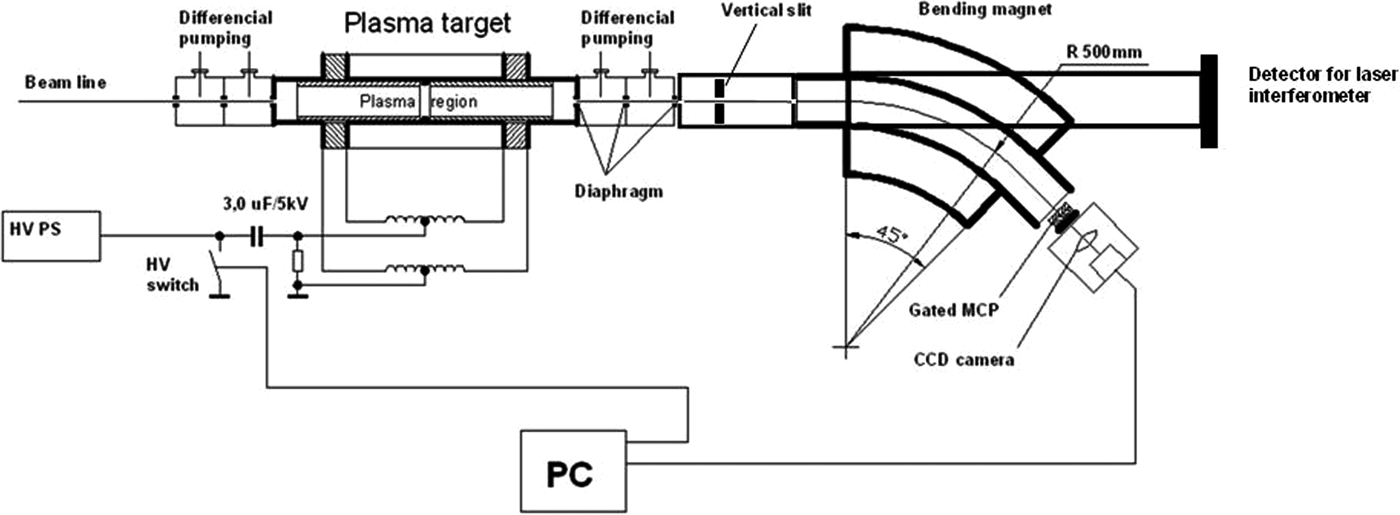
At the Institute of Modern Physics, Chinese Academy of Sciences, we operate a high-voltage platform, where a maximum high voltage of 320 kV is available (Cheng et al., Reference Cheng, Zhou, Sun, Lei, Wang and Xu2011, Reference Cheng, Zhao, Zhou, Li, Wang, Lei, Sun, Wang, Yu, Ren, Liu, Xiao and Hoffmann2013; Zhao et al., Reference Zhao, Hu, Cheng, Wang, Peng, Goiubev, Zhang, Lu, Zhang, Zhou, Wang, Xu, Ren, Li, Lei, Sun, Zhao, Wang, Wang and Xiao2012; Deng et al., Reference Deng, Zhao, Cheng, Zhou, Peng, Wang, Lei, Liu, Sun, Ren, Xiao, Ma, Xiao, Gavrilin, Savin, Golubev and Hoffmann2015). The ion source is of the electron cyclotron resonance (ECR) type; proton and many species of heavy ions can be produced from the ion source. The available current ranges from 100 enA to 100 eμA. The energy may be varied from 20q to ~320q keV (q is the charge state of projectile). The projectile velocity is typically 1% of the speed of light (more or less), which is close to the Bohr velocity of typical ions. In the experiment, the protons were accelerated to 100 keV and transmitted to the specific terminal for the investigation of ion beam–plasma interaction, where the installation of the gas discharge plasma target and the coupled detector system has been completed. In Figure 1, we present the beam line configuration and a schematic outline of the method of measurement.
Schematic setup of the experiment for measuring the proton energy losses in a hydrogen plasma.

In our experiment, the protons were accelerated to 100 keV and delivered to the target. Two deflector plates for X-Y deflection and a glass lens were used to optimize the beam and transport the ion beam to the target through a series of diaphragms along the beam line, which can ensure enough intensity of the projectiles in the interaction period of ion beam–plasma. A bending magnet with a deflection of 45° over the radius of 0.5 m and a time resolved with position sensitive ions detector were employed to measure the energy losses of the protons. The beam deflection caused by the bending magnet depends on the proton energy. If the protons lose a certain amount of energy (dE) in the plasma, the position of outgoing beam at the detector shifts by dx correspondingly. The detector consists of three parts: a gated micro-channel plate detector [two pieces microchannel plate (MCP) structure], a fast phosphor screen and a charge-coupled device camera. The original signal intensity amplified by a factor of 106 through the two-piece MCP. The range of the delay time (after the ignition of the discharge) of the detector is about 200 ns–20 ms, and the width of the detection time is from the minimum of 10 ns up to infinity. The spatial resolution was about 70 µm. In the experiment, the beam size was about 1 mm and the shift distance of about 0.5 mm can be well distinguished. Thus, the resolution of energy loss on the detector system is about 0.5 keV.
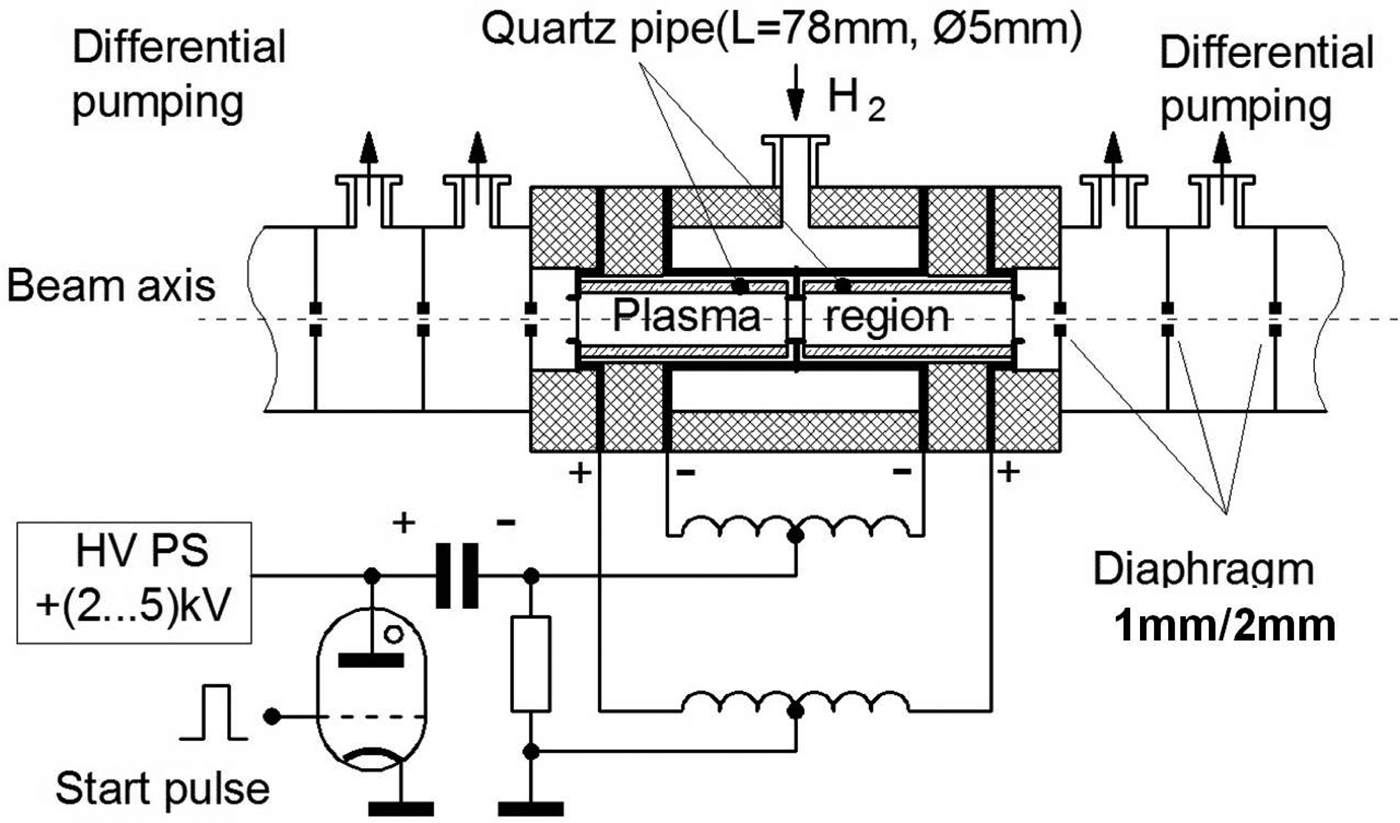
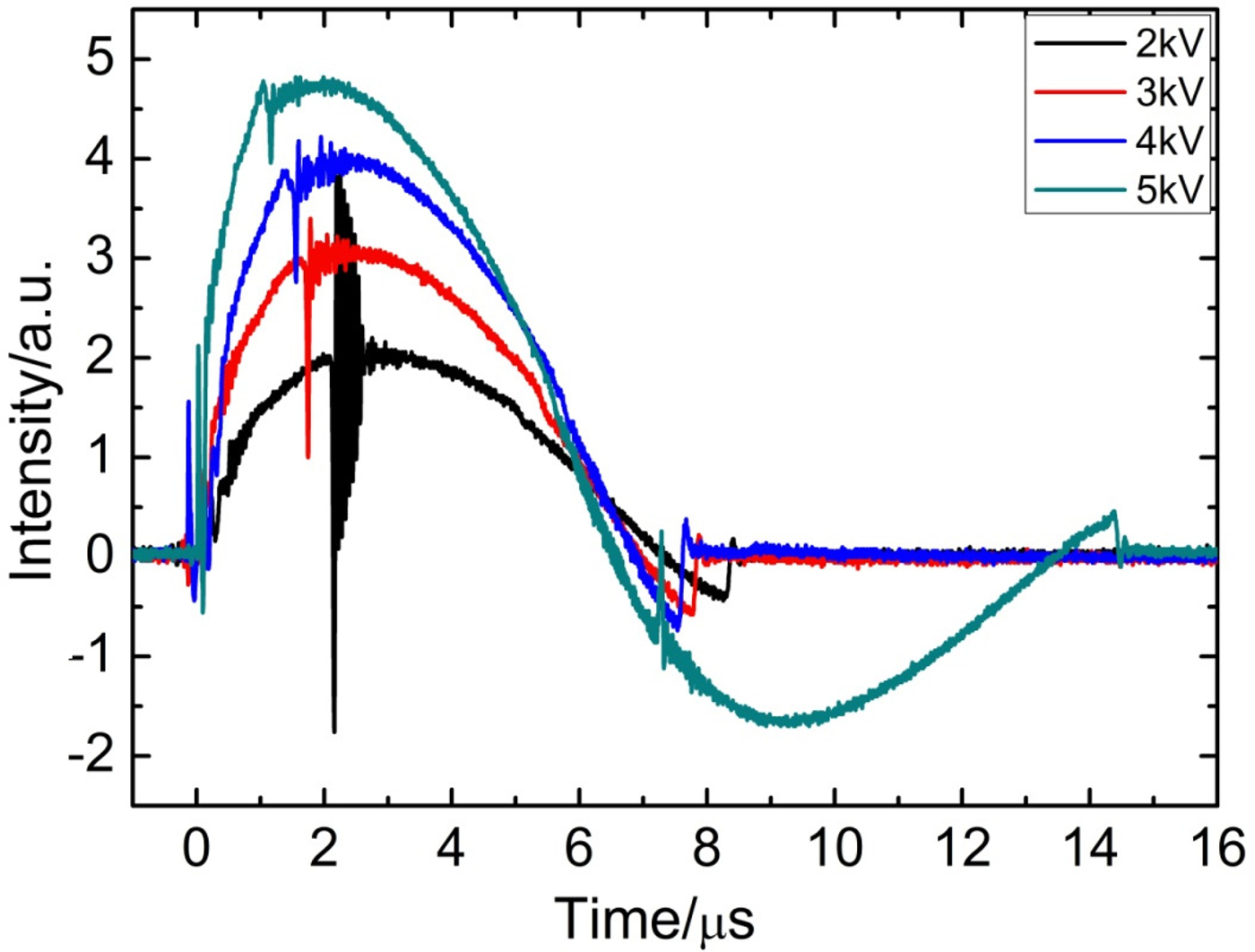
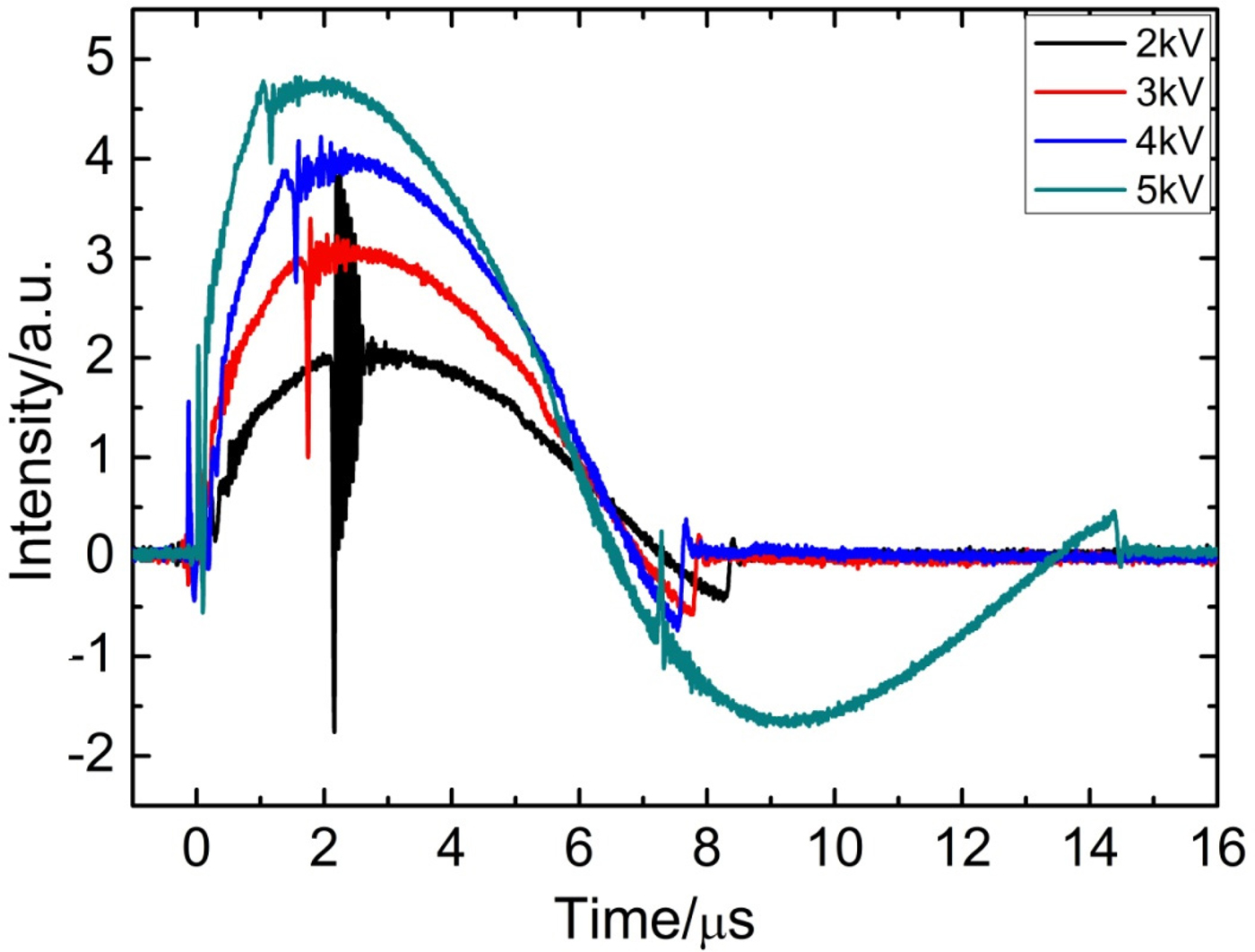
The plasma target is based on a linear electric discharge in Z-pinch geometry and it was developed for experimental studies of the stopping power of charged particles in ionized matter. The plasma was generated by igniting an electric discharge in two 78 mm long collinear quartz tubes with an inner diameter of 5 mm (see Fig. 2). A 3 µF capacitor bank charged to 2–5 kV initiated a current of up to 2 kA in each discharge quartz tube (Kuznetsov et al., Reference Kuznetsov, Byalkovskii, Gavrilin, Golubev, Gubskii, Rudskoi, Savin, Turtikov and Khudomyasov2013). The discharge current in the two discharge tubes is of opposite direction. The high-voltage electrode is situated in the center. This design substantially suppresses the plasma lens focusing effect on ion beam, which is caused by the magnetic field of the discharge current. Due to the opposite current direction, the focusing effect of the first discharge tube compensated by the defocusing effect of the second one and vice versa. This is true at least in first order ion optical approximation; however, it is sufficient for this experiment. The plasma would exist for about 8 µs and the temperature was about 1–2 eV. A Rogowsky coil was used to measure the temporal discharge current (see in Fig. 3), and the start pulse signal for triggering the detector was derived from the rising edge when the voltage was higher than 0.89 volt. The higher voltage of discharge produced the larger current intensity, which means the higher ionization degree and the larger amount of free electron density; however, the maximum of the free electron density remains at about 3 µs (relative to the ignition) for all the different discharge voltage cases. The plasma linear electron density has been determined by the laser interferometry techniques (Kuznetsov et al., Reference Kuznetsov, Bashutin, Byalkovskii, Vovchenko, Korotkov and Savjolov2008, Reference Kuznetsov, Byalkovskii, Gavrilin, Golubev, Gubskii, Rudskoi, Savin, Turtikov and Khudomyasov2013).
Principle scheme of the hydrogen plasma target and the differential pumping system.

Result of the temporal discharge current measured by a Rogowsky coil in our experiment.
At both ends of the discharge device, there are two diaphragms with 1 mm-diameter apertures, and they serve as entrance and exit apertures of the ion beams and define the beam trajectory. The length of the gas column in the target is limited to about 220 mm. The vacuum system of the beam line is protected from the gas load of the target by means of differential pumping. A powerful root pump (evacuation rate: 8 L/s) and two turbo molecular pumps (evacuation rate: 300 L/s) at the second pumping stage consist of the two-stage differential pumping system. As a result, each stage can reduce the pressure by about a factor of 100, which ensures the base pressure along the beam line to stay at 10−7 mbar, and the pressure in the target without filling hydrogen gas was about 4 × 10⁻³ mbar. Each stage is separated by small apertures with a diameter of 2 mm, length of 20 mm, which allows a windowless penetration of the ion beam into the plasma target. For the initial pressure of the hydrogen gas ranging 1–9 mbar, the free electron density of up to 1017 cm−3 could be created in such a discharge.
The filling pressure of the plasma target was measured by a conventional vacuum gauge, which is at some distance from the beam–plasma interaction region. The IONIVAC ITR90 vacuum meter we used was sensitive to the gas type, and an apparent difference between the indicated pressure and the effective pressure was given by the company. This may cause a systematic uncertainty in the initial target atomic density concerned to the energy loss process. Therefore, additionally we used the 100 keV protons beam to penetrate the gas target before it being discharged and the energy loss of protons was used to determine the linear atomic density along the ions beam pathway in plasma. We believe this in situ atomic density diagnose is more precise and reliable than the conventional pressure measurement (Chen et al., Reference Chen, Cheng, Zhang, Zhou, Zhao, Wang, Lei, Ma, Wang, Ren, Ma and Xiao2018).
Results and discussion
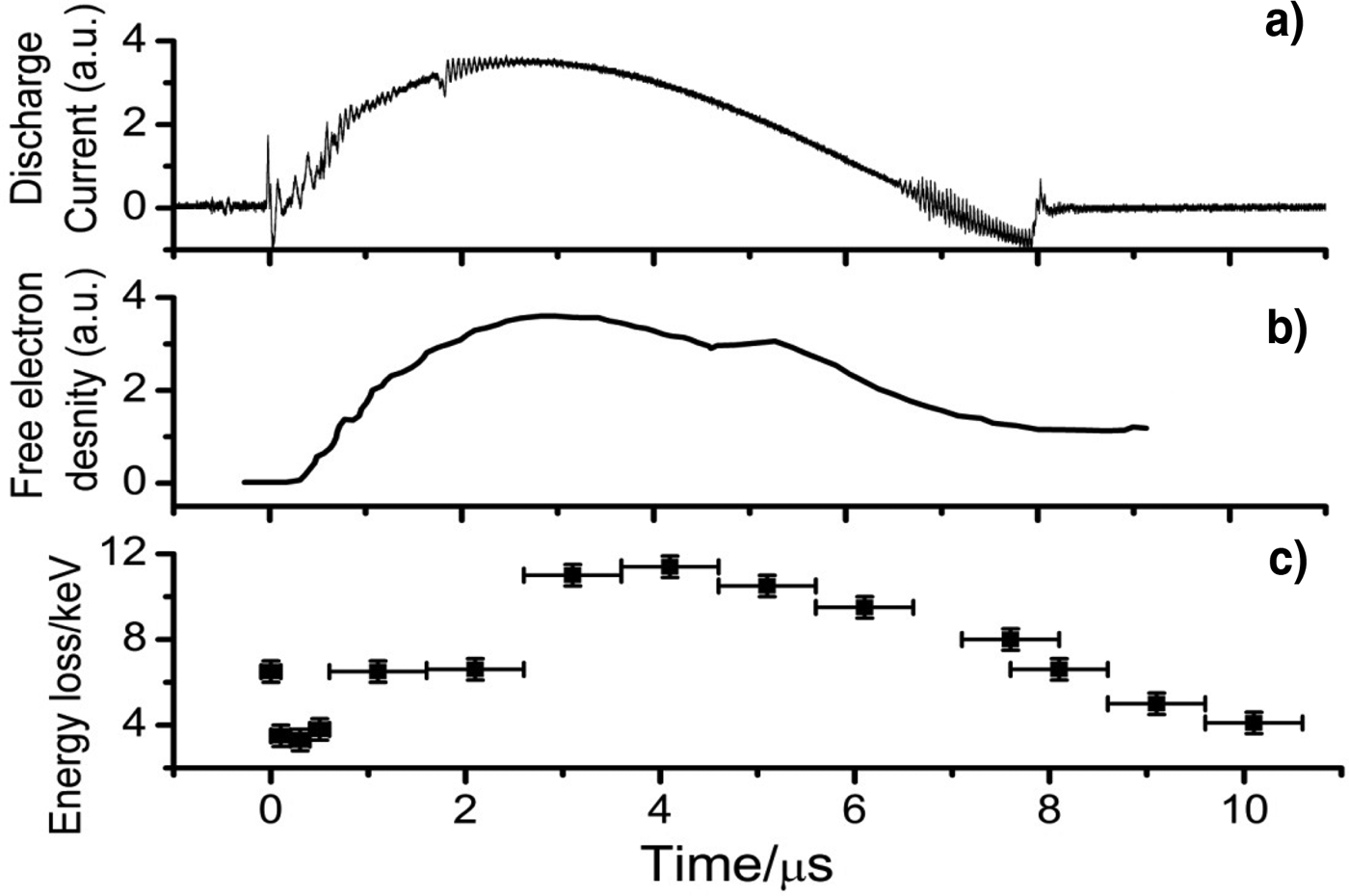
As a typical example, we present in Figure 4 the energy losses of protons in the hydrogen plasma together with the discharge current, the linear free electron density as a function of time under the condition of initial hydrogen pressure of 1.035 mbar and capacitor voltage of 3 kV. A similar behavior for the three curves can be found. The discharge current is measured by the Rogowsky coil measurement [Fig. 4(a)]. The time dependence of linear free electron densities is measured by the laser interferometry [Fig. 4(b)], where the bound electron density as a function of time is discussed in the literature (Kuznetsov et al., Reference Kuznetsov, Byalkovskii, Gavrilin, Golubev, Gubskii, Rudskoi, Savin, Turtikov and Khudomyasov2013) too. The experimental results of energy losses are shown in Figure 4(c), and at time = 0, the energy loss results from the energy deposition of the protons in the initial hydrogen gas. When the gas was heated by the discharge current to be plasma, the energy loss dramatically increases and reaches the maximum at the time of about 3 µs, although it decreases slightly at the very beginning, then it slowly goes down until the plasma state ends where the time is about 8 µs. The energy loss at 10 µs is lower than that at time = 0 moment, which is deduced to the lower target atomic density induced by the high-temperature heating of plasma. The decrease of target atomic density might be fast: starting with the ignition process, a shockwave travels through the plasma, which causes a rarefaction wave by pressing gas through the apertures outward and the density of bound electrons correspondingly becomes lower. Taking the laser interferometry and particle-in-cell simulation, the changes of free electron density and bound electron density in the gas discharge plasma target have been studied in Kuznetsov et al. (Reference Kuznetsov, Byalkovskii, Gavrilin, Golubev, Gubskii, Rudskoi, Savin, Turtikov and Khudomyasov2013). It is found that the free electron density reaches the maximum at 3 µs where the bound electron density decreases.
Waveform of the discharge current (a); linear free electron density as function of time (b); energy losses of protons in the plasma target as a function of time (c). The initial hydrogen pressure is 1.035 mbar and the capacitor voltage is 3 kV.

The specific energy losses of heavy ions in plasma have been discussed by Weyrich et al.’s work (Weyrich et al., Reference Weyrich, Hoffmann, Jacoby, Wahl, Noll, Haas, Kunze, Bimbot, Gardes, Rivet, Deutsch and Fleurier1989), but the evolutions of free electron density and bound electron density were not involved. Recently Kuznnetsov carried out the measurement on the free electron density and the bound electron density as a function of time based on this same plasma device which we used. In our experiment, it was found that the time of the maximum free electron density coincides with the time of the maximum discharge current, while the density of bound electrons conversely reaches a smaller value (Kuznetsov et al., Reference Kuznetsov, Byalkovskii, Gavrilin, Golubev, Gubskii, Rudskoi, Savin, Turtikov and Khudomyasov2013). Our experimental energy loss data are compared with the change of free electron density and they are fitted by the theoretical model predictions, as well as the comparison is given for the energy losses in plasma and in cold gas.
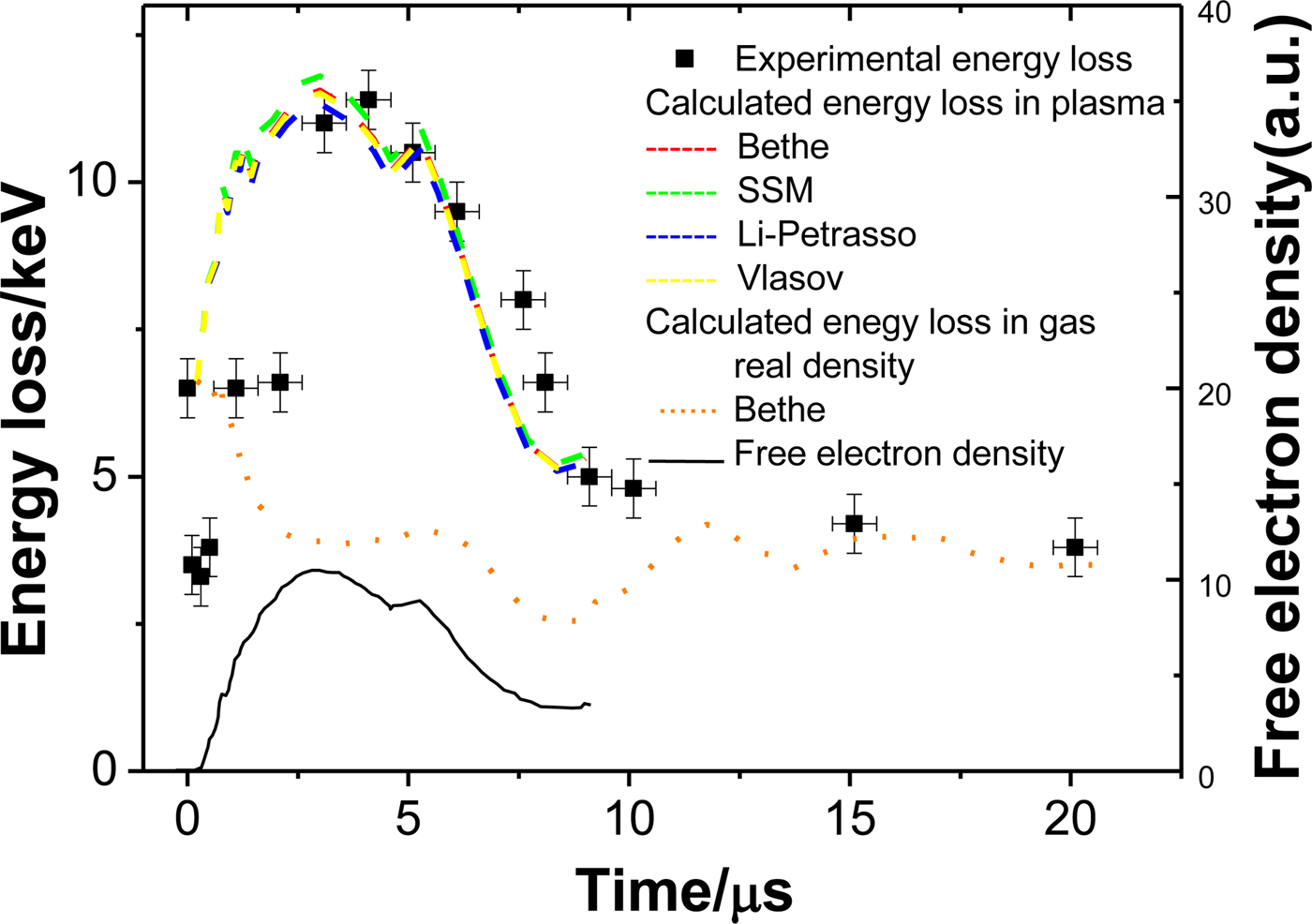
Figure 5 shows the experimental energy losses of protons in plasma with the pressure = 1.035 mbar and HV = 3 kV. The dashed lines are the theoretical predictions given by the different models. As a contrast, the energy losses of protons in gas environment with the same real electron density in the plasma is shown by the dot line too, where the electron density data are obtained from reference (Kuznetsov et al., Reference Kuznetsov, Byalkovskii, Gavrilin, Golubev, Gubskii, Rudskoi, Savin, Turtikov and Khudomyasov2013). The decrease of energy losses at the beginning of plasma, which is not clear yet and the similar phenomena are found in the experiments of literatures (Frank et al., Reference Frank, Blažević, Grande, Harres, Heßling, Hoffmann, Knobloch-Maas, Kuznetsov, Nürnberg, Pelka, Schaumann, Schiwietz, Schökel, Schollmeier, Schumacher, Schümtrumpf, Vatulin, Vinokurov and Roth2010) and (Frank et al., Reference Frank, Blažević, Bagnoud, Basko, Börner, Cayzac, Karaus, Heßling, Hoffmann, Ortner, Otten, Pelka, Pepler, Schumacher, Tauschwitz and Roth2013). Later, the energy loss increases very dramatically and reaches the maximum value of about 11 keV around 3–4 µs, where the energy loss in gas is only about 4 keV. Thus, an apparent energy loss enhancement by a factor of 2.8 can be obtained from the graph, and the reason is deduced to the increase in the ionization degree and simultaneously free electron density, where the collisions between protons and free electrons dominate and the increase of the stopping-power Coulomb logarithm play a more important role. After 8 µs when the plasma is over, the energy losses decrease to even smaller than it was in the initial gas state, due to the areal density decreases induced by plasma expansion and the relative refill speed of gas.
Experimental energy losses of protons in the plasma as a function of time with HV = 3 kV, pressure = 1.035 mbar. The calculated energy losses of protons in gas are shown with dot line, where the electron remains the real density as it is plasma case. Theoretical predictions from the models of Bethe, SSM, Li–Petrasso, and Vlasov are shown as the dashed lines (color on line), respectively. The change of free electron density in the plasma obtained from reference (Kuznetsov et al., Reference Kuznetsov, Byalkovskii, Gavrilin, Golubev, Gubskii, Rudskoi, Savin, Turtikov and Khudomyasov2013) is shown by the solid line as well.

The interaction between protons and free electrons may dominate the energy loss process and the models’ predictions are very coincident with the change of free electron density. In fact, the energy losses can be written as a function of the electron density f(ρe). With taking the plasma's areal density changes of free electrons and bound electrons in the target, the energy loss calculation was performed according to the models of Bethe, SSM, Li–Petrasso, Vlasov, respectively, which are valid for stopping by free electrons. Since the plasma was not fully ionized, the bound electrons have to be considered and the contribution was calculated with the help of Bethe model. In Figure 5, the calculated energy losses are compared to the experimental data and it is apparent that they can well fit the experimental results within the error bars (except for the decrease at the beginning). The differences among these models for the case of 100 keV protons penetrating the hydrogen plasma seem to be not significant at all, and the reason may be that all these models are taking the linear perturbative approaches as discussed in (Cayzac et al., Reference Cayzac, Bagnoud, Basko, Blažević, Frank, Gericke, Hallo, Malka, Ortner, Tauschwitz, Vorberger and Roth2015).
For our case, protons of 100 keV and the plasma temperature about 2 eV, thus the ratio of (V p/V th) ≈ 5(V p – the projectile velocity and V th – the thermal velocity of free electron). For the high projectile velocity situation V p/V th, the weak-coupling approximation is available and the interaction can be described by the dielectric plasma theory and the stopping power can be described by a Bethe-like formula, which only considers the contribution of free electrons in the plasma:
 $$\displaystyle{{dE} \over {dx}} = - \displaystyle{{4\pi n_{\rm e} e^2 Z_{\rm p}^2 e^2} \over {m_{\rm e} v^2}} \ln \displaystyle{{2m_{\rm e} v^2} \over {\hbar \omega _{\rm p}}}, $$
where 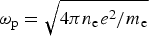 ${\rm \omega} _{\rm p} = \sqrt {4\pi n_{\rm e} e^2 /m_{\rm e}} $ is the plasma frequency.
When the corrections of Bloch and Barkas are added in the Bethe–Bloch formula, which can describe the relative lower projectile velocity case (but still V p > V th) and the Bloch denotes the close collisions and Barkas denotes the higher order polarization, the new expression is called the SSM. G(V p/V th), a thermal coupling factor, the Chandrasekhar function is used to describe the beam–plasma coupling, which can be added to the Bethe–Bloch function. However, in our case, the Barkas correction which is proportional to Z p3 and the Bloch correction proportional to Z p4 seem not to play an important role for protons at all. The G(V p/V th) function remains a constant value in our experimental energy regime. In the results, the SSM results seem a little larger than Bethe's calculations at the maximum of free electron density area, although all the date placed in the experimental error.
Li–Petrasso model is using a Fokker–Planck approach to describe the stropping power, which can include all the impact parameters, approximately. A related Coulomb logarithm and the improved  $G{\bf (}V_{\rm p}^2 /V_{{\rm th}}^2 {\bf )}$ expression is describing the small-angle collisions and the close collisions. Even it is limited in the linear interaction regime, Li–Petrasso is widely applied in the ICF environment. In our case, the Li–Petrasso calculations are the lowest than the other predictions given by the Bethe, SSM, and Vlasov models.
In the Vlasov model, an alternative dielectric function derived from the Vlasov–Poisson equations, the contributions of small-angle collisions, and the collective plasma oscillations are taken into account. The polarization of the medium is induced by the projectile and the induced field counters the motion of projectile. In our case, the calculations are quite close to the Bethe's predictions and they are lower than SSM's but higher than Li–Petrasso's.
We choose the conventional theoretical models to describe the energy loss of protons in the plasma target and all the predictions fit the experimental results well. Considering the simple interaction system, proton–hydrogen plasma, the linear perturbative dielectric functions are found suitable to apply in the regime. However, one can more easily differentiate the models when to use the heavy ion beam and lower down the velocity to close the thermal velocity of free electrons, or increase the density of plasma, when the strong coupling effect between projectiles and electrons play. Now some new theoretical models with non-perturbative treatment are proposed to explain the energy loss for the V p close the V th situation (Cayzac et al., Reference Cayzac, Bagnoud, Basko, Blažević, Frank, Gericke, Hallo, Malka, Ortner, Tauschwitz, Vorberger and Roth2015, Reference Cayzac, Frank, Ortner, Bagnoud, Basko, Bedacht, Bläser, Blažević, Busold, Deppert, Ding, Ehret, Fiala, Frydrych, Gericke, Hallo, Helfrich, Jahn, Kjartansson, Knetsch, Kraus, Malka, Neumann, PéPitone, Pepler, Sander, Schaumann, Schlege, Schroeter, Schumacher, Seibert, Tauschwitz, Vorberger, Wagner, Weih, Zobus and Roth2017).
Although there is more and more interest on heavy ions with dense plasma interaction, the protons, the simplest ions, are powerful enough to describe the interaction effects from plasma itself. We believe the free electron density changes as time can be easer derived from the energy loss, although some one has proposed using heavy ions to determine the plasma density (Xu et al., Reference Xu, Barriga-Carrasco, Blazevic, Borovkov, Casas, Cistakov, Gavrilin, Iberler, Jacoby, Loisch, Morales, Mäder, Qin, Rienecker, Rosmej, Savin, Schönlein, Weyrich, Wiechula, Wieser, Xiao and Zhao2017). Our experimental results show good agreement with the predicted energy losses which mainly are the function of electron density. Considering the lack of conventional pressure gauges, the proton energy loss with in situ, highly precise and time-resolved, can be well working in the radiation surrounding. Thus, we introduce the proton energy loss as the new electron density diagnostic in plasma (Golubev et al., Reference Golubev, Basko, Fertman, Kozodaev, Mesheryakov, Sharkov, Vishnevskiy, Fortov, Kulish, Gryaznov, Mintsev, Golubev, Pukhov, Smirnov, Funk, Stoewe, Stetter, Flierl, Hoffmann, Jacoby and Iosilevski1998; Cayzac et al., Reference Cayzac, Frank, Ortner, Bagnoud, Basko, Bedacht, Bläser, Blažević, Busold, Deppert, Ding, Ehret, Fiala, Frydrych, Gericke, Hallo, Helfrich, Jahn, Kjartansson, Knetsch, Kraus, Malka, Neumann, PéPitone, Pepler, Sander, Schaumann, Schlege, Schroeter, Schumacher, Seibert, Tauschwitz, Vorberger, Wagner, Weih, Zobus and Roth2017; Chen et al., Reference Chen, Cheng, Zhang, Zhou, Zhao, Wang, Lei, Ma, Wang, Ren, Ma and Xiao2018).
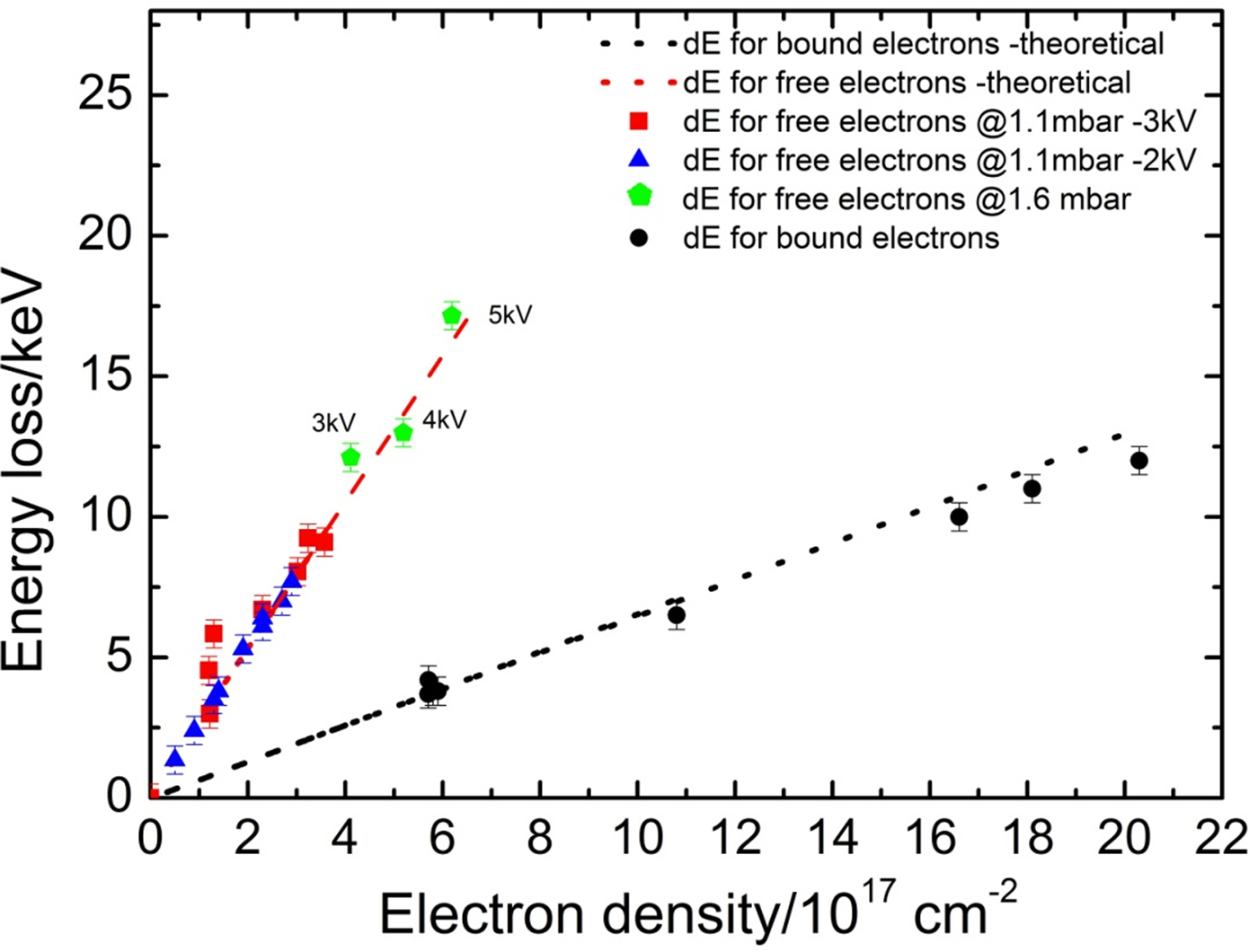
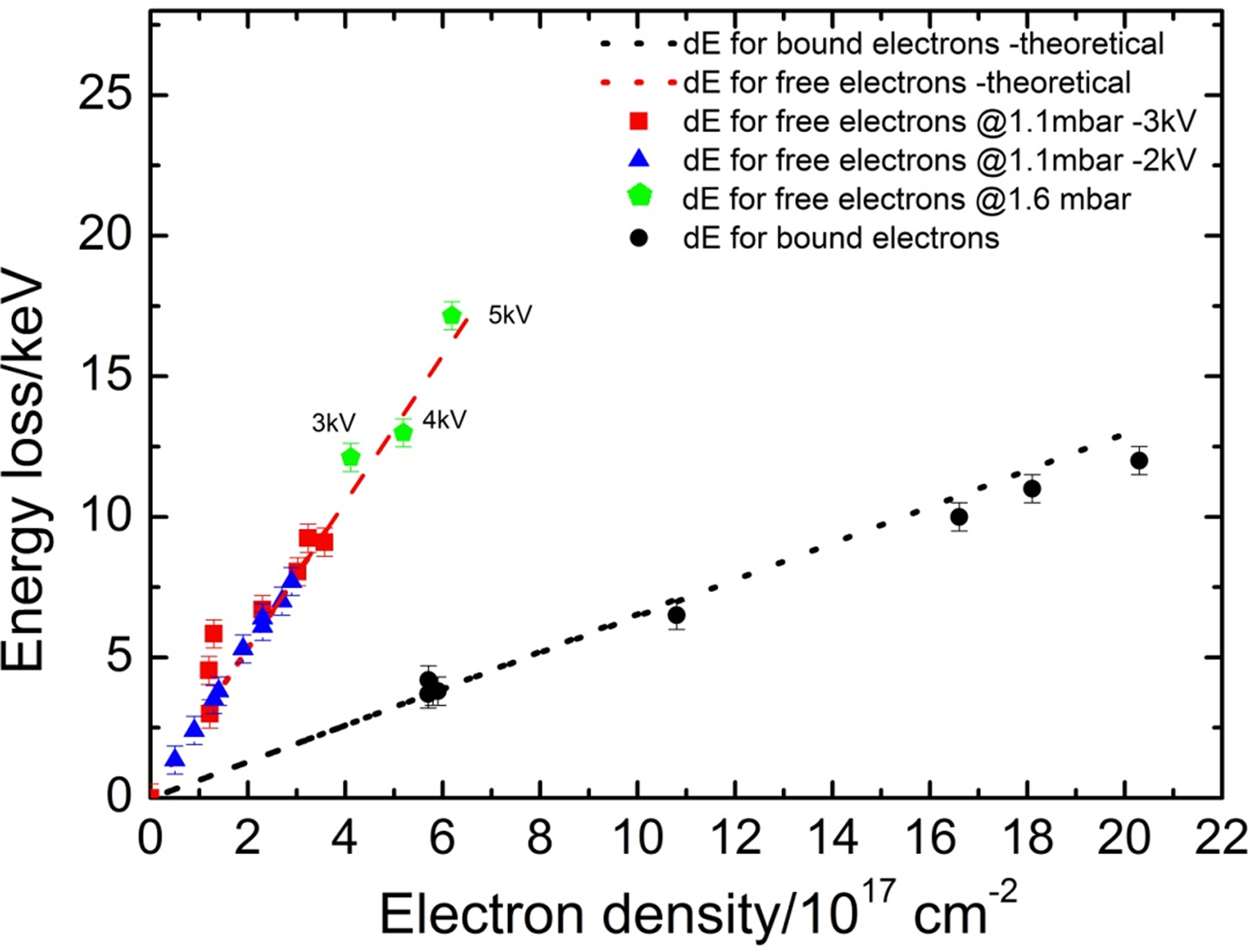
The energy losses are considered resulting from the collisions between protons and free electrons together with the bound electrons in the plasma. We obtained the density change of free electrons and bound electrons in (Kuznetsov et al., Reference Kuznetsov, Byalkovskii, Gavrilin, Golubev, Gubskii, Rudskoi, Savin, Turtikov and Khudomyasov2013), with the help of Bethe model, the energy loss is separated into two parts: one from free electrons and the other from bound electrons. Figure 6 shows the result of the “pure” energy losses versus the electron density for free electron and bound electron, respectably. The changes for free electron and for bound electron can be very easily differentiated because of the different slopes.
Energy losses of protons increase linearly with the free electron density (in fully ionized plasma) and the bound electron density (in cold gas), respectively. The energy losses of free electron part are obtained from the different states of plasma, where the initial pressure varies from 1.1 to 1.6 mbar and the capacitor voltage ranging from 2 to 5 kV.
In our understanding, the energy loss of charged particles in plasma arises from four processes: interaction with bound electrons, free electrons, nuclear interactions, and free plasma ions. In the low-energy regime, the contributions from the latter two parts can be neglected. The stopping power can be simply written as
 $$- \displaystyle{{dE} \over {dx}} = \displaystyle{{4\pi e^4 Z_{{\rm eff}}^2} \over {m_{\rm e} v_{^{\rm p}} ^2}} \left\{ {n_{{\rm be}} L_{{\rm be}} + G\left(\displaystyle{{V_{\rm p}} \over {V_{{\rm th}}}} \right)n_{{\rm fe}} L_{{\rm fe}}} \right\},$$
where m e and e are the mass and the charge of the electron; V p and V th are the projectile velocity and the thermal velocity of free electron; n be and n fe are the density of bound electrons and free electrons, respectively. Z eff is the effective charge of the projectile and in our case it is constant as 1. The Chandrasekhar function G(V p/V th) originates from averaging the relative velocity of the ion with respect to the target electrons over the Maxwell distribution. The Coulomb logarithms L be and L fe are for the bound and free electrons, respectively.
For our case, the Coulomb logarithm of bound electrons using the Bethe formula can be simply expressed as:
 $$L_{{\rm be}} = \ln \displaystyle{{2m_{\rm e} V_{_{\rm p}} ^2} \over I},$$
where I is the mean excitation energy.
Correspondingly the Coulomb logarithm for free electrons has a similar expression:
 $$L_{{\rm fe}} = \ln \displaystyle{{2m_{\rm e} V_{_{\rm p}} ^2} \over {\hbar \omega _{\rm p}}}, $$
where the I was replaced by  $\hbar \omega _{\rm p} $ and ωp is the plasma frequency.
As shown in Figure 6, the different slopes for free electron and bound electron, respectively. Consequently the ratio of the Coulomb logarithm (L fe/L be) can be easily inferred from the ratio of the slope (k fe/k be) and it is found as 4.0. This value is very close to the result of 4.3 ± 0.6 which we reported by choosing another analysis method (Deng et al., Reference Deng, Zhao, Cheng, Zhou, Peng, Wang, Lei, Liu, Sun, Ren, Xiao, Ma, Xiao, Gavrilin, Savin, Golubev and Hoffmann2015). We believe that the Coulomb logarithm term increases by a factor about 4.0 in a fully ionized hydrogen plasma for 100 keV energy regime protons.
Conclusion
We have presented a thorough investigation on the interaction of 100 keV protons with the ionized hydrogen plasma. The high-intensity protons are extracted from the ECR ion source at IMP and the energy losses in plasma are experimentally measured by using the bending magnet coupling with the time-resolved position-sensitive detector system.
The energy loss of protons increases dramatically in the plasma and it goes up to about 11 keV when the free electron density reaches the maximum at 3 µs, where in contrast the energy loss in cold gas is only about 4 keV. As a result, the enhancement of energy loss by a factor of 2.8 is found. The value is a little larger than Hoffmann et al.’s results (Hoffmann et al., Reference Hoffmann, Weyrich, Wahl, Gardes, Bimbot and Fleurier1990, Reference Hoffmann, Jacoby, Laux, Magistris, Boggasch, Spiller, Stoeckl, Tauschwitz, Weyrich, Chabot and Gardes1994) (the enhancement factors are 2–2.6 from Ca to U at the energy of 1.4 MeV/u) because we applied the lower energy regime. But the value is much smaller than Jacoby et al.’s result (Jacoby et al., Reference Jacoby, Hoffmann, Laux, Müller, Wahl, Weyrich, Boggasch, Heimrich, Stöckl, Wetzler and Miyamoto1995) (the enhancement factor is about 35), the reason is attributed to the fact that the charge state effects do not play any role on the proton.
The enhanced energy losses in plasma can be well fitted by all the theoretical predictions from the Bethe, SSM, Vlasov, and Li–Petrasso models. The small difference between the models may be the projectile velocity is still high and there is no strong coupling effect, as well as the effective charge state effect is not obvious for proton at all. Thus, we proposed the proton energy loss as a new probe to in situ diagnose the electron density in plasma.
As the effective charge state is constant for proton, the Coulomb logarithm respective to the free electron and the bound electron can be directly compared. The ratio of L fe to L be is found to be about 4.0 which is larger than the value of 3.1 found by Belyaev.
Acknowledgments
This work was supported by the National Natural Science Foundation of China (Grant Nos. U1532263, 11105192, 11505248,11375034, 11775042, 11775278, 11605147, 11275241, 11275238, 11205225, 11505248, 1375034). The project was also supported by the Russian Basic Research Foundation (RFBR). The authors wish to thank J. Li, H. Liu, L. Kang, and T. Zhang from 320 kV platform at IMP for their efficient helps in this work.