Introduction
Familial hypercholesterolaemia is a hereditary disorder characterised by elevated serum cholesterol and low-density lipoprotein cholesterol levels, resulting from mutations in the low-density lipoprotein receptor gene or genes involved in the cellular uptake of low-density lipoprotein. Reference Brown and Goldstein1,Reference Bouhairie and Goldberg2 The clinical manifestation of familial hypercholesterolaemia includes an increased risk of atherosclerosis and cardiovascular diseases, with untreated individuals facing a 13-fold higher risk compared to non-familial hypercholesterolaemia individuals. Reference Benn, Watts, Tybjaerg-Hansen and Nordestgaard3
Recent research indicates that the prevalence of heterozygous familial hypercholesterolaemia is now estimated to affect approximately 1 in 200–250 individuals, while the prevalence of homozygous familial hypercholesterolaemia is estimated to be 1 in 300,000 people, which is higher than earlier estimations, and it is known to be higher in some regions due to founder effects. Reference Sjouke, Kusters and Kindt4–Reference Tokgozoglu and Kayikcioglu6 Despite the increased awareness of its prevalence, familial hypercholesterolaemia remains frequently underdiagnosed, leaving numerous individuals at risk of premature cardiovascular disease. Reference Nordestgaard, Chapman and Humphries7,Reference Tromp, Hartgers and Hovingh8 It is demonstrated by the Homozygous Familial Hypercholesterolaemia International Clinical Collaborators Registry that the major manifestations of atherosclerotic cardiovascular diseases or aortic stenosis were already present in 9% of patients at diagnosis of homozygous familial hypercholesterolaemia. Reference Tromp, Hartgers and Hovingh8
Recognising the critical importance of early detection, the International Familial Hypercholesterolaemia Foundation recommends familial hypercholesterolaemia diagnosis before the age of 18, aiming for identification of homozygous cases ideally by the age of 2, or even earlier. Screening for potential heterozygous cases is advised before the age of 10, ideally between 5 and 10 years, while children at risk for homozygous familial hypercholesterolaemia should undergo screening by the age of 2 at the latest. Reference Watts, Gidding and Wierzbicki9 However, a lack of global consensus persists regarding the optimal screening approach, leaving a gap in strategies for identifying affected individuals. Diverse screening strategies, including universal screening, cascade screening, and selective screening, are proposed by different societies. Universal screening involves assessing all children, regardless of risk factors, while selective screening targets those with specific family histories and risk factors. Cascade screening, on the other hand, entails screening family members of an identified familial hypercholesterolaemia patient, and it can be accomplished through cholesterol level assessments or genetic testing. Reference Langslet and Ose10,Reference Force, Bibbins-Domingo and Grossman11
Understanding the diagnostic characteristics and factors influencing the age of familial hypercholesterolaemia diagnosis is crucial for adapting effective screening strategies. This study aims to comprehensively assess the diagnostic features of children with familial hypercholesterolaemia in Turkey, including their age at diagnosis, and explore the determinants influencing the diagnostic process. By shedding light on these aspects, our research aims to contribute insights for refining screening approaches within the country and potentially influencing global practices.
Materials and methods
This retrospective study included patients aged 0–18 years diagnosed with familial hypercholesterolaemia at the Pediatric Metabolism Outpatient Clinic of Istanbul University Faculty of Medicine. Familial hypercholesterolaemia was defined according to the International Familial Hypercholesterolaemia Foundation guidance. Genetic testing was performed and confirmed the diagnosis in patients where it was available; however, as not all patients underwent genetic testing, the diagnosis was primarily based on lipid profile criteria recommended in the guidance. Specifically, familial hypercholesterolaemia was diagnosed when fasting serum low-density lipoprotein cholesterol levels exceeded 155 mg/dL in at least two separate measurements, accompanied by a positive parental history of familial hypercholesterolaemia or early cardiovascular disease. In the absence of a family history, familial hypercholesterolaemia was diagnosed if low-density lipoprotein cholesterol exceeded 194 mg/dL in at least two measurements. Patients with serum low-density lipoprotein cholesterol levels above 500 mg/dL were classified as having homozygous familial hypercholesterolaemia, while others were categorised as heterozygous familial hypercholesterolaemia. Reference Watts, Gidding and Wierzbicki9
Exclusion criteria included secondary hyperlipidaemia due to conditions such as nephrotic syndrome, hypothyroidism, hypopituitarism, idiopathic hypercalcemia, anorexia nervosa, type 1 and type 2 diabetes mellitus, metabolic syndrome, obesity, lipodystrophy, ketogenic diet, chronic liver or kidney diseases, pregnancy, Turner syndrome, Klinefelter syndrome, cancer, burns, HIV infection, systemic lupus erythematosus, rheumatoid arthritis, glycogen storage disease type 1, and sphingolipidosis. Patients with a history of isotretinoin, antiretroviral therapy, anabolic steroids, oral contraceptives, or alcohol use were also excluded. Reference Descamps, Tenoutasse and Stephenne12
Among the 247 cases whose records were reviewed, 11 were excluded due to secondary hyperlipidaemia. Of the remaining 236 patients, 102 did not meet the diagnostic criteria for familial hypercholesterolaemia based on their lipid profile. Five of the 134 cases meeting the study criteria were excluded due to insufficient data, and 129 patients were included in the study.
The study data were obtained retrospectively from patient medical records. Information on demographic characteristics, age at diagnosis, presence and duration of diagnostic delay, familial risk factors, parental hypercholesterolaemia, parental use of antihyperlipidemic medication, parental consanguinity, clinical findings at the time of diagnosis, fasting lipid levels, and the indications for initial lipid assessment were extracted.
The duration of diagnostic delay was determined based on adherence to current screening recommendations. This approach was adopted to evaluate alignment with recommended screening timelines and to determine the proportion of patients who underwent lipid evaluation within the suggested age thresholds. A diagnosis was considered delayed if it was established after the age of two in patients with a positive family history of hypercholesterolaemia or early cardiovascular disease and after the age of ten in those without a family history. The duration of the delay was calculated as the interval between the recommended screening age threshold and the actual age at diagnosis. Reference Watts, Gidding and Wierzbicki9,Reference Cuchel, Raal and Hegele13
Familial risk factors included a history of early cardiovascular or cerebrovascular events or sudden death in first- or second-degree relatives. A family history of hypercholesterolaemia was defined as the presence of either elevated cholesterol levels—specifically, a low-density lipoprotein cholesterol level exceeding 130 mg/dL in individuals under 18 years or 190 mg/dL in those over 18 years, or a total cholesterol level above 240 mg/dL—or the use of antihyperlipidaemic medication in first- or second-degree relatives. Reference Grundy, Stone and Bailey14,Reference Daniels and Greer15
Statistical tests
Data collection was performed using Microsoft Excel (Microsoft Corporation, Redmond, WA, USA), and all statistical analyses were performed using IBM SPSS Statistics for Windows, version 30.0 (IBM Corp., Armonk, NY, USA). Descriptive statistics were used to summarise the data. Categorical variables were presented as frequencies and percentages, while continuous variables were expressed as means ± standard deviations for normally distributed data and as medians with minimum and maximum values for non-normally distributed data. The normality of continuous variables was assessed using the Shapiro–Wilk test and visual methods (histograms and Q-Q plots). For comparisons between two independent groups, Student’s t-test was used for normally distributed variables, and the Mann–Whitney U test was used for non-normally distributed variables. Comparisons among more than two independent groups were performed using one-way analysis of variance for normally distributed data. For the analysis of associations between categorical variables in contingency tables larger than 2×2, the Fisher-Freeman-Halton test was used. A p-value< 0.05 was considered statistically significant in all analyses.
Results
Demographic data, clinical features, family history, and assessment of familial hypercholesterolaemia subtypes
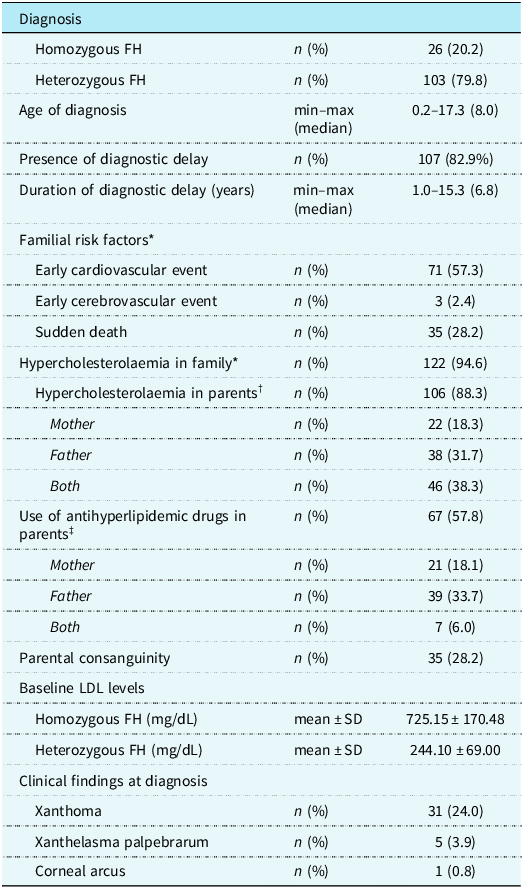
A total of 129 patients, 72 boys (55.8%) and 57 girls (44.2%), were included in the study. Of the patients, 26 (20.2%) were classified as having homozygous familial hypercholesterolaemia, while 103 (79.8%) were classified as having heterozygous familial hypercholesterolaemia. Genetic testing was conducted in 25 patients (19.37%) where it was available, confirming familial hypercholesterolaemia in all tested cases. Two patients were homozygous for LDLR mutations. Among the 23 heterozygous patients, 20 carried an LDLR mutation, while 3 carried an APOB100 variant. The median age at diagnosis was 8.0 years (range: 0.2–17.3) in the whole cohort. Diagnostic delay was present in 107 patients (82.9%) with a median duration of 6.8 years (range: 1.0–15.3). Detailed data on the demographic characteristics, clinical features, and family history of the entire cohort are presented in Table 1.
Demographic characteristics, clinical features, and family history of the whole cohort

FH = familial hypercholesterolaemia; LDL = low density lipoprotein; SD= standard deviation.
* In first and second-degree relatives.
† Data available for 120 patients.
‡ Data available for 116 patients.
When homozygous and heterozygous familial hypercholesterolaemia patients were analysed within their respective groups, the median age at diagnosis was 8.4 years (range: 0.4–17.2) in heterozygous familial hypercholesterolaemia patients and 6.1 years (range: 0.2–17.3) in homozygous familial hypercholesterolaemia patients, with no significant difference (p = 0.488). The presence of physical findings at diagnosis was more common in homozygous familial hypercholesterolaemia patients (n = 23, 88.5%) compared to heterozygous familial hypercholesterolaemia patients (n = 11, 10.7%) (p < 0.001). Parental consanguinity was reported in 16.2% of heterozygous familial hypercholesterolaemia patients, whereas it was higher in the homozygous familial hypercholesterolaemia group (76.0%) (p < 0.001).
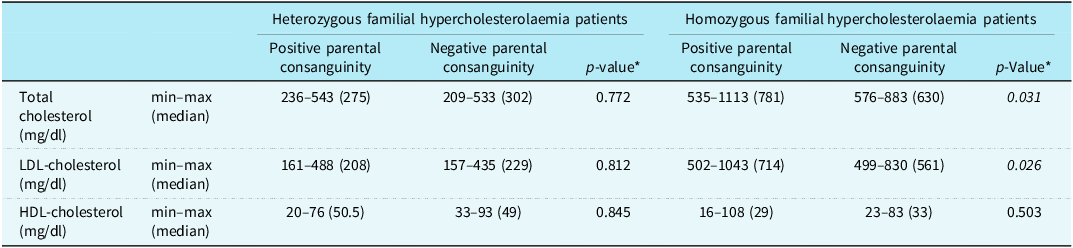
When the impact of consanguineous marriage on cholesterol levels was assessed, no significant difference was observed in total cholesterol and low-density lipoprotein-cholesterol levels among heterozygous familial hypercholesterolaemia patients with or without a history of consanguineous marriage. However, in homozygous familial hypercholesterolaemia patients, total cholesterol and low-density lipoprotein-cholesterol levels were significantly higher in those with a history of consanguineous marriage (Table 2).
Lipid profiles of homozygous and heterozygous FH patients with and without a history of parental consanguinity

* Mann-Whitney-U test.
HDL: high density lipoprotein; LDL: low density lipoprotein.
Initial lipid testing indications
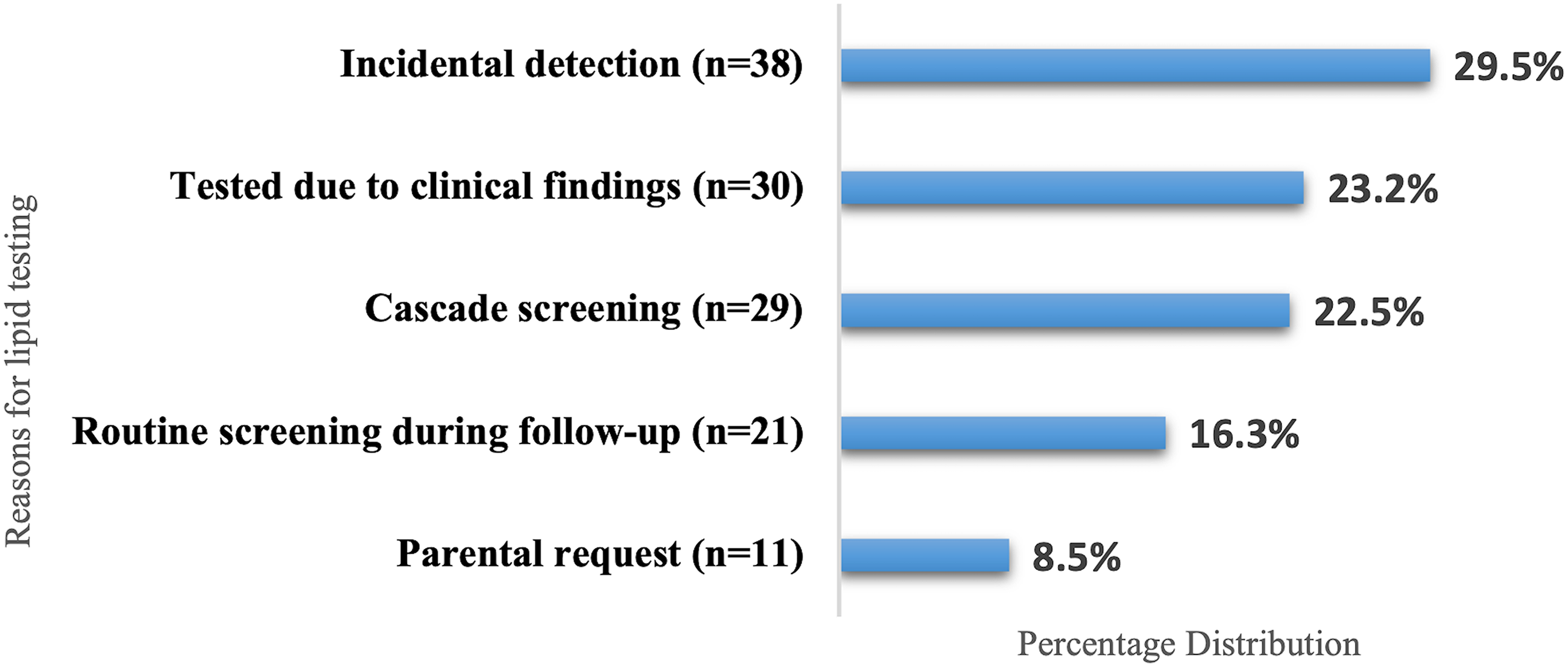
An analysis of the factors prompting initial cholesterol testing in patients revealed five distinct reasons. The most common reason, accounting for 29.5%, was the incidental detection of elevated cholesterol levels during hospital admission for unrelated conditions. The second most frequent reason, at 23.2%, was the presence of clinical symptoms. The distribution of these reasons is illustrated in Figure 1.
Percentage distribution of reasons for initial lipid testing, showing the relative frequency of each cause within the patient population.

When comparing the initial indications for lipid testing between homozygous and heterozygous familial hypercholesterolaemia patients, clinical findings were the most common reason in homozygous patients (homozygous: n = 20, 76.9% vs. heterozygous: n = 10, 9.7%; p < 0.01), whereas incidental detection was more frequent in heterozygous patients (heterozygous: n = 37, 35.9% vs. homozygous: n = 1, 3.8%; p < 0.001). No significant differences were found between the groups for the other indications.
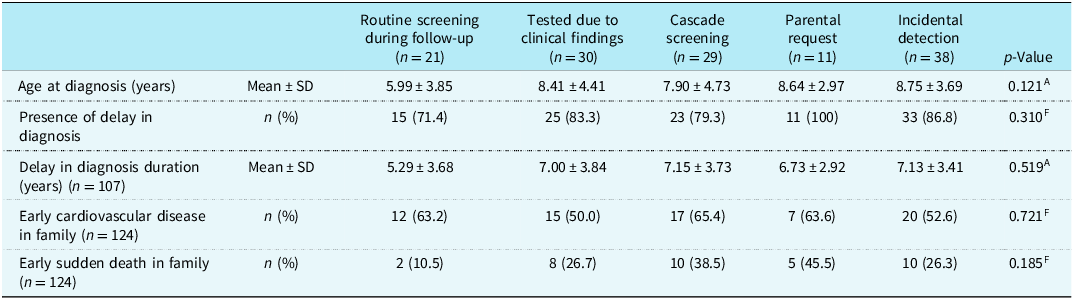
Additionally, to evaluate both the potential motivating factors and the impact of lipid testing indications on the diagnostic process, the relationship between each reason for testing and relevant factors was analysed. No significant association was found between the reasons for lipid testing and age at diagnosis, delay in diagnosis, duration of diagnosis delay, family history of early cardiovascular disease, or family history of early sudden death (Table 3).
Factors related to the indication for initial lipid testing

A One-way ANOVA,
F Fisher Freeman Halton test.
SD = standard deviation.
Factors affecting age at diagnosis and delay in diagnosis duration
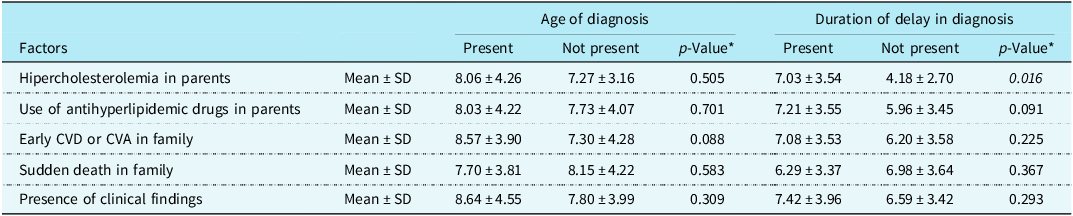
When evaluating the factors affecting age at diagnosis and delay in diagnosis, it was found that patients with only parental hypercholesterolaemia had a significantly longer diagnostic delay (7.03 ± 3.54 vs. 4.18 ± 2.70 years, p = 0.016). No significant differences were observed in age at diagnosis or delay in diagnosis between patients with and without a family history of antihyperlipidemic medication use, early-onset cardiovascular disease, sudden death at a young age, or the presence of clinical findings (Table 4).
Comparison of age at diagnosis and diagnostic delay according to family history and clinical features

* Student’s T-test.
CVA = cerebrovascular accident; CVD = cardiovascular disease.
Discussion
This study provides a comprehensive analysis of the clinical and familial characteristics of children diagnosed with familial hypercholesterolaemia, with a particular emphasis on diagnostic delay, clinical findings, and factors influencing initial testing and diagnosis.
Despite being a rare condition, homozygous familial hypercholesterolaemia accounted for a substantial proportion (20.2%) of the cohort. This relatively high frequency can likely be explained by two key factors: the study’s setting in a tertiary referral centre and the high prevalence of consanguineous marriages in Turkey. Reference Nair, Sharifi and Al-Rasadi16,Reference Alonso, Perez de Isla, Muniz-Grijalvo, Diaz-Diaz and Mata17 Supporting this, consanguinity was significantly more common among homozygous patients compared to those with heterozygous patients (76.0% vs. 16.2%), consistent with rates typically observed in autosomal recessive genetic disorders. Reference Tuncbilek and Ozguc18 Notably, the consanguinity rate among heterozygous patients aligned with the general population rate in Turkey. Reference Koc19 These findings underscore the ongoing impact of consanguineous marriage as a major risk factor for autosomal recessive conditions such as homozygous familial hypercholesterolaemia, particularly in regions where such practices are culturally or geographically prevalent. It should also be acknowledged that, as a tertiary referral centre, our institution is more likely to receive patients with more severe clinical phenotypes, which may have enriched the cohort for homozygous or more advanced cases and thereby limited the generalisability of the observed subtype distribution.
Furthermore, consanguinity was associated with significantly higher total cholesterol and low-density lipoprotein cholesterol levels in homozygous patients but not in those with heterozygous familial hypercholesterolaemia. This likely reflects the presence of homozygous mutations in consanguineous cases. While compound heterozygous or double heterozygous mutations can also result in a homozygous familial hypercholesterolaemia-like phenotype, they typically present with lower cholesterol levels compared to true homozygous mutations, which may help explain the observed differences in lipid levels. Reference Tada, Kawashiri and Ohtani20–Reference Cuchel, Bruckert and Ginsberg22
The mean age at diagnosis for patients in our study was 8.02 ± 4.14 years. Notably, the age at diagnosis in homozygous patients was higher than the age of 2 years recommended in the literature for the diagnosis of homozygous familial hypercholesterolaemia. Reference Watts, Gidding and Wierzbicki9 In a 2014 study by Kayıkçıoğlu et al., which included 17 adult homozygous familial hypercholesterolaemia patients, the mean age at diagnosis was found to be 25 ± 14 years, with only 5 of the patients having been diagnosed during childhood. Reference Kayikcioglu, Kismali, Can and Payzin23 This highlights the fact that patients in the high-risk homozygous familial hypercholesterolaemia group—who are more prone to serious cardiac complications—are often diagnosed later than the ages recommended for screening. Considering that coronary artery disease has been reported in homozygous familial hypercholesterolaemia patients at earlier stages than the median age of diagnosis in our cohort (6.1 years), early diagnosis is crucial for this population. Reference Tromp, Hartgers and Hovingh8 For heterozygous patients, the mean age at diagnosis was within the 5–10-year range recommended by expert societies that advocate for population-based screening. However, considering that many guidelines recommend screening around the age of 2 in children with a positive family history or other risk factors, it appears that heterozygous patients are also not being identified through the recommended early screening protocols. Reference Watts, Gidding and Wierzbicki9,Reference Cuchel, Raal and Hegele13
As familial hypercholesterolaemia is an inherited disorder, a high prevalence of hypercholesterolaemia and a family history of cardiovascular disease are anticipated as part of its clinical presentation. In a study conducted with 419 adult patients with familial hypercholesterolaemia, the rate of family history of hypercholesterolaemia was found to be 98.2%, and the rate of known family history of heart disease was 23.2%. Reference Harada-Shiba, Arai and Okamura24 In another study conducted with 508 paediatric patients with familial hypercholesterolaemia, a history of early cardiovascular disease was found in the first-degree relatives of 31% and in the second- and third-degree relatives of 57%. Reference Wiegman, Rodenburg and de Jongh25 In a study examining an adult patient group in Turkey, 48.1% of whom developed cardiovascular disease, the rate of family history of cardiovascular disease was found to be as high as 71.1%. Reference Kayikcioglu, Tokgozoglu and Dogan26 In our study, a very high percentage of patients, 57.3%, had a known family history of cardiovascular disease at the time of diagnosis, although only 16.3% of all patients were diagnosed through family screening. Additionally, patients with a family history of cardiovascular disease or a history of early sudden death in the family did not show significant differences in age at diagnosis or diagnostic delay. Similarly, the association between parental hypercholesterolaemia and longer diagnostic delay may appear counterintuitive; however, because current guidelines recommend lipid screening at an earlier age in children with a positive parental history, the reference age used to calculate delay is lower in this group. Consequently, failure to perform screening within this earlier recommended timeframe results in a longer calculated delay and may reflect missed opportunities for timely referral and systematic screening of at-risk children. It is also worth noting that literature underscores significant gaps in knowledge about the disease risks and genetic transmission among familial hypercholesterolaemia patients and their families, which may further hinder timely recognition and diagnosis. Reference Brett, Qureshi, Gidding and Watts27,Reference Collaboration, Vallejo-Vaz and De Marco28
Although no statistically significant difference was found in age at diagnosis among the groups defined by the reason for lipid profile testing, the youngest age at diagnosis was observed in the group identified through routine screening during follow-up (5.99 ± 3.85 years). It should also be considered that subgroup sizes were relatively small, and earlier unadjusted comparisons may have been underpowered to detect meaningful differences between testing indications. Cascade screening is an effective approach for identifying familial hypercholesterolaemia cases; however, genetic cascade screening may pose challenges in countries with limited access to genetic testing. Its successful implementation can also be hindered by variations in healthcare infrastructure and resources. In our study, cascade screening did not appear to be as successful, which highlights the need for additional strategies. This study emphasises that, in addition to cascade screening, general population screening plays a critical role in detecting cases that may otherwise be missed. Indeed, screening strategies should be tailored to the healthcare infrastructure and resources available in each country.
The strength of this study lies in its relatively large paediatric cohort and detailed analysis of both clinical and family history-related parameters. However, several limitations should be acknowledged. First, the retrospective design may limit the generalisability of the findings. In addition, genetic confirmation was not available for all patients, and the diagnosis of familial hypercholesterolaemia was primarily based on established clinical criteria. This constitutes a limitation, particularly in the context of homozygous familial hypercholesterolaemia, in which genetic testing contributes to more precise diagnostic classification. Access to comprehensive genetic testing, however, remains limited in many regions and is not uniformly available in routine paediatric practice. Importantly, this study was not designed to evaluate specific clinical phenotypes of familial hypercholesterolaemia or treatment outcomes, but rather to examine diagnostic processes and patterns of clinical identification. In this context, the reliance on validated clinical criteria is consistent with real-world practice in settings where genetic testing cannot be systematically performed. Therefore, although the absence of universal genetic confirmation should be considered when interpreting the findings, the diagnostic approach used in this study reflects current routine practice in many clinical environments. Moreover, the data were collected from a single centre, which may not fully reflect the national distribution of familial hypercholesterolaemia types. Additionally, since the study evaluates paediatric patients, it may not fully capture the diagnostic status of individuals diagnosed at older ages.
In conclusion, this study provided insights into the age at diagnosis and diagnostic characteristics of a large familial hypercholesterolaemia cohort. It suggests that patients were generally not screened according to the recommended guidelines, resulting in delayed diagnoses, with many cases being diagnosed incidentally. There is a need for large-scale studies to develop comprehensive screening strategies and for the creation of standardised screening methods tailored to the healthcare systems of each country.
Data availability statement
The datasets generated during and/or analysed during the current study are available from the corresponding author on reasonable request.
Acknowledgements
None declared.
Author contributions
All authors contributed to the study conception and design. Material preparation, data collection and analysis were performed by GKK and GFG. The first draft of the manuscript was written by GKK, and all authors commented on previous versions of the manuscript. All authors read and approved the final manuscript.
Financial support
The authors declare that no funds, grants, or other support were received during the preparation of this manuscript.
Competing interests
The authors have no relevant financial or non-financial interests to disclose.
Ethical standard
This study was performed in line with the principles of the Declaration of Helsinki. Approval was obtained from the Istanbul University Ethics Committee (approval date and number: 2016/1000).
Consent to participate
Informed consent was obtained from all individual participants included in the study.