



%20--%3e%3c!DOCTYPE%20svg%20PUBLIC%20'-//W3C//DTD%20SVG%201.0//EN'%20'http://www.w3.org/TR/2001/REC-SVG-20010904/DTD/svg10.dtd'%3e%3csvg%20version='1.0'%20id='Layer_1'%20xmlns='http://www.w3.org/2000/svg'%20xmlns:xlink='http://www.w3.org/1999/xlink'%20x='0px'%20y='0px'%20width='64px'%20height='64px'%20viewBox='5.5%20-3.5%2064%2064'%20enable-background='new%205.5%20-3.5%2064%2064'%20xml:space='preserve'%3e%3cg%3e%3ccircle%20fill='%23FFFFFF'%20fill-opacity='0'%20cx='37.785'%20cy='28.501'%20r='28.836'/%3e%3cpath%20fill='%23595959'%20d='M37.441-3.5c8.951,0,16.572,3.125,22.857,9.372c3.008,3.009,5.295,6.448,6.857,10.314%20c1.561,3.867,2.344,7.971,2.344,12.314c0,4.381-0.773,8.486-2.314,12.313c-1.543,3.828-3.82,7.21-6.828,10.143%20c-3.123,3.085-6.666,5.448-10.629,7.086c-3.961,1.638-8.057,2.457-12.285,2.457s-8.276-0.808-12.143-2.429%20c-3.866-1.618-7.333-3.961-10.4-7.027c-3.067-3.066-5.4-6.524-7-10.372S5.5,32.767,5.5,28.5c0-4.229,0.809-8.295,2.428-12.2%20c1.619-3.905,3.972-7.4,7.057-10.486C21.08-0.394,28.565-3.5,37.441-3.5z%20M37.557,2.272c-7.314,0-13.467,2.553-18.458,7.657%20c-2.515,2.553-4.448,5.419-5.8,8.6c-1.354,3.181-2.029,6.505-2.029,9.972c0,3.429,0.675,6.734,2.029,9.913%20c1.353,3.183,3.285,6.021,5.8,8.516c2.514,2.496,5.351,4.399,8.515,5.715c3.161,1.314,6.476,1.971,9.943,1.971%20c3.428,0,6.75-0.665,9.973-1.999c3.219-1.335,6.121-3.257,8.713-5.771c4.99-4.876,7.484-10.99,7.484-18.344%20c0-3.543-0.648-6.895-1.943-10.057c-1.293-3.162-3.18-5.98-5.654-8.458C50.984,4.844,44.795,2.272,37.557,2.272z%20M37.156,23.187%20l-4.287,2.229c-0.458-0.951-1.019-1.619-1.685-2c-0.667-0.38-1.286-0.571-1.858-0.571c-2.856,0-4.286,1.885-4.286,5.657%20c0,1.714,0.362,3.084,1.085,4.113c0.724,1.029,1.791,1.544,3.201,1.544c1.867,0,3.181-0.915,3.944-2.743l3.942,2%20c-0.838,1.563-2,2.791-3.486,3.686c-1.484,0.896-3.123,1.343-4.914,1.343c-2.857,0-5.163-0.875-6.915-2.629%20c-1.752-1.752-2.628-4.19-2.628-7.313c0-3.048,0.886-5.466,2.657-7.257c1.771-1.79,4.009-2.686,6.715-2.686%20C32.604,18.558,35.441,20.101,37.156,23.187z%20M55.613,23.187l-4.229,2.229c-0.457-0.951-1.02-1.619-1.686-2%20c-0.668-0.38-1.307-0.571-1.914-0.571c-2.857,0-4.287,1.885-4.287,5.657c0,1.714,0.363,3.084,1.086,4.113%20c0.723,1.029,1.789,1.544,3.201,1.544c1.865,0,3.18-0.915,3.941-2.743l4,2c-0.875,1.563-2.057,2.791-3.541,3.686%20c-1.486,0.896-3.105,1.343-4.857,1.343c-2.896,0-5.209-0.875-6.941-2.629c-1.736-1.752-2.602-4.19-2.602-7.313%20c0-3.048,0.885-5.466,2.658-7.257c1.77-1.79,4.008-2.686,6.713-2.686C51.117,18.558,53.938,20.101,55.613,23.187z'/%3e%3c/g%3e%3c/svg%3e)
%20--%3e%3c!DOCTYPE%20svg%20PUBLIC%20'-//W3C//DTD%20SVG%201.0//EN'%20'http://www.w3.org/TR/2001/REC-SVG-20010904/DTD/svg10.dtd'%3e%3csvg%20version='1.0'%20id='Layer_1'%20xmlns='http://www.w3.org/2000/svg'%20xmlns:xlink='http://www.w3.org/1999/xlink'%20x='0px'%20y='0px'%20width='64px'%20height='64px'%20viewBox='5.5%20-3.5%2064%2064'%20enable-background='new%205.5%20-3.5%2064%2064'%20xml:space='preserve'%3e%3cg%3e%3ccircle%20fill='%23FFFFFF'%20fill-opacity='0'%20cx='37.637'%20cy='28.806'%20r='28.276'/%3e%3cg%3e%3cpath%20fill='%23595959'%20d='M37.443-3.5c8.988,0,16.57,3.085,22.742,9.257C66.393,11.967,69.5,19.548,69.5,28.5c0,8.991-3.049,16.476-9.145,22.456%20C53.879,57.319,46.242,60.5,37.443,60.5c-8.649,0-16.153-3.144-22.514-9.43C8.644,44.784,5.5,37.262,5.5,28.5%20c0-8.761,3.144-16.342,9.429-22.742C21.101-0.415,28.604-3.5,37.443-3.5z%20M37.557,2.272c-7.276,0-13.428,2.553-18.457,7.657%20c-5.22,5.334-7.829,11.525-7.829,18.572c0,7.086,2.59,13.22,7.77,18.398c5.181,5.182,11.352,7.771,18.514,7.771%20c7.123,0,13.334-2.607,18.629-7.828c5.029-4.838,7.543-10.952,7.543-18.343c0-7.276-2.553-13.465-7.656-18.571%20C50.967,4.824,44.795,2.272,37.557,2.272z%20M46.129,20.557v13.085h-3.656v15.542h-9.944V33.643h-3.656V20.557%20c0-0.572,0.2-1.057,0.599-1.457c0.401-0.399,0.887-0.6,1.457-0.6h13.144c0.533,0,1.01,0.2,1.428,0.6%20C45.918,19.5,46.129,19.986,46.129,20.557z%20M33.042,12.329c0-3.008,1.485-4.514,4.458-4.514s4.457,1.504,4.457,4.514%20c0,2.971-1.486,4.457-4.457,4.457S33.042,15.3,33.042,12.329z'/%3e%3c/g%3e%3c/g%3e%3c/svg%3e)
1. The Missing Binaries of M17
Messier 17, also known as the Omega nebula, is one of the best studied HII regions in the Milky Way. Due to its youth and lack of evolved stars, Broos et al. (Reference Broos, Feigelson and Townsley2) believe that M17 has not yet had a supernova, meaning that we can observe massive stars and their interactions with each other and their environment before the disruption of a supernova explosion. Since M17 is a young, active star-forming region, we expect the main-sequence to be dominated by massive stars and thus, by binary and multiple systems. However, of the massive stars resolved to be in binary systems, the amount of short-period binary systems is much lower than expected in the region [13, 15]. Observing massive star systems shortly after formation will answer why we are not seeing short-period binaries in this region, and whether the difference in the binary fraction in M17 is due to observational bias or a lack of these binaries (Reference Sana, Le Bouguin and Lacour15). The extreme mass ratio binaries are the key to understanding the formation of binary and multiple systems (Reference Moe and Di Stefano7). Using high contrast and high spatial resolution imaging techniques, we can observe low-mass companions to massive stars that may still be forming and expand the general understanding of binary systems to a much greater range of mass ratios. With this study, we are sensitive to wider systems which we can compare with the short period binary fraction. This can give us insight into the dynamical history and stellar interactions of M17.
2. Observations and High-Contrast Imaging
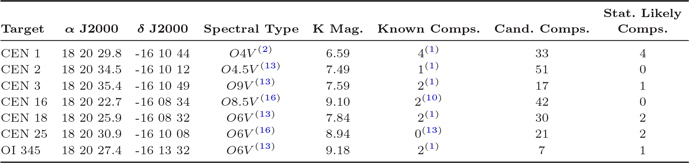
Focusing on seven massive O-type stars in M17, described in Table 1, we observed our targets using the Spectro-Polarimetric High-contrast Exoplanet REsearch (SPHERE) instrument on VLT UT3. Using the simultaneous dual-band imaging in bands
 $K_1$
and
 $K_2$
and integral field spectroscopy in YJH, along with SPHERE’s extreme adaptive optics, we were able to achieve high-contrast ratios of up to 15 mag in the K-band.
Table of the targets in M17 that are studied in this work. The first column is the identifier used in this work to refer to the target star according to the nomenclature of Chini, Elsaesser, & Neckel (Reference Chini, Elsaesser and Neckel3) and Ogura & Ishida (Reference Ogura and Ishida9). The second and third columns display the right ascension (
 $\alpha$
) and declination (
 $\delta$
) (J2000), respectively. The spectral types are listed in the fourth column with the magnitude in the fifth column from (Reference Broos, Feigelson and Townsley2). The sixth column is the number of known companions each star has. The seventh column is the number of detections within the FOV of IRDIS for each target star above the threshold of SNR
 $\gt 5\sigma$
. The final column is the number of newly detected statistically likely companions as a result of this work.

Table 1 Long description
A table with 8 rows and 8 columns comparing targets in M17. Columns are Target, α J2000, δ J2000, Spectral Type, K Mag., Known Comps., Cand. Comps., and Stat. Likely Comps. Row 1: CEN 1, 18 20 18.0, -16 10 29.8, O4V, 6.59, 4, 33, 4. Row 2: CEN 2, 18 20 34.5, -16 10 12, O4.5V, 7.49, 1, 51, 0. Row 3: CEN 3, 18 20 35.4, -16 10 49, O9V, 7.59, 2, 17, 1. Row 4: CEN 16, 18 20 22.7, -16 08 34, O8.5V, 9.10, 2, 42, 0. Row 5: CEN 18, 18 20 25.9, -16 08 32, O6V, 7.84, 2, 30, 2. Row 6: CEN 25, 18 20 30.9, -16 10 08, O6V, 8.94, 0, 21, 1. Row 7: OI 345, 18 20 27.4, -16 13 32, O6V, 9.18, 2, 7, 1.
In order to maximize the signal-to-noise ratio (SNR) of our detections, we utilized high-contrast imaging techniques on our science files. This project made use of the Vortex Image Processing (VIP) pipeline (Reference Gomez Gonzalez, Wertz and Absil6). This high-contrast imaging method can also be used for extreme mass ratio binaries, as demonstrated in works such as [12, 11, 14].
For each target star, we processed the image using principal component analysis and angular differential imaging. After processing our data, we use the detection function in VIP to find any objects in the field with an SNR of 5 or greater and get an estimate on their separation, flux, and SNR. We utilized the initial estimates of separation and flux for each detection in the field to feed into a Simplex Nelder-Mead (Reference Nelder and Mead8) optimization along with the Negative Fake Companion technique. In conjunction, this techniques uses a negative PSF template in order to “cancel out” each detection by varying the position, flux, and angular separation of the candidate companion with respect to the primary and optimize based on the input parameters. We then used a Monte Carlo sampler in order to estimate our uncertainties.
We use the statistical approach described by Correia et al. (Reference Correia, Zinnecker, Ratzka and Sterzik4) to calculate the probability of an unrelated source to be found in our FOV. This method, given by Eq 1 determines the probability of a chance projection based on the surrounding stellar density
 $\Sigma$
from the limiting magnitude of the candidate companion and the angular separation
 $\Theta$
.
 \begin{equation} P(\Sigma,\Theta) = 1 - e^{-\pi\Sigma\Theta^2}\end{equation}
3. Discussion of Results
In our seven star sample of M17, we detected 201 total candidate companions within 10,000 AU of their corresponding primary star. Of these candidate companions, we found 10 statistically likely companions (P(
 $\Sigma, \Theta)\lt.01$
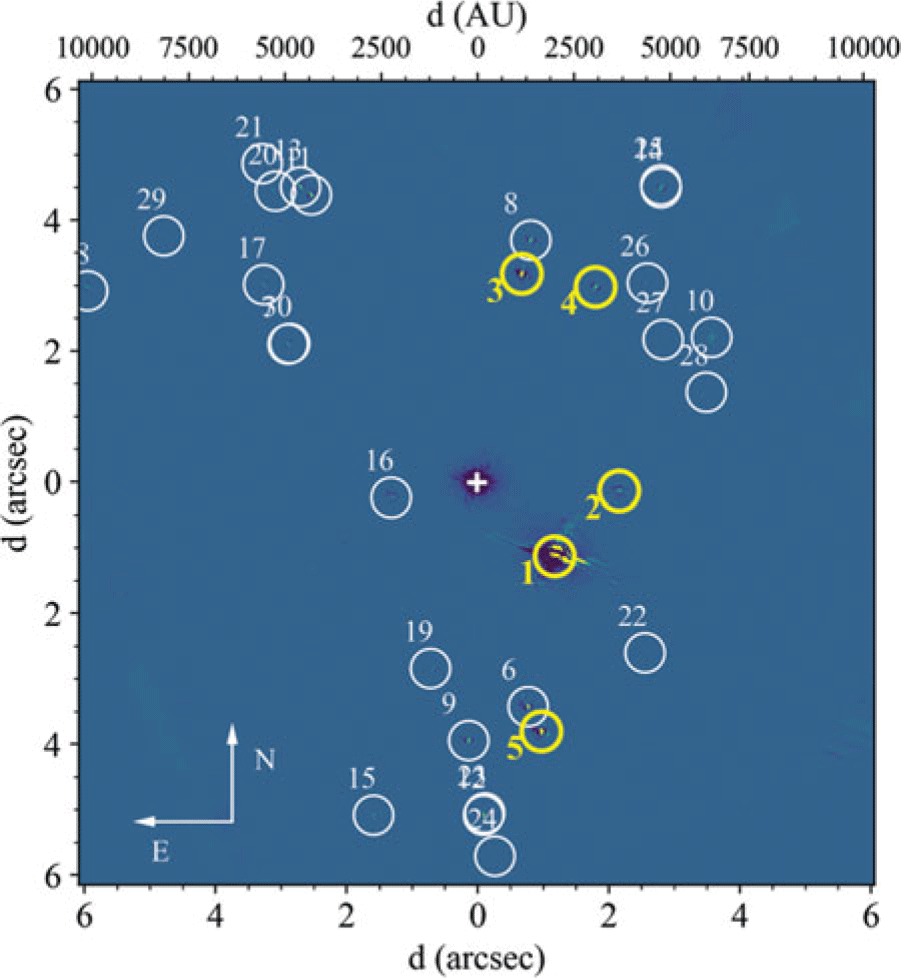
) that have not been previously detected, listed in column eight of Table 1. The detections above 5-sigma for CEN 1 can be seen in Figure 1 with the statistically likely companions circled in yellow. Five of our seven companions have at least one statistically likely candidate companion detected in this work. Including previously reported binaries, we determine a 100% multiplicity fraction and a companion fraction of 2.86.
A reduced and combined image of CEN 1 in the K1 filter with the detected companions with an SNR
 $\gt$
5
 $\sigma$
. Detections circled in yellow are statistically likely companions. Companion 1 within the image is not listed in the table of results as it is a known companion (a triplet dubbed B189SW or CEN 1b).

4. Future Work
Our next steps will be to analyze data taken with SPHERE IFS to characterize the potential companions within the FOV of IFS. This will provide support for the candidate companions that are statistically likely to be gravitationally bound. For IFS, we will be doing the same process as IRDIS with a SNR calculation and spectral differential imaging rather than angular. The IFS low resolution spectroscopic data along with the IR color information will aid in the characterization of the candidate companions.
All seven of our targets have been observed previously with the Near-Infrared Integral Field Spectrometer (NIFS) on Gemini North, using its Adaptive Optics and Natural Guide Source capabilities. We will use this archival data to study the companions in two epochs and in an extended spectral range.
5. Acknowledgments
We would like to thank the IAU Massive Stars Commission and the American Astronomical Society for their support. This work made use of the SIMBAD data base. This research has made use of the Spanish Virtual Observatory (https://svo.cab.inta-csic.es) project funded by MCIN/AEI/10.13039/501100011033/ through grant PID2020-112949GB-I00. This work made use of the Besançon Galaxy Model (Reference Czekaj, Robin and Figueras5). This work is funded through NASA FINESST under proposal 23-ASTRO23-0242.
 α
 δ
 >5σ
 >
 σ

 Open access

