Introduction
Alzheimer's Disease International (2013) estimates that 44.35 million people are living with dementia globally, with approximately 820,000 people in the United Kingdom with a diagnosis of dementia (Alzheimer's Research UK 2011). Two-thirds of those with the diagnosis will be cared for in the community by their partner or spouse (Alzheimer's Society 2008), and consequently, there is an increasing recognition of the role of the family, and particularly of the spouse, in providing care for those living with dementia. The relational elements of care for dementia have been explored by several authors (e.g. Caron and Bowers Reference Caron and Bowers2003; Chan and O'Connor Reference Chan and O'Connor2008; Chesla, Martinson and Muwaswes Reference Chesla, Martinson and Muwaswes1994; Gott Reference Gott2005; Hellström, Nolan and Lundh Reference Hellström, Nolan and Lundh2005, Reference Hellström, Nolan and Lundh2007; Kaplan Reference Kaplan2001; La Fontaine and Oyebode Reference La Fontaine and Oyebode2013; O'Connor Reference O'Connor1995, Reference O'Connor1999; Sims-Gould and O'Connor Reference Sims-Gould and O'Connor2008), as it is clearly important to recognise how much dementia care is provided in-relationship and how dementia and care-giving impacts relationships (Hellström, Nolan and Lundh Reference Hellström, Nolan and Lundh2005).
Early research in this area focused on the role of the carer, emphasising the particular vulnerability of spousal care-givers to the stresses associated with caring (O'Connor Reference O'Connor1999). Caring for a partner with dementia is associated with fewer shared social activities, isolation, loss of the partner's emotional support and reduced social interaction with the partner. The care-giving partner often experiences this reduced social and emotional interaction as an additional stressor (Baikie Reference Baikie2002). Maintaining relationships with family and other carers is a key element in the maintenance of self-esteem and dignity for people living with dementia (Bowers Reference Bowers1988; Phinney Reference Phinney1998, Reference Phinney2002). Spousal carers do play a central role in enabling people living with dementia to maintain a sense of agency and self-esteem, and partner relationships are a living context within which these qualities of personhood can be maintained (Perry and O'Connor Reference Perry and O'Connor2002). Evidence suggests that the better supported and happier the carer, the longer the cared-for can stay at home (Soltysiak, Gardiner and Skirton Reference Soltysiak, Gardiner and Skirton2007), thus giving the couple greater autonomy. Further, close relationships between carer and care-giver predict better health and wellbeing outcomes for both partners (Fauth et al. Reference Fauth, Hess, Piercy, Norton, Corcoran, Rabins and Tschanz2012). It is therefore important to understand the way that people experience their intimate relationships, in order to better support dementia care.
However, it is important to remember that caring relationships are not just about care, and that becoming a carer involves a major shift in established relationships, for both partners. Becoming a carer involves a new labelling of long-term intimate relationships that come to include (among other things) components of advocacy and struggle, of standing up for your partners' rights as a patient, and your own rights as a carer (Tranvåg, Petersen and Nåden Reference Tranvåg, Petersen and Nåden2013). Partners have to negotiate a new space for themselves to be recognised as both a ‘good carer’ and a ‘good husband or wife’ (O'Connor Reference O'Connor1999: 223). Care takes place at ‘the interface between the private experience of living with a memory-impaired partner and the use of formal support services’ (O'Connor Reference O'Connor1999: 231), and consequently the personal, intimate relationship necessarily becomes a more public one. Relationships, the quality and form of interaction between partners, are also clearly impacted by the experience of living with dementia, and shifts in relational experiences map on to the progression of the illness (Hellström, Nolan and Lundh Reference Hellström, Nolan and Lundh2007; Kaplan Reference Kaplan2001). People's understanding of their relationships, their definition of themselves as a couple, shifts as dementia progresses. Kaplan explores how some couples retain a strong sense of ‘we’, that defines the experience of relationship, while others experienced their relationship as ‘in limbo’, and still others regarded themselves as ‘married’ but functionally ‘single’ (Reference Kaplan2001: 87, 93, 94) – still legally married, but no longer part of a couple as the person with dementia is still physically present, but is experienced as a different person by the care-giving partner. This experience hinges on the spouse's perception of the degree to which the partner with dementia could be an active and reciprocal participant in the marriage relationship. Hellström, Nolan and Lundh found that spouses used a range of strategies to ‘live positively’ (Reference Hellström, Nolan and Lundh2007: 383) when a partner has dementia, and that these shifted over time as both partners (and the relationship) adapted to the illness. A sense of coupledom was retained through a strategy of ‘talking things through’, being affectionate and appreciative, and maintaining some involvement of the partner with dementia in decision making and family activity. For some there is a point in the relationship when the caring spouse feels they must accept the loss of their partner, and they begin to move on. These relationship changes are not linear, rather they are circular and systemic processes that develop in response to the movement of the illness and changes in circumstances. Relationships adapt and change as the illness progresses.
Inevitably, when relationships are affected by dementia, couples’ experience of intimacy will shift and change too. Intimacy is a core aspect of human relating, involving elements of self-disclosure and shared experience, enabling a mutual sense of understanding that unfolds within a relational (often dyadic) context (Laurenceau et al. Reference Laurenceau, Riviera, Schaffer, Pietromonaco, Mashek and Aron2004). While much research on intimacy focuses on younger adults, nonetheless, the sense of closeness, affection and sexuality that characterise intimacy remain important through to old age (Blieszner and de Vries Reference Blieszner and de Vries2001; Prager Reference Prager1995; Scheidt, Vanden Bosch and Kivnick Reference Scheidt, Vanden Bosch and Kivnick2012). Sexual intimacy is conceptualised as a sub-type of intimacy, and is usually key to the experience of intimacy in long-term relationships like marriages and other long-term partnerships (Birnie-Porter and Lydon Reference Birnie-Porter and Lydon2013). Sexual intimacy remains a feature of intimate older adult relationships, and is important too in relationships affected by dementia (Dourado et al. Reference Dourado, Finamore, Barroso, Santos and Laks2010), where romance, touching, feeling attractive and loved, and being sexual are still important components of close partnerships (Rheaume and Mitty Reference Rheaume and Mitty2008). Sexuality is for many couples an important way for a partner with a diagnosis of dementia to feel that they still bring something to the relationship despite the gradual and inevitable erosion of other interpersonal skills (Davies et al. Reference Davies, Zeiss, Shea and Tinklenberg1998). Even when one partner requires nursing care and leaves the family home, the need for physical closeness and connectedness is still something most people feel, and intimacy needs do need to be discussed by services supporting individuals affected by dementia and their partners (Bamford Reference Bamford2012). In order for the couple to feel more able to seek help, sexuality and intimacy in later life need to be seen as normal and accepted (Bauer et al. Reference Bauer, Fetherstonhaugh, Tarzia, Nay, Wellman and Beattie2013a).
However, intimacy needs, and particularly sexual needs, are often seen from a problematic perspective (Bauer et al. Reference Bauer, Nay, Tarzia, Fetherstonhaugh, Wellman and Beattie2013b; Manthorpe and Price Reference Manthorpe and Price2003). For example, hypersexuality has been linked with dementia as a cause for concern in care provision (Bamford Reference Bamford2012; Garrett Reference Garrett2014), while some medical literature has focused on sexual dysfunction in dementia, highlighting the attendant loss of sexual satisfaction (Dourado et al. Reference Dourado, Finamore, Barroso, Santos and Laks2010). This kind of description frames sexuality as a pathological phenomenon for people living with dementia (Bamford Reference Bamford2012; Bauer et al. Reference Bauer, Fetherstonhaugh, Tarzia, Nay, Wellman and Beattie2013a & Reference Bauer, Nay, Tarzia, Fetherstonhaugh, Wellman and Beattieb). Sexuality is rendered discursively as something inappropriate to be managed. This construction of sexual intimacy and sexual behaviour as problematic does not enable a consideration of the complexity of feelings people living with dementia might have regarding their intimate relationships. In residential contexts, sex and intimacy might be regarded as an individual need to be addressed (often by an under-prepared staff group) (Bamford Reference Bamford2012; Garrett Reference Garrett2014), but not as an element of relationality or personal identity.
In contrast, Higgins, Barker and Begley (Reference Higgins, Barker and Begley2004) suggest that sexuality in those with dementia should not be researched as problematic in and of itself, but more from the point of view that this is an inappropriately voiced expression of a human need for intimacy. They argue that for those with communication difficulties, intimate behaviour such as touching is an important aspect of their care. We would argue that intimate behaviour does function as another way of expressing care, but is also embedded as an extension of previous intimacies in the relationship, and that it is important to understand these complexities. This point is emphasised by Zarit (Reference Zarit2001) who suggested that long-term relationships are varied phenomena, and that care packages should be individually tailored, taking time to understand the relationship before illness set in. Zarit further suggests that emotional and sexual intimacy play an important role in maintaining a more positive outlook in the caring relationship, and that intimate behaviours can calm patients with a diagnosis of dementia.
Our focus in this article is not on the relationship as a context for care, but on partners' experiences of the lived relationship in relation to intimacy. Much of the important work described above has focused on the way that the relationship in dementia care provides a supportive context for the person with dementia, as well as exploring how the relationship adapts and changes as the illness progresses. However, in this work, we want to consider the experience of the relationship in its own right, rather than the relationship as a context in which care is provided. In particular, our interest is in the lived experience of intimacy itself. We did not initially set out to consider the sexual aspect of long-term relationships; rather our initial focus was on emotional intimacy and the lived experience of relationships when dementia is present. However, in talking to carers who have partners with dementia, it quickly became apparent in our interviews that the sexual and physical elements of intimacy were a particularly important concern. Based on our analysis of this interview data, we suggest that understanding this aspect of the relationship – the lived and felt experience of being intimate, emotionally and physically – is an important grounding for making sense of the caring relationship more broadly. Long-term relationships are first and foremost intimate ones, and the element of intimacy is often subsumed under the construct of care in public engagement with dementia. It is not our intention to undermine the importance of care both as an element of relationships more broadly, or as a crucial aspect of relationships where a partner has dementia. However, we did want to explore the reality that care relationships are located in a broader relational history, and we argue that intimacy and sexuality are key elements of those relational histories.
Method
The study is a qualitative investigation using semi-structured interviews, which were analysed using Interpretive Phenomenological Analysis (Eatough and Smith Reference Eatough, Smith, Willig and Stainton Rogers2008; Smith Reference Smith2004; Smith and Osborn Reference Smith, Osborn and Smith2007). Interpretive Phenomenological Analysis was chosen because of its particular ability to capture the phenomenological density of personal accounts, and to enable a detailed consideration of participants' experience and meaning making about complex social and personal phenomena. This was felt to be particularly relevant to partners talking about the lived experience of complex interpersonal relationships.
Interviews
It was important to the researchers to approach the topic of intimacy and dementia in a way that was both appropriate and acceptable to the participants. At the beginning of the research process, the general topic of intimacy was discussed at a local carers group to gain a sense of how the participant group would feel about the topic. These discussions informed the development of the interview schedule, and as a result of advice from these discussions the questions do not make explicit reference to sex or sexuality but are worded in a way that allows the participant to discuss issues at the level of detail with which they feel most comfortable. The interviewer created sufficient space for the participants to self-define what was meant by intimacy in the context of their relationships, and the question of sexual intimacy was raised directly by participants in each interview.
Each interview was held at a local day centre or care home, and only the participant and the researcher were present during the interviews. The interviews were informal in style; the approach taken was more conversational and friendly than formal. Before each interview, the interviewer discussed the informed consent documentation with each participant, and consent was then obtained at the beginning of each interview. All interviews were recorded using a digital recorder. The interview schedule was used as a guide to questioning and often participants added much more detail than was requested. The mood during the interviews was a mix of good humour and sadness.
Participants
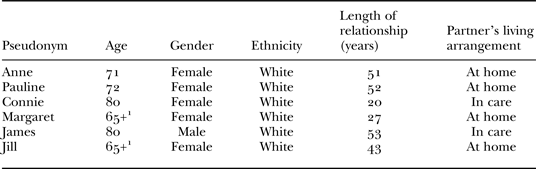
This is a small-scale study, to explore questions of intimacy, intended to inform the development of a larger-scale project which includes carers and individuals with dementia, and several different care contexts. Consequently, a small number of participants (six) were approached through a support network for carers, and agreed to be interviewed. Given the complexity and density of interview material typically elicited for such studies, Smith (Reference Smith2004) suggests that a sample of five to ten is appropriate for an Interpretive Phenomenological Analysis-based study. All participants were in long-term relationships with a partner who had a diagnosis of dementia, although the types of dementia could differ. Our inclusion criteria did not deliberately exclude LGBQT participants, but available participants were all heterosexual. For demographic details, see Table 1.
Demographic details of participants

Note: 1. Specific age not revealed in interview.
Ethical issues
The study had both University of Northampton ethical approval and local Primary Care Trust approval (KM241108, MN/cec). The researcher conducting the interviews (JY) had the support of both an academic and a clinical supervisor. The British Psychological Society's ethical framework was closely adhered to, with informed consent being appropriately secured and the participants' rights to withdrawal and to anonymity being ensured. Particular attention was paid to putting in place appropriate support in case of distress. Each interview was conducted at a care home or day centre. A member of the older people's mental health team, who was known to and supported the participant, was on site and could be called upon for the duration of the interview should any participant wish them to be present.
The interview was structured so that more general questions around the marital relationship, how long they have been married, etc., were asked first. Then followed more specific questions around the caring role and intimacy. Participants were offered the opportunity towards the end of the interview to add any further comments. Participants were given full contact details should they wish to withdraw following the interviews. Each participant was provided with a brief report highlighting the key findings and at this point they were again offered the opportunity to withdraw should they so wish. All participants were given a pseudonym to protect their anonymity, and any identifying information was removed from the transcripts of interviews before analysis.
Interpretive Phenomenological Analysis
The interviews were transcribed verbatim, to form a stable written record of the interviews. These were analysed using Interpretive Phenomenological Analysis (Eatough and Smith Reference Eatough, Smith, Willig and Stainton Rogers2008; Smith Reference Smith2004; Smith, Flowers and Larkin Reference Smith, Flowers and Larkin2009; Willig Reference Willig2001). This involved a careful, line by line analysis of the interview transcripts (often with the tapes playing alongside the written record), coding the transcripts for experiential and meaning-making content. The interviews were coded independently, in full by JY and JC, and a sample of them were coded by KB. JC and JY used double margin coding to enable engagement with a double hermeneutic in the analysis of the interviews (Smith, Flowers and Larkin Reference Smith, Flowers and Larkin2009). This form of coding was particularly useful in this analysis, as it enabled the two coders to work with their own experiences as carers in a manner that allowed them to function as a resource for the interpretation, without blurring the boundaries between what the participants said and the researchers' own meaning making about those experiences. Patterns and connections in participants' understanding and experience were drawn both within and across the transcripts. From these codes, themes were built up that were grounded in the data being analysed.
Analysis
The aim of the study was to understand the care-giving partner's lived experience and understanding of intimacy and relationships, when their partner has dementia. Our analysis therefore focuses on enabling the texture, subtleties and nuances of the carers' experiences, articulated in their own words, to be heard. Three phenomenological master themes emerged from the analysis: ‘everydayness’, ‘absent presence’ and ‘I don't know if you want to know this…’ ‘Everydayness’ highlights the sense of loss that is felt as everyday activities like conversation or going to the shops are eroded by the dementia. As activities were diminishing so too was their experience of the essence of the partner with dementia, as reflected in the theme ‘absent presence’. Here we discuss the implications of this slow disappearance and its associated losses for the experience of intimacy. The final theme, ‘I don't know if you want to know this…’, offers insight into the delicate but complex balance being struck in participants' experiences of these relationships in relation to intimacy, physicality and sex. The three emergent themes build a picture of the complex, difficult nature of the experience of living in a relationship affected by dementia. The accounts of our participants are riven with loss, but also are characterised by a sense of tenderness, poignancy and deep affection, as they struggle with both their sense of intimacy with their partners, and the loss of intimacy. This highlights the paradoxical complexity of the partner's experience of the relationship, of the sense of connection – emotional and physical – that remains and is lost all at the same time.
Everydayness
Much of our sense of intimacy and relationships is constituted around what we might describe as the ‘everydayness’ of living together. Berman describes perfectly this lived, everyday sense of intimacy and the experience we have when it is disrupted by loss:
The daily routine … of shopping and eating and cleaning up, of ordinary hugs and kisses, may be not only infinitely joyous and beautiful, but also infinitely precarious and fragile. (Reference Berman1983: 14)
Family relationships are made up of the ordinariness of the everyday. They are constructed in a physical space of the family home, and in the embodied day-to-day-ness of living together, of shared relational spaces. The experience of dementia is clearly one that involves a sense of disruption to the everydayness that forms the bedrock of intimacy. This sense of disruption to everyday intimacy was present in all the interviews we conducted. It was the small everyday interactions which were probably taken for granted before the diagnosis which now become a focus for a sense loss in these relationships. The day-to-day lived realities of being together have to be re-negotiated, and participants reported a sense of trying to hold on to the everyday exchanges whilst finding coping strategies in the face of diminishing reciprocity. All participants reported that their partners' dementia caused disruption in everyday activities and most spoke in terms of loss and sadness:
You can't have a normal conversation because a normal conversation means confrontation to them, it means they don't understand what you're trying to say so they get annoyed not so much with you but with themselves but they lash out at you verbally and you have to find a cut-off point before they lash out at you, literally. (Pauline)
What is clear in this paragraph is the sense of a discontinuity between what is regarded as normal in their past experience of relational life, and what their relationship is like now. Normal conversation, the everyday stuff of relationships, has been rendered impossible by the illness – and yet normal conversation is precisely what is needed to keep a sense of relationship intact – it is a key element of the daily work of relational maintenance (Canary and Stafford Reference Canary, Stafford, Canary and Stafford1994; Stafford and Canary Reference Stafford and Canary1991). Expressing yourself, and feeling heard and understood, is the foundation of relational intimacy that unfolds organically within a dyadic process (Laurenceau et al. Reference Laurenceau, Riviera, Schaffer, Pietromonaco, Mashek and Aron2004). The everyday business of marriage or long-term relationships, the daily chatter that is an expression of intimacy and relatedness, is disrupted by the illness. In the extract above, Pauline describes a loss of mutual exchange. Her husband is no longer able to follow the thread of conversation or apparently to partake in the necessary turn-taking structure of conversation. A conversation between Pauline and her husband is no longer an equal exchange and Pauline has to take sole responsibility for the conversation as her husband gets quite frustrated with his inability to follow what is being said. Instead of being a conversational partner, she becomes a conversational manager – and consequently the sense of shared understanding, and the sense of intimacy and closeness that is built in that dyadic process, is disrupted. Pauline positions her husband as unpredictable or unstable, as different from his previous self who she understood so well – and her relationship with her partner becomes structured around managing this disruption both of the everyday fabric of their relationship, and the connection that that everydayness enables to their relational past.
A further element of the disruption of the everyday that is brought about by the illness is the sense of it making the ordinary and familiar unfamiliar and strange. For example, Connie found that real confusion occurred during everyday interactions such as watching television:
when we watch the telly sometimes we can be watching racing or rugby, whatever, he says they'll have to give it up these games, these boys are too young for him to cope with and I'm a jockey and I begin the horse race and when I'm leaving him, I say ‘I'm going now’, because we have got to that stage, ‘I'm going now I'll see you later’, ‘I suppose you've got to go see to the horse haven't cha’ and I say ‘yeah’, yep, you don't argue, you just go along. (Connie)
Connie, of course, is not a jockey, and does not have a horse. But her partner has become confused, blurring the boundaries between their shared television watching and the real. This becomes a slightly surreal interchange for Connie, one that she must manage conversationally by going along with his confusion. Conversation is no longer about a shared social reality, but about her managing his increasingly confused understanding of that reality. Jill feels a similar sense of responsibility for maintaining conversational interaction with her partner:
I started buying some of the old movies, you know, with the old songs on I put those on, and, if it's the right day, you know what I mean by that, if it's the right day he'll sit and watch it and we'll sing the songs together and that's as much interaction as we'll get, that is an improvement. (Jill)
Both Connie and Jill recognise that the illness has disrupted the sense of an everyday shared social reality. By accepting this shift, they are able to go along with it; to avoid unhelpful conflict and therefore find some mutual ground. They construct a shared social space – different from the one they had before the illness, but shared nonetheless. Connie does not dispute her husband's belief she is going to tend to her horse; Jill changes the kinds of programming that they watch together on television. Both recognise the potential for a disjointed and often sporadic interaction – but allowing space for this disjointedness enables them to continue to interact. Both carers are having to develop a new register of social interaction to deal with what is happening in their relationships. A sense of frequent accommodations, of allowing the relationship to change with the illness, typifies the new daily relational work of living with a partner with dementia:
I used to take her out in the car but that became too dangerous, then I wheeled her out in the wheelchair and now, you know, go in the garden down here it's quite nice, but I do feel just having the sun on your face must make a difference, you know, and a breeze, a little breeze whatever condition you're in, I think you must notice… (James)
…and I mean when he first went in one of the carers well got him to phone me up and got him to say ‘happy birthday’. I hadn't heard that for years, you know, coz he forgets. (Connie)
Both Connie's and James's partners are in residential care, but importance is placed on preserving a connection, through regular, shared activity – constructing a new sense of the ordinary and everyday, that takes the place of the everydayness that has been lost. James thinks carefully about what activities he can still share with his wife and hopes that she, at some level, enjoys that time. Connie was clearly touched by her call from her husband on her birthday. She is aware that the carer instigated the contact, but values it nonetheless. Each carer gives great thought and consideration to how they can renegotiate shifts in their connectedness and intimacy; whether by going along with confused thinking, watching old movies, stepping outside or hearing ‘happy birthday’. These accounts are filled with affection and poignant loss.
Absent presence
The disruption of the everyday might be better understood when considered in relation to another experiential dimension participants reflected – the sense of the partner they have loved as an absent presence. Each participant expressed in varying ways how it felt to still have their partner alive and for most still living at home, but that the essence of that person was missing. Anne was particularly aware of this in her relationship:
…and that is one of the hardest things with the dementia, is the loss of empathy, you know, Edward has absolutely no, well, almost as if he doesn't care and that isn't, well the old Edward would have cared. (Anne)
The reference to the ‘old Edward’ gives a sense that Anne is acknowledging the change she has noticed in her husband since the diagnosis. But this reference goes further by implying that the Edward she has at home now is some sort of other person and no longer the husband she knew, giving a sense that she is living with a familiar-looking stranger. There is a sense of creeping resentment of the loss of the ‘old Edward’, the loss of the Edward who would have cared. This has clear echoes of Boss's notion of ‘ambiguous loss’ – a sense of a relational loss that remains either incomplete or unclear (Boss Reference Boss1999: 1, Reference Boss2004: 251; Boss and Greenberg Reference Boss and Greenberg2006: 1). Anne remains in relationship with the ‘old Edward’, but recognises at the same time that he is not really with her any more. It is Anne's love for the old Edward that helps her to maintain her relationship with him as he is now. Her sense of her relationship with him is formed and held around a memory of previous intimacies, and it is this emotional bond with the ‘old Edward’ that is both a source of comfort for her and a source of considerable loss and sadness. Each time Edward behaves in a way that is alien to her sense of who her husband is, she is reminded of the profound loss she has experienced. He is present with her, as a constant reminder that he is no longer with her as he once was. This sense of absent presence is expressed in other ways in the relationship. For example, Jill says:
…there's very few minutes when you're in a room on your own and, erm, even when you are in a room with him you might as well be on your own coz there is no conversation; there is no interaction.
Here, her long-term companion is with her physically, but is no longer a companion – he is no longer able to engage in companionable conversation. There is such poignancy in Jill's sense of being alone while being together, while the lack of spoken interaction underscores the sense of absent presence. To live with someone who no longer speaks, or who speaks infrequently, is a constant reminder to these participants of the gradual loss and decline of their partner's condition.
‘I don't know if you want to know this…’: intimacy and sexual relationships in dementia
While our interview schedule did not explicitly ask about sex or physical intimacy, nonetheless participants all raised this as a key element of their experience of relationships. The need to talk about these issues was apparent within the framework of each interview and frequently was preceded by a comment such as ‘I don't know if you want to know this’. This appeared to us to suggest that while the experience of physical intimacy and sex was a key phenomenological aspect of relationships affected by dementia, equally core to this experience was a fear that people might not ‘want to know’ about this. In this sense, the physical and sexual aspect of long-term partnerships where dementia is present are positioned as difficult to articulate, and as something that perhaps participants have historically found hard to make heard.
Each participant reported a degree of satisfaction with their sex lives prior to the diagnosis but as their partners; illness progressed sexual activity either became problematic or ended completely.
Anne: Edward was always very, well, yeah, you know, quite highly sexed I suppose you'd say, sort of, I mean take it or leave it, it's just for men, what's really strange is that he still, he still feels he wants that, which is really strange I find.
Interviewer: And how do you feel about that?
Anne: Well … it's … I don't like it, it doesn't seem to be him … it's … it's I feel really is … it's horrible, and that's an awful thing to say after a lot of years.
The phrasing ‘what's really strange is that he still, he still feels he wants that, which is really strange I find’ implies that now Edward is ill he should not also be sexual; for Anne, Edward is not playing the role of someone who is ill. This quote highlights the pain felt by partners coping with changing sexualised behaviour and illness, and is filled with confusion and distress. The phrase ‘it doesn't seem to be him’ gives a sense of how the illness has gradually eroded Edward as the man Anne married and loved and this makes sex for Anne ‘horrible’ – almost like sex with a stranger. There is a sense of profound sorrow that this is how the relationship is ending. This is exacerbated by a view that sex is ‘just for men’, a traditionally gendered account of sex, which positions it outside the realms of things Anne could truly enjoy herself. And yet, at the same time, her sense that not enjoying sex with her husband is a ‘horrible thing to say after a lot of years' suggests that she feels she should enjoy sex with her husband – that it is in some way what is expected of a wife. Her experience of physical contact with her husband is clearly wrapped up in the experience of absent presence – she is simultaneously a wife, and not a wife, Edward is simultaneously a husband and a stranger. Of particular note is the way that Anne's story seems to emerge. Normally articulate in the interview, her description of these experiences is a little more disjointed, highlighting the pain and discomfort Anne feels in these moments of physical contact.
Edward's sexual behaviour is uncomfortable and unpleasant for Anne but she feels it is still an important factor in their relationship as the following comments explain:
…and then I, it's really funny because you're battling with yourself, and I'm thinking he hasn't got a lot; he hasn't got a lot going for him, and if it pleases him and it gives him … and if he think she's doing what he's doing, you know, I've gotta go with it, I've gotta do it, I've gotta support. (Anne)
Here there is an expression of the confusion felt by Anne. She loves her husband and has a clear sense of the husband and wife roles within that relationship, but ‘it doesn't seem to be him’ creates almost a feeling of sex with a stranger – something a woman who views sex as ‘just for men’ will surely find extremely uncomfortable and distressing. Anne feels that she must submit to sex because Edward ‘doesn't have a lot’. Calasanti and Bowen (Reference Calasanti and Bowen2006: 261) suggested that many care-giving wives found ways of adapting their relationship to enable their husbands with dementia to ‘still feel like men’, and that this support for gender identity was one way that they helped their partners retain a sense of their personal identity. Anne is performing this role here in a more intimate context than that described by Calasanti and Bowen (who had focused primarily on managing adaptations to tasks round the home, driving, etc.). Anne frames sexual intimacy as an aspect of her carer role, but this role is not neatly segmented from her sense of the history of the relationship and her experience of herself as Edward's wife. It is this complex and contradictory position of wife and carer, of old and new Edward, that appears to cause both distress and confusion. She clearly cares for Edward very deeply, submitting to an act she finds uncomfortable and distressing, for the sake of the shreds of comfort that sex seems to give to Edward. This reflects a need to hold on to whatever small part of the relationship she can, but that this is difficult for a woman who feels her husband is becoming a stranger. These quotes highlight the way that sex is not so much an expression of Anne and Edward's marital relationship, but an aspect of the care relationship. Anne has sex because ‘it's all he has’. The marital and caring relationships become intertwined in ways that are complicated, difficult and painful.
In a somewhat different story of the complexity of sex and sexual intimacy in a relationship affected by dementia, Pauline narrates the impact of medication for dementia on sex. She discusses how maintaining an active sex life is difficult for her and her husband now due to issues concerning medication:
…but then your doctor and the psychiatrists advise you to give the person with Alzheimer's medication which will, you can't stop it progressing but instead of it progressing quickly it progresses slowly but the medication affects their personality and it makes them impotent. (Pauline)
…and [sex] it's just very difficult, you try and help but nothing helps and you know, they just end up apologising and, you know, you say it's not a problem, you know, forget it, you know, move on but it's very difficult, quite hard to live with. (Pauline)
Pauline discusses the sexual impact of the medicine, its significance for both her husband's character and sex drive. Both partners are clearly still interested in sex, and want to maintain the intimate connection it offers. But the medication that is intended to slow the progress of the disease has a contrary implication that requires some consideration – in Pauline's experience it produces impotence. The medication slows the disease, prolonging sufficient awareness for sex to be desired, but not enough for the desire to be fulfilled. By prolonging the transition from being well to being lost, medication also creates a complexity of sexual desire that cannot be fulfilled, and that ‘can be difficult to live with’.
From both carers’ quotes there is a sense of embarrassment conveyed in the language being used to talk about sex. Sex is described as ‘it’, ‘you try and help’ and ‘it's just for men’. There is no mention of the women's own sexual needs or indeed any other needs. To a large degree these appear to have been subsumed in the caring role, possibly aggravated by cultural constructions of femininity in relation to both sex and to caring. Sex here becomes positioned as an extension of the caring role, and the women's own discomfort with their sexual experience is largely dismissed or seen as secondary to the importance of providing their husband with care and comfort, even at the cost of their own comfort.
Hinchliff and Gott (Reference Hinchliff and Gott2004) found that for some older couples a diminished sex life was just part of getting older and to be expected. However, this does not seem to have been a taken-for-granted or straightforward experience for the participants in this study. For Connie, this was a gradual process:
…our sex life, this is what we're getting at ain't it, just went down the drain absolutely, there was no closeness … I suppose it was gradual but I didn't really realise at the time what was happening.
Of particular importance in this quote is Connie's perception that loss of physical intimacy was closely connected to a sense of emotional intimacy – and that the feeling of closeness was eroded as sexual activity diminished. For Connie, this change was a slow process, which she can reflect back on, retrospectively, but that she did not notice as it happened. In their review of the literature on marriage relationships and dementia, Evans and Lee (Reference Evans and Lee2014) noted the importance of sexual intimacy for married couples living with dementia, but highlighted that that there is typically a decline in intimacy for couples as the disease develops. Loss of sexual closeness becomes one more loss in the relational experiences of people living with dementia, and narratives of intimacy and loss intertwine.
With both the carer, and the medical and social care staff who support them being so firmly focused on concerns about diagnosis, treatment options and cognitive deterioration, it may be some time before the effects of dementia on the relationship are fully realised. The instrumental and practical worries and preoccupations that characterise adaptations to life with dementia obscure its relational impact. This is a particularly important thing for staff who support carers and people with dementia to consider. Emotions around a particular event may surface a long time after these changes first began and so workers should not overlook comments about past events, but should perhaps explore a little more their full impact.
The extracts suggest that it is the small, almost trivial, interactions which are most keenly missed. Some participants accept the situation more easily than others but all express a sense of sadness that this disease has changed their lives so radically. However, it is important to remember too that sex is, as Margaret reminds us, ‘not everything’, and that there is more to the experience of physical intimacy:
No, I would say there's intimacy really. I am one of these people I don't believe, probably age or situation, I don't know. But I don't believe sex is everything. I don't think you've got to have sex to have a happy marriage. I think to just you know, providing you look after one another and that and see to one another you can be happy without sex and as I say to me being intimate is just being touchy and cuddly and what have you. (Margaret)
Margaret stresses the importance of a physical side to the relationship – being ‘touchy and cuddly’ is essential in ‘looking after one another’. The lack of full sexual interaction does not mean that this kind of loving touch is either unimportant or not a key part of intimate relating in long-term relationships where a partner has dementia. Sex is seen as an important, but not essential component of a long-term relationship and several strategies are adopted to maintain intimacy wherever possible. Contact and caring did not decrease when the partner with dementia required respite or permanent care. It is crucially important that staff supporting people living with dementia give consideration to this key part of relational life.
Conclusions and implications
The aim of this study was to investigate care-giving partners' experiences of intimacy in long-term relationships where one partner has a diagnosis of dementia. Partners' experiences of intimacy in relationships affected by dementia are complex and multi-textured, as partners live with the tensions and contradictions of living with a beloved partner when the stories and shared experiences that bind partnerships together have been gradually eroded by the illness. Although the people we interviewed were clearly challenged and stretched by the changes that dementia had brought to their relationships, nonetheless, they worked actively to preserve some sense of closeness with their partners. The three themes that emerged from our analysis, ‘everydayness', ‘absent presence’ and ‘I don't know if you want to know this…’, highlight both continuity and disruption of intimacy in their experience of these relationships.
A loss of reciprocity in the relationship was felt particularly in everyday activities and shared spaces of a life lived together – found both in the themes of absent presence and everydayness. The everydayness of doing things together, chatting together, living together become disrupted. Conversations were difficult to maintain as exchange was no longer possible because of common symptoms of dementia like diminishing cognitive abilities, memory loss and confusion (Alm et al. Reference Alm, Astell, Ellis, Dye, Gowans and Campbell2004). Shared communication – expressing yourself, and being heard and understood – is an essential element in a long-term intimate relationship (Quilliam Reference Quilliam2001) and is key to the maintenance of intimacy (Eloniemi-Sulkava et al. Reference Eloniemi-Sulkava, Notkola, Hamalainen, Rahkonen, Viramo, Hentinen, Kivela and Sulkava2002; Laurenceau et al. Reference Laurenceau, Riviera, Schaffer, Pietromonaco, Mashek and Aron2004). Loss of communication seems to disrupt the everyday intimacies that partners once shared and disturbs the narrative of the relationship, the shared sense of a relational past, present and future. This leaves the caring partner feeling isolated within the partnership as the feeling of being a couple is lost – the feeling of a mutual partnership is disrupted. This is exacerbated by the sense of the partner and the partnership as a kind of absent presence. The partner is lost, but not lost to them (Boss Reference Boss2004; Boss and Greenberg Reference Boss and Greenberg2006). The glimpses of the partner-as-they-were further complexifies the disrupted intimacy of their relationship with their partner, as the sense of closeness they are still able to feel with their partner at times sharpens the grief and loss they feel when intimate communication breaks down. However, grief and loss is not all that characterises these participants' experiences of living with a partner with dementia. What also comes through very strongly in the interviews is their active management of intimacy and closeness in the relationship. The care-giving partner works to bridge the cracks and fissures that emerge as relationality is disrupted, to actively manage the conversations, to smooth over confusions and losses of meaning, to contain and hold the intimate relatedness between themselves and their partner. It is important to recognise this relational work that care-giving partners do, and to support them as much as possible in performing it.
Touch was an important aspect of maintaining relational intimacy for our participants – and several participants made the point that physical intimacy was about more than ‘just sex’. Most participants stated that they were tactile in their relationship with their partner and would support Wright's (Reference Wright1991) finding that touch is used more readily in groups where one person has dementia. Thayer (Reference Thayer1988) discusses the importance of touch and wellbeing and argues that to deny any sort of touching may have a detrimental effect for both partners. The findings of the present study would suggest that for most participants touch is a means by which they still communicate affection with their partners. Whilst there is evidence of change in the relationship, most participants still maintained intimate behaviours, where possible. Whether this be through humour, touch, visiting or sex, intimacy was still valued in the marriages. Zarit (Reference Zarit2001) suggests that intimacy promotes a more positive outlook in the caring relationship and this would appear to be supported by the majority of the participants in the current study.
All participants suggested that dementia had an impact on their experience of sexual intimacy, and the lived experience of sex and physical intimacy is clearly understood by participants in relation to dementia itself. Maintaining physical intimacy and sexual contact with someone who has dementia is not a straightforward or simple matter. Participants' accounts highlight the complexity of this aspect of the relationship and their stories underscore the way these experiences might be couched in other social experiences, such as notions of gender roles, understandings of the carer role, as well as social perceptions of older adults and their experiences of sex. This produces complicated and contradictory experiences of sexual intimacy as something emotionally charged, difficult to work with in the context of the relationship and yet difficult to articulate – something the carer is not sure we ‘want to know about’. Davies et al. (Reference Davies, Zeiss, Shea and Tinklenberg1998) suggest that sexuality is a means of maintaining something of the previous marital relationship, but it appears for some partners lack of emotional content in a relationship makes sex problematic.
A significant limitation of the current study is that only care-givers were included as participants. Braun et al. (Reference Braun, Scholz, Bailey, Perren, Hornung and Martin2009) have pointed out that in making sense of the impact of dementia on couples, it is crucially important to take both the caring partner and the partner with dementia into account, and that we must find ways to provide a more dyadic perspective. Research exploring the perspectives of both partners in relationships affected by dementia is crucial, both in terms of understanding the lived experience and in providing appropriate future support for people living with dementia.
In conclusion, this study adds to a growing body of research into the relationships where one person has dementia. Intimacy in these relationships is understood as complex and paradoxical. Care-giving partners are active in the maintenance of a sense of closeness in relationships, but clearly need support to be able to contain and cope with the emotion-work they do on a day-to-day basis. In particular, sex and sexual intimacy emerges as an ambivalent and ambiguous area for participants. On the one hand, it is a positive space within which they can maintain a sense of closeness and connection, expressing their care and affection for their partner. But the disruption they feel in the relational narrative can mean that sexual encounters are experienced as painful, uncomfortable and difficult. The small everyday affectionate gestures are so keenly missed, the slow erosion of the person they married is witnessed, the life they hoped to live out together diminishes, and sexual intimacy slowly changes and becomes complex and difficult. And yet, these couples remain together caring and loving their partner. Dementia takes so much from these couples and every effort should be made to support and care for those who care. The mechanics of a sexual relationship, the experience of sex in a context of absent presence, are difficult things for partners to contain within the context of a relationship, and stigmatising representations of sex and the older adult (Benbow and Beeston Reference Benbow and Beeston2012) can only function to complicate this even further. Support services need to be aware that relationships where one partner has dementia often remain sexual, and that sexual intimacies do need to be accommodated in the provision of care. Sexual contact can remain a very important and positive aspect of intimacy for partners living with dementia. However, it can also be a complex, painful and confusing experience for partners, and one that can be difficult for individuals to discuss. Normalising sex and sexuality, rather than positioning it as a ‘problem to be managed’, is an important consideration in developing dementia-friendly support. By actively de-stigmatising sex for older adults, and by being proactive in their support for sexual matters for older couples, services can create a climate that makes it easier for couples affected by dementia to approach them for support if needed.
Acknowledgements
We would like to dedicate this article to the memory of our friend and colleague, Kevin Buchanan, whose kindness, generosity and insight we greatly miss. We are very grateful to the people we interviewed, who gave so generously of their time to talk to us about this complex and often difficult aspect of their lives. Ethical clearance was secured through the University of Northampton's Psychology Ethics Panel.