

INTRODUCTION
The Beanka Protected Area of central western Madagascar, a remote area of dry forest on rugged limestone, offers an opportunity to study newly discovered “subfossil” sites (i.e., sites containing unfossilized remains from recent millennia). These were previously unknown to the scientific world and largely undisturbed by local people or other human visitors. Precious finds of this sort provide special opportunities to study paleodistributions, extinction patterns, and paleoecological characteristics of extinct species as well as the living fauna.
Beanka offers a wealth of untouched bone material lying on sheltered cave surfaces, as well as in situ stratigraphic contexts not excavated previously or otherwise disturbed by recent human activity. This in itself is important, because the rarest type of subfossil site on Madagascar is one that has not been previously disturbed by large-scale collection. Notable exceptions, such as parts of the Ankarana Massif in northern Madagascar (Simons et al., Reference Simons, Burney, Chatrath, Godfrey and Rakotosamimanana1995) and Anjohikely in northwestern Madagascar (Burney et al., Reference Burney, James, Grady, Rafamantanantsoa, Ramilisonina, Wright and Cowart1997), have offered possibilities for geochronological, taphonomic, and paleoecological analyses otherwise hampered in the majority of sites by the rapid and careless excavation and collection techniques typical of earlier centuries and decades.
The location of Beanka provides the opportunity to fill in gaps concerning the inferred ranges of extinct species in a large region previously understudied for extinct fauna characteristic of the late Holocene. Beanka is situated well north of the many subfossil sites of semiarid southwestern Madagascar and south of the mesic subfossil sites in the northwest. Only a few subfossils have been described from the nearby Bemaraha karst formation (Godfrey et al., Reference Godfrey, Simons, Jungers, DeBlieux and Chatrath2004). With the new material from Beanka, it is now feasible to see whether the fauna of this previously unknown region is more similar to the mesic fossil sites of the northwest or the arid southwestern sites or whether it represents a combination of the two or a unique assemblage.
In addition, the extremely rugged and isolated nature of the Beanka region raises the possibility that some taxa that are believed to have gone extinct earlier (Burney et al., Reference Burney, Burney, Godfrey, Jungers, Goodman, Wright and Jull2004; Crowley, Reference Crowley2010) might have survived significantly later in such a remote and virtually impenetrable landscape. Some extinction hypotheses for the demise of the island's megafauna would predict a mosaic-like pattern of extinction that would include pockets of late survival in habitat that was resistant to anthropogenic change—an example of “synergy” (Burney, Reference Burney and MacPhee1999; Burney et al., Reference Burney, Robinson and Burney2003) or “subsistence shift” (Godfrey et al., Reference Godfrey, Scroxton, Crowley, Burns, Sutherland, Pérez, Faina, McGee and Ranivoharimanana2019). In contrast, two hypotheses proposed for late prehistoric extinctions following human arrival, “blitzkrieg” (Martin, Reference Martin, Martin and Klein1984) and “hypervirulent disease” (MacPhee and Marx, Reference MacPhee, Marx, Goodman and Patterson1997), predict that extinction on a landmass following human arrival would proceed as a wave in the former case or break out everywhere simultaneously (in geologic time) in the latter (Burney et al., Reference Burney, Burney, Godfrey, Jungers, Goodman, Wright and Jull2004). Hypotheses that invoke climate change as a major factor, such as Virah-Sawmy et al. (Reference Virah-Sawmy, Willis and Gillson2010), do not make an explicit prediction regarding patterns of extinction over the landscape, but it would be reasonable to expect that areas with late survival would be somehow buffered against drought conditions.
In the last few years, protected area staff and scientific collaborators have systematically explored Beanka, discovering many caves and rock shelters containing promising materials for paleontological and archaeological studies. Here we report the first results from a richly fossiliferous cave, named by the discovery group as “Anjohingidrobe” (Giant Lemur Cave; hereafter AGB), and a small fissure or slot cave nearby that the group named “Anjohimaletsy” (Narrow Cave; hereafter AMT). By providing a description of the deposits, including positional and stratigraphic information, a preliminary radiocarbon chronology, and evaluation of preservation and paleoecological potential, we hope to provide some insight concerning environmental change and extinction dynamics as a backdrop to the late Holocene biodiversity crisis that is continuing and perhaps accelerating in Madagascar today. We also wish to set the stage for studies in progress, focusing on the details of chronology, biogeochemistry, systematics, and biogeography of an extensive area of Madagascar whose past was until now essentially unknown.
LOCATION AND METHODS
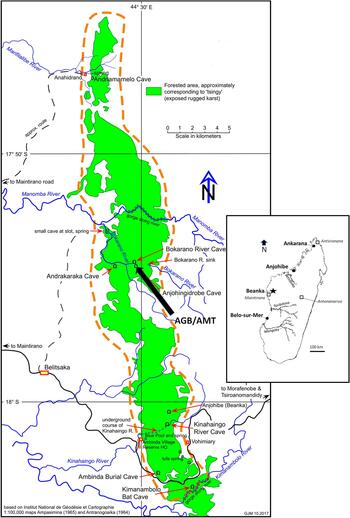
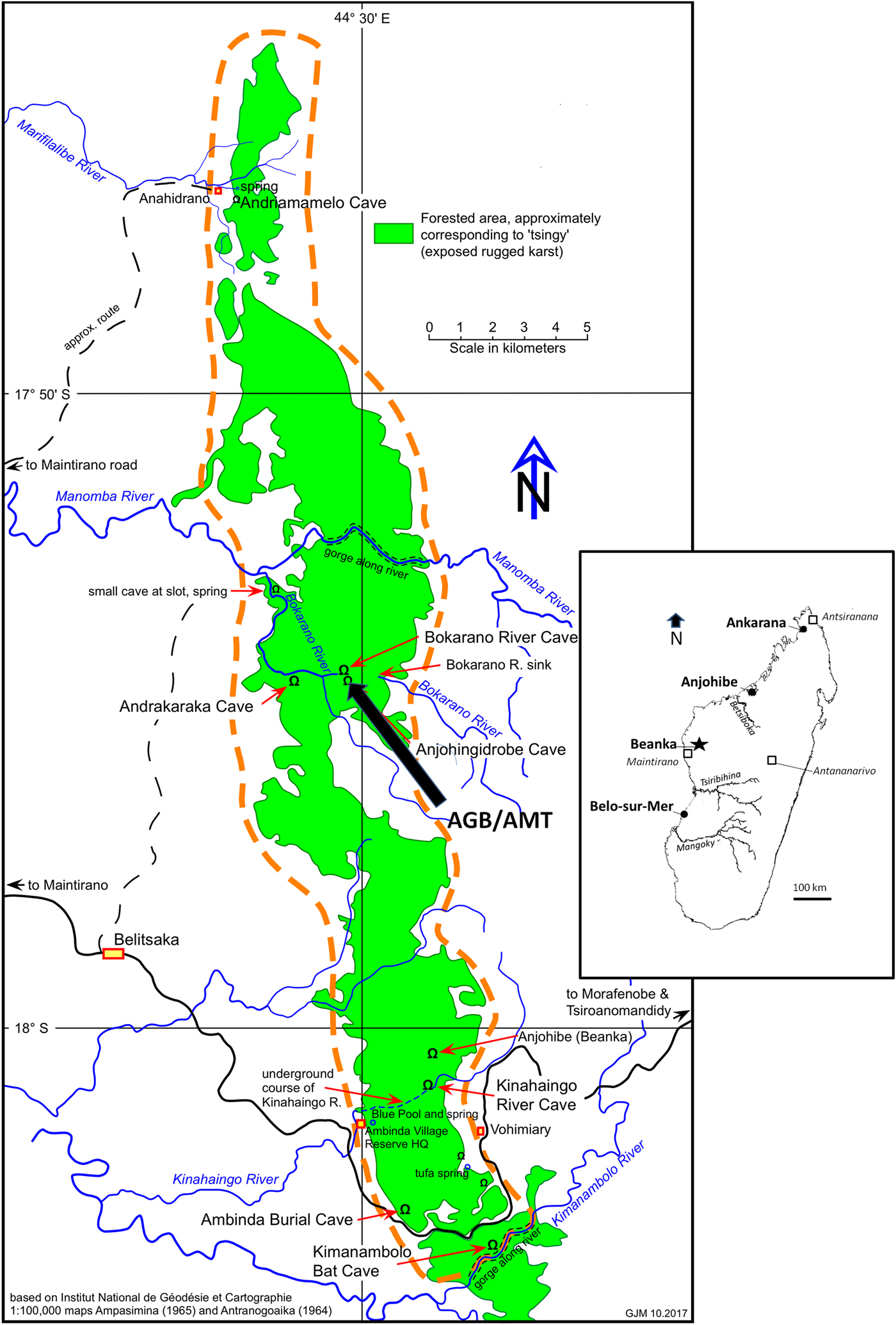
The Paysage Harmonieux Protégé de Beanka, a 17,100-ha protected area that was officially recognized on April 22, 2015, by a Malagasy government decree and is managed by Biodiversity Conservation Madagascar (BCM), is located ca. 350 km northwest of Antananarivo and 55 km east of Maintirano (Fig. 1). It is part of an extensive karst region (tsingy in Malagasy) that includes the Parc National de Bemaraha to the south, which is a UNESCO World Heritage site, and the remote Antsingimavo karst area to the north. The primary rock formation at Beanka is a Middle Jurassic limestone (Roig et al., Reference Roig, Tucker, Delor, Peters and Théveniaut2012; Crowley and Sparks, Reference Crowley, Sparks, Goodman, Raherilalao and Wohlhauser2018). Outcrops of Jurassic sandstone and shale are found along its eastern edge, and mid-Cretaceous sandstone, conglomerate, and shale flank its western edge. Within the limestone, rugged karst surface features, caves, narrow canyons, and subterranean rivers are covered in dense dry deciduous forest, thick with lianas, and more open woodlands. The nearly impenetrable nature of this landscape, combined with modern low human population densities, has resulted in limited anthropogenic pressure in this vast area, preserving natural habitats and endemic species and offering good potential for the discovery of caves containing previously untouched evidence for past life.
(color online) Large arrow indicates location of Anjohingidrobe Cave (AGB) near the center of the Beanka Protected Area in western Madagascar, at 17°54.35′S, 44°29.40′E (WGS 84) and 218 m above sea level. Anjohimaletsy (AMT) is a small fissure cave 80 m east of AGB.
The Beanka area was briefly visited by speleologists in 1996, and the group returned in 2006 for a more detailed survey that revealed several interesting caves (Middleton, Reference Middleton, Goodman, Gautier and Raherilalao2013). As in the adjacent karst areas, many caves are grikes, limestone features thought to have been formed by the solution of joints in the rock below the water table that subsequently opened to the surface (Veress et al., Reference Veress, Lóczy, Zental, Toth and Schläffer2008).
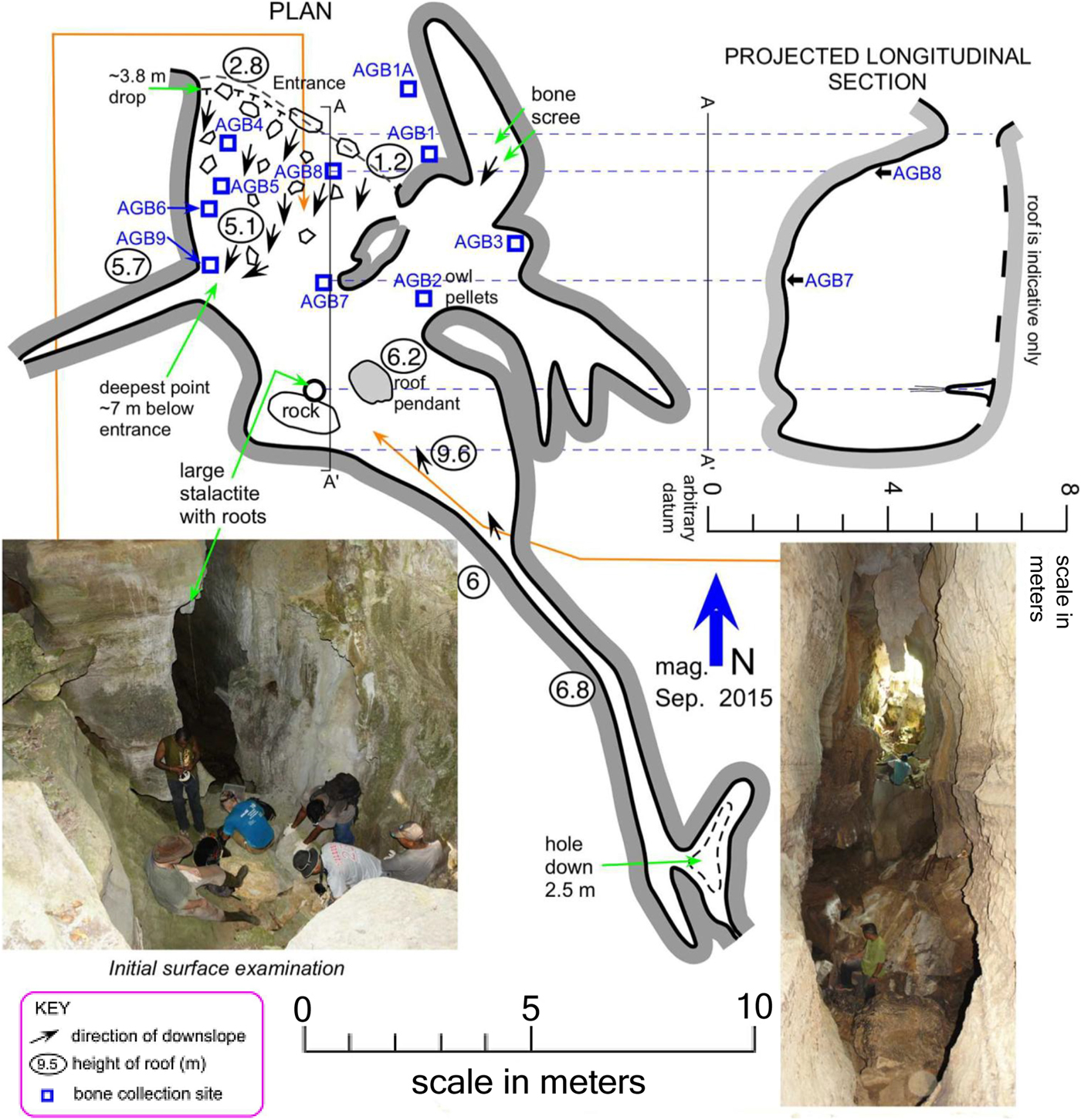
Deep in the central part of the protected area is the Bokarano River, which itself flows underground through a winding cave passage for more than 1.6 km. Near the river, but higher up the hillside, is a small nearly vertical cave (AGB) that is ideally configured to collect and preserve animal remains (Fig. 2). In 2009, BCM project manager Roger Randalana discovered the small opening and noted that many bones, some visibly larger than any of the living lemurs of the area, littered the surfaces inside. In subsequent years, AGB and a smaller fissure cave nearby (AMT) were inspected by several collaborating scientists, and plans were made, including procurement of the necessary permits, to mount an expedition primarily for the purpose of making surface bone collections, excavating test pits, and mapping the cave deposits. This work was conducted from September 5 to September 7 in 2015.
(color online) Plan map, vertical profile, and photographs of Anjohingidrobe Cave in the Beanka Protected Area. Surveyed by GJM with compass, inclinometer, and laser distance measure, September 21, 2013, and September 5, 2015.
Description of caves
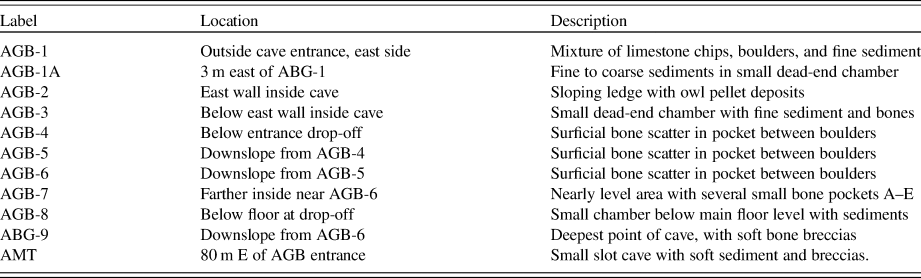
AGB has a single opening, facing northeast, about 5 m wide and varying from 1 to 3 m high, at 17°54.35′S, 44°29.40′E (WGS 84) and 218 m above sea level. Directly above the opening on the outside, there is a large rock ledge, 9.4 m above the top of the cave opening and greater than 1 m2 in area. Immediately inside the cave opening (Fig. 2), the floor drops 3.8 m; large boulders form pockets inside at succeeding depths toward the back of the main chamber, where the ceiling is generally 6 to 9 m high and stalactites extend ca. 1 m from the ceiling. Rock shelves and scree slopes typify the east wall, and two small chambers end in soft clay sediment deposits. On the west wall, the boulder slope continues into the deepest point of the cave, 7 m below the entrance. A narrow passage at the rear (south) end of the cave continues upward to end at a small hole in the floor lacking sediment. On the outside, 3 m east of the entrance, a small indentation in the rock forms a dead-end passage containing clay sediments, and similar material continues back along the cave wall westward to the cave entrance.
Sublocations within AGB
Because the cave is predominantly vertical, with no large areas of horizontal or near-horizontal floor, it was necessary to distinguish bone accumulations in and near the cave by separate sublocation numbers, rather than a grid reference. These are noted in Figure 2, and Table 1 summarizes the characteristics of each sublocation. ABG-1 is the sediment layer immediately east of the cave entrance. Where this rock wall enfolds to produce a small alcove, surface material and sediments were sublocated as AGB-1A. Proceeding into the main cave, a small ledge on the east wall inside is covered with a slope of fine debris (ABG-2). Directly below on the cave floor, a dead-end chamber descends farther under the east wall and is partially filled with soft clay sediment (AGB-3). Returning to the entrance, small pockets of bone-rich debris and sediment have accumulated at the base of the 3.8 m entrance drop, in a series of steps downward (AGB-4, AGB-5, and AGB-6). Immediately below AGB-5 and AGB-6 on the southward slope going back into the cave is a larger area of uneven topography, composed of large stones interspersed with bone-rich debris and sediment. This is the very productive sublocation AGB-7. Beneath the uneven floor of the cave near the entrance, there is a small chamber containing sediments with bones (AGB-8). On the opposite (west) wall of the cave, the cave floor descends to its lowest depth below the entrance at −7 m. There is a lag concentrate of darkly stained bones and fine limestone chips in this deepest pocket, in places lightly cemented into a breccia (AGB-9).
Characteristics of sublocations.

AMT, at 17°54.35′S, 44°29.41′E, is a small fissure cave, or slot cave, about 80 m east of AGB, at approximately the same elevation. The entire floor comprises only about 1 m2 of sediment. At the back of the small cave is a narrow solution pit that descends another ca. 5 m.
Bone extraction
At each sublocation inside AGB, the bone surface scatter was described and photographed with orientation and scale, and larger bones were then picked up individually and packed in labeled plastic bags or boxes. The smaller bones were placed in labeled containers along with all associated sediment and detritus and were removed from the cave for sifting. After removal of a layer of large bones and the associated fines down to ca. 10 cm, the sublocation was rephotographed and all the remaining material taken out down to another 10 cm if that much was available. Most of these bone pockets, however, were very shallow, ending at bare rock in 10 cm or less.
Excavation
Two sublocations (AGB-3 and AGB-8) contained deeper sediments. AGB-3 was excavated in 10 cm levels down to rock at 50 cm in a ca. 1.0 m2 floor surface, and excavated sediment was carried outside for sifting. Excavation was undertaken with bare hands and small plastic tools, taking care to avoid contact that might damage the bones. AGB-8 was left intact for future research options. Only the visible remains on or within 10 cm of the surface were collected.
Outside the cave along the wall east of the entrance (AGB-1) and in the adjacent small chamber (AGB-1A), a mixture of boulders, limestone breakdown, and clay was excavated down to rock base. Sediments were removed in approximately 10-cm levels, large bones were packed and labeled, and all fines were sifted. Small metal tools were used in the hard stony material.
At AMT, surface bones were collected and loose breccia was excavated to 50 cm depth from the narrow floor (with some careful use of metal tools to dislodge crusts). This material was disaggregated and sifted.
Sifting and cataloging
Fine material collected from the surface or excavated from deeper layers was dry-screened through mesh down to 3 mm, and all biological materials were picked, sorted, and labeled. Each accessioned specimen container was labeled with sublocation and depth in sediment (0 cm or 0–10 cm for materials on bare surface or embedded in surface material, respectively). In sublocation AGB-7, because of its uniformity and larger size compared with other sublocations, labels for individual pockets of bone received a letter subscript (A through E). The fossils were divided, accessioned, and cataloged by the Université d'Antananarivo (UA) and the Field Museum of Natural History (FMNH) in Chicago.
Fossil analyses
Sediment samples from AGB-1 and AGB-3 were processed for pollen and microscopic charcoal analysis at the University of Amsterdam following methods described in De Boer et al. (Reference De Boer, Hooghiemstra, Florens, Baider, Engels, Dakos, Blaauw and Bennett2013), including a heavy liquid separation using a bromoform-ethanol mixture. Microfossil slides were examined for pollen, spores, and charcoal at 400× and 1000× oil immersion under a light microscope. Bones collected were identified by direct comparison to reference materials housed primarily in the collections of UA and FMNH, with reference in some cases to other extensive collections (listed in the “Acknowledgments”).
Isotopic analysis and radiocarbon dating
Approximately 200 mg of bone fragments were removed from each of 25 specimens chosen for dating, using tin snips. Specimens were included from all sublocations. Roughly 200 mg of each specimen was processed for radiocarbon and stable carbon (δ13C) and nitrogen (δ15N) isotope analysis. Collagen was isolated following methods modified from Fox-Dobbs et al. (Reference Fox-Dobbs, Leonard and Koch2008) and Sparks and Crowley (Reference Sparks and Crowley2018). Samples were demineralized in 0.5 N hydrochloric acid at 4°C and rinsed five times with ultrapure water. They were then soaked in 0.01 N sodium hydroxide for 2 hours to remove humic acids, rinsed five times with ultrapure water, and lyophilized. Samples were gelatinized in 0.01 N hydrochloric acid at 80°C for 15–17 hours. To maintain acidity, 100 μl of 0.1 N HCl were added after several hours (Ambrose Reference Ambrose1990). Samples were then filtered through 1.5 μm glass-fiber filters and lyophilized.
Approximately 0.3 mg of dried collagenous residue from each sample were weighed into tin boats. Stable isotope and elemental concentration data were analyzed on a Costech Elemental Analyzer connected to a ThermoFisher Delta V Isotope Ratio Mass Spectrometer via a Conflo IV in the Stable Isotope Biogeochemistry Laboratory at the University of Cincinnati. Isotope data were normalized for size (linearity), drift, and scale (Coplen et al., Reference Coplen, Brand, Gehre, Gröning, Meijer, Toman and Verkouteren2006; Skrypzpek Reference Skrypzpek2013). We used an internal reference material (caffeine) for linearity and drift, and we used caffeine and USGS 41 l-glutamic acid for scale. Analytical precision, which was calculated using caffeine, USGS 41, and two independent internal reference materials (glycine and gelatin), was ± 0.15‰ and ± 0.09‰ for carbon and nitrogen, respectively. Sample preservation was assessed using visual observation (including bone strength and coloration), collagen yield, and atomic C:N ratios. Only eight samples yielded C:N ratios between 2.9 and 3.6. These were deemed sufficiently robust and were selected for radiocarbon dating (Ambrose, Reference Ambrose1990).
Samples were dated in the W. M. Keck Carbon Cycle Accelerator Mass Spectrometry (AMS) Laboratory at the University of California, Irvine, and the Center for Accelerator Mass Spectrometry at Lawrence Livermore National Laboratory. Conventional radiocarbon age estimates were based on a 5568 yr half-life, 13C corrected, and include a background subtraction based on simultaneously prepared modern and 14C-free bone standards.
Two additional AMS radiocarbon dates obtained from Beta Analytic were supplied by Steven Goodman from sublocation AGB-1. This lab's methods differ slightly from those outlined earlier (Hood, D., personal communication). The bone samples were washed with deionized water, the outermost layers of their surfaces were scraped free, and then the samples were gently crushed. Dilute, cold HCl was repeatedly applied and replenished until the mineral fraction was eliminated. The demineralized bone was then dissected and inspected for rootlets. Any rootlets present were also removed when replenishing the acid solutions. Collagen residue was then pretreated with NaOH to ensure the absence of secondary organic acids.
Radiocarbon dates were converted to calendar years (cal yr BP) using Calib 7.1 and the ShCal13 calibration curve (Stuiver and Reimer, Reference Stuiver and Reimer1993; Hogg et al., Reference Hogg, Hu, Blackwell, Niu, Buck, Guilderson and Palmer2013). Resulting 2σ-calibrated age ranges were rounded to the nearest 5-yr interval.
Seven of the dated samples were also processed for strontium isotope (87Sr/86Sr) analysis. Roughly 20 mg were pulverized using an agate mortar and pestle and chemically pretreated following Crowley and Wheatley (Reference Crowley and Wheatley2014). Samples were soaked in 30% H2O2 at room temperature for 72 hours (liquid was refreshed after 24–48 h) and rinsed five times with ultrapure water. They were then soaked in 1 M acetic acid buffered with calcium acetate at 4°C for 24 hours, rinsed five times with ultrapure water, and lyophilized. Samples were analyzed in the Multicollector ICPMS Laboratory in the Department of Geology at the University of Illinois, Urbana–Champaign. Strontium was isolated by dissolving 3–5 mg of each sample in 0.5 ml of 3 N H2NO3 and filtering the dissolved sample through 0.2 ml of Eichrom strontium-specific resin in Teflon cation-exchange columns. Samples were then eluted with 0.05 N H2NO3 into 4 ml autosampler vials and analyzed on a Nu Plasma HR Multi-collector inductively coupled plasma mass spectrometer. Data were corrected for mass bias fractionation using an internal normalization (86Sr/88Sr = 0.1194) and normalized using international standard NBS 987 and two internal laboratory standards (“E & A” and South China Sea Coral). Precision for all analyses was ±0.0005.
RESULTS
The sediments that have accumulated on the east side of the cave entrance at sublocation AGB-1 are a mixture of cobbles, angular limestone fragments spalled off the cave wall, and well-preserved bones. Pollen, spores, and charcoal are preserved in the finer component of the sediments. However, large pieces of rock that have fallen off the wall above have disturbed the stratigraphy here. Sediments are also penetrated by roots and bioturbated by soil invertebrates and rodents. From 0 to 50 cm, a 0.5 m2 test pit revealed pale brown silty clay (Munsell color 10YR 6/3) with stones of gravel to cobble size and one small boulder. At 50 cm, we found two small light gray sherds of thin, burnished pottery with triangles around the rim, probably part of a hole-mouth jar. They have a relatively fine clay body with sandy inclusions, fired in a reducing atmosphere. Around the rim are large impressed triangles alternating in a false-chevron design. This is a well-known and well-dated early west coast pottery type of the Kingany phase, found in village sites on the central west coast of Madagascar and dated between AD 1350 and AD 1550 (Wright et al., Reference Wright, Vérin, Ramilisonina, Burney, Burney and Matsumoto1996; also see figs. 103 and 104 in Vérin, Reference Vérin1975). The sherds were collected with some small charcoal fragments in apparent association.
Excavation was stopped at this level, as only friable limestone was detected below. One large stone was removed, with a small amount of sediment underneath, including two oval objects 20 mm × 15 mm, made of very fine organic material. These are likely to be coprolites of a large primate. They are similar to Archaeolemur coprolites described from caves in northwest Madagascar (Burney et al., Reference Burney, James, Grady, Rafamantanantsoa, Ramilisonina, Wright and Cowart1997; Vasey et al., Reference Vasey, Burney, Godfrey, Masters, Gamba and Génin2013) but differ in being finer textured and lacking any macroscopic animal or plant remains.
About 2 m north of AGB-1, a second 0.5 m2 test pit, AGB-1A, was excavated in the floor of a small overhang. From 0 to 30 cm, the matrix was light reddish-brown (5YR 6/4) silty clay containing bones, land-snail shell fragments, and one pottery sherd of a local type of unknown age. At 30 cm there is a discontinuous 2-cm band of dark brown (7.5 YR 3/4) humic silt. Below this level, from 32 to 45 cm is reddish-brown (7.5YR 4/4) silty clay, resting on limestone.
Inside the cave entrance, surface bone scatters extend from AGB-4 just below a steep drop-off to successively lower levels at AGB-5, AGB-6, AGB-7, and AGB-9. The distributions of animal long bones show no strong patterns, instead following the contours of the spaces between other bones and the enclosing rocks. No articulated bones were observed. Smaller bones were mixed with sediment and plant detritus. Tan-colored crusts, generally <1 cm thick and 2–5 cm across, were scattered among these bones. They are currently under study as possible raptor coprolites, as they are similar to deposits often observed beneath raptor nests. No pottery or other human evidence was recovered from these surface scatters, although some bones from different parts of the cave are under study for evidence of butchery. Tooth marks are not abundant on this material, but where present appear to be postmortem rodent chewing. Evidence for scavenging by snails was also noted, in the form of shallow sinuous channels on some bone surfaces.
Beneath the floor of the uppermost bone scatters, there is a small chamber (AGB-8) with access from the east side. It contains sediment similar to that of the excavated sites, but was left intact for future research.
Inside the cave, on a sloping shelf along the east wall (AGB-2), a bone deposit was collected from the surface that appears to be, at least in part, a debris cone made up of dissociated owl pellets, based on the occurrence of bones of many small prey items and a lack of tooth marks. Approximately 5 m below this shelf at the base of the wall, an excavation was conducted in soft sediment inside a small lateral passage (AGB-3). A 1-m2 pit was excavated down to the limestone floor at 50 cm, following the contour of natural layers. Sediments were a uniform light reddish-brown (7.5YR 6/4) silty clay, with well-preserved bones scattered throughout. Pollen preservation in these sediments is poor, although microscopic charcoal particles are abundant and fungus spores are present.
The test pit from AMT yielded sediment that was a partly consolidated light reddish-brown (7.5YR 6/4) silty-clay breccia. A few bones of all sizes occurred from the surface down to the limestone floor at ca. 50 cm depth.
Faunal remains
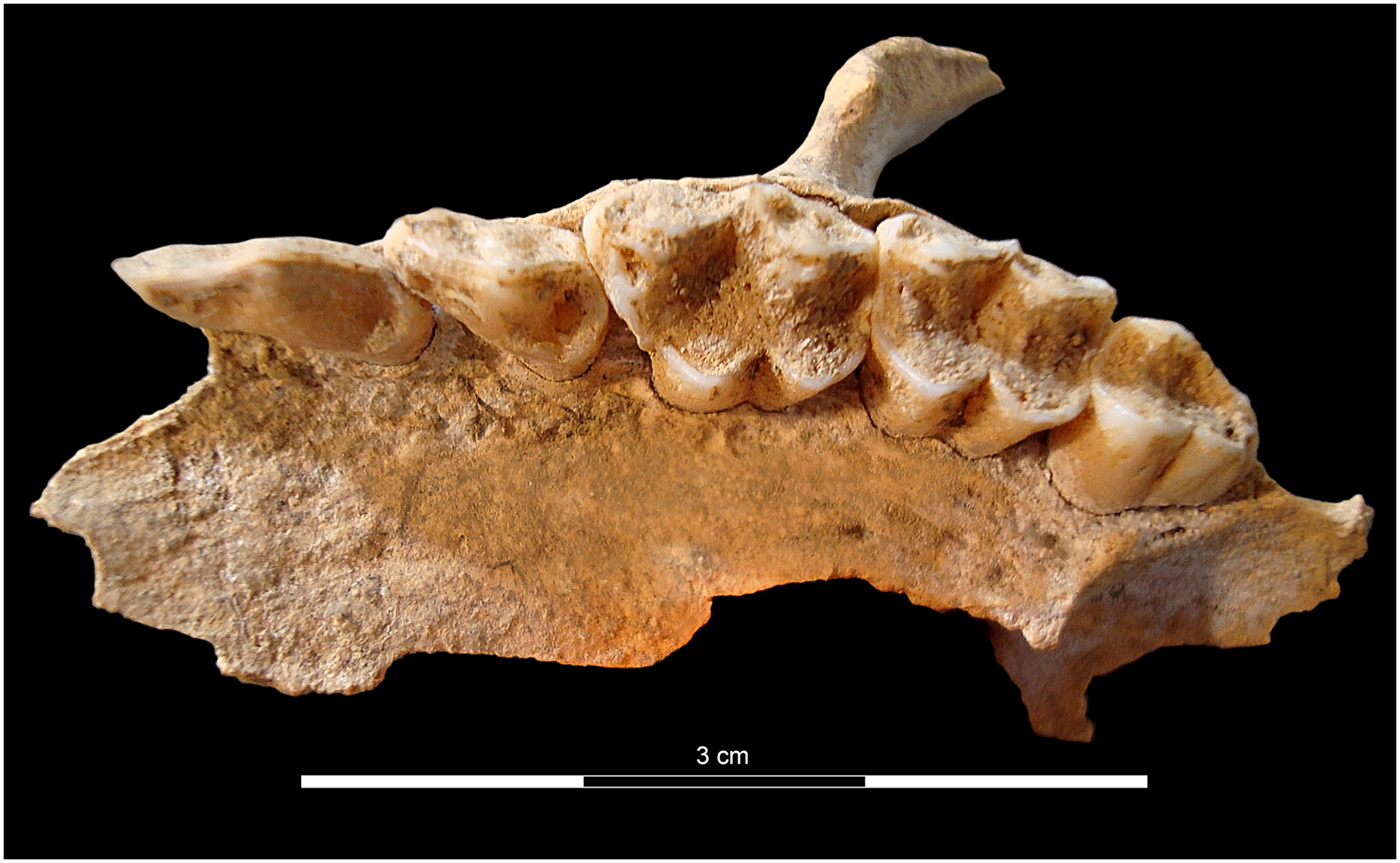
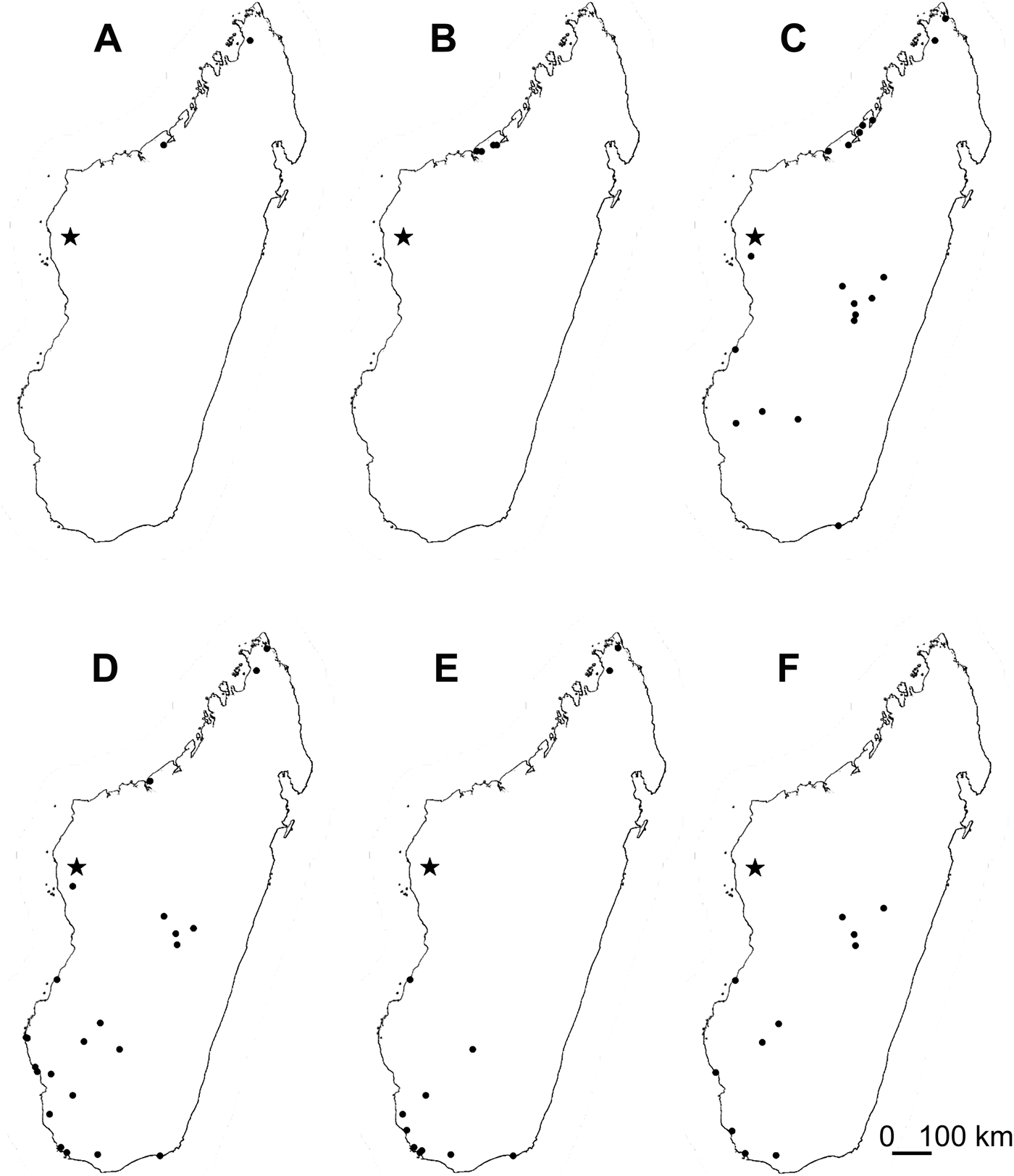
Six species of extinct large mammals and one extinct bird have been identified to date in the bone assemblages from AGB and AMT (Table 2), including four species of large-bodied extinct lemurs. These deposits are dominated by specimens of Babakotia radofilai (Fig. 3), and represent a considerable southwesterly range extension for this medium-sized sloth lemur. Remains of Palaeopropithecus kelyus also indicate significant range extensions for this highly suspensory large lemur. Both B. radofilai and P. kelyus were previously known from clusters of cave sites in the western dry forests near Mahajanga; Babakotia is also known from caves in the extreme north (the Ankarana Massif), just south of Antsiranana (Fig. 4, Table 3).
(color online) Left maxilla of Babakotia radofilai from Anjohingidrobe Cave, site AGB-1 (outside the cave entrance on the east side), FMNH PM 70197, showing full adult postcanine dentition (two premolars and three molars) in occlusal view.

Previously known fossil occurrences of extinct species on Madagascar (dots) in relation to the Beanka Protected Area (star). (A) Babakotia radofilai; (B) Palaeopropithecus kelyus; (C) Archaeolemur edwardsi; (D) Pachylemur sp.; (E) Cryptoprocta spelea; (F) Plesiorycteropus spp. See Table 3 for details.

Vertebrates identified from bones found in Anjohingidrobe and Anjohimaletsya.

a Symbols: *, Introduced to Madagascar; †, extinct; ‡, believed extinct in western Madagascar.
Previously known distribution of extinct vertebrate species from Beanka.a

a See Godfrey and Jungers (Reference Godfrey, Jungers and Hartwig2002), Goodman and Jungers (Reference Goodman and Jungers2014),and Meador et al. (Reference Meador, Godfrey, Rakotondramavo, Ranivoharimanana, Zamora, Sutherland and Irwin2019) for biogeographic references. See Fig. 4 for mapped occurrences.
Archaeolemur edwardsi (Fig. 5) was previously known from a broad array of sites and habitats (Table 3), ranging from the extreme north to the Central Highlands and dry west, but there are no prior records of Archaeolemur in the Beanka or Bemaraha regions. Pachylemur is difficult to assess, because species allocations of this broadly distributed genus need reevaluation (Godfrey and Jungers, Reference Godfrey, Jungers and Hartwig2002; Godfrey et al., Reference Godfrey, Jungers, Burney, Werdelin and Sanders2010). Populations are known from a wide range of habitats, including dry spiny forest, succulent woodland, central mosaic, and western dry forest; again, there are no prior records from the Beanka region or nearby (Fig. 4, Table 3).
(color online) Left maxilla of Archaeolemur edwardsi from Anjohingidrobe Cave, site AGB-8 (below the floor at a drop-off), FMNH PM 70196, showing full adult dentition (two incisors, canine, three premolars, and three molars) in lateral view.

Two other extinct mammals identified among the recovered fossils were the large carnivoran Cryptoprocta spelea (family Eupleridae) and the aardvark-like Plesiorycteropus sp. (tentatively placed in the order Afrosoricida). These findings represent yet another significant range expansion, as C. spelea was previously known primarily from sites in the dry spiny thicket, the succulent woodlands, and the southern part of the western dry forest. It was rare in the Central Highlands (Fig. 4, Table 3). Plesiorycteropus was previously known from a wide variety of habitats, including dry spiny forest, central mosaic, and western dry forest in the northwest (near Mahajanga) as well as the central west (Belo-sur-Mer), but it was not previously recorded at sites close to Beanka (Fig. 4). Finally, we have recovered remains of a large extinct terrestrial bird, referable to the genus Coua (family Cuculidae).
Two extant species that are regionally extirpated were discovered in the faunal remains: the critically endangered greater bamboo lemur Prolemur (= Hapalemur) simus and Eulemur mongoz. Beanka falls well outside P. simus’s modern range in eastern rain forests (Wright et al., Reference Wright, Johnson, Irwin, Jacobs, Schlichting, Lehman and Louis2008) but within the geographic envelope of other fossil sites that have yielded remains from this species (Muldoon et al., Reference Muldoon, Crowley, Godfrey and Simons2017). This species has been previously recorded in subfossil deposits of the Bemaraha Massif, just south of the Beanka Protected Area (Godfrey et al., Reference Godfrey, Simons, Jungers, DeBlieux and Chatrath2004). Prolemur simus appears to have had a past distribution similar to that of A. edwardsi, through the Central Highlands and the western dry forests of the extreme north and northwest. Eulemur mongoz no longer lives at Beanka, although it occurs today at Anjamena near the Betsiboka River (Dammhahn et al., Reference Dammhahn, Markolf, Lührs, Thalmann, Kappeler, Goodman, Gautier and Raherilalao2013), where it is sympatric with Eulemur rufus, and also east of the Betsiboka.
Bones of eight additional primate taxa were identified, almost all of which are still extant in the Beanka forests (Dammhahn et al., Reference Dammhahn, Markolf, Lührs, Thalmann, Kappeler, Goodman, Gautier and Raherilalao2013). These include some widespread taxa, such as the “eastern” lesser bamboo lemur Hapalemur cf. griseus, the fat-tailed dwarf lemur Cheirogaleus medius, and an undescribed species of Cheirogaleus with a wide geographic distribution in western Madagascar (Dammhahn et al., Reference Dammhahn, Markolf, Lührs, Thalmann, Kappeler, Goodman, Gautier and Raherilalao2013). There are also some rare taxa, including some species endemic only to the zone between the Tsiribihina and Betsiboka Rivers (e.g., Avahi cf. cleesei, Propithecus deckenii, and Lepilemur cf. randrianasoloi).
Unlike most subfossil sites elsewhere in Madagascar (Goodman and Jungers, Reference Goodman and Jungers2014), this site produced no remains of ratites or hippopotami. Crocodiles are present today just a few hundred meters downslope from the caves in the adjacent Bokarano River, but thus far we have not identified any crocodile remains. The subfossil cave sites are situated in sharp limestone tsingy and a tangle of huge vines high above the river. Given the location of the site on an upland forest slope, we did not expect to find crocodile bones, although we did recover bones of a freshwater turtle, the Madagascan big-headed turtle (Erymnochelys madagascariensis). It is critically endangered; whereas it occurs in the region today, it is rare because it is exploited by humans. Bones of a small tortoise, the spider tortoise (Pyxis sp.), were also found, well outside the modern range in southwestern Madagascar. As turtles and tortoises are unlikely to negotiate such rugged terrain, they were probably transported to the site by humans or other predators. We also found skeletal material belonging to an unidentified frog and a fish scale gecko (Geckolepis sp.).
Extant species in the subfossil deposits include, in addition to the four herpetofaunal species mentioned earlier, a total of 12 birds, 4 rodents (Eliurus spp.), 4 tenrecs, 8 bats, and 4 carnivorans. The extant birds include two predatory species [probably Madagascar buzzard (cf. Buteo) and Madagascar sparrowhawk (cf. Accipiter madagascariensis)] and two extant couas. The tenrecs include a species, Microgale talazaci (Talazac's shrew tenrec), that lives today in the eastern rainforest and was previously entirely unknown in dry western forest habitats. Work on these assemblages indicates that within AGB, AGB-2 (inferred to contain dissociated owl pellets) was especially rich and diverse in microfauna. The small slot cave (AMT) sampled faunal elements at lower rates than the larger AGB, although the species lists for AGB and AMT were similar.
Temporal trends
We successfully obtained radiocarbon dates for 10 specimens: seven from Babakotia and three from Archaeolemur (Table 4). Extreme care was taken, through attention to provenance by sublocation and recording the skeletal element used, to avoid sampling the same individual twice. Combined calibrated radiocarbon dates (2σ) ranged from ca. 1305–2855 cal yr BP for Archaeolemur and ca. 960–2015 cal yr BP for Babakotia. Five of the Babakotia have ages that are ca. 1000 cal yr BP. These are among the most recent ages reported for extinct megafauna on the island (Simons et al., Reference Simons, Burney, Chatrath, Godfrey and Rakotosamimanana1995; Simons, Reference Simons, Goodman and Patterson1997; Burney et al., Reference Burney, James, Grady, Rafamantanantsoa, Ramilisonina, Wright and Cowart1997, 2004; Crowley, Reference Crowley2010; Crowley et al., Reference Crowley, Godfrey, Bankoff, Perry, Culleton, Kennett, Sutherland, Samonds and Burney2017).
Radiocarbon dates and isotopic data for extinct lemur bones from Anjohingidrobe and Anjohimaletsy.

a Calibrated using 2σ ranges in Calib 7.1 (Stuiver and Reimer Reference Stuiver and Reimer1993; Hogg et al. Reference Hogg, Hu, Blackwell, Niu, Buck, Guilderson and Palmer2013). Age ranges rounded to nearest 5 yr.
b Beta Analytic δ13C determinations were excluded from regression analysis in Fig. 6, as the methods differed in some particulars (see “Location and Methods”).
c Analytical error was ± 0.00005 for all specimens.
Isotopic trends
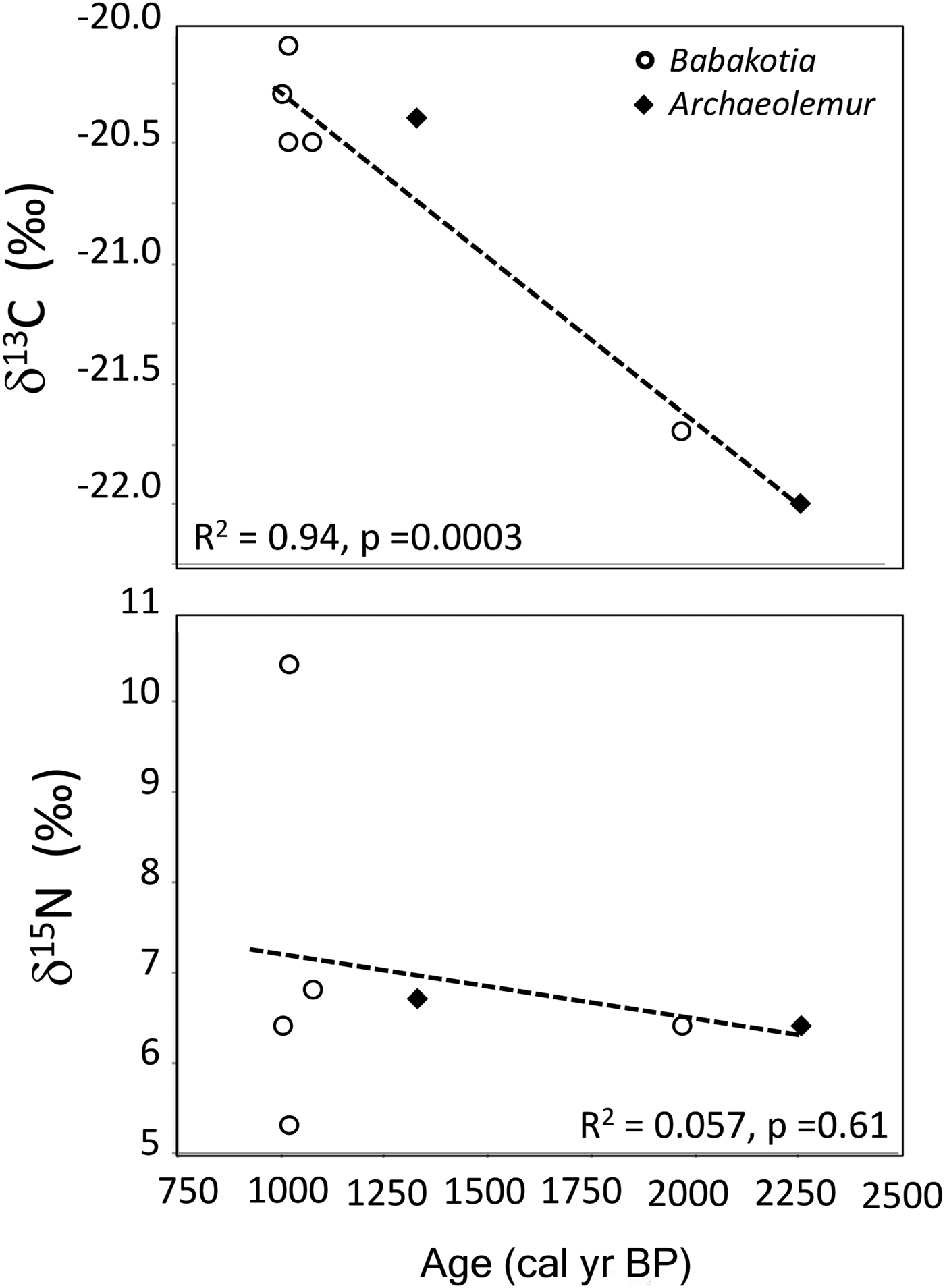
Carbon isotope data are similar for Babakotia and Archaeolemur, and range less than 2‰ for both taxa (Table 4). Assuming a collagen-diet offset of 5‰ (Koch, Reference Koch1998), and correcting for isotopic shifts in atmospheric CO2 over time (ca. −1.2‰ in the Southern Hemisphere; Keeling et al., Reference Keeling, Piper, Bollenbacher and Walker2010; Crowley et al., Reference Crowley, Godfrey, Guilderson, Zermeño, Koch and Dominy2012), carbon isotope data suggest that both taxa consumed C3 vegetation and inhabited a relatively arid habitat similar to modern dry forest and scrub in western Madagascar (Crowley et al., Reference Crowley, Thorén, Rasoazanabary, Vogel, Barrett, Zohdy and Blanco2011). There is a strong correlation (R 2 = 0.93, P < .001, n = 8) between δ13C values and time (Fig. 6). This isotopic trend may reflect late Holocene habitat changes, for instance, from precipitation changes or a slight opening of the habitat between 2000 and 1000 yrs ago. However, if this were the case, we would also expect a temporal shift in δ15N values, which we do not observe (see following paragraph). High-resolution δ18O records from speleothems in Anjohibe Cave north of Beanka also show relatively little climate change during this period and no simple unidirectional trend (Scroxton et al., Reference Scroxton, Burns, McGee, Hardt, Godfrey, Ranivoharimanana and Faina2017; Wang et al., Reference Wang, Brook, Burney, Voarintsoa, Liang, Cheng and Edwards2019). Another possible explanation for the observed isotopic trend is that it reflects a gradual behavioral change, such as animals feeding higher in the canopy over time. Such a behavioral shift might be expected if these lemurs were increasingly threatened by ground predators, such as humans, or adjusting to some change in forest structure.
Linear regression plots of δ13C vs. age and δ15N vs. age for bones of extinct large lemurs from Beanka caves.

Nitrogen isotope (δ15N) data are considerably more variable. Whereas the two Archaeolemur individuals have δ15N values between 6.4‰ and 6.7‰, values for Babakotia range from 5.3‰ to 10.4‰ (Table 4). Unlike carbon isotope data, nitrogen isotope values show no clear chronological trend (Fig. 6). Both Archaeolemur individuals and the oldest Babakotia individual have δ15N values between 6‰ and 7‰; the large range in δ15N values is only observed in the five Babakotia measured for δ15N that are younger than 1200 cal yr BP. This could indicate differences in dietary breadth among individuals, differing habitats, or differing locations. With the exception of a single sample from AGB-7D, strontium isotope ratios vary little (Table 4), suggesting that most individuals lived on the same geological substrate.
DISCUSSION
Radiocarbon dates obtained for Beanka subfossil material so far suggest that elements of the local fauna, notably large extinct lemurs, were deposited into the pit below the cave entrance over approximately the last three millennia. Babakotia was still present a millennium ago, well after humans began colonizing the island. Based on just ten 14C determinations, it is too early to specify the entire time range that this site has been sampling the local fauna or when Babakotia became locally extinct. However, on the basis of collagen preservation, we can speculate that the bone deposits may span considerably more than 3000 yrs. Of 27 bones tested, only 10 yielded collagen deemed suitable for dating. The deepest sublocation, AGB-9, contained bones that were heavily mineral stained and in some cases encrusted in weakly cemented breccias. The two bones from this unit that were tested lacked collagen, as did some bones from other sublocations such as AGB-7 directly above. It is possible that these are significantly older bones, or merely that collagen preservation conditions are not as good in the deeper and more alkaline parts of the cave.
AGB appears to be an active bone accumulation site today, and the faunal list (Table 2) contains undated bones of many smaller species found in good condition in surface deposits inside the cave. Six species were identified that are believed to have been introduced by humans (Numida meleagris, Potamochoerus larvatus, Felis lybica, Viverricula indica, Mus musculus, and Rattus rattus), but the dates of these introductions to Beanka are not constrained. There is also some fragmentary material that may be goat (Capra aegagrus hircus). Only further dating of specimens believed to be relatively recent on the basis of stratigraphic position and preservation will confirm whether the large extinct lemurs, such as Babakotia, indeed declined locally sometime around 1000 yrs ago, or more recently. In any case, the dates from Beanka are far more recent than the single mid-Holocene date obtained for this taxon previously from Ankarana (Simons et al., Reference Simons, Burney, Chatrath, Godfrey and Rakotosamimanana1995) and add to late dates previously obtained for Archaeolemur, Daubentonia robusta, Pachylemur, Megaladapis, and Palaeopropithecus (Simons, Reference Simons, Goodman and Patterson1997; Burney et al., Reference Burney, Burney, Godfrey, Jungers, Goodman, Wright and Jull2004; Crowley, Reference Crowley2010; Crowley et al., Reference Crowley, Godfrey, Bankoff, Perry, Culleton, Kennett, Sutherland, Samonds and Burney2017). The scarcity of pottery and other human evidence in the cave vicinity suggests only occasional human presence over the centuries. Cuts and chop marks on some bones recovered are under study, but none of the sublocations described contained a concentration of bones, pottery, or charcoal that could be attributed exclusively to human activity.
The late occurrence of Babakotia at this site is consistent with extinction hypotheses such as synergy (Burney, Reference Burney and MacPhee1999; Burney et al., Reference Burney, Robinson and Burney2003) and subsistence shift (Godfrey et al., Reference Godfrey, Scroxton, Crowley, Burns, Sutherland, Pérez, Faina, McGee and Ranivoharimanana2019) that predict local extinctions may lag behind the more general trend in isolated pockets where human impacts are delayed by local conditions. Likewise, these results showing late survival contradict any hypothesis that predicts rapid island-wide extinction, such as blitzkrieg (Martin, Reference Martin, Martin and Klein1984) and hypervirulent disease (MacPhee and Marx, Reference MacPhee, Marx, Goodman and Patterson1997). The date of human arrival to Madagascar has been regarded in recent decades to have been ca. 2.5 ka BP (Burney et al., Reference Burney, Burney, Godfrey, Jungers, Goodman, Wright and Jull2004; Crowley, Reference Crowley2010), but more recent estimates have ranged from as early as ca. 11 ka BP (Hansford et al., Reference Hansford, Wright, Rasoamiaramanana, Pérez, Godfrey, Errickson, Thompson and Turvey2018) to as late as AD 700 (Anderson et al., Reference Anderson, Clark, Haberle, Higham, Nowak-Kemp, Prendergast and Radimilahy2018). Regardless of the chosen scenario, however, the Beanka sites support the notion that some large lemurs survived for at least a few centuries or more after human arrival.
There is no current or recent evidence for the use of the site as a large mammalian carnivore lair. Owls continue to use the ledges inside and outside the cave, but no fresh mammalian scat was found in the surface material and sifted sediment, and only a few bones showed tooth marks. The only definite subfossil coprolites were two that appear to be fine-textured dung from a large lemur. Ancient DNA testing is inconclusive so far as to whether these are, as we hypothesize, from Babakotia. Ancient DNA testing has also been inconclusive thus far regarding the material collected as possible subfossil scatological evidence for eagles or other large raptors.
Paleoecological and biogeographic inferences
The major factors affecting vertebrate species distributions in Madagascar continue to be debated (e.g., Vences et al., Reference Vences, Wollenberg, Vietes and Lees2009; Ganzhorn et al., Reference Ganzhorn, Wilmé, Mercier and Scales2014). Robert Martin (Reference Martin1972) suggested that large perennial rivers are primary among them. Other important factors include ecogeographic constraints such as variation in rainfall, temperature, and habitat (e.g., Albrecht et al., Reference Albrecht, Jenkins and Godfrey1990; Yoder and Heckman, Reference Yoder, Heckman, Lehman and Fleagle2006) and watershed boundaries (Wilmé et al., Reference Wilmé, Goodman and Ganzhorn2006). On the basis of their review of the geographic distributions of extant species, Wilmé et al. (Reference Wilmé, Goodman and Ganzhorn2006) identified Melaky (the biogeographic region in which Beanka falls) as one of several centers of exceptional microendemism in Madagascar today. They suggested that such “centers of high microendemism” owe their existence to climatic fluctuations, which affect riverine forests differently, depending on whether the river sources are at lower or higher elevations. Watersheds with river sources at lower elevations are more easily isolated during periods of high aridity, and these therefore become centers of unusual microendemism. Subfossil deposits may hold the key to a better understanding of this and other isolating mechanisms. They can reveal past corridors of dispersal for species on Madagascar, how climate fluctuations relate to the expansion and contraction of forests and other types of habitat, and how these in turn help to explain the current distribution of species (Burney et al., Reference Burney, James, Grady, Rafamantanantsoa, Ramilisonina, Wright and Cowart1997; Muldoon et al., Reference Muldoon, de Blieux, Simons and Chatrath2009).
The Beanka Protected Area lies within the low-elevation center of microendemism bordered by the Tsiribihina River to the south and the Betsiboka River to the north and east. Some extant vertebrates in this region, including some primates, have been shown to conform to the expectations of the centers-of-endemism hypothesis (Wilmé et al., Reference Wilmé, Goodman and Ganzhorn2006), but the pattern is by no means universal (see Dammhahn et al., Reference Dammhahn, Markolf, Lührs, Thalmann, Kappeler, Goodman, Gautier and Raherilalao2013). Similarly, our review of subfossils at Beanka supports the notion that the isolation of the low-elevation watersheds due to fluctuations in climate may not have been the dominant force shaping faunal compositions in this region in the past. Most of the taxa that we documented are western in character, but many are not limited in geographic range to the center of microendemism bounded by the Tsiribihina River to the south and the Betsiboka River to the north. Some were distributed broadly across the dry deciduous (“western”) forests, some from the northernmost tip of Madagascar to the Mangoky River, and some even south of the Mangoky, into the dry spiny bush. Some ranged into the mosaic habitats of the Central Highlands, suggesting greater tolerance of high elevation and perhaps cold temperatures. Some likely depended on particular resources (e.g., species of bamboo) that were undoubtedly far more abundant across northern, central, and western Madagascar in the past than they are now. Finally, it is possible that moist forested corridors once crossed the Central Highlands, at least intermittently, and connected the forests of the east and the forests of the Tsiribihina–Betsiboka interriver zone in the west (Godfrey et al., Reference Godfrey, Jungers, Simons, Chatrath, Rakotosamimanana, Rakotosamimanana, Rasamimanana, Ganzhorn and Goodman1999).
Based on the faunal composition of the AGB and AMT localities, it is likely that the late Holocene environment of Beanka was very similar to the environment of today in terms of floristic composition and climate. The paleohabitat at Beanka supported extinct lemurs that probably spent most of their time in trees, such as sloth lemurs. Archaeolemur has been identified as the most likely of the extinct large lemurs to have been comfortable in a wide variety of habitats, spending considerable time on the ground. It has been considered a habitat generalist based on bone morphology, teeth, and coprolites (Burney et al., Reference Burney, James, Grady, Rafamantanantsoa, Ramilisonina, Wright and Cowart1997; Godfrey et al., Reference Godfrey, Semprebon, Schwartz, Burney, Jungers, Flanagan, Cuozzo and King2005; Vasey et al., Reference Vasey, Burney, Godfrey, Masters, Gamba and Génin2013). Pachylemur was likely as comfortable on the tsingy as are extant lemurids today. Plesiorycteropus, as suggested by MacPhee (Reference MacPhee1994), may have been a more adept climber than the more familiar African aardvark or many other large insectivorous mammals (assuming it was able to negotiate the adjacent tsingy, and not transported there by a predator). Two species of Crytoprocta (C. ferox and C. spelea) are present in the subfossils at Beanka. While C. spelea is now extinct, C. ferox persists in the region. The absence of evidence for large-carnivore gnawing or other mammalian processing (other than rodents) on the Beanka bone specimens makes it doubtful that the primary mode of bone transport to these caves was via Cryptoprocta.
At least three (and perhaps all four) of the extinct large lemurs (i.e., B. radofilai, P. kelyus, and A. edwardsi), as well as some of the locally extirpated species that have been recovered, are taxa with affinities to the western dry forests of the island, rather than the spiny bush of the southwest, although A. edwardsi was also abundant in the subhumid forests of the Central Highlands (Goodman and Jungers, Reference Goodman and Jungers2014). The biogeographic implications of the presence at Beanka of the fourth extinct lemur, Pachylemur, are more difficult to assess. This genus was widespread throughout Madagascar, though its concentration was highest in the spiny bush of the southwest and in the Central Highlands. Populations of Pachylemur from these two regions have been attributed to different species (P. insignis and P. jullyi), but these attributions have been questioned (Godfrey and Jungers, Reference Godfrey, Jungers and Hartwig2002; Godfrey et al., Reference Godfrey, Jungers, Burney, Werdelin and Sanders2010). The identity of specimens from the dry forests of the north, due to the dearth of specimens, has not yet been determined. Furthermore, only a few specimens of Pachylemur have been found at Beanka thus far, and they will require further evaluation. If there were indeed two species of Pachylemur on Madagascar, as has been claimed, and if the Pachylemur at Beanka belonged to the species that occupied the Central Highlands, then this species may have had a geographic range similar to that of A. edwardsi, including the dry forests of the north and northwest. Alternatively, if the Beanka population was conspecific with the Pachylemur population from the southwest, it would represent a range distribution very different from those of all other giant lemurs at Beanka.
Several extant species have disjunct distributions today in the humid eastern forests and the Beanka region in the west. This includes the eastern lesser bamboo lemur H. griseus and the euplerid Galidia elegans (the ring-tailed vontsira). The western population of the “eastern” lesser bamboo lemur may have diverged sufficiently long ago to be genetically distinct; it is therefore referred to here as H. cf. griseus. It is also genetically distinct from H. occidentalis (which lives in the northeast and the more mesic forests of the north and northwest). Eastern and western populations of the vontsira or ring-tailed mongoose, G. elegans, may similarly be genetically distinct (Bennett et al., Reference Bennett, Pastorini, Dollar and Hahn2009). There is today a population in the dry forests of the extreme north that is genetically closer to the eastern population than are populations in the northwest (Bennett et al., Reference Bennett, Pastorini, Dollar and Hahn2009). Interestingly, Muldoon et al. (Reference Muldoon, de Blieux, Simons and Chatrath2009) reported G. elegans in the subfossil fauna of Ankilitelo Cave in the southwest; this is its first documented occurrence in the spiny bush ecoregion. Two additional extant species present in the Beanka subfossil deposits are now limited to the eastern rainforest. These are P. simus and M. talazaci. As stated earlier, subfossil Prolemur is also known from the adjacent Bemaraha and other subfossil sites in the extreme north, northwest, and central regions of Madagascar.
The Beanka site is remarkable for the apparent absence of the “typical” subfossil megafauna of many other Madagascar sites (see Goodman and Jungers, Reference Goodman and Jungers2014). With its lack of hippopotami and ratites, Beanka resembles the tsingy of Ankarana (Simons et al., Reference Simons, Burney, Chatrath, Godfrey and Rakotosamimanana1995). Ankarana, however, did have Megaladapis and other large lemur taxa (e.g., Mesopropithecus dolichobrachion) lacking at Beanka. Limestone areas less rugged or extensive, on the other hand, such as Anjohibe (Burney et al., Reference Burney, James, Grady, Rafamantanantsoa, Ramilisonina, Wright and Cowart1997) and Andrahomana (Burney et al., Reference Burney, Vasey, Godfrey, Ramilisonina, Jungers, Ramarolahy and Raharivony2008), generally sample most of these taxa.
It is possible that some of the subfossil bones at Beanka were transported there from other localities. However, 87Sr/86Sr for the subset of Babakotia and Archaeolemur specimens that we analyzed are, with one possible exception, consistent with what we would expect for individuals that foraged on the local Jurassic limestone (McArthur et al., Reference McArthur, Howarth and Bailey2001). This substantially decreases the likelihood that the individuals were gathered from a broad geographic area, but is consistent with the possibility that animals lived in a variety of habitats within Beanka. Variability in δ15N values among the more recent Babakotia specimens could also reflect different habitats at Beanka, which even today is heterogeneous in terms of vegetation structure and floristic diversity (Gautier et al., Reference Gautier, Bolliger, Callmander, Hanitrarivo, Luino, Nusbaumer, Phillipson, Goodman, Gautier and Raherilalao2013; Rakotozafy et al., Reference Rakotozafy, Hanitrarivo, Ranirison, Tahinarivony, Edmond, Gautier, Goodman, Gautier and Raherilalao2013). Perhaps they were gathered to this location by a predator, such as the extinct primate-eating eagle Stephanoaetus mahery, discussed in Goodman and Jungers (Reference Goodman and Jungers2014). Its living African congener, the crowned eagle (S. coronatus) feeds primarily on monkeys (Williams and Arlott, Reference Williams and Arlott1980), including large specimens in the estimated size range of Babakotia (Jungers et al., Reference Jungers, Demes, Godfrey, Fleagle and Gilbert2008). Cryptoprocta spelea could be expected to take prey in this size range as well (Meador et al., Reference Meador, Godfrey, Rakotondramavo, Ranivoharimanana, Zamora, Sutherland and Irwin2019). People were butchering and eating animals at Beanka at some point in time, so their impact on the distribution of faunal remains cannot be discounted.
CONCLUSIONS
Evidence presented here demonstrates that the extinct large sloth lemur B. radofilai and other extinct taxa persisted in the remote Beanka region many centuries and perhaps millennia after human arrival to the island, contrary to the expectations of any extinction hypothesis predicting a rapid, island-wide extinction pattern. More work in largely undisturbed paleontological sites, such as these in Beanka, focusing on dating of shallow deposits as those most likely to contain late-occurring specimens, will help clarify the timing and causes of disappearance of Madagascar's unique fauna of large lemurs and other extinct species. In addition, the assemblage described shows that taxa present here include elements of both wetter- and drier-adapted faunas described elsewhere and show no strong pattern of microendemism for the species sampled by the fossil record. The late survival of extinct taxa at Beanka, as well as the high diversity that persists in this region today, points to the value of this new protected area and others like it for preservation of what remains of Madagascar's threatened natural heritage.
ACKNOWLEDGMENTS
Research at Beanka was supported by the National Geographic Society via Waitt Foundation grants W263-13 and W388-15 to DAB, and by the site-managing organization, Biodiversity Conservation Madagascar (BCM). EJdB was supported by a travel grant from the Society for Advancement of Research in the Tropics (Treub Maatschappij). The scientific study authorization was provided by the Bureau du Cadastre Minier de Madagascar with the reference 024/2015. Many thanks to faculty of the Université d'Antananarivo and staff of BCM and Association Vahatra for assistance with permits and logistics. To the staff of BCM and the people of the village of Ambinda, we extend special thanks for hospitality and assistance with fieldwork and information regarding sites and access. Bone specimens were identified from studies of comparative materials at the Field Museum of Natural History, the Université d'Antananarivo, Association Vahatra, Duke Lemur Center, Muséum national d'Histoire naturelle (Paris), the Natural History Museum (London), the Smithsonian Institution, the American Museum of Natural History, and the University of Massachusetts, Amherst. Species identifications were supported in part by NSF BCS-1750598 (to LRG). Isotopic and radiocarbon analyses were supported in part by NSF BCS-1749676 (to BEC). Thanks to T. Johnson, G. Bartov, T. Guilderson, and J. Southon for analytical assistance.