Introduction
Many people's physiological functions, lifestyles, financial position, family and social roles gradually change during the process of ageing. In addition, the various setbacks and difficulties encountered during adaptation, including physical and autonomic nervous system function decline, maladaptation to life, low self-esteem, low life satisfaction, degraded social skills, loneliness and depression may affect older people's physical, mental and social development (Lang and Carstensen, Reference Lang and Carstensen1994; Reker, Reference Reker1997; Roberts et al., Reference Roberts, Kaplan, Shema and Strawbridge1997; Fees et al., Reference Fees, Martin and Poon1999; Robins et al., Reference Robins, Trzesniewski, Tracy, Gosling and Potter2002; Blazer, Reference Blazer2003; Kuchel and Hof, Reference Kuchel and Hof2004; Mroczek and Spiro III, Reference Mroczek and Spiro III2005; Hotta and Uchida, Reference Hotta and Uchida2010). After moving into long-term care (LTC) facilities, older people often experience additional stress from their attempts to adapt to changes in lifestyle. Studies have indicated that during such adaptation, people tend to experience relocation stress syndrome characterised by symptoms such as anxiety, desperation, loneliness and depression (Walker et al., Reference Walker, Curry and Hogstel2007). Therefore, as the proportion of older people moving into LTC facilities is likely to increase in many countries, more attention should be placed on the mental health of institutionalised older people to reduce the occurrence of stress related to relocation.
Reminiscence therapy has been used since the late 1960s (Butler, Reference Butler1963). As a type of adjuvant therapy, it aims to evoke older people's memories of previous experience, thoughts and feelings (Sellers and Stork, Reference Sellers and Stork1997). Studies have found that reminiscence therapy can reduce older people's negative emotions and increase life satisfaction, cognitive functions and self-esteem. For some it may revive bitter memories, serve as death preparation, and reduce boredom and depression (Head et al., Reference Head, Portnoy and Woods1990; Kovach, Reference Kovach1991; Nugent, Reference Nugent1995; Cully et al., Reference Cully, LaVoie and Gfeller2001; Pasupathi and Carstensen, Reference Pasupathi and Carstensen2003; Lin et al., Reference Lin, Dai and Hwang2003; Cappeliez et al., Reference Cappeliez, O'Rourke and Chaudhury2005). Recent research has further confirmed that reminiscence therapy can be used to reduce patient depression, increase life satisfaction and improve social relationships, and assist some individuals to find meaning in their own lives (Cappeliez and O'Rourke, Reference Cappeliez and O'Rourke2006; Stinson and Kirk, Reference Stinson and Kirk2006; Bohlmeijer et al., Reference Bohlmeijer, Westerhof and Emmerik-de Jong2008; Karimi et al., Reference Karimi, Dolatshahee, Momeni, Khodabakhshi, Rezaei and Kamrani2010).
Reminiscence therapy, often referred to as reminiscence work (Gibson, Reference Gibson2011), emphasises the importance of using multi-sensory triggers to evoke personal recollections. Currently, studies on reminiscence therapy have mostly used visual memories as prompts or triggers (Watt and Cappeliez, Reference Watt and Cappeliez2000; Jonsdottir et al., Reference Jonsdottir, Jonsdottir, Steingrimsdottir and Tryggvadottir2001; Bohlmeijer et al., Reference Bohlmeijer, Westerhof and Emmerik-de Jong2008; Karimi et al., Reference Karimi, Dolatshahee, Momeni, Khodabakhshi, Rezaei and Kamrani2010). In fact, among the five senses, smell is the one that most quickly evokes vivid memories and generates emotional responses. For example, the memory of visual images may fade within several days; however, the memory of smell can be retained from one year to several decades (Herz, Reference Herz1998; Carter, Reference Carter2014). Moreover, numerous studies have confirmed that olfactory stimuli are conducive to physiological and psychological health (Saeki, Reference Saeki2001; Kuroda et al., Reference Kuroda, Inoue, Ito, Kubota, Sugimoto, Kakuda and Fushiki2005; Kyle, Reference Kyle2006; Kritsidima et al., Reference Kritsidima, Newton and Asimakopoulou2010; Sakamoto et al., Reference Sakamoto, Ebihara, Ebihara, Tomita, Toba, Freeman, Arai and Kohzuki2012; Karaman et al., Reference Karaman, Karaman, Dogru, Tapar, Sahin, Suren, Arici and Kaya2016). However, the sense of smell is considered to decline with age (Brewer, Reference Brewer2011), and only a few studies have used describing food aromas to evoke reminiscence (Willemse et al., Reference Willemse, Depla and Bohlmeijer2009; Puyenbroeck and Maes, Reference Puyenbroeck and Maes2009). The goals of this study are:
(1) To examine whether reminiscing about childhood olfactory experiences improves the physiological and psychological health of older people living in LTC facilities.
(2) To explore the kind of smells older people recall and what they have meant to them throughout their lives.
(3) Consequently, to suggest improvements in the design and effectiveness of future reminiscence interventions through incorporating olfactory triggers.
Methods
Research design, participants and locations
This study adopted mixed-methods research that combines quantitative and qualitative designs. In the quantitative part, a quasi-experimental design was employed, and convenience sampling was performed to select four LTC facilities in Taichung and Kaohsiung City, Taiwan. Sixty people meeting the inclusion criteria were recruited and randomly divided into the experimental and control groups. The inclusion criteria of participants were as follows: (a) aged 50 or above; (b) with a score of 25 points or more in the Mini-Mental State Examination, which indicates that the respondent is free from intellectual or cognitive impairment; and (c) capable of engaging in verbal conversation. Using conversations to let the elders talked about the past is a common activity in LTC facilities. The researcher conducted conversations with participants in accordance with this principle. The research is of the lowest risk, namely the probability or intensity of harm or discomfort suffered by participants is not higher than the harm or discomfort experienced in daily life, so we do not have formal ethics review in the committee. However, to protect the elders, we prepared informed consent. After explanations concerning the study's purpose, methods, protection of anonymity and freedom to withdraw, informed consent was obtained from all participating adult subjects and from parents or legal guardians for incapacitated adults.
Research instruments
Psychological benefits tests
This study adopted the state anxiety sub-scale of the State–Trait Anxiety Inventory (STAI) and the Geriatric Depression Scale – Short Form (GDS-SF) to measure participants’ anxiety and depression levels. The STAI is a brief self-assessment tool consisting of two sections, namely state anxiety and trait anxiety (Marteau and Bekker, Reference Marteau and Bekker1992). State anxiety refers to feelings such as anxiety, worry and apprehension that a person experiences at specific moments. We only used the state anxiety sub-scale in this study. The state sub-scale consists of 20 items, among which ten items are inverse questions. The score of the scale ranges from 20 to 80, and a high score indicates a high level of state anxiety (Julian, Reference Julian2011). The GDS-SF was revised by Sheikh and Yesavage (Reference Sheikh, Yesavage and Brink1986), and is currently one of the most commonly used instruments for screening geriatric depression. This scale is composed of 15 items, among which five are inverse questions. Cumulative score is used in the scale, where the responses ‘yes’ and ‘no’ denote the score of one and zero points, respectively. The cumulative score of five points represents the critical point, above which the scores of 5–8, 9–11 and 12–15 points indicate mild, moderate and severe depression, respectively (Greenberg, Reference Greenberg2012). These instruments were translated from English. We used the Chinese version that is revised by Jhong and Long (Reference Jhong and Long1984) and Beyondblue (2014). They have been normed for use with Taiwanese populations.
Physiological benefits tests
In this study, NeXus-10 MKII was employed to measure the galvanic skin response (GSR) and heart rate variability (HRV) of participants, in order to observe the physiological reactions before and after the experiment.
The GSR reflects the variations in skin resistance and surface electric currents of the skin. When a subject is relaxed, GSR is low. By contrast, when a subject is in a tense, anxious or fearful state, GSR is high because the sympathetic nervous function is enhanced, inducing sweat gland secretion and vasoconstriction that lowers the skin resistance and increases the current passing through the skin (Pflanzer and McMullen, Reference Pflanzer and McMullen2000).
The HRV represents the slight difference in beat-to-beat intervals. In HRV analysis indicators, SDNN refers to the standard deviation of normal beat-to-beat intervals, which can indicate how strongly autonomic nerves regulate the heart's sinus node, thereby representing the overall activity of the autonomic nervous system. Normalised low-frequency power (LF%), which is calculated as low frequency/(total power − ultra-low frequency power) × 100, represents sympathetic nervous activity. Normalised high-frequency power (HF%), which is calculated as high frequency/(total power − ultra-low frequency power) × 100, denotes parasympathetic nervous activity. The ratio of LF% to HF%, or LF/HF, serves as an indicator to evaluate the sympathetic–parasympathetic balance (European Society of Cardiology and North American Society of Pacing and Electrophysiology, 1996). When a subject is experiencing negative emotions, such as anxiety and depression, sympathetic nervous activity (LF%) and LF/HF increase, whereas parasympathetic nervous activity (HF%) and SDNN decrease. By contrast, when the subject's negative emotions become alleviated or the subject is relaxed, sympathetic nervous activity (LF%) and LF/HF decrease, whereas parasympathetic nervous activity (HF%) and SDNN increase (Friedman and Thayer, Reference Friedman and Thayer1998; Sheps and Sheffield, Reference Sheps and Sheffield2001).
Data collection methods
The quantitative data (i.e. physiological and psychological data) of this study were collected before and after the interviews that took place with each individual in quiet surroundings in each facility and were the source of the qualitative data collected.
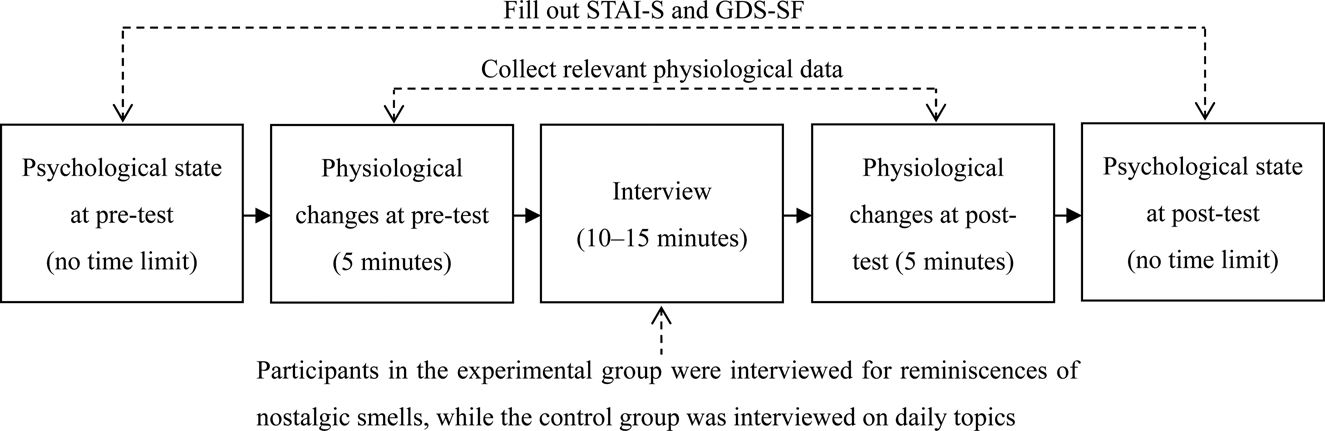
The experimental procedure was divided into five stages (Figure 1). Participants in the experimental group were asked to recall what smells deeply impressed them in their childhood environments (i.e. preschool to elementary school) and why these smells are meaningful to them. By contrast, participants in the control group engaged in daily conversation and were mainly asked to talk about their daily life and activities. This is a common conversation between the staff members and residents of the LTC. Every participant was interviewed for approximately 10–15 minutes. The experimental group questions were as follows: (a) What was the smell that impressed you the most in your childhood? (b) Please describe under what conditions you experienced this smell and (c) Why do you like/hate this smell? The control group questions were as follows: (a) Please talk about your daily life and activities during the week and was there any activity or moment in this week that impressed you? and (b) Why were you impressed?
Experimental procedure.

Data analysis
The comparability of the baseline attributes of the experimental and control groups were established by the use of chi-square and t-tests. Next, an independent-samples t-test was conducted to examine the physiological and psychological values of the experimental and control groups before and after the interviews. By doing so, this study compared the differences between the physiological and psychological benefits that reminiscing about nostalgic smells and talking about daily topics exerted on older people. All the analyses were implemented using SPSS 22, and the significance level was set at α = 0.05.
For qualitative data, this study first transcribed the interview contents, and numbered the transcriptions according to the grouping and the order in which the participants were interviewed in order to differentiate the data sources. Subsequently, coding and content analysis were carried out using ATLAS.ti, computer-assisted qualitative data analysis software, which helps researchers extract, compile and classify the interview contents, followed by analysing the types of nostalgic smells reported by the participants. Finally, their opinions and responses were compared with the quantitative results.
Results
Analysing sample attributes
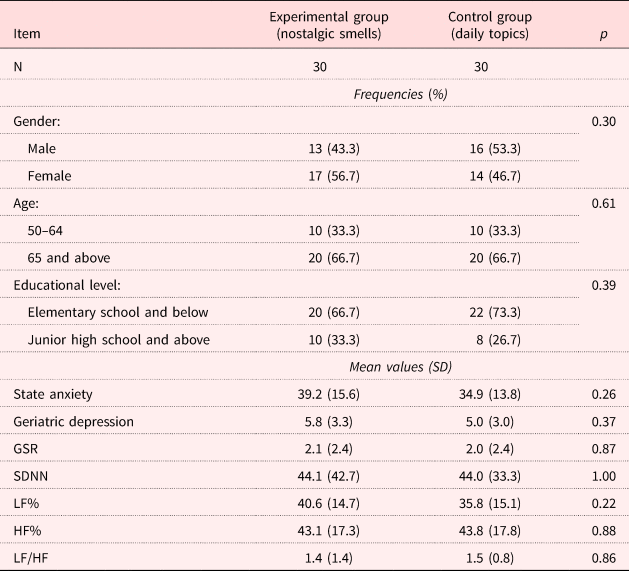
The analytical results of the participants’ baseline attributes are presented in Table 1. The participants’ demographic data as well as their pre-test physiological and psychological data, including the GSR, SDNN, HF%, LF% and LF/HF ratio, were individually tested for homogeneity using a chi-square test and an independent-samples t-test. Neither tests revealed significant differences, indicating that the two groups of participants did not differ significantly in their baseline attributes. Accordingly, the subsequent analyses were unlikely to be affected by the difference in the participants’ baseline attributes.
Participants’ baseline attributes
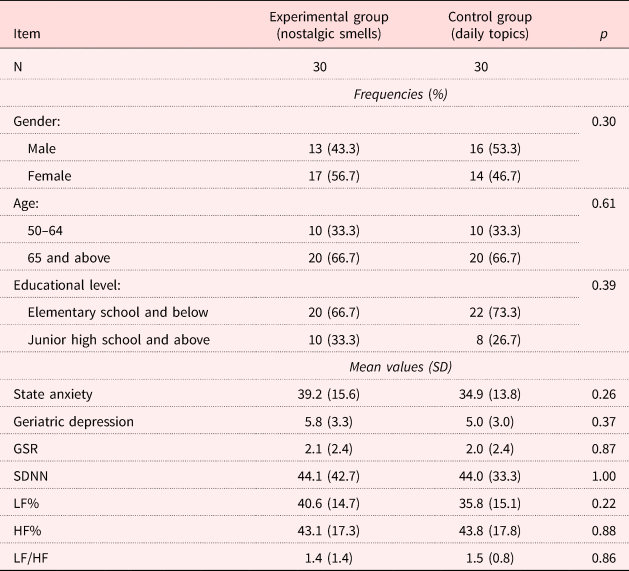
Notes: SD: standard deviation. GSR: galvanic skin response. SDNN: standard deviation of normal heart beat-to-beat intervals. LF%: normalised low-frequency power. HF%: normalised high-frequency power. LF/HF: ratio of LF% to HF%.
Analysing the physiological and psychological benefits of reminiscences of nostalgic smells and daily topics
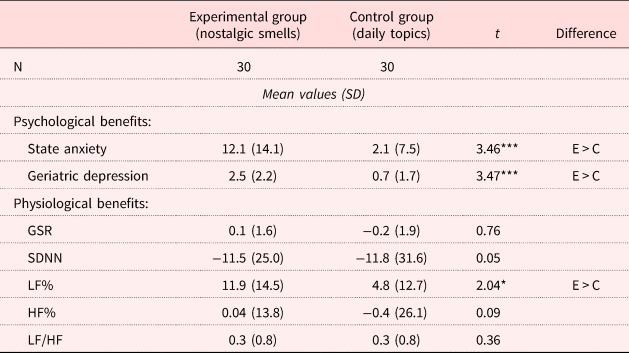
To determine if the experimental group experienced higher physiological and psychological benefits than the control group did, this study conducted an independent-samples t-test on their pre-test and post-test scores (Table 2). The results revealed that the experimental group attained significantly higher pre-test–post-test differences in state anxiety (p < 0.001), geriatric depression (p < 0.001) and LF% (p < 0.05) than did the control group, indicating that reminiscing about nostalgic smells was more effective than recalling daily activities in reducing anxiety, depression and sympathetic nerve activity (LF%). However, the two groups differed non-significantly in their pre-test–post-test differences of GSR, SDNN, HF% and LF/HF, showing that the participants’ physiological conditions were scarcely improved in these aspects.
Comparing the pre-test–post-test differences of the physiological and psychological benefits attained through the different interview topics
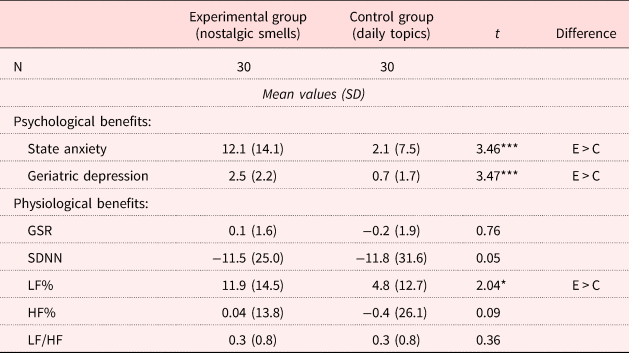
Notes: SD: standard deviation. GSR: galvanic skin response. SDNN: standard deviation of normal heart beat-to-beat intervals. LF%: normalised low-frequency power. HF%: normalised high-frequency power. LF/HF: ratio of LF% to HF%.
E: experimental group. C: control group. Significance levels: * p < 0.05, *** p < 0.001.
Content analysis of experimental group interviews
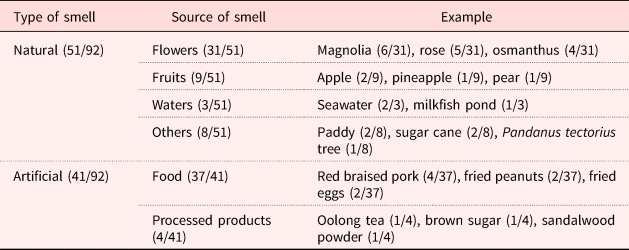
This study divided the nostalgic smells recollected by the participants of the experimental group in the interviews into natural smells that are emitted directly from natural materials and artificial smells arising from processed materials. The participants reported a total of 51 natural smells and 41 artificial smells (Table 3).
Classification of nostalgic smells

Note: Numbers in parentheses are the number of occurrences of each category and the total number of times reported.
Although natural smells were not the nostalgic smells first recalled by participants, the reported number of natural smells was higher than that of artificial smells after the participants were guided gradually to reminisce about their olfactory memories. The memory of natural smells was derived from the participants’ experiences with their family, relatives, friends and themselves. Most participants recollected flower fragrance and exhibited positive emotions directly for this memory. Notably, several participants’ memory of natural smells was restricted to the smells they sensed during work because of family hardship in childhood. Specifically, the participants mentioned during interview:
My family had a hard life when I was young. We didn't have time to mind the smells in our surroundings. All we cared about was money, work and food.
However, the participants were smiling while recalling the smells they sensed during work, stating that they now consider this experience a pleasurable memory rather than a sad memory. Several participants expressed lament and regret that the recollected smells have vanished forever because of environmental changes. For example, a participant recalled:
My family grew rice when I was young, and we used to smell rice paddies. But this smell seldom appeared later. In the past, the air was fresh. Now, with the terrible air quality and pollution, I no longer sensed that smell.
Another participant noted:
My family grew a large field of sugar cane at the present location of the Asia University. I loved eating sugar cane, and I missed the smell of sugar cane being peeled and split apart. The times have changed. Sugar cane is rare now, but I've always remembered that smell.
Discussion and conclusion
The quantitative results indicated that reminiscing about nostalgic smells was more effective than talking about daily topics in reducing state anxiety, depression and sympathetic nerve activity (LF%). The result that reminiscing about nostalgic smells can reduce state anxiety and depression symptoms corresponds with those of several studies regarding reminiscence therapy in older adults residing in LTC facilities (Watt and Cappeliez, Reference Watt and Cappeliez2000; Jonsdottir et al., Reference Jonsdottir, Jonsdottir, Steingrimsdottir and Tryggvadottir2001; Karimi et al., Reference Karimi, Dolatshahee, Momeni, Khodabakhshi, Rezaei and Kamrani2010). The reduced sympathetic nerve activity (LF%) observed in the present study also concurs with the findings of other studies on olfactory stimuli (Saeki, Reference Saeki2001; Kuroda et al., Reference Kuroda, Inoue, Ito, Kubota, Sugimoto, Kakuda and Fushiki2005). Accordingly, although the previous research assertion that older adults do not have an intact sense of smell, the results of this study suggest that possibly recalling olfactory memories of childhood has the same alleviation effects on negative emotions (e.g. anxiety) as actual olfactory stimuli do.
The qualitative results also showed that reminiscing about nostalgic smells was more effective than talking about daily topics possibly because it can facilitate resolving one's conflicts with one's past, create a sense of reconciliation with the past and enhance self-identity (Wong and Watt, Reference Wong and Watt1991). During the interviews, participants recalled not only happy memories but also memories of negative emotions. For example, a participant recalled:
My family led a hard life, and we didn't have time to mind the fragrances around us. I worked hard growing rice until I was 20 years old. Upon smelling the scent of rice paddies, I could feel and recall the hard life we had in the past. But I wouldn't feel sad recalling this experience; instead, I missed it sometimes.
Another participant described the experience of missing one's family:
There's a magnolia planted by others behind my home. I like the fragrance of magnolia. After I grew up, I bought magnolia flowers every time I saw someone selling them. The fragrance reminds me of the scene of my childhood when I used to carry one of my younger sisters or brothers on my back. I miss that feeling sometimes, but it's already passed.
Through the researcher's guidance in the interviews, participants could clearly describe and explain the meanings of the smells, and thus obtain a sense of achievement during the process of reminiscing about smells, as well as explain their lives and the meanings they attached to their pasts. Negative feelings did not persist for participants. This method can not only relieve state anxiety and depression, but also help older people in LTC facilities compile and recollect their personal life experiences. Therefore, compared with discussing daily activities, the benefits of reminiscing about nostalgic smells facilitate addressing psychological aspects of life.
In summary, this study verified that the symptoms of anxiety and depression were relieved more effectively in the experimental group than in the control group. Moreover, the nostalgic smells recalled by the participants in the experimental group were mostly natural smells, particularly flower and fruit fragrances. These results provide further support that reminiscing about nostalgic smells is an effective and beneficial method for guiding LTC facilities in conducting reminiscence therapy. Future studies could compare the benefits of reminiscing about visual and auditory memories, and explore how the narration of different sensory memories is related to emotions. Accordingly, care professionals will be able to administer suitable interventions to LTC institutional older people with different characteristics. Additionally, the small sample size used in this study and the absence of further post-test follow-up to determine whether gains persisted over time are limitations in this study. Nevertheless, it is reasonable to conclude that care professionals in LTC facilities in Taiwan, and possibly further afield, may be able to reduce somewhat symptoms of anxiety and depression in elderly residents by encouraging them to recall and share olfactory memories of naturally occurring substances related to earlier periods in their lives. Further studies using this approach with larger samples are recommended. Cross-country replication would add an interesting dimension to testing the transferability of this approach to stimulating reminiscence as a means of decreasing stress and depression in older people living in residential care facilities.