INTRODUCTION
Marine mammal blubber provides insulation, buoyancy and is a store of energy. It is rich in lipid which is composed of a wide variety of fatty acids (FAs). Some of these FAs can be synthesized in vivo by mammals but many others cannot and instead have to be derived from the diet and this can lead to informative variations in FA profiles (that is to say the relative proportions of each FA by weight) between individuals. Because some in-vivo synthesis occurs and also because of metabolic factors (such as differential uptakes and releases of individual FAs) the FA profiles of blubber are related, but not identical to, those of the prey. The extent to which blubber FA profiles are influenced by diet and the extent to which FA data can be used has led to some controversy principally on whether or not it is possible to obtain quantitative prey data by using correction factors, derived from feeding experiments, to account for the blubber/prey differences (see Grahl-Nielsen et al., Reference Grahl-Nielsen, Andersen, Derocher, Lydersen, Wiig and Kovacs2004; Iverson et al., Reference Iverson, Field, Bowen and Blanchard2004; Thiemann et al., Reference Thiemann, Budge, Bowen and Iverson2004 for the respective arguments). However, despite these contrasting views on obtaining quantitative information both sets of researchers, as well as others, have used FA data to provide qualitative information. For instance FA profiles have been used to differentiate between stocks of fish (Budge et al., Reference Budge, Iverson, Bowen and Ackman2002); harp seal Phoca groenlandica (Grahl-Nielsen et al., Reference Grahl-Nielson, Mjaavatten and Tvedt1993); harbour seal Phoca vitulina (Iverson et al., Reference Iverson, Frost and Lowry1997a); grey seal Halichoerus grypus (Walton & Pomeroy, Reference Walton and Pomeroy2003); minke whale Balaenoptera acutorostrata (Møller et al., Reference Møller, Born, Dietz, Haug, Ruzzante and Øien2003; Olsen & Grahl-Nielsen, Reference Olsen and Grahl-Nielsen2003). Other studies have used FA profiles to indicate that dietary differences have occurred over time or between locations (Iverson et al., Reference Iverson, Arnould and Boyd1997b; Walton et al., Reference Walton, Henderson and Pomeroy2000; Walton & Pomeroy, Reference Walton and Pomeroy2003; Beck et al., Reference Beck, Iverson, Bowen and Blanchard2007) or between sexes (Beck et al., Reference Beck, Iverson, Bowen and Blanchard2007). These FA studies mentioned were performed using whole depth blubber samples which are relatively easy to obtain from certain species such as seals which haul out on land or whale species which are hunted. However, many cetacean species of interest are not hunted and are difficult to capture. The preferred method to collect material from these species is to use a biopsy dart or lance (Cockcroft, Reference Cockcroft and Notarbartolo di Sciara1994). Such biopsy sampling programmes are becoming increasingly common usually in the quest to obtain skin samples for DNA studies. Skin biopsy samples usually have a small piece of blubber attached which is often cut off and discarded. However, such a blubber sample has the potential to provide useful ecological data through the analysis of stable isotopes (Hooker et al., Reference Hooker, Iverson, Ostrom and Smith2001), pollutants (Borrell et al., Reference Borrell, Aguilar, Tornero, Sequeira, Fernandez and Alis2006) as well as FA profiles.
In most marine mammal species the lipids of blubber are nearly all in the form of triacylglycerols (FAs conjugated with glycerol). However, in a few species such as the sperm whale Physeter macrocephalus and some beaked whales (Hansen & Cheah, Reference Hansen and Cheah1969; Hooker et al., Reference Hooker, Iverson, Ostrom and Smith2001) the lipid is mainly in the form of wax esters (FAs conjugated with fatty alcohols) although some triacylglycerols are also present. In previous studies on such species where the FA profiles have been investigated it has usually been either the total lipid (e.g. Hooker et al., Reference Hooker, Iverson, Ostrom and Smith2001) or the triacylglycerol portion that has been characterized (e.g. Lockyer, Reference Lockyer1991). The present study was performed in order to characterize both the wax ester and triacylglycerol components and to see if they provide similar or different qualitative information.
Blubber biopsy samples were obtained from 40 sperm whales found in waters around the Azores. The FAs from both the triacylglycerols and wax esters as well as the fatty alcohols portion of the wax esters were separated, characterized and their potential to distinguish possible differences between male and female whales investigated. Sperm whales are the largest odonotocete (toothed whale) species and show sexual dimorphism, with the males being larger and heavier (average 16 m, 44 tonnes) than females (average 11 m, 13 tonnes) (Shane et al., Reference Shane, Wells and Wursig1986; Lockyer Reference Lockyer1991). Males can dive deeper and may forage on different prey to females. There is also sex-based dispersal (Lyrholm et al., Reference Lyrholm, Leimar, Johanneson and Gyllensten1999) with mature males travelling up to the polar regions, whereas females and young stay in the equatorial regions. Thus, it is possible that these sexual differences may lead to differences in the FA profiles of the blubber, as has been found in common dolphins Delphinus delphis (Smith & Worthy, Reference Smith and Worthy2006) and grey seals (Beck et al., Reference Beck, Iverson, Bowen and Blanchard2007).
The work was performed as part of the CETAMARH project from 2002 to 2004, which was set up to examine the population structure and ecology of sperm whales around the Azores by assessing the relationship and extent of interactions between different population units through the use of several complementary techniques (genetics, photo-identification, stable-isotopes and FA profiles).
MATERIALS AND METHODS
Study area
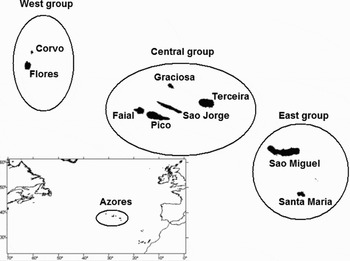
The Azores is an isolated archipelago extending more than 480 km from north-west to south-east across the northern Mid-Atlantic Ridge (Figure 1). It consists of nine volcanic islands, divided into three groups; western (Flores and Corvo); central (Graciosa, Terceira, San Jorge, Pico and Faial); eastern (San Miguel and Santa Maria) which are separated by deep waters of >2000 m depth with scattered seamounts.
Map of the Azores archipelago.

Sample collection
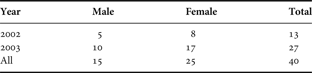
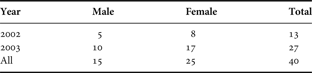
Biopsy samples of about 0.5 cm diameter by 2 cm depth were collected by biopsy dart fired by a cross-bow. The number of samples collected, categorized by sex and year are given in Table 1. The skin part of the biopsy was used in a separate study to investigate DNA microsatellite variations and also to detect the sex of the animals (Pinela et al., Reference Pinela, Quérouil, Magalhães, Silva, Prieto, Matos and Santos2005).
Sample sizes classified by sex and year of collection.
Lipid extraction and analysis
The blubber was separated from the skin with a scalpel and the lipid extracted by the method of Folch et al. (Reference Folch, Lees and Sloane-Stanley1957). Briefly, the samples were homogenized in 10 ml dichloromethane:methanol (2:1, vol/vol) containing 0.01% butylated-hydroxytoluene as antioxidant and filtered. The organic phase was washed with 0.9% KCl, treated with anhydrous Na2SO4, dried under nitrogen, weighed and dissolved in hexane. Thin-layer chromatography (tlc) on silica-gel G plates using hexane:diethyl ether:acetic acid 80:20:2 (Henderson & Tocher, Reference Henderson, Tocher, Hanilton and Hamilton1992) showed that the lipid was predominantly a mix of wax esters and triacylglycerols with some unesterified cholesterol and unidentified lipids. The lipid was applied to a 1 g silica-gel (particle size 0.2–0.5 mm) column and eluted successively with 5 ml hexane (fraction 1), 10 ml hexane:diethyl ether (97:3 vol:vol) (fraction 2) and 10 ml hexane:diethyl ether (90:10 vol:vol) (fraction 3). Fraction 1 was discarded; fraction 2 (essentially wax esters) and fraction 3 (essentially triacylglycerols) were taken to dryness under a stream of nitrogen and redissolved in 1 ml toluene and aliquots separated by thin layer chromatography which showed that there was only trace cross-contamination of the fractions. The two fractions were converted to fatty acid methyl esters (FAMES) using acidified methanol (Henderson et al., Reference Henderson, Kalogeropoulos and Alexis1994) and the resultant FAMES were dissolved in 2 ml hexane. The FAMES fraction from the triacylglycerols was essentially pure but those from the wax esters contained both FAMES and free fatty alcohols which were separated by using a 1 g silica-gel column (Christie, Reference Christie1989). The FAMES were eluted with 8 ml hexane: diethyl ether (90:10 vol:vol) and the fatty alcohols with 8 ml diethyl ether. In order to characterize the fatty alcohols they were first converted to FAs by the method of Budge & Iverson (Reference Budge and Iverson2003) and then converted to methyl esters. Thus, from the original blubber, three FAMES fractions for analysis were obtained relating to triacylglycerol fatty acids (TFA), wax ester fatty acids (WEFA) and wax ester fatty alcohols (WEFAlc).
The FAMES were analysed by gas–liquid chromatography using a Trace GC-2000 gas chromatograph (Thermoquest, CE Instruments) equipped with a flame-ionization detector and fitted with a DB23 fused silica capillary column (25 m × 0.25 mm internal diameter, J&W Scientific). Hydrogen was employed as the carrier gas and the temperature programme was as described previously (Walton & Pomeroy, Reference Walton and Pomeroy2003). Separated components were identified by reference to authentic standards, equivalent chain length values, fractionation of seal samples by silver nitrate chromatography and by comparisons with samples run at other laboratories. Individual FAs are expressed as mass per cent of the total FAs characterized. As is customary values are quoted to 2 decimal places, but this is for comparison purposes and this degree of accuracy is not implied (see Ackman et al., Reference Ackman, Epstein and Eaton1971).
Statistical treatment of results
Principal component analysis (PCA) was performed using the open source statistical package R v. 2.0. The data were first standardized and normalized such that for each variable the mean was zero and the standard deviation was 1 (Storr-Hansen & Spliid, Reference Storr-Hansen and Spliid1993). Discriminant analysis was performed using SPSS v. 12 (SPSS Inc.).
A quantitative measure of the difference between FA profiles was obtained using the average inter-population difference between profiles called Dfap as described by Walton & Pomeroy (Reference Walton and Pomeroy2003). This is an analogue of Gst (Palumbi et al., Reference Palumbi, Martin, Kessing, McMillan and Hoelzel1991) or the Phist measures of analysis of molecular variance (Excoffier et al., Reference Excoffier, Smouse and Quattro1992) but uses differences between FA profiles rather than DNA sequences. Dfap can take a value between 0 and 1 and represents the proportion of the total variance in the data due to inter-population differences. In practice, at least with DNA studies, the theoretical maximum of 1 is rarely approached and even values of 0.05 can indicate genetic differentiation (Wright, Reference Wright1978). The statistical significance of the actual Dfap value was tested by Monte Carlo resampling of the dataset.
RESULTS
The average weight of the 40 biopsied blubber samples was 511±175 mg of which the percentage lipid was 9.3±5.8%. When subjected to column chromatography the recovered weights of the lipid fractions were wax esters 70.9 ±19.9% and triacylglycerols 11.4±7.0% of the total lipid.
Although the main aim was to investigate possible differences in FA profiles between males and females it is important to check for a possible difference between years. Significant inter-annual differences in diet have previously been found in other marine mammal species (e.g. Tollit & Thompson, Reference Tollit and Thompson1996) and such changes can lead to differences in FA profiles (Walton & Pomeroy, Reference Walton and Pomeroy2003). Hence for the statistical tests samples were classified according to sex and year of sampling.
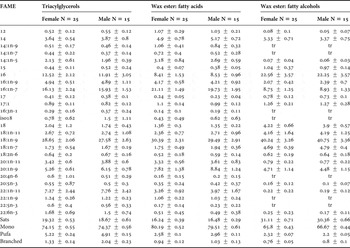
For each sample 64 FA peaks were quantified and Table 2 shows those FAs which contributed >0.25% of the total (the full list is available from the corresponding author on request). The FA profiles of the triacylglycerols and wax esters were broadly similar in overall composition being predominantly high in MUFA (~74–80%) and low in PUFA (~2–5%) with saturated fatty acids contributing about ~16–19%. The predominant FAs were 18:1n-9 (~27–30%), 16:1n-7 (~16–21%) and 16:0 (~8–12%). The fatty alcohols of the wax esters were likewise low in PUFA but somewhat richer in SFA and lower in MUFA. The predominant alcohols were 18:1n-9 (~40%) and 16:0 (~22%).
Fatty acid profiles of sperm whale blubber lipid components.

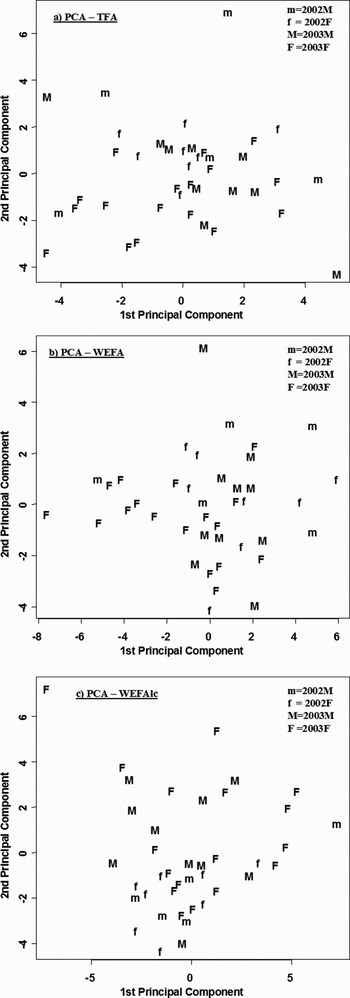
The individual FA profiles were subjected to several multivariate statistical procedures. The purpose of PCA is to reduce the large number of original correlated variables (FAs) to a small number of transformed uncorrelated variables (principal components) that retain as much of the information in the original variables and also explain as much of the sample variance as possible. The procedure does not require prior categorization of the data before analysis and it is not a test of statistical difference but rather a visual representation of the spread of the data points in which one can look for natural clusterings. As shown in Figure 2A–C there are no clear-cut clusterings corresponding to the sex of the animals or year of sampling.
Principal components analysis (PCA) of the fatty acid (FA) profiles of the blubber biopsy samples (N = 40). The samples are labelled by sex and year sampled (m, 2002 males; M, 2003 males; f, 2002 females; F, 2003 females). (A) is the plot for TFA (triacylglycerol fatty acid); (B) is the plot for WEFA (wax ester-fatty acid); (C) is the plot for WEFAlc (wax ester-fatty alcohols).

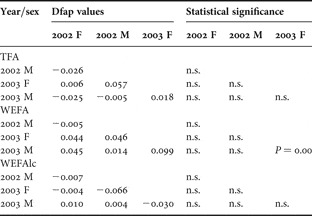
The Dfap (a quantitative measure of the difference between FA profiles) results are presented in Table 3. No significant differences were seen between any of the inter-year comparisons, nor between males and females in the same year except for males vs females for 2003 WEFA. From other work in the CETAMARH project it is known that the whales around the Azores are not site specific and move between the island groups (Pinela et al., Reference Pinela, Quérouil, Magalhães, Silva, Prieto, Matos and Santos2005; Seabra et al., Reference Seabra, Silva, Magalhães, Prieto, August, Vigness-Raposa, Lafon and Santos2005) therefore one would not expect to find any differences in FA profiles relating to the geographical site where the whales were sampled. This is what we found: if the TFA samples were pooled by sex and year of sampling and classified by island group none of the comparisons were significantly different (central vs west dfap = –0.0114, P = 0.996; central vs east dfap = –0.0145, P = 0.338; east vs west dfap = –0.003, P = 0.893). Similar findings (results not shown) occurred when the WEFA and WEFAlc classes were tested.
Dfap distance measures classifying samples according to sex, year and lipid class.

F, female; M, male; n.s., not significant; TFA, triacylglycerol-fatty acids; WEFA, wax ester-fatty acids, WEFAlc, wax ester-fatty alcohols.
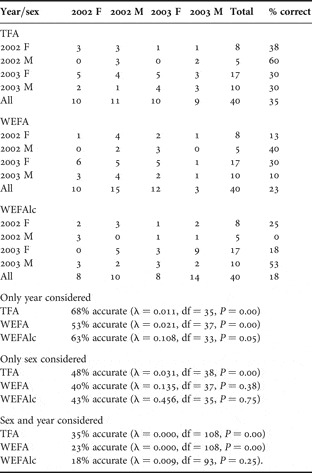
Discriminant analysis shows how well two or more predefined groups of individuals are separated, given measurements of several variables. It provides linear functions of the variables that best separate the cases into the predefined groups. The results are presented in a cross-validated (jack-knifed) classification matrix (Table 4), which classifies each sample without using that sample to calculate the group means. In all cases, when considering the samples by sex and/or year the degree of correct classifications were no better than what would be expected by chance, and misclassification rates were still fairly high. Thus, no strong evidence was seen to allow the samples to be reliably classified by sex or year of sampling.
Discriminant analysis classification matrix (cross-validated) classifying samples according to sex, year and lipid class.

F, female; M, male; TFA, triacylglycerol-fatty acids; WEFA, wax ester-fatty acids; WEFAlc, wax ester-fatty alcohols.
DISCUSSION
As the blubber samples were obtained by biopsy dart it was not possible to reliably sample from the same body site in all animals. If FA profiles varied with body location this would affect the findings but Lockyer (Reference Lockyer1991) investigated the triacylglycerol component of sperm whale blubber and found that FA composition did not vary with body location. Similarly Samuel & Worthy (Reference Samuel and Worthy2004) found FA profiles were indistinguishable when tested from nine different body sites of common dolphins.
However, it is known that the FA profile is not uniform across the whole depth of the blubber layer and the degree of variation differs between species (see Smith & Worthy, Reference Smith and Worthy2006). Lockyer (Reference Lockyer1991) found little variation of triacylglercol FAs with blubber depth in sperm whale and likewise Hooker et al. (2001) found that the variations of total lipid FAs across the blubber depth of bottlenose whales Hyperoodon ampullatus was much less than many other cetacean species such as porpoise. The consensus view is that the inner regions (nearer the muscle) will have more similarity to the diet than the outer regions (nearer the skin) and it is likely that the outer blubber layers will change more slowly over time than the inner layers although no precise measurements are available (Iverson et al., Reference Iverson, Field, Bowen and Blanchard2004). However, the turnover times of FAs have been measured in human adipose tissue and found to be slow with a half-life in the order of six months to two years (Beynon et al., Reference Beynon, Hermus and Hautvast1980; Strawford et al., Reference Strawford, Antelo, Christiansen and Hellerstein2004).
Although it is very unlikely that the blubber FA profiles of outer layer blubber such as obtained by dart biopsy would be suitable for the quantitative procedures described by Iverson et al. (Reference Iverson, Field, Bowen and Blanchard2004) they can still provide qualitative information. Olsen & Grahl-Nielsen (Reference Olsen and Grahl-Nielsen2003) compared the inner and outer regions of blubber in minke whales from the Norwegian and North Seas and found that both layers could be used for population differentiation. More recently, Herman et al. (Reference Herman, Burrows, Wade, Durban, Matkin, Le Duc, Barrett-Lennard and Krahn2005) used FA profiles of biopsied outer region blubber to differentiate between resident and transient killer whales Orcinus orca from the same regions of the North Pacific. Although conclusive proof was not possible, Hooker et al. (Reference Hooker, Iverson, Ostrom and Smith2001) found that the FA profiles of bottlenose whale Hyperoodon ampullatus biopsy blubber were consistent with those of its main prey the squid Gonatus fabricii. Smith & Worthy (Reference Smith and Worthy2006) found that FA differences in outer, middle and inner blubber layers of the common dolphin could distinguish between males and females, and contrary to expectations the outer layer showed a lower misclassification rate than the inner layers. However, in North American bottlenose dolphins Tursiops truncatus no statistically significant differences were seen between the sexes (Samuel & Worthy, Reference Samuel and Worthy2004).
In sperm whales the blubber biopsy samples were denser, more fibrous and tougher than other seal and dolphin species blubber samples with which the authors have experience. As a consequence the lipid content at 9.5% was relatively low. However, this finding is in agreement with a previous report by Lockyer (Reference Lockyer1991) who investigated the outer, middle and inner blubber layers of 26 sperm whale carcasses obtained from Icelandic waters and found that lipid levels were in the order of 10–20% in the outer layer which was denser in texture and more fibrous than the other layers. The outer layer contained about 53% water, and 27% protein in addition to the lipid. In that study the lipids were 61% wax ester and 18% triacylglycerol which is similar to the respective 70.9% and 11.4% found in the present study and also to the 86% and 14% found in bottlenose whales (Hooker et al., Reference Hooker, Iverson, Ostrom and Smith2001).
The FA compositons of the TFA in this study are similar to those found by Lockyer (Reference Lockyer1991) with a predominance (~74%) of MUFA especially 18:1n-9 (~28% and 16:1n-7 (~16%) and SFA especially 16:0 (~12%). Levels of PUFA were low with the combined levels of 20:5n-3 and 22:6n-3 being ~2%.
Sperm whales inhabit the entire North Atlantic basin and using mtDNA both Engelhaupt (Reference Engelhaupt2004) and Drout (Reference Drout2003) have reported significant stock divisions between the Mediterranean Sea and the North Atlantic Ocean populations, but, so far, no further population structure within the North Atlantic has been described. Around the Azores sightings and photographic-identification studies revealed that sperm whales were not site specific and that they migrated throughout the whole archipelago (Magalhães et al., Reference Magalhães, Silva, Prieto, Quérouil, Pinela and Santos2005). Not surprisingly microsatellite DNA studies failed to distinguish between whales sampled from around different island groups of the Azores (Pinela et al., Reference Pinela, Quérouil, Magalhães, Silva, Prieto, Matos and Santos2005; Seabra et al., Reference Seabra, Silva, Magalhães, Prieto, August, Vigness-Raposa, Lafon and Santos2005). Knowing this, we did not expect to see any differences in FA profiles in our samples due to location, and this is what we found.
What we did hypothesize was that there would be a difference in the profiles between males and females because of their different sizes, travel patterns, diving behaviour (Shane et al., Reference Shane, Wells and Wursig1986) and diet. Sperm whales are deep and prolonged divers foraging mainly near the bottom and feed regularly throughout the year. Clarke et al. (Reference Clarke, Martins and Pascoe1993) studied the diet of sperm whales from around the Azores by analysing the stomachs of 19 animals and found that the ratio of cephalopods to fish was in the order of 5000 to 1 with over 40 different species of cephalopods. Different sized cephalopods were eaten according to whale sex and size and the presence of Gonatus sp. in the males was indicative of migration south from higher latitudes. Differences in diet can lead to differences in blubber FA profiles as shown in grey seals (Walton & Pomeroy, Reference Walton and Pomeroy2003). Foraging differences between male and female common whales have been observed in the wild (Young & Cockcroft, Reference Young and Cockcroft1994; Chou et al., Reference Chou, Bright and Yeh1995). In the present study no clear differences in profiles due to the sex of the animal were observed either by PCA, using the Dfap measure or discriminant analysis. This suggests that in this species any differences in the diet of the sexes are not reflected in the blubber FA profiles. The one exception to this was a significant difference in the Dfap measure for WEFA between males and females in 2003 which could have been a real difference, or bearing in mind all the other non-significant findings it could have been a false-positive. As the ages of the whales in our study are unknown it may be that most of the males had not reached full maturity and had not yet embarked on long migrations. The results therefore contrast with the results for common dolphin (Smith & Worthy, Reference Smith and Worthy2006) and grey seal (Beck et al., Reference Beck, Iverson, Bowen and Blanchard2007) described above.
Thus, in the present study, biopsy samples of outer region blubber from sperm whales were collected and the lipid components characterized. The FA profiles of both the wax esters and triacylglycerols are fairly similar and for future work it would seem that total lipid would be suitable and that no particular benefit would arise from the extra effort involved in separating the lipid classes. The profiles should be suitable for qualitative studies but are unlikely to be suitable for QFASA. In this particular study no differences could be detected in the profiles of males and females but it would be interesting to compare males and females which are known to be mature at breeding grounds.
ACKNOWLEDGEMENTS
This research was funded by the Portuguese Science and Technology Foundation (FCT), under the CETAMARH project (POCTI/BSE/38991/01). M.A.S. was supported by an FCT PhD scholarship and S.M.M. received a research grant from FCT, through the CETAMARH project. The work was conducted under license of the Environment Directorate of the Regional Government of the Azores.