Efforts have recently been made to identify the endophenotypic markers of psychopathic personality, a multidimensional construct encompassing a cluster of distinct personality traits: callous–unemotional affective traits, arrogant–deceitful interpersonal traits, and impulsive–irresponsible behavioral traits (Hare, Reference Hare1991; Lynam, Reference Lynam1997). The endophenotype, referring to some “intermediate” phenotype on the pathway from distal genotype to mental disorder of interest, has received increasing attention in the etiological studies of psychopathology (Gottesman & Gould, Reference Gottesman and Gould2003). An endophenotype can be neurophysiological, biochemical, endocrinological, neuroanatomical, cognitive, or neuropsychological in nature, but it must also (a) be heritable, (b) be reliably associated with the disorder, and (c) share genetic covariance with the disorder (Rijsdijk et al., Reference Rijsdijk, Viding, De Brito, Forgiarini, Mechelli and Jones2010). The concept of endophenotype represents an effort to decompose or deconstruct the complex disorder or syndrome into more basic elements, which are more proximal to the genetic predispositions than the disorder per se and, thus, may help advance our understanding of the etiology of the disorder.
Psychopathic traits show moderate to strong heritability (Bezdjian, Raine, Baker, & Lynam, Reference Bezdjian, Raine, Baker and Lynam2011; see reviews by Viding & Larsson, Reference Viding, Larsson, Randall and Salekin2010; Waldman & Rhee, Reference Waldman, Rhee and Patrick2006), and this genetic vulnerability is likely to be reflected at a physiological level. One of the primary physiological constructs that has been found to be reliably associated with psychopathic traits is attenuated anticipatory skin conductance responses (SCRs) to aversive stimuli in conditioning or quasi-conditioning paradigms (Arnett, Reference Arnett1997; Hare, Frazelle, & Cox, Reference Hare, Frazelle and Cox1978). For example, using a (quasi-conditioning) countdown paradigm in which participants are presented with numbers counting down from 12 to 0 signaling a loud noise burst, we among others have found reduced anticipatory SCRs in children and adolescents with psychopathic tendencies (Fung et al., Reference Fung, Raine, Loeber, Lynam, Steinhauer and Venables2005; Wang, Baker, Gao, Raine, & Lozano, Reference Wang, Baker, Gao, Raine and Lozano2012) as well as in college students with antisocial personality features (Sylvers, Brubaker, Alden, Brennan, & Lilienfeld, Reference Sylvers, Brubaker, Alden, Brennan and Lilienfeld2008). Using various conditioning paradigms, other studies have reliably demonstrated the link between reduced anticipatory SCRs and psychopathic traits in clinical and community samples (Fairchild, Van Goozen, Stollery, & Goodyer, Reference Fairchild, Van Goozen, Stollery and Goodyer2008; Flor, Birbaumer, Hermann, Ziegler, & Patrick, Reference Flor, Birbaumer, Hermann, Ziegler and Patrick2002; Rothemund et al., Reference Rothemund, Ziegler, Hermann, Gruesser, Foell and Patrick2012). This attenuated SCR may reflect psychopathic individuals’ lack of fear or anxiety prior to the aversive event or their insensitivity or lack of concern about the impending punishment (Hare, Reference Hare, Hare and Schalling1978; Hare & Thorvaldson, Reference Hare and Thorvaldson1970; Lykken, Reference Lykken1957). The amygdala and ventromedial prefrontal cortex (vmPFC), regions closely involved in moral reasoning and emotional processing, may serve as important neural bases underlying reduced anticipatory SCRs in psychopaths (Bechara et al., Reference Bechara, Tranel, Damasio, Adolphs, Rockland and Damasio1995; Blair, Reference Blair2007; LaBar, LeDoux, Spencer, & Phelps, Reference LaBar, LeDoux, Spencer and Phelps1995).
Despite the large amount of evidence demonstrating the association between psychopathic traits and anticipatory SCRs, little is known about the heritability of the latter. Hettema, Annas, Neale, Kendler, and Fredrikson (Reference Hettema, Annas, Neale, Kendler and Fredrikson2003) reported that individual differences in SCRs at all phases of fear conditioning (e.g., habituation, acquisition, and extinction) were mainly due to genetic (26%~53%) and nonshared environmental (47%–74%) influences, while environmental effects shared by twins were nonsignificant. Using a loud tone (105 db) as aversive stimulus, Lykken, Iacono, Haroian, McGue, and Bouchard (Reference Lykken, Iacono, Haroian, McGue and Bouchard1988) found that genetic (40%–70%) and nonshared environmental (30%–60%) effects were significant for almost all components of SCR habituation (e.g., slope, intercept, maximum magnitude, number of trials before habituation). Further, studies examining the heritability of skin conductance orienting responses, that is, responses to neutral but innovative stimuli in the environment, also reported significant genetic and nonshared environmental effects (but no significant shared environmental influences; Crider et al., Reference Crider, Kremen, Xian, Jacobson, Waterman and Eisen2004; Isen, Iacono, Malone, & McGue, Reference Isen, Iacono, Malone and McGue2012; Tuvblad et al., Reference Tuvblad, Gao, Isen, Botwick, Raine and Baker2012). Taken together, evidence suggests that SCR measures in general are moderately heritable. It is therefore predicted that for anticipatory SCRs, there would be appreciable effects due to genetic and nonshared environmental but negligible influences due to shared environment.
Another physiological measure that is often linked to psychopathic traits in a conditioning or quasi-conditioning paradigm is autonomic reactivity to the aversive or punishment stimulus itself, for example, the unconditioned stimulus (UCS). Psychopathic individuals have shown reduced SCRs to the UCS (Fairchild, Stobbe, Van Goozen, Calder, & Goodyer Reference Fairchild, Stobbe, Van Goozen, Calder and Goodyer2010; Fung et al., Reference Fung, Raine, Loeber, Lynam, Steinhauer and Venables2005; Hare et al., Reference Hare, Frazelle and Cox1978) compared to nonpsychopathic groups, although some studies have failed to find group differences (Fairchild et al., Reference Fairchild, Van Goozen, Stollery and Goodyer2008; Flor et al., Reference Flor, Birbaumer, Hermann, Ziegler and Patrick2002; López, Poy, Patrick, & Moltó Reference López, Poy, Patrick and Moltó2013; Rothemund et al., Reference Rothemund, Ziegler, Hermann, Gruesser, Foell and Patrick2012). Prior research has been done on adults and adolescents, and to date no study has examined the association in children younger than 14 years.
Therefore, we attempted to fill the above-mentioned research gaps by examining two physiological correlates of psychopathic traits, namely, anticipatory SCRs and the SCRs to the aversive stimulus itself, in a sample of 9- to 10-year-old twins. We have previously demonstrated that psychopathic traits are substantially accounted for by genetic (46%–64%) and nonshared environmental influences (36%–54%; Bezdjian et al., Reference Bezdjian, Raine, Baker and Lynam2011), and that reduced anticipatory SCRs are associated with high psychopathic traits in boys but not in girls (Wang et al., Reference Wang, Baker, Gao, Raine and Lozano2012). In the current study, we expand on these findings by investigating: (a) if both SCRs (anticipatory SCR and SCR to the UCS) are heritable; (b) whether SCR to the UCS bears significant phenotypic association with psychopathic traits; and (c) should there be significant association between psychopathic traits and SCRs, whether common genetic influences can explain this association. Finally, we also attempted to compare the genetic etiology of these associations between boys and girls. In summary, the primary objective of this study was to investigate whether anticipatory SCR and SCR to the UCS meet the criteria for candidate endophenotypes for psychopathy. To our knowledge, no previous multivariate twin study has conducted such analyses, and our study will be among the first to examine the genetic covariance between these physiological markers and psychopathic traits in both males and females.
Method
Participants
The present study was based on 616 sets of twins and triplets (1,241 subjects in total; 49% males, mean age = 9.6, SD = 0.58) who participated in the first wave of an ongoing Twin Study of Risk Factors for Antisocial Behavior at the University of Southern California (Baker et al., Reference Baker, Tuvblad, Wang, Gomez, Bezdjian and Niv2013). Twins were mainly recruited through public schools in the Greater Los Angeles area around 2000–2001, and the ethnic distribution (36.74% Hispanic, 27.4% Caucasian, 14.02% Black, 4.35% Asian, 0.16% Native American, and 17.32% mixed) was comparable to that of the Southern California urban community. Among them, 139 twin pairs were monozygotic males, 147 were monozygotic females, 88 were dizygotic males, 93 were dizygotic females, and the remaining 149 were dizygotic opposite sex.
Measures
To assess psychopathic traits, Lynam's (Reference Lynam1997) Childhood Psychopathy Scale (CPS) was completed separately for each child by a caregiver. The CPS comprises 58 items rated on a 2-point scale (1 = yes, 2 = no). Two moderately correlated factors (r = .45, p < .01) were derived from these 58 items (Bezdjian et al., Reference Bezdjian, Raine, Baker and Lynam2011): the first factor included seven subscales (unreliability, lack of planning, boredom susceptibility, impulsivity, behavioral dyscontrol, poverty of affect, and callousness), reflecting impulsive–antisocial tendencies of psychopathy and thus labeled “impulsive/disinhibited”Footnote 1 in the current study; and the second factor loaded on six subscales (manipulativeness, parasitic lifestyle,Footnote 2 glibness, untruthfulness, failure to accept responsibility, and lack of guilt), reflecting the affective–interpersonal features of psychopathy and thus labeled “manipulative/deceitful.” Psychometric details of the CPS and formation of these two factors as their genetic analyses can be found in Bezdjian et al. (Reference Bezdjian, Raine, Baker and Lynam2011) and Wang et al. (Reference Wang, Baker, Gao, Raine and Lozano2012).
The countdown task
The task was composed of three signaled trials and two unsignaled trials. In each of the signaled trials, participants watched numbers count down from 12 to 0 (at a rate of 1 s each) on the computer screen. They were told that a loud noise (1-s burst of 105 dB white noise) would be delivered when the number reached 0. For the unsignaled trials, the same loud noise burst was also presented, but no numeric countdown was visually presented; instead, participants viewed a blank screen, and thus they were unaware of when the trial began or the noise occurred. The 12 s prior to the unsignaled noise were examined for these unsignaled trials as a comparison condition in order to evaluate the efficacy of the countdown in the signaled trials in eliciting anticipatory fear (Fung et al., Reference Fung, Raine, Loeber, Lynam, Steinhauer and Venables2005). More details on the task can be found in Wang et al. (Reference Wang, Baker, Gao, Raine and Lozano2012).
Psychophysiological data attainment
All psychophysiological data were collected with equipment and software from the James Long Company (Caroga Lake, NY). Skin conductance activity was recorded from bipolar leads on the distal phalanges of the index and middle fingers of the nondominant hand using Ag-AgCl electrodes (8 mm in diameter). A SCR was defined as an increase in conductivity exceeding 0.05 microsiemens in amplitude and the number of nonspecific SCRs (NS-SCRs) was scored manually (Fung et al., Reference Fung, Raine, Loeber, Lynam, Steinhauer and Venables2005; Wang et al., Reference Wang, Baker, Gao, Raine and Lozano2012).
Skin conductance data during the 12 s before and 12 s after the white noise burst were examined. To test our hypotheses, two SCR measures were derived: the prenoise response averaged across three signaled trials (anticipatory NS-SCRs, indicating anticipatory fear responses to aversive stimuli), and the postnoise response averaged across all five trials (aversive NS-SCRs, three signaled and two unsignaled conditions combined, representing unconditioned responses to aversive event). Finally, the prenoise responses averaged across the two unsignaled trials was only included as a baseline to test the efficacy of countdown in eliciting anticipatory responses, because no significant associations were found for them with any factor of CPS scores in Wang et al. (Reference Wang, Baker, Gao, Raine and Lozano2012).
Due to equipment error, all the SCR data from the countdown task before September 2001 was contaminated and thus removed. Only 752 subjects (45% boys) were retained for the NS-SCR data. This sample showed similar characteristics to those subjects excluded on almost all aspects except that there were fewer Caucasians in the current sample (for more details, see Wang et al., Reference Wang, Baker, Gao, Raine and Lozano2012).
Statistical analysis
To evaluate the efficacy of the countdown number in the signaled condition, mean difference in prenoise NS-SCRs between signaled and unsignaled conditions was examined using paired-sample t tests. The classical twin design was utilized to estimate the genetic and environmental influences on individual differences in the observed phenotypes. The variance–covariance structure in the classical twin design is usually attributed to three sources: the additive genes (A), the shared environment common to twins within a family (C), and the nonshared environment (E), including individual-specific environmental factor or experiences (e.g., peer relationships) and measurement errors. There are several important assumptions in the classical twin design: (a) monozygotic twins are assumed to share 100% of their genes such that the genetic correlation between both twins is set to 1, whereas it is only 0.5 for dizygotic twins because they are assumed to only share about 50% of genes; (b) the correlation of shared environment is set to 1 for both monozygotic and dizygotic twins if they are reared up together; and (c) the nonshared environment of a twin is independent of those of the other twin, such that the correlation of nonshared environment is set to be 0 (Evans, Gillespie, & Martin, Reference Evans, Gillespie and Martin2002).
To examine how genetic and environmental influences contributed to variations in anticipatory NS-SCRs and aversive NS-SCRs, separate univariate genetic analyses were conducted. To test potential sex differences, three genetic models were fit to the data: Model 1 allowed sex differences on mean levels of the observed phenotype as well as the magnitudes of ACE components; Model 2 was a constrained model that equated magnitudes of ACE components; and Model 3 was a further constrained model that equated both means and ACE components between males and females. A saturated model with all parameters freely estimated (Model 0) served as a baseline model to derive chi-square statistics (a difference between –2 log likelihood of the saturated model and that of the assessed model) and degree of freedom (a difference between the number of free parameters and that of the assessed model) for each model. Goodness of model fits was mainly determined using the differences in the chi-square statistics. In addition, the suitability of the models were also assessed by comparing the Akaike information criterion (Akaike, Reference Akaike1987) and the Bayesian information criterion, with smaller values indicating better fit (Raftery, Reference Raftery1995).
Next, phenotypic correlations of the two SCR variables with two factors of CPS (impulsive/disinhibited and manipulative/deceitful) were examined separately in males and females. In case of significant phenotypic correlations, a bivariate genetic analysis with a correlated factors solution was employed to investigate the genetic and environmental architecture of that correlation. This correlated factors solution decomposes the variance of each phenotype as well as the covariances between two measures into genetic, shared environmental, and nonshared environmental factors. A genetic correlation (r g) indicates the extent to which genetic effects on one measure overlap with genetic effects on another measure. Similarly, shared (r c) and nonshared (r e) environmental correlations indicate the extent to which environmental effects on one measure overlap with environmental effects on another. These statistics vary from –1.0 and +1.0, and are independent of the magnitudes of genetic influences (or heritability) for each set of measures (Posthuma et al., Reference Posthuma, Beem, De Geus, Van Baal, von Hjelmborg and Iachine2003).
We also calculated the proportion of the phenotypic correlation that was due to genetic (i.e., bivariate heritability [BH]), shared environmental (i.e., bivariate shared environment [BSE]), and nonshared environmental (i.e., bivariate nonshared environment [BNSE]) influences through the following equations:
 $${\rm BH}= \displaystyle{{\sqrt{A_{\rm SCR}} \times r_{\rm g} \times \sqrt{A_{\rm CPS}}} \over {\eqalign{& \sqrt{A_{\rm SCR}} \times r_{\rm g} \times \sqrt{A_{\rm CPS}} + \sqrt{C_{\rm SCR}} \times r_{\rm c} \times \sqrt{C_{\rm CPS}} \cr & + \sqrt{E_{\rm SCR}} \times r_{\rm e} \times \sqrt{E_{\rm CPS}}\comma}}}$$
 $${\rm BSE}= \displaystyle{{\sqrt{C_{\rm SCR}} \times r_{\rm c} \times \sqrt{C_{\rm CPS}}} \over {\eqalign{& \sqrt{A_{\rm SCR}} \times r_{\rm g} \times \sqrt{A_{\rm CPS}} + \sqrt{C_{\rm SCR}} \times r_{\rm c} \times \sqrt{C_{\rm CPS}} \cr & + \sqrt {E_{\rm SCR}} \times r_{\rm e} \times \sqrt{E_{\rm CPS}}\comma}}}$$
 $${\rm BNSE} = \displaystyle{{\sqrt{C_{\rm SCR}} \times r_{\rm c} \times \sqrt{C_{\rm CPS}}} \over {\eqalign{& \sqrt{A_{\rm SCR}} \times r_{\rm g} \times \sqrt {A_{\rm CPS}} + \sqrt{C_{\rm SCR}} \times r_{\rm c} \times \sqrt {C_{\rm CPS}} \cr & + \sqrt{E_{\rm SCR}} \times r_{\rm e} \times \sqrt{E_{\rm CPS}}}}}.$$
Bivariate heritability is a measure of the extent to which shared genetic influence generates a correlation between two traits and varies from 0 to 1. The bivariate statistics sum to the phenotypic correlation and are only informative when r g, r c, and r e are in the same direction (Plomin, DeFries, McClearn, & McGuffin, Reference Plomin, DeFries, McClearn and McGuffin2008).
Phenotypic correlations between SCR measures and CPS factors were conducted in SAS 9.2 (SAS, 2008). All genetic models based on the raw data (rather than the covariance matrix) were implemented in Mplus 5.2 (Muthén & Muthén, Reference Muthén and Muthén2007). Prior to all the analyses, CPS and SCR were first ranked (PROC RANK; Blom, Reference Blom1958) and then normalized (PROC STANDARD) in SAS to decrease the skewness and kurtosis in their distributions. According to a simulation study by van den Oord et al. (Reference van den Oord, Simonoff, Eaves, Pickles, Silberg and Maes2000) for behavior genetic analysis with psychiatric symptom count data, this transformation procedure performed best in identifying the true genetic model among a set of alternative models.
Results
The paired-sample t test showed significantly fewer prenoise NS-SCRs under unsignaled conditions (M = 0.54, SD = 0.66) than those under signaled conditions (M = 0.76, SD = 0.79), t (757) = 8.03, p < .01, indicating the validity of the signaled countdown in eliciting anticipatory fear to impending aversive stimuli. About 70% of the sample (i.e., 540 participants out of the 758 cases with usable SCR data) showed one or more prenoise NS-SCRs in any of the three signaled trials.
Univariate analyses
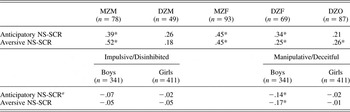
The intrafamily correlations for the two SCR measures stratified by zygosity are presented in Table 1. For each measure, the correlations in monozygotic twins were larger than those in dizygotic twins, indicating genetic influences.
Intrafamily correlations of SCR measures by zygosity and their sex-specific correlations with two Child Psychopathy Scale factors

Note: Pearson correlations based on rank-normalization transformed data are presented. SCR, Skin conductance response; MZM, monozygotic males; MZF, monozygotic females; DZM, dizygotic males; DZF, dizygotic females; DZO, dizygotic opposite sex; anticipatory NS-SCR, nonspecific SCR at signaled prenoise phase; aversive NS-SCR, NS-SCR at postnoise phase, combining signaled and unsignaled conditions.
a This was also reported in Wang et al. (Reference Wang, Baker, Gao, Raine and Lozano2012).
*p < .05.
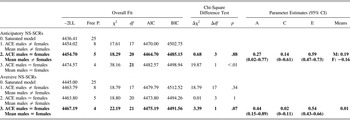
Univariate genetic model comparisons suggested that, for anticipatory NS-SCRs, although males and females differed significantly on means, the proportion of variance due to genetic, shared environmental, and nonshared environmental influences were comparable between sexes (Model 2, χ2 = 0.68, df = 3, p = .88). There was no significant sex difference for aversive NS-SCRs in either means or variance due to genetic and environmental influences (Model 3, χ2 = 3.39, df = 1, p = .07). Table 2 summarizes the details of model comparisons as well as parameter estimates with their 95% confidence intervals (CIs) based on the best-fitting model. As expected, the contribution of shared environmental effects was nonsignificant for both SCR measures.
Model comparisons in univariate genetic analyses

Note: Best-fitting models are in bold. Anticipatory NS-SCR, nospecific skin conductance response at signaled prenoise phase; aversive NS-SCR, NS-SCR at postnoise phase, combining signaled and unsignaled conditions.
Bivariate analysis
For both males and females, impulsive/disinhibited was not significantly correlated with either SCR measure (Table 1). In contrast, manipulative/deceitful was negatively associated with both anticipatory NS-SCRs (r = –.14, p < .05) and aversive NS-SCRs (r = –.17, p < .05) in males, but not in females. A Steiger t test (Steiger, Reference Steiger1980) showed that the association for manipulative/deceitful with aversive NS-SCR was significantly larger than that for impulsive/disinhibited (t = 2.36, p < .05) in males. No other significant differences were found.
As a result of this, two sets of bivariate genetic analyses were conducted in boys only: anticipatory NS-SCR with manipulative/deceitful and aversive NS-SCR with manipulative/deceitful. This male-only sample (n = 341) could potentially decrease the statistical power in differentiating genetic and shared environmental influences. Therefore, only full ACE models were fitted to data and no further model comparisons (i.e., comparing reduced models by dropping A or C components) were conducted.
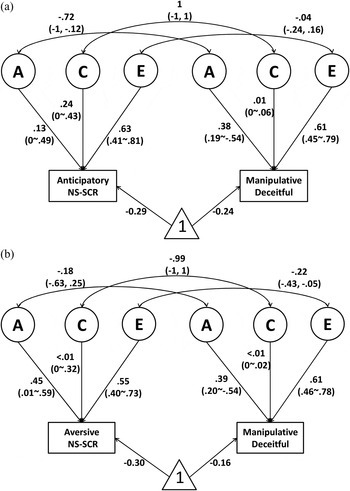
Figure 1 presents the correlated factor solutions for these two full ACE models, along with parameter estimates and 95% CIs. Anticipatory NS-SCRs and aversive NS-SCRs exhibited divergent patterns. Specifically, there was a significant genetic correlation between anticipatory NS-SCR and manipulative/deceitful (r g = –.72, 95% CI = –1 to –0.12), whereas for the covariation between aversive NS-SCR and manipulative/deceitful only the nonshared environmental correlation was significant (r e = –.22, 95% CI = –0.43 to –0.05).
Correlated factors solution with 95% confidence intervals for bivariate genetic analysis between manipulative/deceitful traits and skin conductance responses (SCR), including males only. The number 1 in the triangle indicates a constant, and its loading to each observed variable denotes the intercept/mean value of that variable. (a) Manipulative/deceitful and anticipatory NS-SCRs and (b) manipulative/deceitful and aversive NS-SCRs. A, Additive genetic variance; C, shared environmental variance; E, nonshared environmental variance; anticipatory nonspecific SCR (NS-SCR), NS-SCR at signaled prenoise phase; aversive NS-SCR, NS-SCR at postnoise phase, combining signaled and unsignaled conditions.

Further calculation indicated that 35% (see Equation 1 for how to derive this proportion) of the phenotypic correlation between aversive NS-SCR and CPS manipulative/deceitful was explained by genetic influences, almost none were accounted for by shared environmental influences (see Equation 2) and the remaining 65% (see Equation 3) was explained by nonshared environmental influences. Bivariate statistics were not calculated for the relationship between anticipatory NS-SCR and manipulative/deceitful because r g and r c were in opposite directions.
Discussion
This study aimed to investigate the heritability of anticipatory SCRs and SCRs to aversive stimuli, and more importantly the genetic and environmental sources of the covariance between these two measures and psychopathic personality traits in children. The main findings were the following:
-
1. significant phenotypic relationships between manipulative/deceitful (but not impulsive/disinhibited) and the two types of SCRs were found in males only;
-
2. genetic and nonshared environmental effects were important for both types of SCRs, whereas the contribution of the shared environment was negligible;
-
3. for males there was significant genetic correlation between anticipatory SCRs and manipulative/deceitful, suggesting an overlap between genetic influences in anticipatory SCRs and manipulative/deceitful, whereas for aversive SCRs and manipulative/deceitful there was a significant nonshared environmental correlation; and
-
4. the phenotypic correlation between anticipatory SCRs and manipulative/deceitful was mediated by common genetic influences.
These findings together suggest that reduced anticipatory SCRs may be a candidate endophenotype for the interpersonal aspects of psychopathic traits in males.
First, the phenotypic relationships found only between manipulative/deceitful (not impulsive/disinhibited) and SCRs were consistent with previous findings (Fowles & Dindo, Reference Fowles and Dindo2009; Patrick & Bernat, Reference Patrick, Bernat, Berntson and Cacioppo2009) and indicated that reduced affective-physiological responses were unique to the affective-interpersonal aspects of psychopathy. This provided further support for divergent etiologies for different facets of psychopathy and the importance in differentiating them (Patrick, Fowles, & Krueger, Reference Patrick, Fowles and Krueger2009; Patrick, Hicks, Nichol, & Krueger, Reference Patrick, Hicks, Nichol and Krueger2007). Second, as predicted, we demonstrated that genetic and nonshared environmental effects, but not shared environmental influences, contributed significantly to the variations of both anticipatory SCRs and aversive SCRs. Furthermore, each measure was under a similar amount of genetic and environmental influences in both sexes.
However, although males with high manipulative/deceitful traits showed significantly fewer anticipatory NS-SCRs and aversive NS-SCRs, a significant phenotypic correlation was not found for females. This discrepancy provides further evidence that there may be distinctive genotype–phenotype pathways for the development of psychopathy for these two sexes (Isen et al., Reference Isen, Raine, Baker, Dawson, Bezdjian and Lozano2010). Consistent with this finding, other recent studies have demonstrated the sexually dimorphic effect of catechol-O-methyltransferase and monoamine oxidase A, two candidate genes implicated in fear processing (Montag et al., Reference Montag, Buckholtz, Hartmann, Merz, Burk and Hennig2008; Williams et al., Reference Williams, Gatt, Kuan, Dobson-Stone, Palmer and Paul2009), on genetic susceptibility to an array of psychiatric disorders, including major depression (Åberg, Fandiño-Losada, Sjöholm, Forsell, & Lavebratt, Reference Åberg, Fandiño-Losada, Sjöholm, Forsell and Lavebratt2011), obsessive–compulsive disorder (Karayiorgou et al., Reference Karayiorgou, Sobin, Blundell, Galke, Malinova and Goldberg1999) and attention-deficit/hyperactivity disorder (Biederman et al., Reference Biederman, Kim, Doyle, Mick, Fagerness and Smoller2008). Evidence from brain imaging studies (Tranel, Damasio, Denburg, & Bechara, Reference Tranel, Damasio, Denburg and Bechara2005) has also shown sex-specific patterns for functional asymmetry of the vmPFC, a brain region implicated in reduced fear responses of psychopaths (Blair, Reference Blair2007). For example, defects in emotional processing and decision making arose from damages to the unilateral right vmPFC in men but the left vmPFC in women (Tranel et al., Reference Tranel, Damasio, Denburg and Bechara2005). It is possible that this functional asymmetry of the vmPFC may be a neurophysiological expression of those sexually dimorphic genes. Given the scarcity of research investigating psychopathy at the molecular level (Blair, Peschardt, Budhani, Mitchell, & Pine, Reference Blair, Peschardt, Budhani, Mitchell and Pine2006), we must await more evidence to elucidate the sex-specific genotype–phenotype pathways involved in emotion learning and the development of psychopathic traits.
Despite significant genetic influences found for both SCR measures and for the two CPS factors, only the anticipatory SCRs were found to share a significant genetic covariance with manipulative/deceitful, and thus considered to be a potential endophenotype in males. This differential relationship may be partly due to the different neurobiological mechanisms underlying the two types of physiological responses. In one study, LaBar et al. (Reference LaBar, LeDoux, Spencer and Phelps1995) used a classical fear conditioning paradigm to investigate the SCRs to the conditioned stimulus (CS+), CS–, and UCS in human subjects with lesions to the amygdala, and they found that the temporal lobectomy group and the nonepileptic control group differed significantly on responses to the CS+, but not to the CS– or the UCS. A significant amount of animal research on amygdala and fear has also suggested that there are different neurocircuitries for conditioned and unconditioned fears (see a review by Rosen, Reference Rosen2004; Walker & Davis, Reference Walker and Davis1997): the former involves more cognitive processes like learning and memory than the latter. In addition, the early growth response gene 1, a type of gene implicated in learning and memory, has been found to play dissociative roles in conditioned and unconditioned fears (Malkani, Wallace, Donley, & Rosen, Reference Malkani, Wallace, Donley and Rosen2004). Enlightened by findings from animal research and the hypothesis that psychopaths’ reduced NS-SCRs in anticipation of an aversive stimulus reflect a lack of cognitive activity, specifically a deficit in the ability to imagine future consequences (Öhman & Mineka, Reference Öhman and Mineka2001; Schalling, Reference Schalling, Hare and Schalling1978), a tentative explanation would thus be that the common genes underlying anticipatory fear responses and psychopathy exert influences on the relevant phenotypes through cognitive appraisal of the impending negative stimuli. In contrast, nonshared environmental factors contribute more to the association between psychopathic traits and an emotional appraisal of the threatening stimuli. Future behavioral genetic research examining the mediating effect of cognitive processes such as learning/memory and their related brain activities are needed to test this hypothesis.
It is worth noting that although the significant genetic correlation was found between manipulative/deceitful and anticipatory SCRs, the total variance of manipulative/deceitful that could be accounted for by anticipatory SCRs through shared genetic influences was only about 3% (0.13 × [–0.72]2 × 0.38). Similar effect sizes have also been reported in studies on resting heart rate and antisocial behaviors (Baker et al., Reference Baker, Tuvblad, Reynolds, Zheng, Lozano and Raine2009), fear conditioning and self-reported fear (Hettema, Annas, Neale, Fredrikson, & Kendler, Reference Hettema, Annas, Neale, Fredrikson and Kendler2008), and gray matter and psychopathic traits (Rijsdijk et al., Reference Rijsdijk, Viding, De Brito, Forgiarini, Mechelli and Jones2010). These relatively small percentages, on the one hand, were not able to provide strong support for the mediating effect of these endophenotypes in the pathway from genetic risks to full spectrum of psychopathology. It is yet to be tested, hopefully through experimental studies, whether these endophenotypes did play a direct, causal role as an intermediate phenotype in the pathophysiology (for a discussion about endophenotype vs. intermediate phenotype, see Lenzenweger, Reference Lenzenweger2013).
On the other hand, however, we must also be cautious in taking these small variances as signs for discounting the importance of these endophenotypes in unraveling etiologies of complex traits or diseases, which are usually under the influences of multiple loci interacting with each other. The main purpose of detecting an endophenotype is to identify elementary and “downstream” phenotypes (as opposed to behavior macros) that are associated with fewer genes and might Mendelize in a predicted manner, which in turn may decrease the heterogeneity in traits or disease symptoms (Gottesman & Gould, Reference Gottesman and Gould2003; Iacono, Reference Iacono1998). Future studies could benefit from adopting a multivariate endophenotype approach (i.e., combined use of multiple endophenotypes) to increase predictive power of the endophenotype for complex traits or disorders such as psychopathy (Iacono, Carlson, & Malone, Reference Iacono, Carlson and Malone2000).
The conclusions of the current study are subject to several limitations. First, our subjects were 9- to 10-year-old boys and girls, and it thus remains a question as to whether our findings would also apply to older populations. Although we have found that the heritability of parent-reported CPS total scores is relatively stable from ages 9 to 20 (Tuvblad, Wang, Bezdjian, Raine, & Baker, Reference Tuvblad, Wang, Bezdjian, Raine and Baker2014), the genetic influences on skin conductance orienting responses, which were found to be positively associated with skin conductance fear conditioning (Gao, Glenn, Schug, Yang, & Raine, Reference Gao, Glenn, Schug, Yang and Raine2009), were the largest at ages 11–14 (Tuvblad et al., Reference Tuvblad, Gao, Isen, Botwick, Raine and Baker2012). Therefore, the next step is to see how the genetic architecture of the covariation between psychopathic traits and anticipatory fear responses varies with ages. Second, another limitation is related to sample size in the bivariate analyses, where only males were included. Typically, a small sample size lacks sufficient power to differentiate between genetic and shared environmental effects; as such, a full ACE model was presented. A decrease in the magnitude of heritability of anticipatory SCRs as well as a change from significance to nonsignificance arose (compared to univariate genetic analyses). Therefore, future replications with larger sample sizes are warranted. However, this finding did not contradict the overall conclusion that the association between anticipatory SCRs and CPS manipulative/deceitful is mainly accounted for by genetic influences given the negligible contribution of the shared environment in both CPS manipulative/deceitful and SCRs and the significant phenotypic correlation between these two measures. Third, although the factor structure of CPS reported in the current sample fit in the classical distinction of impulsive–antisocial and interpersonal–affective aspects of psychopathy, an independent replication of the same factor structure (especially the tentative labeling of the impulsive/disinhibited factor) would reinforce generalizability of conclusions in current study.
Conclusions
To summarize, this was the first study to demonstrate significant genetic covariance between anticipatory SCRs and the interpersonal–affective features of psychopathy, thus providing initial evidence that anticipatory SCRs may be an endophenotype of psychopathy. Reduced SCRs to aversive stimulus were also related to psychopathic traits, but this association was mainly due to nonshared environmental factors. Finally, these findings were found for males only, providing further support that there may be distinctive genotype–phenotype pathways for the development of psychopathy for different sexes. Future studies may concentrate on genetic architecture of these covariances across development from adolescence to adulthood.