




No CrossRef data available.
Article contents
The course of maternal depressive symptoms and maternal sensitivity as predictors of attachment security at 36 months
Published online by Cambridge University Press: 01 June 2004
Abstract
We examined the course of maternal depressive symptoms and children's attachment security at 36 months in a large sample of mother–child pairs from 10 sites across the country participating in the NICHD Study of Early Child Care (N = 1077). Maternal depressive symptoms predicted higher rates of insecure attachment. Women who reported intermittent symptoms across the first 36 months had preschoolers who were more likely to be classified as insecure C or D; women with chronic symptoms were more likely to have preschoolers who were classified as insecure D. Symptoms reported only during the first 15 months were not associated with elevated rates of later insecurity. After controlling for potentially confounding demographic variables, maternal sensitivity (observed at 6, 15, 24, and 36 months) did not meaningfully account for links between attachment security and patterns of depressive symptoms. However, the course and timing of maternal depressive symptoms interacted with maternal sensitivity to predict insecurity. Women with late, intermittent, or chronic symptoms who were also low in sensitivity were more likely to have preschoolers who were insecure, in contrast to symptomatic women who were high in sensitivity. These data have implications for understanding the combined impact of maternal depressive symptoms and maternal sensitivity on children's socioemotional development.These data were collected under the auspices of the NICHD Study of Early Child Care. Susan B. Campbell, Celia A. Brownell, and Susan J. Spieker are investigators in this multisite study. We acknowledge the generous support of the NICHD (Grants HD25420 and HD25447). The study is directed by a Steering Committee and supported by NICHD through a cooperative agreement (U10) that calls for a scientific collaboration between the grantees and the NICHD staff. The authors thank their coinvestigators who worked with them on the design of the larger study, the site coordinators and research assistants who collected the data, and the children and families who continue to participate in this longitudinal study. Our appreciation is also expressed to Dr. Carey Ryan for statistical advice. We also thank the coders who scored the maternal sensitivity and preschool attachment videotapes.
Information
- Type
- Research Article
- Information
- Copyright
- © 2004 Cambridge University Press
It is well established that maternal depression, whether defined in terms of clinical diagnosis or self-reported depressive symptoms, is considered a risk factor for a range of negative cognitive and socioemotional outcomes in young children (e.g., Cummings & Davies, 1994; Downey & Coyne, 1990; Gelfand & Teti, 1990). Studies have documented more negative affect and poorer affect regulation, more behavior problems, less cooperation, and poorer cognitive and language functioning in children whose mothers are clinically depressed (e.g., Cohn & Campbell, 1992; DeMulder & Radke–Yarrow, 1991; Murray, 1992; Zahn–Waxler, Iannotti, Cummings, & Denham, 1990) or report high levels of depressive symptoms (e.g., NICHD Early Child Care Research Network [ECCRN], 1999a). Moreover, the effects of maternal depressed mood and symptoms on development may be especially evident during infancy, toddlerhood, and the preschool years because young children are more dependent upon stimulation, nurturance, and scaffolding from primary caregivers (Beardslee, Bemporad, Keller, & Klerman, 1983). Because of the importance of maternal responsiveness to children's optimal socioemotional development, it is not surprising that maternal depression has also been considered a risk factor for insecure attachment (Martins & Gaffan, 2000). In the present study, we examine the relations between maternal depressive symptoms and preschool attachment security in a large sample of children followed from birth.
According to attachment theory (Bowlby, 1969; Carlson & Sroufe, 1995) and empirical findings (DeWolff & van IJzendoorn, 1997), mothers who are more sensitive and responsive are more likely to have children who are securely attached. Although maternal sensitivity accounts for only a small proportion of the variance in attachment security, with an average effect size across 30 studies of r = .22 (DeWolff & van IJzendoorn, 1997), the link between maternal sensitivity and attachment security is robust. From an attachment theory perspective, maternal depression may well represent a prime example of an “experiment of nature” (Cicchetti, 1989) because the very symptoms that define depression, for example, sad mood, loss of interest, disengagement, fatigue, and irritability, should be associated with lower maternal sensitivity, which in turn would be expected to predict lower rates of attachment security in young children. This is because the symptoms of maternal depression, whether or not they reach diagnosable levels, may be experienced by the young child as unresponsive, inconsistent, unavailable, or rejecting care (Carlson & Sroufe, 1995; Cummings, Davies, & Campbell, 2000). Consistent with this view, a growing literature indicates that women who report elevated symptoms of depression are less positive, more negative, and less engaged with their young children (e.g., Campbell, Cohn, & Meyers, 1995; DeMulder & Radke–Yarrow, 1991; Field, 1992; NICHD ECCRN, 1999a; Teti & Gelfand, 1991) across infancy, toddlerhood, and the preschool years. Thus, it is reasonable to expect that the disengagement and lack of responsiveness characteristic of many depressed mothers will be reflected in higher rates of insecurity in their children in comparison to children of nondepressed mothers. Therefore, we examined rates of attachment insecurity as a function of maternal depressive symptoms and then asked whether maternal sensitivity mediated any associations between maternal depressive symptoms and young children's attachment security. Alternatively, the combination of both high levels of depressive symptoms and lower maternal sensitivity may be associated with increased rates of insecurity, consistent with a dual risk model wherein depressive symptoms and low levels of sensitivity have synergistic effects on preschool children's attachment security.
Studies of attachment using the Ainsworth Strange Situation or variations on that paradigm (Ainsworth, Blehar, Waters, & Wall, 1978; Cassidy, Marvin, & the MacArthur Working Group on Attachment, 1992; Crittenden, 1992) have classified insecure infants, toddlers, and preschool children into avoidant, resistant, and disorganized subgroups. Preschool children considered avoidant show little affect, either positive or negative, during separation or reunion episodes (Cassidy et al., 1992). Insecure-resistant preschool children (C) tend to show ambivalent approach behavior, and they are not comforted by their mother's return. In the toddler or preschool system (Cassidy et al., 1992), the D category includes children who show controlling behavior or a mix of insecure strategies. After separation from mother in the laboratory, 2- and 3-year-olds classified as D may try to take over, either by being solicitous, or by being punitive and angry toward mother. Other preschoolers classified as “insecure other” (D) may show combinations of strategies during reunion such as ambivalence and avoidance or avoidance mixed with controlling behavior. In contrast, children who are secure (B) use their mother as a base for exploration and as a source of comfort and support throughout infancy and early childhood.
The behaviors that characterize insecurity in preschoolers of depressed mothers may reflect children's varying reactions to separation and reunion, given that their mothers are presumably sometimes less psychologically available and/or more negative. For example, maternal irritability and intrusive behavior may be associated with avoidance as children learn that attachment bids may provoke rejection, and thus it is better not to be too demanding (Isabella & Belsky, 1991; Main, 1981). Inconsistency in caregiving may be associated with resistant and clingy behavior, as children learn that heightened emotionality sometimes succeeds in eliciting a response from a preoccupied caregiver (Cassidy & Berlin, 1994). The controlling behavior characteristic of some preschool children with D attachments also may be a reaction to the passivity and lack of engagement that characterizes some depressed mothers, leading the child to take charge of the interaction (Teti & Gelfand, 1997). We are not suggesting that these are conscious strategies but are instead potentially adaptive behaviors that have emerged over the course of interaction with a sometimes less available mother, because demanding behavior may be a successful way of obtaining maternal attention (Greenberg, Speltz, & DeKlyen, 1993).
The theoretical link between maternal depression and attachment security in young children seems obvious, but studies examining this association have shown equivocal results. Martins and Gaffan (2000) conducted a meta-analysis on seven studies of child–mother attachment in samples of women with clinical diagnoses of unipolar depression. Four studies found that children of depressed mothers were more likely to be insecure (Hipwell, Goossens, Melhuish, & Kumar, 2000; Murray, 1992; Seifer, Sameroff, Dickstein, Keitner, Miller, Rasmussen, & Hayden, 1996; Teti, Gelfand, Messinger, & Isabella, 1995) and three studies reported no such association (Campbell & Cohn, 1997; Dawson, Klinger, Panagiotides, Spieker, & Frey, 1992; DeMulder & Radke–Yarrow, 1991). Children in these relatively small samples ranged in age from 12 to 52 months, and the timing of depression also varied. Martins and Gaffan (2000) concluded that “both the insecure-avoidant (A) and disorganized (D) categories increase to a marginally significant extent among infants of depressed mothers,” with the relation between maternal depression and D classifications somewhat more consistent. They suggested that the timing of the assessments, co-occurring risk factors, and maternal behavior may have accounted for inconsistent findings. Results also appeared to be more consistent when toddlers and preschoolers were studied and when co-occurring risk was in evidence.
Another meta-analysis of the link between depression and Strange Situation attachment security based on 15 studies, some of which overlapped with the Martins and Gaffan meta-analysis, found an overall effect size of r = .18 for the association between depression and insecure attachment (Atkinson, Paglia, Coolbear, Niccols, Parker, & Guger, 2000). However, the effect size was quite heterogeneous across studies and was stronger in clinical samples (r = .27) and weaker in nonclinical samples (r = .09). This may be because some of the women in studies of community samples are showing only temporary distress. Thus, studies that include multiple assessments of depressive symptoms may be more likely to identify community women with more serious problems (NICHD ECCRN, 1999a). In yet another meta-analysis, van IJzendoorn, Schuengel, and Bakermans–Kranenburg (1999) examined the link between maternal depression and D attachment and also found inconsistent results. Atkinson et al. (2000) report no difference in effect sizes for studies using the D classification, compared to those that only used A, B, and C classifications.
Cicchetti, Rogosch, and Toth (1998) used the attachment Q-set to assess attachment in toddlers of depressed mothers. They found much higher rates of mother-rated insecurity in children whose mothers met diagnostic criteria for depression than in offspring of control mothers. This study includes a much larger sample of depressed women, but the use of the attachment Q-set instead of a laboratory based observation of separation and reunion behavior makes it difficult to compare these results to other studies of attachment security and maternal depression.
These inconsistent results highlight problems comparing studies that have examined attachment in children of different ages, using different classification systems (Ainsworth, MacArthur, Crittenden, Q-set). In addition, differences in the course, severity, and timing of maternal depression may need to be considered. Campbell, Cohn, and Meyers (1995) studied women with depression that was diagnosed in the postpartum period and found that the chronicity of maternal depression was related to maternal sensitivity and responsiveness across assessments at 2, 4, and 6 months during feeding and play. However, chronicity through 6 months was not related to attachment security (Campbell & Cohn, 1997). This may be because most of the depressions had remitted by 6 months postpartum, or because, in general, this was a low risk sample. In addition, women with depression vary widely in their behavior with their children (Campbell & Cohn, 1997), so that group designation is not automatically a proxy for inconsistent or disengaged parenting. Differences in the proximal features of maternal behavior may partly explain discrepant findings. Thus, studies with large enough samples to examine the course and timing of maternal depressive symptoms, maternal behavior, and patterns of insecurity are needed.
As already suggested, the links between attachment security/insecurity and depression may be at least partly a function of other aspects of the mother–child relationship, especially maternal sensitivity and responsiveness. Using the same data set as the current report, the NICHD ECCRN (1999a) examined how observed maternal sensitivity during a semistructured play interaction varied from 6 to 36 months in concert with self-reported symptoms of depression by comparing groups defined as never depressed, sometimes depressed, and chronically depressed. As expected, women who never reported elevated symptom levels were the most sensitive. Women reported symptoms sometimes and chronically differed from each other in patterns of change, with women who reported chronic symptoms appearing especially insensitive at the 24-month assessment, possibly because their toddlers' needs for autonomy at this developmental stage made parenting particularly challenging for them. In addition, women who reported depressive symptoms, especially more chronic symptoms, were more likely to have preschoolers who performed poorly on measures of school readiness and language development and who were rated as having more behavior problems at 36 months. However, the effects of maternal depression on cognitive and language outcomes were partially accounted for by levels of maternal sensitivity, although these effects were modest.
Maternal sensitivity also moderated the association between maternal depressive symptoms and developmental outcomes. The combination of depressive symptoms and less sensitive maternal behavior predicted lower expressive language abilities in children at 36 months and maternal ratings of more problem behavior and less cooperation. Conversely, maternal sensitivity acted as a buffer when mothers reported depressive symptoms. Not all women who report depressive symptoms are disengaged from their children, and the effects of maternal depressed mood and symptoms on the quality of the mother–child relationship and on child outcomes may vary with more proximal maternal behavior toward the child. Thus, mothers who report symptoms of depression, but who are also sensitive and responsive, may be no more likely to have children who are classified as insecure than are mothers not reporting depressive symptoms. In contrast, the dual risk of depressive symptoms, especially more prolonged symptoms and maternal insensitivity, should be associated with higher rates of insecurity. The combination of chronic symptoms and high levels of insensitivity are likely to expose young children to more continuous experiences with rejection and negative affect, whereas when mothers are able to be sensitive despite their reports of depressive symptoms, even chronic symptoms, their children are less likely to be regularly exposed to the parenting sequelae of these symptoms.
In addition to the NICHD study, data from DeMulder and Radke–Yarrow (1991) are consistent with the hypothesis that maternal behavior during mother–child interaction may moderate the links between depressive symptoms and insecurity. They found that depressed mothers with insecure children were observed to show more sadness and irritability with their toddlers when observed in a naturalistic apartment setting. Their toddlers in turn were less affectionate with their depressed mothers. However, this pattern of mother–child interaction did not characterize the dyads with depressed mothers and securely attached toddlers or the nondepressed control dyads. These findings underscore the importance of studying individual differences in maternal behavior among symptomatic women in order to better explain individual differences in children's functioning. Thus, we will examine maternal sensitivity as a moderator of the association between insecure attachment and depressive symptoms.
In addition to individual differences in maternal behavior among mothers reporting depressive symptoms, it is important to consider variations in the course and timing of these symptoms. Some women show brief episodes of depression that do not appear to be reflected in less involved maternal behavior, whereas more prolonged depression is associated in general with less positive and sensitive engagement (Campbell & Cohn, 1997; Campbell et al., 1995; NICHD ECCRN, 1999a). In addition, the timing of the depression during the child's life may be relevant. Few studies address this issue and they are at best inconclusive, given the problems with small samples (e.g., Campbell et al., 1995; DeMulder & Radke–Yarrow, 1991; Murray, 1992) and retrospective data on the timing of symptom onset.
When studying attachment security, however, the timing of the depression may be especially important. For example, depression over the course of the first year when the attachment relationship is developing may be more deleterious to the infant's development of a sense of felt security than depression that develops during the toddler's second year. On the other hand, depressive symptoms may be of greater concern if they interfere with maternal engagement and gentle guidance during the child's second and third years, as the “goal corrected partnership” becomes consolidated (Bowlby, 1969; Cicchetti, Cummings, Greenberg, & Marvin, 1990) and a sense of autonomy develops. Maternal depressive symptoms experienced during this developmental period may be reflected in lower rates of security at 36 months. Generally, more short-lived depressions, regardless of timing, may be less salient than depressions that are more prolonged, more frequent, or more unpredictable. Both chronic depressive symptoms and symptoms that wax and wane over the course of the child's development may have a more negative effect on the quality of the mother–child relationship than symptoms that cover a briefer period of young children's lives. Although this issue has not been examined to our knowledge, the meta-analysis by Martins and Gaffan (2000) did hint at the possibility that depression that is evident in toddlerhood and the early preschool period may be more strongly associated with insecurity, especially when other indicators of family risk are also evident, which is consistent with the findings of Cicchetti et al. (1998). The availability of a large data set with repeated assessments of maternal depressive symptoms allowed us to explore this possibility.
In summary, although meta-analyses find a significant association between maternal depression and attachment security, there is heterogeneity across studies. This may be due to methodological variations, including sample composition, and the definition and severity of depression. It may also be because maternal sensitivity varies among mothers reporting depressive symptoms and serves as a mediator or moderator of the effects of depressive symptoms on attachment, a possibility largely overlooked in prior research. Further, the course and timing of maternal depressive symptoms may affect associations between depression and attachment, and this possibility has not yet been examined systematically either. The NICHD Study of Early Child Care data set permits us to address these issues because of the large sample and the repeated assessments of both maternal depressive symptoms and maternal sensitivity over the first 3 years of life. The 36-month time point was chosen because it permits us to examine the course of depression symptoms beyond infancy and toddlerhood and to assess attachment at a time when children are becoming more independent and when the attachment relationship as a goal-corrected partnership should be well established (Cicchetti et al., 1990).
Using data from the NICHD Study of Early Child Care, we examined the following questions:
- Are children whose mothers report depressive symptoms at any time over the course of their first 3 years of life more likely to be insecurely attached when observed in the laboratory with their mothers in a modified Strange Situation at 36 months than children whose mothers do not report elevated depressive symptoms?
- Does the course and timing of maternal depressive symptoms over infancy and early childhood relate systematically to attachment security at 36 months? Comparisons between women reporting no depressive symptoms and those reporting early, late, intermittent, or chronic patterns of depressive symptoms will allow us to address this question.
- Are relations between maternal depressive symptoms and attachment security mediated by maternal sensitivity? That is, does maternal sensitivity account for the association between depressive symptoms and patterns of insecurity?
- Does maternal sensitivity moderate the association between maternal depressive symptoms and attachment security? Are children whose mothers report depressive symptoms but who are also sensitive when interacting with them less likely to be insecurely attached than children of depressed mothers who are insensitive? In particular, do maternal depressive symptoms, especially chronic or intermittent symptoms, and insensitivity work together to predict especially high rates of insecurity?
Methods
Participants
Mothers and infants were recruited to participate in the NICHD Study of Early Child Care from hospitals in Little Rock, Arkansas; Irvine, California; Lawrence, Kansas; Boston; Philadelphia, Pennsylvania; Pittsburgh, Pennsylvania; Charlottesville, Virginia; Morganton, North Carolina; Seattle; and Madison, Wisconsin. During selected 24-hr sampling periods in 1991, 8,986 women giving birth were visited in the hospital. Of these, 5,265 met the eligibility criteria for the study and agreed to be contacted after their return home from the hospital. A subset was selected in accordance with a conditional-random sampling plan that was designed to ensure that recruited families reflected the demographic diversity (economic, educational, and ethnic) of the catchment area at each site. More details of sample recruitment may be found in an earlier paper (NICHD ECCRN, 1997a).
When the infants were 1 month old, 1,364 families (58% of those contacted) with healthy newborns were enrolled in the study. The participating children and families were diverse: 24% of the children were ethnic minority, 11% of the mothers had not completed high school, and 14% were single mothers. The recruited families were similar to the families who were contacted in the hospital and met eligibility criteria on these demographic variables, except that slightly more (4%) of the participating mothers planned to be employed during the study child's first year than did mothers who did not participate. Subjects were excluded from the sample if (a) the mother was under 18, (b) she was not sufficiently conversant in English, (c) the family planned to move, (d) the child was hospitalized for more than 7 days following delivery or had obvious disabilities, or (e) the mother had a known or acknowledged problem with substance abuse.
Data for this report are based on the 1,077 families (79% of the initial sample, 543 or 50.4% boys, 15% ethnic minority) who had attachment data at 36 months and at least four complete self-report measures of depressive symptoms. These families were more advantaged on several measures than those not included because of missing data. Based on data collected during a home visit at 1 month (see below), the women included in this report were more educated, M = 14.45 versus 13.41 years of education, F (1, 1361) = 40.14, p < .001; older, M = 28.6 versus 26.2, F (1, 1362) = 43.78, p < .001; had higher income to needs ratios, M = 2.92 versus 2.17, F (1, 1272) = 16.56, p < .001; and reported somewhat lower levels of depressive symptoms, M = 10.95 versus 12.90, F (1, 1361) = 10.59, p < .001, than those with missing data. They were also more likely to be married at 1 month (79.9 vs. 64.3%) whereas those without complete data were more likely to be partnered but not married (13.3 vs. 7.8%) or single (22.4 vs. 12.3%), χ2 (3) = 30.79, p < .001. Minority families were also more likely to be excluded from these analyses because of missing data, 31% of minority families versus 18.6% of European American families, χ2 (1) = 20.16, p < .001. Thus, the final sample for these analyses is somewhat biased in favor of majority families and those who are better functioning with more resources and lower levels of depression at 1 month. Higher risk families were more likely to drop out after initial recruitment or to have missing data.
Overview of data collection
Data for this report were collected when the child was 1 month old and again at 6, 15, 24, and 36 months. During a home visit when the child was 1 month of age, basic demographic information on the child and family was gathered and mothers completed questionnaires. Maternal reports of depressive symptoms were obtained during home visits at each age and demographic data were updated. Observational assessments of mother–child interaction were carried out when children were 6, 15, 24, and 36 months. At 6 and 15 months these assessments were conducted as part of the home visit. At 24 and 36 months, mother–child interaction was observed as part of a laboratory visit. Attachment security at 36 months was also assessed during the laboratory visit.
Measures
Demographics
Maternal education was operationalized as number of years in school at the time of recruitment. Marital status was coded as married, partnered but not married, or single at the 1-month visit and the status was updated at each assessment. A variable was computed to reflect the percentage of time over the first 36 months that the mother had a partner in the household. In most families the partner was the child's biological father and his presence in the household was stable, but this variable allowed us to use one continuous variable to take into account families with somewhat different structures. An income to needs ratio was also computed from maternal interview data collected at each home visit. Income was divided by the appropriate poverty threshold for each household size to yield the income to needs ratio (NICHD ECCRN, 1997a).
Depressive symptoms
Maternal reports of depressive symptoms were assessed at 1, 6, 15, 24, and 36 months with the Center for Epidemiological Studies Depression Scale (CES-D; Radloff, 1977). Cronbach alphas were high at each assessment, indicating good internal consistency for this measure (range = .88 to .91), and depression scores were moderately correlated over time (rs from .41 to .58). In line with the work of Radloff and others (Myers & Weissman, 1980), a cutoff score of 16 or above was used to define potentially clinical levels of depression. Only women with at least four out of five possible CES-D scores are included in the analyses.
Attachment security at 36 months
A modified Strange Situation procedure was used at 36 months to assess the quality of the child's attachment to the mother (Cassidy et al., 1992; NICHD ECCRN, 2001). During the laboratory visit, mother and child were invited to make themselves comfortable in a room containing a beanbag chair, a chair for the mother, a basket of toys, and a toy schoolhouse with plastic figures. After 3 min, the mother was signaled to leave and the separation lasted for 3 min unless the child became distressed. After a 3-min reunion, the mother left again, this time for 5 min unless the child became distressed. The second reunion lasted 3 min. Research assistants at each site were trained and certified by experts with extensive prior experience to conduct this procedure in a standard manner. Assessments were videotaped for later coding.
Videotapes were sent to a central site for coding by a team of coders blind to any other information about the study children. The child's behavior was scored according to the system developed by the MacArthur Working Group on Attachment (Cassidy et al., 1992). Coders were trained to reliability by Dr. Jude Cassidy.
The MacArthur coding system classifies preschoolers as secure (B) or insecure (A, C, or D). Secure children are able to cope with the stress of separation and resume interaction with the mother upon reunion. Insecure-avoidant (A) children remain neutral toward the parent and express little emotion on reunion. Insecure-resistant (C) children show fussy, helpless, or resistant behavior toward the mother. Insecure-controlling children show reunion strategies that may involve controlling behaviors such as role reversal or punitive behavior. Insecure-other children show a mixture of insecure strategies. Insecure-controlling and insecure-other children are included in the D classification.
A more detailed discussion of interrater reliability may be found in a prior publication (NICHD ECCRN, 2001). Overall, 867 tapes were coded by two coders and the remaining tapes were coded by a single coder. Intercoder agreement on the A, B, C, or D classification was 75.7% (κ = .58); agreement on secure–insecure was 80.3% (κ = .63).
The decision to use the MacArthur scoring system was made because this system is most similar to the Ainsworth system, but still takes developmental change into account. For example, C attachments still reflect ambivalence about physical contact, although the angry resistant behavior evident in infancy is less intense in the preschool years. Avoidant preschoolers do not initiate physical contact and remain affectively neutral, similar to avoidant infants. The D category behaviors in both infancy and early childhood represent a mixture of insecure strategies. At preschool, the additional controlling dimension indicative of this category may suggest, in part, the child's need to control the situation because of maternal unpredictability or lack of engagement (NICHD ECCRN, 2001). In a prior publication (NICHD ECCRN, 2001), the validity of the MacArthur system was demonstrated for the current sample. Validation analyses examined antecedents and concurrent correlates of MacArthur attachment categories at 36 months, including measures of maternal attitudes and observed behavior, as well as children's positive engagement with mother, compliance with mother, and reported behavior problems. Overall, secure–insecure differences were consistent with theoretical predictions. Secure preschoolers had mothers who were more sensitive during semistructured play, more responsive at home, and endorsed more child-centered attitudes. Secure children were more compliant, positively engaged with their mothers, and rated lower on behavior problems. In addition, differences were most pronounced between B and D preschoolers. These data give us confidence that the MacArthur system is a valid indicator of relationship quality at 36 months.
Maternal sensitivity
Maternal sensitivity was assessed in the context of a mother–child semistructured play interaction observed at each age to obtain an age-appropriate, but conceptually coherent, index of maternal sensitivity and responsiveness. Play was selected because it could be measured consistently across development and could be used to assess aspects of the mother–child relationship that have been demonstrated to relate to a range of child outcomes in early childhood, such as attachment and compliance (e.g., Crockenberg & Litman, 1990; DeWolff & van IJzendoorn, 1997; NICHD ECCRN, 1997b, 1998). Similar measures of maternal sensitivity have been used in prior studies of maternal depression and children's functioning (e.g., Campbell et al., 1995; Teti & Gelfand, 1991).
At the 6- and 15-month home visits, mothers and infants were videotaped in 15-min semistructured play interactions. During the first 7 min of the 6-month observation, mothers were asked to play with their infants and were told they could use any toy or object or none at all. For the remaining 8 min, mothers were given a standard set of toys including a rattle with faces, a small activity center, a ball with animal forms, a rolling toy, a rattle with various parts, a book with shapes and faces, and a stuffed animal. At 15 months, mothers were asked to show their infants the contents of three containers in a set order (Vandell, 1979). A storybook was in the first container, a toy stove and related objects were in the second, and a toy house was in the third. At 24 and 36 months, mother–child interaction was observed in the laboratory. The toys that were used at 24 months were similar to those used at 15 months; at 36 months the toys in container one included stencils, a tablet, and markers whereas container two had dress-up clothes and a cash register and container three had Lego blocks with a pictured model that could be copied. The mother–child interaction at each assessment was videotaped for later coding.
The videotapes of mother–child interaction from all 10 sites were sent to a central location for coding, which was different from the site that coded attachment. Teams of coders scored the videotapes at each age. All coders were blind to depression and attachment status and any other information about study families. At each age, 20% of the tapes, selected at random, were double coded to obtain a measure of intercoder reliability. Reliability was monitored throughout the coding period and coders were unaware which of their tapes would be assigned to a second coder.
A composite score of maternal sensitivity during play was created from observer ratings at each age. At 6, 15, and 24 months it reflected the sum of three 4-point ratings of sensitivity to nondistress, positive regard, and intrusiveness (reversed). At 36 months three conceptually similar, but more age-appropriate 7-point ratings made up the composite: supportive presence, respect for autonomy, and hostility (reversed). At each age, the scales ranged from not at all characteristic to highly characteristic of the interaction. Intraclass correlations were used to calculate intercoder reliability on the composite scores (Winer, 1971). Coefficients averaged across pairs of raters were .87 at 6 months, .83 at 15 months, .85 at 24 months, and .84 at 36 months. Cronbach alpha values at each age were .75, .70, .79, and .78, respectively, indicating that these composite scores assessed a coherent construct of maternal behavior. Scores were transformed to standard scores so that composites at each age were on a common metric. This measure was meant to assess qualities of the mother–child relationship independently of situations that activate the attachment system, hence our focus on positive engagement and responsiveness to nondistress. This composite measure has undergone extensive validation in the NICHD Study of Early Child Care and has proven to be an excellent indicator of mother–child relationship quality (NICHD ECCRN, 1997b, 1999b, 2001).
Results
Preliminary analyses
As discussed earlier, the validity of the MacArthur modified Strange Situation and its associated scoring criteria was established in a prior publication from the NICHD ECCRN (2001). Before we examined the associations between maternal depression scores and attachment security, we asked whether observed maternal sensitivity at each age differentiated between children who were secure and insecure (A, C, and D combined) at 36 months. Analyses of variance (ANOVAs) were used to compare the secure and insecure groups on the maternal sensitivity composite score obtained from observations during free play at 6, 15, 24, and 36 months. At each age preschoolers who were securely attached at 36 months had mothers who were rated as significantly more sensitive and responsive during play than mothers whose children were later rated as insecure at 6 months, Ms and SD = 0.06 (0.97) and −0.07 (1.03), F (1, 1062) = 4.23, p = .04; 15 months, Ms and SD = 0.11 (0.94) and −0.09 (1.04), F (1, 1066) = 10.30, p < .001; 24 months, Ms and SDs = 0.18 (0.90) and −0.22 (1.07), F (1, 1054) = 41.26, p < .001; and 36 months, Ms and SD = 0.15 (0.88) and −0.18 (1.09), F (1, 1067) = 30.54, p < .001. As reported in the earlier paper (NICHD ECCRN, 2001) boys were slightly more likely to be secure than girls (64.6 vs. 59.6%), χ2 (1) = 2.96, p = .09. When all four attachment groups were examined, more girls than boys were classified as D (19.3 vs. 12.9%), χ2 (3) = 9.13, p < .03.
36-Month attachment security and maternal depressive symptoms
Mothers were considered to be showing depressive symptoms if they scored at or above 16 on the CES-D at any assessment from 1 to 36 months. A dichotomous depression score was generated for this analysis (ever/never). Attachment was examined using the four-way classification of insecure avoidant (A), secure (B), insecure-resistant (C), and insecure-controlling/insecure-other (D). Data were analyzed in a 2 × 4 contingency table using the EXACON module in SLEIPNER (Bergman & El-Khouri, 1987, 1998), which provides the binomial probability that the observed and expected frequencies in each cell differ significantly from one another. The overall chi square was significant, χ2 (3) = 15.51, p < .01. Examination of individual cells revealed that children of women who reported elevated depressive symptoms at least once were more likely to be classified as D attachments at 36 months (p < .01). This contrasts with children whose mothers never reported depression, who were less likely to be classified as Ds (p < .01) than would be expected by chance.
The course and timing of maternal depressive symptoms and attachment security at 36 months
Because symptoms of depression may be chronic in some women, short lived in others, and episodic in still others, it was important to examine how the course and timing of depression symptoms in women over the first 36 months of their child's life was related to attachment security. Thus, we classified the 1,077 women with at least four depression ratings and an attachment observation at 36 months into five groups on the basis of their symptom ratings at each time point: never depressed women (n = 594, 55.2%) received scores below 16 on the CES-D at each assessment point. Women in the early depression group (n = 198, 18.4%) reported elevated symptoms at the 1-, 6-, and/or 15-month assessment, but not thereafter. (Women with elevated symptoms in the postpartum period only and those with elevated symptoms at 6 and/or 15 months did not differ in maternal sensitivity or in rates of secure versus insecure attachment, so these two groups were combined to decrease the number of subgroups.) Women who did not report depressive symptoms until the 24- and/or 36-month assessment were classified into the late depression group (n = 98, 9.1%). Women who reported elevated symptoms of depression at least twice, separated by a period of lower scores (i.e., <16), were characterized as showing intermittent depression (n = 100, 9.3%). Finally, a group of chronically depressed women (n = 87, 8.1%) reported elevated levels of depressive symptoms at least three out of the five times, with the majority reporting elevated symptoms either at each assessment (n = 40) or at four out of five assessments (n = 39); another eight women reported elevated symptoms at 15, 24, and 36 months, reflecting chronic symptoms across the second and third years of their child's life.
For women missing one depression score, the mean of the two adjacent scores was interpolated. This was done for 66 (6.1%) women who fell into the following groups: never (4%), early (5.1%), late (12.2%), intermittent (4%), and chronic (18.4%). Although women in the chronically depressed group were the most likely to be missing one CES-D score, their scores were elevated at the four assessments with complete data; the means for each woman in this group on the four available scores ranged from 17.7 to 36.3. The average depression scores across all assessment points for each group were as follows: never (M = 5.01, SD = 2.66), early (M = 11.64, SD = 3.31), late (M = 11.53, SD = 3.16), intermittent (M = 15.81, SD = 3.08), and chronic (M = 23.70, SD = 5.07). Thus, the chronic depression group had consistently high levels of self-reported depression symptoms across their children's lives, whereas the average depression scores over time for the other groups were substantially lower.
Women in the five depressive symptom groups were compared on demographic variables. In general, women who never reported depressive symptoms were significantly more likely to be partnered, and to have a higher educational level and income than women in the groups reporting depressive symptoms; women reporting chronic symptoms were generally lowest on demographic indicators and they differed from the early and late depression symptom groups on education and income. Women in the intermittent and chronic groups were also somewhat younger on average than women in the other three groups. Infant gender did not vary with depression symptom group, χ2 (4) = 1.25, ns. These data are displayed in Table 1.
Demographic variables and average maternal sensitivity by the five depression groups

The maternal sensitivity scores were converted to standard scores and averaged across the 6-, 15-, 24-, and 36-month observations. Consistent with a prior report (NICHD ECCRN, 1999a), women in the never depressed group were most sensitive. Women in the intermittent and chronic depressive symptom groups were the least sensitive. A one-way ANOVA indicated a significant difference across groups, F (4, 1072) = 32.65, p < .0001. Post hoc tests indicated that women in the never depressed group were significantly more sensitive than women in the four depression symptom groups (p < .001). Women who reported chronic symptoms were significantly less sensitive than women in the early and late groups (p < .01) who did not differ from each other.
When attachment security was examined as a function of depression group using the EXACON procedure, the association between depression and attachment was significant, χ2 (12) = 32.49, p < .001. An examination of discrepancies between observed and expected frequencies within individual cells in the contingency table revealed that women reporting intermittent symptoms of depression had young children who were more likely than expected to be classified as C (resistant, p < .03) and less likely to be classified as B (secure, p < .04). Women whose symptoms were chronic were more likely to have children who were classified as D (insecure-controlling or insecure-other, p < .01). Surprisingly, women in the early depression group were less likely than expected to have children who were classified as A (avoidant, p < .05). However, the small number of avoidant children makes interpretation of this finding difficult, as only 4.6% of the entire sample was classified as avoidant. In addition, as reported earlier, women who never reported depressive symptoms were less likely to have children who were classified as D (p < .01) than would be expected by chance. In order to compare the effect size for each depression group with the meta-analysis reported by Atkinson et al. (2000), four 2 × 2 contingency tables, depression group (never vs. early, late, intermittent, or chronic) by attachment (secure–insecure), were analyzed. The results indicate a small, but significant association with insecurity for the intermittent (r = .12) and chronic (r = .07) groups. Data on attachment security by depression group are displayed in Table 2.
Depression chronicity by attachment security at 36 months

In summary, then, the course and timing of depressive symptoms were related both to maternal sensitivity and attachment security at 36 months. Women who reported depressive symptoms were less sensitive with their young children than were women who never reported feeling depressed; women reporting chronic symptoms were the least sensitive in independent observations across the 6–36 month period. Women who reported either chronic or intermittent symptoms were more likely than expected by chance to have insecurely attached children who showed either insecure-controlling/insecure-other, or resistant strategies. In contrast, children of women reporting only early or late symptoms did not show higher than expected levels of insecurity at 36 months.
Sensitivity as a mediator and moderator of depression effects
Given these patterns of association between the course of maternal depressive symptoms and 36-month attachment, we next examined whether third variables were accounting for these patterns and then whether maternal sensitivity mediated or moderated the effect of depression symptom group on attachment security. To this end, a multinomial logistic regression (Hosmer & Lemeshow, 1989) was conducted to predict the four preschool attachment classifications. Demographic variables were entered first as control variables (child gender, mother's education, income to needs ratio, and proportion of time mother with partner) followed by depression symptom group (never, early, late, intermittent, and chronic). In these analyses, each insecure attachment group (A, C, and D) was compared with the secure attachment group (B) as the reference. Depression groups were compared with the never group. These results are summarized in Table 3.
Multinomial regression predicting attachment classification at 36 months

The main effects of depression symptom group on attachment classification
The first overall model (Model I), which involved testing for demographic and depression group effects, was significant, χ2 (24) = 66.41, p < .0001. Likelihood ratio tests indicated that maternal education, partner status, child gender, and maternal depression group were significant predictors of attachment classification. After controlling for demographic variables, women who reported symptoms of depression early in their child's life were less likely to have preschoolers who were avoidant (A) than women who never reported elevated symptoms. Women who reported intermittent depressive symptoms were more likely to have children who were classified as either resistant (C) or insecure-controlling/insecure-other (D) than never depressed women; women with chronic symptoms also were more likely to have children classified as D than were women never reporting symptoms. These findings are consistent with the EXACON analysis, but control for potentially confounding demographic variables.
The relationship between maternal sensitivity and the depression–attachment link
Model II included maternal sensitivity averaged over 6, 15, 24, and 36 months, to determine whether sensitivity mediated associations between maternal depression symptom patterns and attachment security. Again the overall model was significant, χ2 (27) = 88.74, p < .0001. Likelihood ratio tests indicated that average sensitivity, child gender, and depression group were significant predictors of attachment classification in the overall model. Thus, with maternal sensitivity included in the model, maternal education and partner status were no longer significant predictors, but depression group continued to be significant. It was not surprising that maternal sensitivity was a strong predictor of attachment classifications, χ2 (3) = 22.32, p < .01.
In looking at individual contrasts, with sensitivity included in the model the link between intermittent symptoms and resistant (C) attachment dropped to nonsignificance; that is depression group (never vs. intermittent) was not a significant predictor, although lower sensitivity predicted higher rates of resistance. However, the evidence for mediation was weak because the odds ratio linking the depression group to resistant attachment only dropped from 1.72 to 1.60, a trivial effect.
The D attachment status was predicted by average sensitivity and child gender, with lower sensitivity and being a girl predicting higher rates of insecure-controlling/insecure-other attachment, which is consistent with the analyses reported earlier. With sensitivity in the model, the association between both intermittent and chronic depressive symptoms and D attachment was attenuated; mothers reporting intermittent symptoms were still significantly more likely than women never reporting symptoms to have children who were insecure D, whereas membership in the never and chronic depression symptom groups was no longer a significant predictor of a D classification. In looking at the strength of the mediation effect, it is noteworthy that the odds ratios showed only modest decreases (from 2.09 to 1.83 and from 2.18 to 1.79), suggesting weak evidence for mediation and underscoring the importance of considering patterns of depressive symptoms and maternal sensitivity simultaneously.
Interactions between patterns of maternal depressive symptoms and maternal sensitivity in predicting attachment classification
Model III examined whether maternal sensitivity moderated the association between depression symptom group and attachment security, on the assumption that the combination of low sensitivity and more chronic or intermittent depressive symptoms would increase the likelihood of insecurity, especially a D classification. Thus, the interaction between maternal sensitivity and depression symptom group was added to the model which remained significant, χ2 (39) = 113.03, p < .0001. When the interaction terms were included, only child gender and the Depression Group × Sensitivity interaction were significant predictors of attachment classification. There were several significant interaction terms of interest: sensitivity by late versus never and intermittent versus never predicted resistant versus secure attachments (C vs. B); sensitivity by late versus never, intermittent versus never, and chronic versus never predicted D attachments (insecure-controlling/insecure-other) versus secure attachments (D vs. B).
To identify the locus of the significant moderator effects, maternal sensitivity was split at the median and the number of secure versus insecure attachments was examined as a function of the level of sensitivity and depression symptom group (never vs. relevant depression group). Specifically, 2 (B vs. C or D) × 4 (high sensitivity never, low sensitivity never, high sensitivity depression group, low sensitivity depression group) chi-square analyses were conducted using the EXACON procedure to pinpoint significant cells. Recall that it was predicted that women with high levels of depressive symptoms who also showed lower levels of sensitivity would be most likely to have preschoolers showing an insecure (C or D) attachment. When interactions between depression symptom group and high or low sensitivity were examined as predictors of resistant versus secure attachments using EXACON, it was determined that women with intermittent symptoms of depression who were also insensitive were especially likely to have preschoolers who were resistant (p < .001) and less likely to have preschoolers who were secure (p < .03). Indeed, as can be seen in Table 2, 26 women with intermittent depression had preschoolers classified as resistant; 22 of these women were also low in sensitivity. A similar pattern was evident when women reported being depressed only later (24 and/or 36 months), but none of the cells showed significant differences between observed and expected frequencies of B or C attachments, presumably because of the small number of late depressed women with children who were resistant (15 were resistant; of these, 12 mothers were in the low sensitivity group).
Similar analyses were conducted examining the interactions between depression group and sensitivity in the prediction of D versus B attachments and a similar dual risk pattern was in evidence (see Figure 1). In each case, when mothers reported depressive symptoms and were rated as lower in sensitivity, their preschoolers were more likely to show the D pattern of attachment. Women who reported being intermittently depressed and who were also insensitive were especially likely to have preschoolers who were classified as D (p < .003); of the 21 D offspring with intermittently depressed mothers, 16 had mothers who were also insensitive when observed interacting with them across the first 3 years of life. Women whose depression was only reported in the toddler/preschool period showed a similar picture (17/21, p < .01). Finally, children whose mothers reported chronic symptoms were especially likely to show D attachments (24 or 27.6%) and the majority of these children (21) also had mothers rated insensitive (p < .001). Further, children with chronically depressed and less sensitive mothers were less likely than expected by chance to be secure (p < .04).

Interactions between depression group and maternal sensitivity in predicting insecure (D) attachment.
In summary, when women reported late, chronic, or intermittent symptoms of depression, and were also observed to be low in maternal sensitivity, their 3-year-olds were more likely to be insecurely attached (C or D), whereas these same patterns of maternal depressive symptoms coupled with high maternal sensitivity did not appear to place the child at greater risk of attachment insecurity, as is evident from Figure 1.
Discussion
We found links between patterns of maternal depressive symptoms and the development of preschool attachment security. The results are consistent with those of other researchers who have reported that maternal depressive symptoms in a community sample are associated with insecure attachment (Atkinson et al., 2000), albeit with a small effect size. Although mothers reporting higher levels of depressive symptoms were also less sensitive, maternal sensitivity, measured from 6 to 36 months, did not explain the association between symptoms of depression and 36-month attachment. Instead, we found that the combination of low maternal sensitivity and high levels of maternal depressive symptoms were associated with higher rates of insecure attachment. Children were not more likely to be insecure if their mothers reported depressive symptoms, but were also sensitive when interacting with them. Children were more likely to be insecurely attached when mothers reported depressive symptoms and were also low in sensitivity.
With the longitudinal data and large sample size afforded by the NICHD Study of Early Child Care, we were able to distinguish among different patterns of maternal depressive symptoms over the child's first 3 years, and to identify which patterns were differentially associated with higher rates of insecure attachment at age 3. Maternal depressive symptoms limited to the first 15 months of the child's life when the attachment relationship is initially becoming consolidated, were not associated with insecure attachment at age 3, possibly because the child's internal working model of attachment changed in response to changes in maternal behavior. It was when mothers reported chronic or intermittent symptoms of depression over their child's first 3 years that their children were more likely to be insecurely attached. Furthermore, the pattern of depression symptoms was associated differentially with forms of insecurity. Intermittent symptoms were associated with both resistant (C) and insecure-controlling/insecure-other (D) attachment patterns at age 3, whereas chronic depressive symptoms were consistently associated only with D attachment. This suggests that aspects of maternal behavior related to symptom patterns may be important determinants of how children use their mothers as a source of support in times of stress.
In addition, attachment was assessed at 36 months, when children are more active partners in controlling the quality and quantity of mother–child interaction than they are at earlier ages. Most studies of attachment security and maternal depression or depressive symptoms have assessed attachment at 12–18 months. Martins and Gaffan (2000) suggest that assessing attachment security at later than 12 months may give a better indication of the relation between maternal depression and attachment because the relationship may be more stable, although only a handful of studies have examined maternal depression and preschool attachment. DeMulder and Radke–Yarrow (1991) found a relation between maternal bipolar disorder and a mixture of avoidant and resistant strategies in toddlers and preschoolers, suggesting that the unpredictability of maternal mood swings was important. However, these authors did not find a direct association between unipolar depression and insecurity. In contrast, Teti et al. (1995) did find an association between maternal depression and insecure (D) attachment in preschoolers. Our results are consistent with those of Teti and colleagues, even though they used a different scoring system to categorize attachment (Crittenden, 1992) and their sample consisted of women seeking treatment. Although the meaning of D attachment in preschool children requires further exploration, these converging findings are intriguing and may suggest that some preschoolers whose mothers show symptoms of depression are especially active in attempting to control the mother–child relationship in the context of separation and reunion because they have learned that their mothers will often not be spontaneously responsive or supportive of their bids for attention or comfort.
In view of our large community sample, use of well-validated and age-appropriate measures, longitudinal data set, and control for demographic confounds, we have reason to be confident in the links we report between maternal depressive symptoms and insecure attachment. Thus, particular patterns of maternal depressive symptoms in the child's early years appear to be associated with insecure attachment, in addition to the poorer cognitive and language functioning and more frequent behavior problems reported earlier from this sample (NICHD ECCRN, 1999a). Importantly, this association is not simply a product of higher levels of family and ecological risk that often co-occur with depression.
The role of maternal sensitivity
Given the empirical relations between infant attachment security and maternal sensitivity (DeWolff & van IJzendoorn, 1997) and between maternal depression and sensitivity (Campbell et al., 1995; NICHD ECCRN, 1999a), we reasoned that insecure attachment might be accounted for by lower levels of maternal sensitivity in depressed mothers. Mothers who reported depressive symptoms in the current sample were indeed less sensitive and responsive to their children during free play. They were less positive and less responsive to their infants' and young children's social bids, and they were more intrusive. They were also less able to support their 3-year-old children's autonomy bids and were more hostile. In general, these qualities of maternal behavior were related to attachment security, but contrary to our expectations, they were not strong mediators of the link between maternal depressive symptoms and attachment. This may be because it is the dual risk of having a mother who reports high levels of depressive symptoms and who is also less engaged and sensitive that is associated with higher rates of insecure attachment in the preschool years.
Our data support this dual risk interpretation. When the combined effects of maternal depressive symptoms and maternal sensitivity were considered, those children whose mothers reported feeling depressed and were observed to be less positive and responsive during play were most likely to have insecure attachments. For children whose mothers reported feeling depressed but who nevertheless were able to remain positive and appropriately engaged with them, there was no increased rate of attachment insecurity. Rather, children are at increased risk for insecurity when maternal depressive symptoms, either consistently or unpredictably, are coupled with other family risk factors (Cummings & Davies, 1994; Lyons–Ruth, Easterbrooks, & Cibelli, 1997), including low maternal sensitivity over the first 3 years of life. This is also consistent with earlier findings from this study indicating an interaction between maternal depressive symptoms and maternal sensitivity in predicting language development and behavior problems (NICHD ECCRN, 1999a). An obvious direction for future research is to determine what accounts for differences among depressed women in their ability to establish or maintain positive, responsive parenting and how this relates to the timing of depressive symptoms.
Course and timing of maternal depressive symptoms and insecure attachment patterns
Given that maternal depressive symptoms are associated with reduced sensitivity, an important question is whether the timing and course of mothers' depressive symptoms are related to attachment security. That is, does maternal depression at any point during the first few years of the child's life constitute a risk for development, or are there particular periods in development, or particular patterns of maternal depression, that seem to be more salient? Interestingly, children in the current study whose mothers experienced depressive symptoms only in the first 15 months of their lives did not differ in preschool attachment security from those whose mothers never reported feeling depressed. Although there was some suggestion that early depression (in the first 6–15 months of the child's life) was associated with lower risk for avoidant attachment, because this finding runs counter to the predictions of attachment theory and was true of only a small group of children in the current sample, it needs to be replicated before we can draw conclusions or even speculate about possible reasons for this association.
The more important implication is that maternal depressive symptoms do not appear to predict lower rates of preschool attachment security when they decrease or resolve early in their children's lives. Although mothers who reported symptoms of depression during their children's infancy were somewhat less sensitive and responsive during play than were mothers who never experienced depressive symptoms, by age 3 their children were just as likely to be securely attached to them as were children of the never depressed mothers. This may be because the reduced sensitivity of early depressed mothers was limited to the period of their depression. An examination of mean scores for maternal sensitivity in the never and early depressed groups provides partial support for this argument. The difference in maternal sensitivity was more marked during the 6- or 15-month period, Ms and SDs = 0.21 (0.91) and −0.11 (1.02), F (1, 751) = 9.91, p < .01, than it was at the 24- and 36-month assessments, Ms and SDs = 0.23 (0.84) and 0.02 (1.03), F (1, 751) = 2.00, p < .05, suggesting that the increase in maternal sensitivity, while not at the level of the never depressed group, had still increased somewhat, possibly enough to be experienced by the child as moderately sensitive.
Other patterns of depressive symptoms over the first 3 years of life, however, have different associations with preschool attachment security. These patterns are interesting not just for what they tell us about the sequelae of maternal depressive symptoms, but also for what they suggest about parenting influences on preschool attachment security. Concurrent symptoms of depression (late group) did not predict higher rates of insecurity as a main effect, although both intermittent and chronic symptoms did. However, when paired with low maternal sensitivity, maternal depressive symptoms occurring only during the child's second and/or third year of life did predict resistant attachment. In general, the results indicated that late-occurring symptoms, whether they were ongoing or unpredictable, were associated with less optimal patterns of attachment in the context of low maternal sensitivity.
Resistant preschoolers are preoccupied with their mothers' whereabouts, unduly distressed by separation, and ambivalent about approaching and contacting her while continuing to show heightened distress and anger. Thus, they show high levels of emotional distress while deriving little comfort or security from their mother's presence (Carlson & Sroufe, 1995). Why might this pattern be especially related to intermittent depressive symptoms? One hypothesis is that the unpredictable nature of maternal behavior leads some children whose mothers have changing symptoms to find satisfaction and comfort only inconsistently when they approach her during episodes of distress. Thus, some preschoolers who have experienced intermittent maternal depressive symptoms may maximize or exaggerate their communications as a way of attracting maternal attention, thus exhibiting the heightened negative emotionality characteristic of resistant attachment. Children whose mothers showed only later depressive symptoms, paired with lower sensitivity, might have been reacting to a change in her availability and responsiveness, leading to more negative emotionality and ambivalence during reunion. It is interesting to note that average levels of depressive symptoms and sensitivity were similar for the early and late depression groups, further underscoring the importance of the timing of the depressive symptoms.
The D attachment pattern at age 3 is thought to reflect controlling, punitive behavior toward the mother and/or mixtures of avoidance and ambivalence. This pattern of attachment is associated with late, intermittent, and chronic depressive symptoms in mothers. Consistent with the discussion of resistant attachment, children whose mothers have intermittent or late symptoms might well be demanding and angry in the face of their mothers' inconsistent and confusing behavior. Children whose mothers' symptoms are more chronic may also be reacting to a history of less maternal responsiveness or a mixture of disengagement and irritability. Controlling children may have learned that their mother is sometimes not available when they are distressed and that it is up to them to create the structure in the interaction that makes the mother's availability more predictable. In considering the group of D infants with chronically symptomatic mothers, it is also worth remembering that the average depression scores are highest in this group, reflecting elevated scores at each assessment point. In addition, maternal sensitivity is lowest in this group and these mothers are highest on every one of the demographic risk indices (i.e., least likely to be partnered and the lowest level of education and financial resources). The fact that other forms of insecurity are not elevated in this group suggests that D attachment may be a response to mothers' more serious and ongoing depressive symptoms and the more problematic rearing environments that accompany them. This is consistent with other studies that have examined maternal depression in the context of family risk factors and poor parenting and suggested that the convergence of risk factors predicts both insecure attachment and other problematic psychosocial outcomes (e.g., Lyons–Ruth et al., 1997; Seifer et al., 1996).
Whereas the offspring of mothers with elevated symptoms who had insecure attachments were also likely to have less sensitive mothers, the reverse is not true. That is, despite this pattern of dual risk, many preschoolers whose mothers reported depressive symptoms were secure. Indeed, half the preschoolers with insensitive mothers who reported being either chronically or intermittently depressed were securely attached at 3 years. There may be several reasons for this. Some children with these dual risks of intermittent or chronic maternal depressive symptoms and insensitive mothering may be spared because of other protective factors in their environments (e.g., an involved father, grandmother, or other caregiver; high quality child care) or because of particular child characteristics that buffer them from their distressed mothers (e.g., good social and/or cognitive skills). Additional analyses will be needed to clarify the precise explanation for this important finding.
Limitations and Conclusions
Despite the many strengths of this study, it is important to remember that we assessed depression with a brief self-report measure of symptoms and we did not conduct diagnostic interviews to determine whether the women met the clinical criteria for a major depressive disorder. We also do not have data on maternal history of psychopathology or on the course of symptoms between assessments. Coyne (1994) reports that fewer than a third of community participants who exceed cutoffs on self-reports of depressive symptoms actually meet diagnostic criteria for major depression, and that high scoring individuals from community samples are not as seriously impaired as those who meet diagnostic criteria. Therefore, our results may apply only to women in the community who report depressive symptoms rather than to women who actually seek treatment for their depression. However, the fact that some of the women in our sample reported high levels of symptoms consistently over the course of a 3-year period suggests that some women in our sample may be at least moderately impaired.
Another limitation pertains to the assessment of attachment; although there are some data suggesting that the assessment of attachment security at 36 months is a valid indicator of relationship quality (e.g., NICHD ECCRN, 2001), more information is needed on the meaning of resistant and especially insecure-controlling patterns of attachment at this age. The possibility remains that the separation and reunion behavior observed in this age group also reflects other aspects of the mother–child relationship because brief separations may be less likely to activate the attachment system in many 3-year-olds. More research is needed on the meaning of these attachment behaviors in preschool-age children, including their concurrent correlates and predictive implications for later functioning.
In summary, we have demonstrated that maternal depressive symptoms are associated with both lower levels of maternal sensitivity and higher rates of insecure attachment (especially D attachment) in a large sample of women and their infants from 10 communities across the United States. After controlling for potentially confounding demographic variables, we found that maternal sensitivity did not meaningfully explain links between depressive symptoms and insecure attachment at age 3. In contrast, the timing and course of depressive symptoms interacted with maternal sensitivity to predict attachment security. Women with late, intermittent, or chronic symptoms who were also insensitive when observed with their children during play over the first 3 years of life were especially likely to have preschoolers who were insecure (C or D). Women with symptoms only during the first year of life were no more likely to have insecure preschoolers than women who never reported symptoms of depression. These data have implications for understanding risk and resilience, and for early intervention. First, they suggest the importance of considering multiple interacting risk factors in trying to understand the impact of maternal depressive symptoms on young children's development. Second, they suggest the possible protective role of maternal sensitivity in the context of maternal depressive symptoms (NICHD ECCRN, 1999a). Third, they underscore the potential for early intervention that focuses on both maternal symptoms and maternal sensitivity in supporting the development of secure attachment in early childhood (Lieberman, 1992; van den Boom, 1994).
References
REFERENCES
Ainsworth, M. D. S.,
Blehar, M. C.,
Waters, E., &
Wall, S.
(1978).
Patterns of attachment: A psychological study of the strange
situation.
Hillside, NJ:
Erlbaum.
Atkinson, L.,
Paglia, A.,
Coolbear, J.,
Niccols, A.,
Parker, K. C. H., &
Guger, S.
(2000).
Attachment security: A meta-analysis of maternal mental health
correlates.
Clinical Psychology Review
20,
1019–1040.Google Scholar
Beardslee, W. R.,
Bemporad, J.,
Keller, M. B., &
Klerman, G. L.
(1983).
Children of parents with major affective disorder: A review.
American Journal of Psychiatry
140,
825–832.Google Scholar
Bergman, L. R., &
El-Khouri, B.
(1987).
EXACON: A Fortran 77 program for the exact analysis of single cells
in a contingency table.
Educational and Psychological Measurement
47,
155–161.Google Scholar
Bergman, L. R., &
El-Khouri, B.
(1998).
SLEIPNER: A statistical package for pattern analysis, V 2.0.
Stockholm:
Stockholm University Department of Psychology.
Bowlby, J.
(1969).
Attachment and loss: Vol. 1. Attachment.
New York:
Basic Books.
Campbell, S. B., &
Cohn, J. F.
(1997).
The timing and chronicity of postpartum depression. In
L. Murray &
P. Cooper (Eds.),
Postpartum depression and child development (pp.
165–197).
New York:
Guilford Press.
Campbell, S. B.,
Cohn, J. F., &
Meyers, T.
(1995).
Depression in first-time mothers: Mother–infant interaction
and depression chronicity.
Developmental Psychology
31,
349–357.Google Scholar
Carlson, E. A., &
Sroufe, L. A.
(1995).
Contribution of attachment theory to developmental
psychopathology. In
D. Cicchetti &
D. J. Cohen (Eds.),
Handbook of developmental psychopathology
(Vol. I., pp.
581–617).
New York:
Wiley.
Cassidy, J., &
Berlin, L. J.
(1994).
The insecure/ambivalent pattern of attachment: Theory and
research.
Child Development
65,
971–991.Google Scholar
Cassidy, J.,
Marvin, R. S., &
the MacArthur Working Group on Attachment
(1992).
Attachment organization in preschool children: Procedures and
coding manual.
Unpublished coding manual.
Pennsylvania State University.
Cicchetti, D.
(1989).
How research on child maltreatment has informed the study of
development: Perspectives on developmental psychopathology. In
D. Cicchetti &
V. Carlson (Eds.),
Child maltreatment: Theory and research on the causes and
consequences of child abuse (pp.
337–431).
New York:
Cambridge University Press.
Cicchetti, D.,
Cummings, E. M.,
Greenberg, M. T., &
Marvin, R. S.
(1990).
An organizational perspective on attachment beyond infancy:
Implications for theory, measurement, and research. In
M. T. Greenberg,
D. Cicchetti, &
E. M. Cummings (Eds.),
Attachment in the preschool years (pp.
3–50).
Chicago:
University of Chicago Press.
Cicchetti, D.,
Rogosch, F. A., &
Toth, S. L.
(1998).
Maternal depressive disorder and contextual risk: Contributions to
the development of attachment insecurity and behavior problems in
toddlerhood.
Development and Psychopathology
10,
283–300.Google Scholar
Cohn, J. F., &
Campbell, S. B.
(1992).
Influence of maternal depression on infant affect regulation. In
D. Cicchetti &
S. Toth (Eds.),
Rochester Symposium on Developmental Psychopathology, Vol 4: A
developmental approach to affective disorders (pp.
103–130).
Rochester, NY:
University of Rochester Press.
Coyne, J. C.
(1994).
Self-reported distress: Analogue or ersatz depression?
Psychological Bulletin
116,
29–45.Google Scholar
Crittenden, P.M.
(1992).
Quality of attachment in the preschool years.
Development and Psychopathology
4,
209–241.Google Scholar
Crockenberg, S., &
Litman, C.
(1990).
Autonomy as competence in 2-year-olds: Maternal correlates of child
defiance, compliance, and self-assertion.
Developmental Psychology
26,
961–971.Google Scholar
Cummings, E. M., &
Davies, P. T.
(1994).
Maternal depression and child development.
Journal of Child Psychology and Psychiatry
35,
73–112.Google Scholar
Cummings, E. M.,
Davies, P. T., &
Campbell, S. B.
(2000).
Developmental psychopathology and family process.
New York:
Guilford Press.
Dawson, G.,
Klinger, L. G.,
Panagiotides, H.,
Spieker, S., &
Frey, K.
(1992).
Infants of mothers with depressive symptoms:
Electroencephalographic and behavioral findings related to attachment
status.
Development and Psychopathology
4,
67–80.Google Scholar
DeMulder, E. K., &
Radke–Yarrow, M.
(1991).
Attachment with affectively ill and well mothers: Concurrent
behavioral correlates.
Development and Psychopathology
3,
227–242.Google Scholar
DeWolff, M., &
van IJzendoorn, M. H.
(1997).
Sensitivity and attachment: A meta-analysis on parental antecedents
of infant attachment.
Child Development
68,
571–591.Google Scholar
Downey, G., &
Coyne, J. C.
(1990).
Children of depressed parents: An integrative review.
Psychological Bulletin
108,
50–76.Google Scholar
Field, T.
(1992).
Infants of depressed mothers.
Development and Psychopathology
4,
49–66.Google Scholar
Gelfand, D. M., &
Teti, D.M.
(1990).
The effects of maternal depression on children.
Clinical Psychology Review
10,
329–353.Google Scholar
Greenberg, M. T.,
Speltz, M. L., &
DeKlyen, M.
(1993).
The role of attachment in the development of disruptive behavior
problems.
Development and Psychopathology
5,
191–214.Google Scholar
Hipwell, A. E.,
Goossens, F. A.,
Melhuish, E. C., &
Kumar, R.
(2000).
Severe maternal psychopathology and infant-mother attachment.
Development and Psychopathology
12,
157–175.Google Scholar
Hosmer, D. W., &
Lemeshow, S.
(1989).
Applied logistic regression.
New York:
Wiley.
Isabella, R. A., &
Belsky, J.
(1991).
Interactional synchrony and the origins of infant–mother
attachment: A replication study.
Child Development
62,
373–384.Google Scholar
Lieberman, A.
(1992).
Infant–parent psychotherapy with toddlers.
Development and Psychopathology
2,
559–574.Google Scholar
Lyons–Ruth, K.,
Easterbrooks, M. A., &
Cibelli, C. D.
(1997).
Infant attachment strategies, infant mental lag, and maternal
depressive symptoms: Predictors of internalizing and externalizing
problems at age 7.
Developmental Psychology
33,
681–692.Google Scholar
Main, M.
(1981).
Avoidance in the service of attachment: A working paper. In
K. Immelmann,
G. Barlow,
L. Petrinovich, &
M. Main (Eds.),
Behavioral development: The Bielefeld interdisciplinary project (pp.
651–693).
New York:
Cambridge University Press.
Martins, C., &
Gaffan, E. A.
(2000).
Effects of early maternal depression on patterns of
infant–mother attachment: A meta-analytic investigation.
Journal of Child Psychology and Psychiatry
41,
737–746.Google Scholar
Murray, L.
(1992).
The impact of postnatal depression on infant development.
Journal of Child Psychology and Psychiatry
33,
543–561.Google Scholar
Myers, J. K., &
Weissman, M. M.
(1980).
Use of a self-report symptom scale to detect depression in a
community sample.
American Journal of Psychiatry
137,
1081–1084.Google Scholar
NICHD Early Child Care Research Network.
(1997a).
Familial factors associated with the characteristics of non-maternal
care for infants.
Merrill–Palmer Quarterly,
43,
340–360.Google Scholar
NICHD Early Child Care Research Network.
(1997b).
The effects of infant child care on infant-mother attachment
security: Results of the NICHD Study of Early Child Care.
Child Development
68,
860–879.Google Scholar
NICHD Early Child Care Research Network.
(1998).
Early child care and cooperation, compliance, defiance, and problem
behavior at 24 and 36 months of age.
Child Development
69,
1145–1170.Google Scholar
NICHD Early Child Care Research Network.
(1999a).
The course of maternal depressive symptoms, maternal sensitivity,
and child outcomes.
Developmental Psychology
35,
1297–1310.Google Scholar
NICHD Early Child Care Research Network.
(1999b).
Early child care and mother–child interaction in the first
three years of life.
Developmental Psychology
35,
1399–1413.Google Scholar
NICHD Early Child Care Research Network.
(2001).
Child care and family predictors of MacArthur preschool attachment
and stability from infancy.
Developmental Psychology
37,
847–862.Google Scholar
Radloff, L. S.
(1977).
The CES-D Scale: A self-report depression scale for research in the
general population.
Applied Psychological Measurement
1,
385–401.Google Scholar
Seifer, R.,
Sameroff, A. J.,
Dickstein, S.,
Keitner, G.,
Miller, I.,
Rasmussen, S., &
Hayden, L.C.
(1996).
Parental psychopathology, multiple contextual risks, and one-year
outcomes in children.
Journal of Clinical Child Psychology
25,
423–435.Google Scholar
Teti, D. M., &
Gelfand, D. M.
(1991).
Behavioral competence among mothers of infants in the first year:
The mediational role of maternal self-efficacy.
Child Development
62,
918–929.Google Scholar
Teti, D. M., &
Gelfand, D. M.
(1997).
The Preschool Assessment of Attachment: Construct validity in a
sample of depressed and nondepressed families.
Development and Psychopathology
9,
517–536.Google Scholar
Teti, D. M.,
Gelfand, D. M.,
Messinger, D. S., &
Isabella, R.
(1995).
Maternal depression and the quality of early attachment: An
examination of infants, preschoolers, and their mothers.
Developmental Psychology
31,
364–376.Google Scholar
Vandell, D.
(1979).
The effects of playgroup experience on mother-son and father-son
interactions.
Developmental Psychology
15,
379–385.Google Scholar
van den Boom, D. C.
(1994).
The influence of temperament and mothering on attachment and
exploration: An experimental manipulation of sensitive responsiveness
among lower class mothers with irritable infants.
Child Development
65,
1457–1477.Google Scholar
van IJzendoorn, M. H.,
Schuengel, C., &
Bakermans–Kranenburg, M. J.
(1999).
Disorganized attachment in early childhood: Meta-analysis of
precursors, concomitants, and sequelae.
Development and Psychopathology
11,
225–249.Google Scholar
Winer, B. J.
(1971).
Statistical principles in experimental design
(2nd ed.).
New York:
McGraw–Hill.
Zahn–Waxler, C.,
Iannotti, R. J.,
Cummings, E. M., &
Denham, S.
(1990).
Antecedents of problem behaviors in children of depressed mothers.
Development and Psychopathology
2,
271–291.Google Scholar
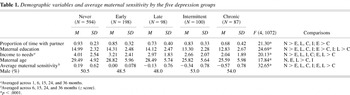
Demographic variables and average maternal sensitivity by the five depression groups
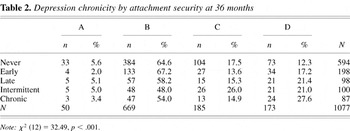
Depression chronicity by attachment security at 36 months
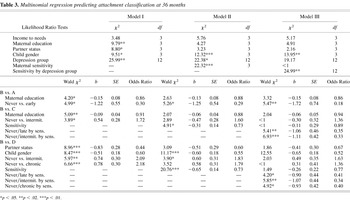
Multinomial regression predicting attachment classification at 36 months
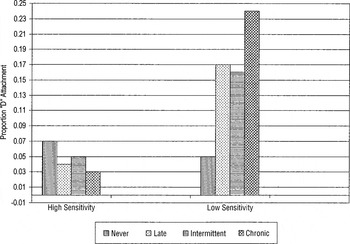
Interactions between depression group and maternal sensitivity in predicting insecure (D) attachment.
 You have
Access
- 204
- Cited by