In their keynote article, Goldrick, Putnam and Schwarz (Reference Goldrick, Putnam and Schwartz2016) present a computational account of code-mixing. Although they review literature on the co-activation of lexical representations and cognate facilitation effects in bilingual language processing, their model remains silent on how it interfaces with lexical factors, and how lexical factors impact code-switching. One such lexical factor is cognate status, which has been found to affect code-switching, as demonstrated in corpus analyses (e.g., Broersma & De Bot, Reference Broersma and de Bot2006) and psycholinguistic experiments (Kootstra, Van Hell & Dijkstra, Reference Kootstra, Van Hell and Dijkstra2012). For example, using the structural priming technique to examine the role of lexical factors in code-switching, Kootstra et al. asked Dutch–English bilinguals to repeat a code-switched prime sentence (starting in Dutch and ending in English) and then describe a target picture by means of a code-switched sentence (also from Dutch into English). They observed that bilinguals' tendency to switch at the same position as in the prime sentence was increased when the prime sentence and target picture contained cognates.
To examine whether Goldrick et al.’s model is flexible enough to tolerate lexically-specific information, we extended their sample computation to include the lexical property of cognate status. We considered four variants of input to Goldrick et al.’s Table A1 (gave/koɖutaa [3rd plural, grant]). Specifically, we replaced the object grant with the English–Tamil cognate pair mango-mangai. To model the activation of both cognate forms in bilinguals, we adapted Goldrick et al.’s approach with variable joint input activation, as illustrated in Goldrick et al.’s Tables 8 and 9. The four variants we considered had the following relative input activations:
-
Case 1: mango = 1, mangai = 0 (English direct object)
-
Case 2: mango = 0, mangai = 1 (Tamil direct object)
-
Case 3: mango = 0.5, mangai = 0.5 (Cognate with equal activation of English and Tamil)
-
Case 4: mango = 0.4, mangai = 0.6 (Cognate with Tamil-biased activation)
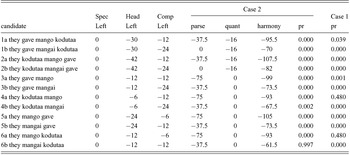
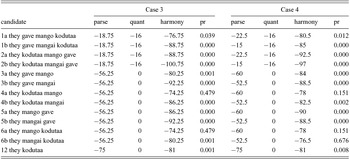
To test the effect of variable weighting on these candidates, we built a table corresponding to Goldrick et al.’s Table A1, in which the output candidates of the grammar fragment are revised to include both mango and mangai. Thus, the first candidate in Goldrick et al.’s Table A1, they gave grant koɖutaa, has two counterparts in our tables: (1a) they gave mango koɖutaa, and (1b) they gave mangai koɖutaa. In Tables 1 and 2, the (a) candidate is always equivalent to the version in Goldrick et al.’s Table A1, substituting only mango for grant, while the (b) candidate always used mangai.
Table 1.
Model output for Case 1 and 2.
Table 2.
Model output for Case 3 and 4. Values for specLeft, headLeft, and compLeft do not change from Case 2, and are therefore omitted here.
Case 1 behaved as expected: The probabilities predicted for the (a) candidate, containing the English direct object mango, matched their equivalents in Goldrick et al.’s Table A1. In Case 2, with the weights reversed to model a Tamil-only direct object, the model's predicted probabilities did not simply shift the probabilities to the (b) candidates, which differed only in using mangai rather than mango (Table 1, with Case 1 probabilities included for comparison). Rather, they showed a distinctly different distribution, along with the penalties for each constraint. As expected, the only two output candidates with non-zero probability are (b) candidates, containing mangai. However, the differences between the two distributions result from the asymmetrical weightings of compLeft between English and Tamil. The position of mango in the (a) candidates never incurs English-specific violations, while the position of mangai incurs Tamil-specific violations in every (b) candidate that places it anywhere beyond the left edge. Under the language-specific weightings proposed by Goldrick et al., doubling constructions are only possible when the direct object is English.
For Case 3, a cognate with equal activation in both languages, the model output is not some blend of Case 1 and Case 2, as we would expect, but nearly identical to Case 1, differing only in the now non-zero probability of candidate (6b; see Table 2).
In Case 4, where the weighting of the two cognate forms is biased towards Tamil, quite a different picture emerges (Table 2). Here, the predicted probabilities seem to be a more intuitive blend of Case 1 and Case 2. The non-zero probability of the doubling construction and the symmetrical probabilities of candidates (4a) and (6a) are consistent with Case 1, while the preference for (6b) is consistent with Case 2.
This demonstration shows that Goldrick et al.’s model is indeed flexible enough to incorporate cognate status, which we know can affect code-switching. Whether the predictions that emerge are accurate is an empirical question. Our demonstration has yielded two such predictions. First, the English and Tamil-specific weights for compLeft are different, while they are equivalent for specLeft. This predicts that the different probability distributions for possible outputs should be sensitive to whether the cognate is in object position, as we modeled here, or in subject position. Second, the modeling of equal activation of both cognate forms in Case 3 showed that the output probabilities are quite similar to those produced in Case 1, the English-only direct object. It required a distinct bias for mangai in Case 4 to produce a more intuitive combination of the probabilities predicted for English-only and Tamil-only direct objects. It would be interesting to see whether a similarly non-linear relationship between relative language (cognate) activation and code-mixing can be observed in experimental data.





 You have
Access
In their keynote article, Goldrick, Putnam and Schwarz (Reference Goldrick, Putnam and Schwartz2016) present a computational account of code-mixing. Although they review literature on the co-activation of lexical representations and cognate facilitation effects in bilingual language processing, their model remains silent on how it interfaces with lexical factors, and how lexical factors impact code-switching. One such lexical factor is cognate status, which has been found to affect code-switching, as demonstrated in corpus analyses (e.g., Broersma & De Bot, Reference Broersma and de Bot2006) and psycholinguistic experiments (Kootstra, Van Hell & Dijkstra, Reference Kootstra, Van Hell and Dijkstra2012). For example, using the structural priming technique to examine the role of lexical factors in code-switching, Kootstra et al. asked Dutch–English bilinguals to repeat a code-switched prime sentence (starting in Dutch and ending in English) and then describe a target picture by means of a code-switched sentence (also from Dutch into English). They observed that bilinguals' tendency to switch at the same position as in the prime sentence was increased when the prime sentence and target picture contained cognates.
To examine whether Goldrick et al.’s model is flexible enough to tolerate lexically-specific information, we extended their sample computation to include the lexical property of cognate status. We considered four variants of input to Goldrick et al.’s Table A1 (gave/koɖutaa [3rd plural, grant]). Specifically, we replaced the object grant with the English–Tamil cognate pair mango-mangai. To model the activation of both cognate forms in bilinguals, we adapted Goldrick et al.’s approach with variable joint input activation, as illustrated in Goldrick et al.’s Tables 8 and 9. The four variants we considered had the following relative input activations:
Case 1: mango = 1, mangai = 0 (English direct object)
Case 2: mango = 0, mangai = 1 (Tamil direct object)
Case 3: mango = 0.5, mangai = 0.5 (Cognate with equal activation of English and Tamil)
Case 4: mango = 0.4, mangai = 0.6 (Cognate with Tamil-biased activation)
To test the effect of variable weighting on these candidates, we built a table corresponding to Goldrick et al.’s Table A1, in which the output candidates of the grammar fragment are revised to include both mango and mangai. Thus, the first candidate in Goldrick et al.’s Table A1, they gave grant koɖutaa, has two counterparts in our tables: (1a) they gave mango koɖutaa, and (1b) they gave mangai koɖutaa. In Tables 1 and 2, the (a) candidate is always equivalent to the version in Goldrick et al.’s Table A1, substituting only mango for grant, while the (b) candidate always used mangai.
Model output for Case 1 and 2.
Model output for Case 3 and 4. Values for specLeft, headLeft, and compLeft do not change from Case 2, and are therefore omitted here.
Case 1 behaved as expected: The probabilities predicted for the (a) candidate, containing the English direct object mango, matched their equivalents in Goldrick et al.’s Table A1. In Case 2, with the weights reversed to model a Tamil-only direct object, the model's predicted probabilities did not simply shift the probabilities to the (b) candidates, which differed only in using mangai rather than mango (Table 1, with Case 1 probabilities included for comparison). Rather, they showed a distinctly different distribution, along with the penalties for each constraint. As expected, the only two output candidates with non-zero probability are (b) candidates, containing mangai. However, the differences between the two distributions result from the asymmetrical weightings of compLeft between English and Tamil. The position of mango in the (a) candidates never incurs English-specific violations, while the position of mangai incurs Tamil-specific violations in every (b) candidate that places it anywhere beyond the left edge. Under the language-specific weightings proposed by Goldrick et al., doubling constructions are only possible when the direct object is English.
For Case 3, a cognate with equal activation in both languages, the model output is not some blend of Case 1 and Case 2, as we would expect, but nearly identical to Case 1, differing only in the now non-zero probability of candidate (6b; see Table 2).
In Case 4, where the weighting of the two cognate forms is biased towards Tamil, quite a different picture emerges (Table 2). Here, the predicted probabilities seem to be a more intuitive blend of Case 1 and Case 2. The non-zero probability of the doubling construction and the symmetrical probabilities of candidates (4a) and (6a) are consistent with Case 1, while the preference for (6b) is consistent with Case 2.
This demonstration shows that Goldrick et al.’s model is indeed flexible enough to incorporate cognate status, which we know can affect code-switching. Whether the predictions that emerge are accurate is an empirical question. Our demonstration has yielded two such predictions. First, the English and Tamil-specific weights for compLeft are different, while they are equivalent for specLeft. This predicts that the different probability distributions for possible outputs should be sensitive to whether the cognate is in object position, as we modeled here, or in subject position. Second, the modeling of equal activation of both cognate forms in Case 3 showed that the output probabilities are quite similar to those produced in Case 1, the English-only direct object. It required a distinct bias for mangai in Case 4 to produce a more intuitive combination of the probabilities predicted for English-only and Tamil-only direct objects. It would be interesting to see whether a similarly non-linear relationship between relative language (cognate) activation and code-mixing can be observed in experimental data.