Refine search
Actions for selected content:
28 results
On odd powers of nonnegative polynomials that are not sums of squares
- Part of
-
- Journal:
- Forum of Mathematics, Sigma / Volume 14 / 2026
- Published online by Cambridge University Press:
- 27 April 2026, e65
-
- Article
-
- You have access
- Open access
- HTML
- Export citation
-
We initiate a systematic study of nonnegative polynomials P such that
 $P^k$ is not a sum of squares for any odd
 $k\geq 1$, calling such P stubborn. We develop a new invariant of a real isolated zero of a nonnegative polynomial in the plane, that we call the SOS-invariant, and relate it to the well-known delta invariant of a plane curve singularity. Using the SOS-invariant we show that any polynomial that spans an extreme ray of the convex cone of nonnegative ternary forms of degree 6 is stubborn. We also show how to use the SOS-invariant to prove stubbornness of ternary forms in higher degree. Furthermore, we prove that in a given degree and number of variables, nonnegative polynomials that are not stubborn form a convex cone, whose interior consists of all strictly positive polynomials.


Log canonical thresholds of high multiplicity reduced plane curves
- Part of
-
- Journal:
- Glasgow Mathematical Journal , First View
- Published online by Cambridge University Press:
- 17 April 2026, pp. 1-13
-
- Article
-
- You have access
- Open access
- HTML
- Export citation
-
We compute log canonical thresholds of reduced plane curves of degree
 $d$ at points of multiplicity
 $d-1$. As a consequence, we describe all possible values of log canonical threshold that are less than
 $2/(d-1)$ for reduced plane curves of degree
 $d$. In addition, we compute log canonical thresholds for all reduced plane curves of degree less than 6.


Gorenstein contractions of multiscale differentials
- Part of
-
- Article
-
- You have access
- Open access
- HTML
- Export citation
Hyperelliptic Gorenstein curves and logarithmic differentials
- Part of
-
- Journal:
- Forum of Mathematics, Sigma / Volume 12 / 2024
- Published online by Cambridge University Press:
- 20 December 2024, e127
-
- Article
-
- You have access
- Open access
- HTML
- Export citation
The analytic classification of plane curves
- Part of
-
- Journal:
- Compositio Mathematica / Volume 160 / Issue 4 / April 2024
- Published online by Cambridge University Press:
- 19 March 2024, pp. 915-944
- Print publication:
- April 2024
-
- Article
-
- You have access
- HTML
- Export citation
Global index of real polynomials
- Part of
-
- Journal:
- Proceedings of the Royal Society of Edinburgh. Section A: Mathematics / Volume 155 / Issue 6 / December 2025
- Published online by Cambridge University Press:
- 18 March 2024, pp. 2020-2048
- Print publication:
- December 2025
-
- Article
-
- You have access
- HTML
- Export citation
-
We develop two methods for expressing the global index of the gradient of a 2 variable polynomial function $f$
 : in terms of the atypical fibres of $f$
 , and in terms of the clusters of Milnor arcs at infinity. These allow us to derive upper bounds for the global index, in particular refining the one that was found by Durfee in terms of the degree of $f$
 .


Surgeries on iterated torus knots bounding rational homology 4-balls
- Part of
-
- Journal:
- Proceedings of the Edinburgh Mathematical Society / Volume 66 / Issue 2 / May 2023
- Published online by Cambridge University Press:
- 23 June 2023, pp. 557-578
-
- Article
-
- You have access
- HTML
- Export citation
-
We show that all large enough positive integral surgeries on algebraic knots bound a 4-manifold with a negative definite plumbing tree, which we describe explicitly. Then we apply the lattice embedding obstruction coming from Donaldson’s Theorem to classify the ones of the form
 $S^3_n(T(p_1,k_1p_1+1; p_2, k_2p_2\pm 1))$ that also bound rational homology 4-balls.
Nonemptiness of severi varieties on enriques surfaces
- Part of
-
- Journal:
- Forum of Mathematics, Sigma / Volume 11 / 2023
- Published online by Cambridge University Press:
- 19 June 2023, e52
-
- Article
-
- You have access
- Open access
- HTML
- Export citation
-
Let
 $(S,L)$ be a general polarised Enriques surface, with L not numerically 2-divisible. We prove the existence of regular components of all Severi varieties of irreducible nodal curves in the linear system
 $|L|$, that is, for any number of nodes
 $\delta =0, \ldots , p_a(L)-1$. This solves a classical open problem and gives a positive answer to a recent conjecture of Pandharipande–Schmitt, under the additional condition of non-2-divisibility.


On one-dimensional local rings and Berger’s conjecture
- Part of
-
- Journal:
- Proceedings of the Edinburgh Mathematical Society / Volume 66 / Issue 2 / May 2023
- Published online by Cambridge University Press:
- 23 May 2023, pp. 437-452
-
- Article
-
- You have access
- HTML
- Export citation
-
Let k be a field of characteristic zero and let
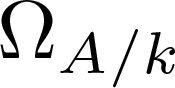 $\Omega_{A/k}$ be the universally finite differential module of a k-algebra A, which is the local ring of a closed point of an algebraic or algebroid curve over k. A notorious open problem, known as Berger’s Conjecture, predicts that A must be regular if
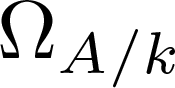 $\Omega_{A/k}$ is torsion-free. In this paper, assuming the hypotheses of the conjecture and observing that the module
 ${\rm Hom}_A(\Omega_{A/k}, \Omega_{A/k})$ is then isomorphic to an ideal of A, say
 $\mathfrak{h}$, we show that A is regular whenever the ring
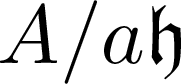 $A/a\mathfrak{h}$ is Gorenstein for some parameter a (and conversely). In addition, we provide various characterizations for the regularity of A in the context of the conjecture.

Deformations of arcs and comparison of formal neighborhoods for a curve singularity
- Part of
-
- Journal:
- Forum of Mathematics, Sigma / Volume 11 / 2023
- Published online by Cambridge University Press:
- 14 April 2023, e31
-
- Article
-
- You have access
- Open access
- HTML
- Export citation
-
Let
 $ {\mathcal C} $ be an algebraic curve and c be an analytically irreducible singular point of
 ${\mathcal C}$. The set
 ${\mathscr {L}_{\infty }}({\mathcal C})^c$ of arcs with origin c is an irreducible closed subset of the space of arcs on
 ${\mathcal C}$. We obtain a presentation of the formal neighborhood of the generic point of this set which can be interpreted in terms of deformations of the generic arc defined by this point. This allows us to deduce a strong connection between the aforementioned formal neighborhood and the formal neighborhood in the arc space of any primitive parametrization of the singularity c. This may be interpreted as the fact that analytically along
 ${\mathscr {L}_{\infty }}({\mathcal C})^c$ the arc space is a product of a finite dimensional singularity and an infinite dimensional affine space.


The symplectic isotopy problem for rational cuspidal curves
- Part of
-
- Journal:
- Compositio Mathematica / Volume 158 / Issue 7 / July 2022
- Published online by Cambridge University Press:
- 16 September 2022, pp. 1595-1682
- Print publication:
- July 2022
-
- Article
-
- You have access
- Open access
- HTML
- Export citation
ON THE FIRST STEPS OF THE MINIMAL MODEL PROGRAM FOR THE MODULI SPACE OF STABLE POINTED CURVES
- Part of
-
- Journal:
- Journal of the Institute of Mathematics of Jussieu / Volume 22 / Issue 1 / January 2023
- Published online by Cambridge University Press:
- 22 April 2021, pp. 145-211
- Print publication:
- January 2023
-
- Article
-
- You have access
- Open access
- Export citation
Triviality Properties of Principal Bundles on Singular Curves. II
- Part of
-
- Journal:
- Canadian Mathematical Bulletin / Volume 63 / Issue 2 / June 2020
- Published online by Cambridge University Press:
- 24 January 2020, pp. 423-433
- Print publication:
- June 2020
-
- Article
-
- You have access
- Export citation
-
For
 $G$ a split semi-simple group scheme and
 $P$ a principal
 $G$-bundle on a relative curve
 $X\rightarrow S$, we study a natural obstruction for the triviality of
 $P$ on the complement of a relatively ample Cartier divisor
 $D\subset X$. We show, by constructing explicit examples, that the obstruction is nontrivial if
 $G$ is not simply connected, but it can be made to vanish by a faithfully flat base change, if
 $S$ is the spectrum of a dvr (and some other hypotheses). The vanishing of this obstruction is shown to be a sufficient condition for étale local triviality if
 $S$ is a smooth curve, and the singular locus of
 $X-D$ is finite over
 $S$.


The Action of a Plane Singular Holomorphic Flow on a Non-invariant Branch
- Part of
-
- Journal:
- Canadian Journal of Mathematics / Volume 72 / Issue 4 / August 2020
- Published online by Cambridge University Press:
- 22 April 2019, pp. 835-866
- Print publication:
- August 2020
-
- Article
-
- You have access
- Export citation
-
We study the dynamics of a singular holomorphic vector field at
 $(\mathbb{C}^{2},0)$. Using the associated flow and its pullback to the blow-up manifold, we provide invariants relating the vector field, a non-invariant analytic branch of curve, and the deformation of this branch by the flow. This leads us to study the conjugacy classes of singular branches under the action of holomorphic flows. In particular, we show that there exists an analytic class that is not complete, meaning that there are two elements of the class that are not analytically conjugated by a local biholomorphism embedded in a one-parameter flow. Our techniques are new and offer an approach dual to the one used classically to study singularities of holomorphic vector fields.

MOTIVIC HILBERT ZETA FUNCTIONS OF CURVES ARE RATIONAL
- Part of
-
- Journal:
- Journal of the Institute of Mathematics of Jussieu / Volume 19 / Issue 3 / May 2020
- Published online by Cambridge University Press:
- 31 October 2018, pp. 947-964
- Print publication:
- May 2020
-
- Article
-
- You have access
- Export citation
-
The motivic Hilbert zeta function of a variety
 $X$ is the generating function for classes in the Grothendieck ring of varieties of Hilbert schemes of points on
 $X$. In this paper, the motivic Hilbert zeta function of a reduced curve is shown to be rational.


BETTI NUMBERS FOR CERTAIN COHEN–MACAULAY TANGENT CONES
- Part of
-
- Journal:
- Bulletin of the Australian Mathematical Society / Volume 99 / Issue 1 / February 2019
- Published online by Cambridge University Press:
- 30 August 2018, pp. 68-77
- Print publication:
- February 2019
-
- Article
-
- You have access
- Export citation
-
We compute Betti numbers for a Cohen–Macaulay tangent cone of a monomial curve in the affine
 $4$-space corresponding to a pseudo-symmetric numerical semigroup. As a byproduct, we also show that for these semigroups, being of homogeneous type and homogeneous are equivalent properties.

VANISHING OF THE NEGATIVE HOMOTOPY
 $K$-THEORY OF QUOTIENT SINGULARITIES
- Part of
-
- Journal:
- Journal of the Institute of Mathematics of Jussieu / Volume 18 / Issue 3 / May 2019
- Published online by Cambridge University Press:
- 08 May 2017, pp. 619-627
- Print publication:
- May 2019
-
- Article
-
- You have access
- Export citation
-
Making use of Gruson–Raynaud’s technique of ‘platification par éclatement’, Kerz and Strunk proved that the negative homotopy
 $K$-theory groups of a Noetherian scheme
 $X$ of Krull dimension
 $d$ vanish below
 $-d$. In this article, making use of noncommutative algebraic geometry, we improve this result in the case of quotient singularities by proving that the negative homotopy
 $K$-theory groups vanish below
 $-1$. Furthermore, in the case of cyclic quotient singularities, we provide an explicit ‘upper bound’ for the first negative homotopy
 $K$-theory group.


Motivic zeta functions for curve singularities
-
- Journal:
- Nagoya Mathematical Journal / Volume 198 / June 2010
- Published online by Cambridge University Press:
- 11 January 2016, pp. 47-75
-
- Article
-
- You have access
- Export citation
Hilbert schemes of points on a locally planar curve and the Severi strata of its versal deformation
- Part of
-
- Journal:
- Compositio Mathematica / Volume 148 / Issue 2 / March 2012
- Published online by Cambridge University Press:
- 26 January 2012, pp. 531-547
- Print publication:
- March 2012
-
- Article
-
- You have access
- Export citation
Modular compactifications of the space of pointed elliptic curves II
- Part of
-
- Journal:
- Compositio Mathematica / Volume 147 / Issue 6 / November 2011
- Published online by Cambridge University Press:
- 30 August 2011, pp. 1843-1884
- Print publication:
- November 2011
-
- Article
-
- You have access
- Export citation
-
We prove that the moduli spaces of n-pointed m-stable curves introduced in our previous paper have projective coarse moduli. We use the resulting spaces to run an analogue of Hassett’s log minimal model program for
 .
 .
