Refine search
Actions for selected content:
30 results
Eulerian posets and $Z$
 -polynomials
- Part of
-
- Journal:
- Forum of Mathematics, Sigma / Volume 14 / 2026
- Published online by Cambridge University Press:
- 10 August 2026, e120
-
- Article
-
- You have access
- Open access
- HTML
- Export citation
-
Let $P$
 be a finite partially ordered set. In a recent series of works, Proudfoot introduced the notion of $Z$
 -polynomials associated with $P$
 -kernels, providing a unified framework for various intersection cohomology Poincaré polynomials arising in diverse areas of mathematics. One of the problems posed by Proudfoot was to interpret the $Z$
 -polynomial in a fundamental setting – namely, when $P$
 is the lattice of faces of a convex polytope (or, more generally, an Eulerian poset). We resolve this problem by proving that the $Z$
 -polynomial of any Eulerian poset coincides with the toric $h$
 -polynomial of the poset of all (possibly empty) closed intervals of $P$
 , ordered by reverse inclusion. Under suitable polyhedral conditions, this result identifies the $Z$
 -polynomial of a polytope with the Poincaré polynomial of the intersection cohomology of an associated auxiliary polytope. We prove some results about the Chow polynomials of the poset of intervals of an Eulerian poset and relate them to the Veronese transforms of polynomials.


The quasisymmetric flag variety: A toric complex on noncrossing partitions
- Part of
-
- Journal:
- Forum of Mathematics, Pi / Volume 14 / 2026
- Published online by Cambridge University Press:
- 10 July 2026, e18
-
- Article
-
- You have access
- Open access
- HTML
- Export citation
Exponential valuations on lattice polygons
- Part of
-
- Journal:
- Canadian Journal of Mathematics , First View
- Published online by Cambridge University Press:
- 25 March 2026, pp. 1-20
-
- Article
-
- You have access
- Open access
- HTML
- Export citation
-
We classify translatively exponential and
 $\mathrm {GL}(2,\mathbb Z)$ covariant valuations on lattice polygons with values in the space of real (complex) measurable functions. A typical example of such valuations is induced by the Laplace transform, but as it turns out there are many more. The argument uses the ergodicity of the linear action of
 $\mathrm {SL}(2,\mathbb Z)$ on
 $\mathbb R^2$, and some elementary properties of the Fibonacci numbers.


Lorentzian polynomials on cones
- Part of
-
- Journal:
- Forum of Mathematics, Sigma / Volume 14 / 2026
- Published online by Cambridge University Press:
- 26 January 2026, e16
-
- Article
-
- You have access
- Open access
- HTML
- Export citation
Root, flow and order polytopes with connections to toric geometry
- Part of
-
- Journal:
- Forum of Mathematics, Sigma / Volume 13 / 2025
- Published online by Cambridge University Press:
- 26 November 2025, e194
-
- Article
-
- You have access
- Open access
- HTML
- Export citation
-
In this paper, we study the class of polytopes which can be obtained by taking the convex hull of some subset of the points
 $\{e_i-e_j \ \vert \ i \neq j\} \cup \{\pm e_i\}$ in
 $\mathbb {R}^n$, where
 $e_1,\dots ,e_n$ is the standard basis of
 $\mathbb {R}^n$. Such a polytope can be encoded by a quiver Q with vertices
 $V \subseteq \{{\upsilon }_1,\dots ,{\upsilon }_n\} \cup \{\star \}$, where each edge
 ${\upsilon }_j\to {\upsilon }_i$ or
 $\star \to {\upsilon }_i$ or
 ${\upsilon }_i\to \star $ gives rise to the point
 $e_i-e_j$ or
 $e_i$ or
 $-e_i$, respectively; we denote the corresponding polytope as
 $\operatorname {Root}(Q)$. These polytopes have been studied extensively under names such as edge polytope and root polytope. We show that if the quiver Q is strongly-connected, then the root polytope
 $\operatorname {Root}(Q)$ is reflexive and terminal; we moreover give a combinatorial description of the facets of
 $\operatorname {Root}(Q)$. We also show that if Q is planar, then
 $\operatorname {Root}(Q)$ is (integrally equivalent to) the polar dual of the flow polytope of the planar dual quiver
 $Q^{\vee }$. Finally, we consider the case that Q comes from the Hasse diagram of a finite ranked poset P and show in this case that
 $\operatorname {Root}(Q)$ is polar dual to (a translation of) a marked order polytope. We then go on to study the toric variety
 $Y(\mathcal {F}_Q)$ associated to the face fan
 $\mathcal {F}_Q$ of
 $\operatorname {Root}(Q)$. If Q comes from a ranked poset P, we give a combinatorial description of the Picard group of
 $Y(\mathcal {F}_Q)$, in terms of a new canonical ranked extension of P, and we show that
 $Y(\mathcal {F}_Q)$ is a small partial desingularisation of the Hibi projective toric variety
 $Y_{\mathcal {O}(P)}$ of the order polytope
 $\mathcal {O}(P)$. We show that
 $Y(\mathcal {F}_Q)$ has a small crepant toric resolution of singularities
 $Y(\widehat {\mathcal {F}}_Q)$ and, as a consequence that the Hibi toric variety
 $Y_{\mathcal {O}(P)}$ has a small resolution of singularities for any ranked poset P. These results have applications to mirror symmetry [61].


Unimodular valuations beyond Ehrhart
- Part of
-
- Journal:
- Forum of Mathematics, Sigma / Volume 13 / 2025
- Published online by Cambridge University Press:
- 19 November 2025, e188
-
- Article
-
- You have access
- Open access
- HTML
- Export citation
Initial degenerations of flag varieties
- Part of
-
- Journal:
- Mathematical Proceedings of the Cambridge Philosophical Society / Volume 180 / Issue 2 / March 2026
- Published online by Cambridge University Press:
- 10 November 2025, pp. 403-431
- Print publication:
- March 2026
-
- Article
-
- You have access
- HTML
- Export citation
-
We prove that the initial degenerations of the flag variety admit closed immersions into finite inverse limits of flag matroid strata, where the diagrams are derived from matroidal subdivisions of a suitable flag matroid polytope. As an application, we prove that the initial degenerations of
 $\mathrm{F}\ell^{\circ}(n)$–the open subvariety of the complete flag variety
 $\mathrm{F}\ell(n)$ consisting of flags in general position—are smooth and irreducible when
 $n\leq 4$. We also study the Chow quotient of
 $\mathrm{F}\ell(n)$ by the diagonal torus of
 $\textrm{PGL}(n)$ and show that, for
 $n=4$, this is a log crepant resolution of its log canonical model.


Equivariant Ehrhart theory of hypersimplices
- Part of
-
- Journal:
- Forum of Mathematics, Sigma / Volume 13 / 2025
- Published online by Cambridge University Press:
- 27 October 2025, e178
-
- Article
-
- You have access
- Open access
- HTML
- Export citation
-
We study the hypersimplex under the action of the symmetric group
 $S_n$ by coordinate permutation. We prove that its equivariant volume, given by the evaluation of its equivariant
 $H^*$-series at
 $1$, is the permutation character of decorated ordered set partitions under the natural action of
 $S_n$. This verifies a conjecture of Stapledon for the hypersimplex. To prove this result, we give a formula for the coefficients of the
 $H^*$-polynomial. Additionally, for the
 $(2,n)$-hypersimplex, we use this formula to show that trivial character need not appear as a direct summand of a coefficient of the
 $H^*$-polynomial, which gives a family of counterexamples to a different conjecture of Stapledon.


THE UNIFICATION TYPE OF ŁUKASIEWICZ LOGIC WITH A BOUNDED NUMBER OF VARIABLES
- Part of
-
- Journal:
- The Journal of Symbolic Logic , First View
- Published online by Cambridge University Press:
- 08 October 2025, pp. 1-18
-
- Article
-
- You have access
- Open access
- HTML
- Export citation
-
Building on the correspondence between finitely axiomatised theories in Łukasiewicz logic and rational polyhedra, we prove that the unification type of the fragment of Łukasiewicz logic with
 $n\geqslant 2$ variables is nullary. This solves a problem left open by V. Marra and L. Spada [Ann. Pure Appl. Logic 164 (2013), pp. 192–210]. Furthermore, we refine the study of unification with bounds on the number of variables. Our proposal distinguishes the number m of variables allowed in the problem and the number n in the solution. We prove that the unification type of Łukasiewicz logic for all
 $m,n \geqslant 2$ is nullary.


Empty simplices of large width
- Part of
-
- Journal:
- Forum of Mathematics, Sigma / Volume 13 / 2025
- Published online by Cambridge University Press:
- 03 February 2025, e21
-
- Article
-
- You have access
- Open access
- HTML
- Export citation
-
An empty simplex is a lattice simplex in which vertices are the only lattice points. We show two constructions leading to the first known empty simplices of width larger than their dimension:
◦ We introduce cyclotomic simplices and exhaustively compute all the cyclotomic simplices of dimension
 $10$ and volume up to
 $2^{31}$. Among them, we find five empty ones of width
 $11$ and none of larger width.
◦ Using circulant matrices of a very specific form, we construct empty simplices of arbitrary dimension d and width growing asymptotically as
 $d/\operatorname {\mathrm {arcsinh}}(1) \sim 1.1346\,d$.


Lattice points in slices of prisms
- Part of
-
- Journal:
- Canadian Journal of Mathematics / Volume 77 / Issue 3 / June 2025
- Published online by Cambridge University Press:
- 08 March 2024, pp. 1013-1040
- Print publication:
- June 2025
-
- Article
-
- You have access
- Open access
- HTML
- Export citation
-
We conduct a systematic study of the Ehrhart theory of certain slices of rectangular prisms. Our polytopes are generalizations of the hypersimplex and are contained in the larger class of polypositroids introduced by Lam and Postnikov; moreover, they coincide with polymatroids satisfying the strong exchange property up to an affinity. We give a combinatorial formula for all the Ehrhart coefficients in terms of the number of weighted permutations satisfying certain compatibility properties. This result proves that all these polytopes are Ehrhart positive. Additionally, via an extension of a result by Early and Kim, we give a combinatorial interpretation for all the coefficients of the
 $h^*$-polynomial. All of our results provide a combinatorial understanding of the Hilbert functions and the h-vectors of all algebras of Veronese type, a problem that had remained elusive up to this point. A variety of applications are discussed, including expressions for the volumes of these slices of prisms as weighted combinations of Eulerian numbers; some extensions of Laplace’s result on the combinatorial interpretation of the volume of the hypersimplex; a multivariate generalization of the flag Eulerian numbers and refinements; and a short proof of the Ehrhart positivity of the independence polytope of all uniform matroids.

Unwinding Toric Degenerations and Mirror Symmetry for Grassmannians
- Part of
-
- Journal:
- Forum of Mathematics, Sigma / Volume 10 / 2022
- Published online by Cambridge University Press:
- 14 December 2022, e111
-
- Article
-
- You have access
- Open access
- HTML
- Export citation
-
The most fundamental example of mirror symmetry compares the Fermat hypersurfaces in
 $\mathbb {P}^n$ and
 $\mathbb {P}^n/G$, where G is a finite group that acts on
 $\mathbb {P}^n$ and preserves the Fermat hypersurface. We generalize this to hypersurfaces in Grassmannians, where the picture is richer and more complex. There is a finite group G that acts on the Grassmannian
 $\operatorname {{\mathrm {Gr}}}(n,r)$ and preserves an appropriate Calabi–Yau hypersurface. We establish how mirror symmetry, toric degenerations, blow-ups and variation of GIT relate the Calabi–Yau hypersurfaces inside
 $\operatorname {{\mathrm {Gr}}}(n,r)$ and
 $\operatorname {{\mathrm {Gr}}}(n,r)/G$. This allows us to describe a compactification of the Eguchi–Hori–Xiong mirror to the Grassmannian, inside a blow-up of the quotient of the Grassmannian by G.


On the maximum dual volume of a canonical Fano polytope
- Part of
-
- Journal:
- Forum of Mathematics, Sigma / Volume 10 / 2022
- Published online by Cambridge University Press:
- 13 December 2022, e109
-
- Article
-
- You have access
- Open access
- HTML
- Export citation
-
We give an upper bound on the volume
 $\operatorname {vol}(P^*)$ of a polytope
 $P^*$ dual to a d-dimensional lattice polytope P with exactly one interior lattice point in each dimension d. This bound, expressed in terms of the Sylvester sequence, is sharp and achieved by the dual to a particular reflexive simplex. Our result implies a sharp upper bound on the volume of a d-dimensional reflexive polytope. Translated into toric geometry, this gives a sharp upper bound on the anti-canonical degree
 $(-K_X)^d$ of a d-dimensional Fano toric variety X with at worst canonical singularities.


The moduli space of Harnack curves in toric surfaces
- Part of
-
- Journal:
- Forum of Mathematics, Sigma / Volume 9 / 2021
- Published online by Cambridge University Press:
- 27 May 2021, e43
-
- Article
-
- You have access
- Open access
- Export citation
-
In 2006, Kenyon and Okounkov Kenyon and Okounkov [12] computed the moduli space of Harnack curves of degree d in
 ${\mathbb {C}\mathbb {P}}^2$. We generalise their construction to any projective toric surface and show that the moduli space
 ${\mathcal {H}_\Delta }$ of Harnack curves with Newton polygon
 $\Delta $ is diffeomorphic to
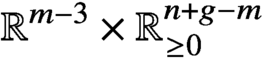 ${\mathbb {R}}^{m-3}\times {\mathbb {R}}_{\geq 0}^{n+g-m}$, where
 $\Delta $ has m edges, g interior lattice points and n boundary lattice points. This solves a conjecture of Crétois and Lang. The main result uses abstract tropical curves to construct a compactification of this moduli space where additional points correspond to collections of curves that can be patchworked together to produce a curve in
 ${\mathcal {H}_\Delta }$. This compactification has a natural stratification with the same poset as the secondary polytope of
 $\Delta $.


GEOMETRIC BIJECTIONS FOR REGULAR MATROIDS, ZONOTOPES, AND EHRHART THEORY
- Part of
-
- Journal:
- Forum of Mathematics, Sigma / Volume 7 / 2019
- Published online by Cambridge University Press:
- 04 December 2019, e45
-
- Article
-
- You have access
- Open access
- Export citation
-
Let
 $M$ be a regular matroid. The Jacobian group
 $\text{Jac}(M)$ of
 $M$ is a finite abelian group whose cardinality is equal to the number of bases of
 $M$. This group generalizes the definition of the Jacobian group (also known as the critical group or sandpile group)
 $\operatorname{Jac}(G)$ of a graph
 $G$ (in which case bases of the corresponding regular matroid are spanning trees of
 $G$). There are many explicit combinatorial bijections in the literature between the Jacobian group of a graph
 $\text{Jac}(G)$ and spanning trees. However, most of the known bijections use vertices of
 $G$ in some essential way and are inherently ‘nonmatroidal’. In this paper, we construct a family of explicit and easy-to-describe bijections between the Jacobian group of a regular matroid
 $M$ and bases of
 $M$, many instances of which are new even in the case of graphs. We first describe our family of bijections in a purely combinatorial way in terms of orientations; more specifically, we prove that the Jacobian group of
 $M$ admits a canonical simply transitive action on the set
 ${\mathcal{G}}(M)$ of circuit–cocircuit reversal classes of
 $M$, and then define a family of combinatorial bijections
 $\unicode[STIX]{x1D6FD}_{\unicode[STIX]{x1D70E},\unicode[STIX]{x1D70E}^{\ast }}$ between
 ${\mathcal{G}}(M)$ and bases of
 $M$. (Here
 $\unicode[STIX]{x1D70E}$ (respectively
 $\unicode[STIX]{x1D70E}^{\ast }$) is an acyclic signature of the set of circuits (respectively cocircuits) of
 $M$.) We then give a geometric interpretation of each such map
 $\unicode[STIX]{x1D6FD}=\unicode[STIX]{x1D6FD}_{\unicode[STIX]{x1D70E},\unicode[STIX]{x1D70E}^{\ast }}$ in terms of zonotopal subdivisions which is used to verify that
 $\unicode[STIX]{x1D6FD}$ is indeed a bijection. Finally, we give a combinatorial interpretation of lattice points in the zonotope
 $Z$; by passing to dilations we obtain a new derivation of Stanley’s formula linking the Ehrhart polynomial of
 $Z$ to the Tutte polynomial of
 $M$.


Interlacing polynomials and the veronese construction for rational formal power series
- Part of
-
- Journal:
- Proceedings of the Royal Society of Edinburgh. Section A: Mathematics / Volume 150 / Issue 1 / February 2020
- Published online by Cambridge University Press:
- 30 January 2019, pp. 1-16
- Print publication:
- February 2020
-
- Article
-
- You have access
- Export citation
-
Fixing a positive integer r and
 $0 \les k \les r-1$, define
 $f^{\langle r,k \rangle }$ for every formal power series f as
 $ f(x) = f^{\langle r,0 \rangle }(x^r)+xf^{\langle r,1 \rangle }(x^r)+ \cdots +x^{r-1}f^{\langle r,r-1 \rangle }(x^r).$ Jochemko recently showed that the polynomial
 $U^{n}_{r,k}\, h(x) := ( (1+x+\cdots +x^{r-1})^{n} h(x) )^{\langle r,k \rangle }$ has only non-positive zeros for any
 $r \ges \deg h(x) -k$ and any positive integer n. As a consequence, Jochemko confirmed a conjecture of Beck and Stapledon on the Ehrhart polynomial
 $h(x)$ of a lattice polytope of dimension n, which states that
 $U^{n}_{r,0}\,h(x)$ has only negative, real zeros whenever
 $r\ges n$. In this paper, we provide an alternative approach to Beck and Stapledon's conjecture by proving the following general result: if the polynomial sequence
 $( h^{\langle r,r-i \rangle }(x))_{1\les i \les r}$ is interlacing, so is
 $( U^{n}_{r,r-i}\, h(x) )_{1\les i \les r}$. Our result has many other interesting applications. In particular, this enables us to give a new proof of Savage and Visontai's result on the interlacing property of some refinements of the descent generating functions for coloured permutations. Besides, we derive a Carlitz identity for refined coloured permutations.


Flow Polytopes and the Space of Diagonal Harmonics
- Part of
-
- Journal:
- Canadian Journal of Mathematics / Volume 71 / Issue 6 / December 2019
- Published online by Cambridge University Press:
- 07 January 2019, pp. 1495-1521
- Print publication:
- December 2019
-
- Article
-
- You have access
- Export citation
-
A result of Haglund implies that the
 $(q,t)$-bigraded Hilbert series of the space of diagonal harmonics is a
 $(q,t)$-Ehrhart function of the flow polytope of a complete graph with netflow vector
 $(-n,1,\ldots ,1)$. We study the
 $(q,t)$-Ehrhart functions of flow polytopes of threshold graphs with arbitrary netflow vectors. Our results generalize previously known specializations of the mentioned bigraded Hilbert series at
 $t=1$,
 $0$, and
 $q^{-1}$. As a corollary to our results, we obtain a proof of a conjecture of Armstrong, Garsia, Haglund, Rhoades, and Sagan about the
 $(q,q^{-1})$-Ehrhart function of the flow polytope of a complete graph with an arbitrary netflow vector.


Galois theory for general systems of polynomial equations
- Part of
-
- Journal:
- Compositio Mathematica / Volume 155 / Issue 2 / February 2019
- Published online by Cambridge University Press:
- 07 January 2019, pp. 229-245
- Print publication:
- February 2019
-
- Article
-
- You have access
- HTML
- Export citation
Convex-normal (Pairs of) Polytopes
-
- Journal:
- Canadian Mathematical Bulletin / Volume 60 / Issue 3 / 01 September 2017
- Published online by Cambridge University Press:
- 20 November 2018, pp. 510-521
- Print publication:
- 01 September 2017
-
- Article
-
- You have access
- Export citation
-
In 2012, Gubeladze (Adv. Math. 2012) introduced the notion of
 $k$ -convex-normal polytopes to show that integral polytopes all of whose edges are longer than
 $4d(d+1)$ have the integer decomposition property. In the first part of this paper we show that for lattice polytopes there is no diòerence between $k$ - and
 $(k+1)$ -convex-normality (for
 $k\ge 3$ ) and improve the bound to
 $2d(d+1)$ . In the second part we extend the definition to pairs of polytopes. Given two rational polytopes
 $P$ and
 $\text{Q}$ , where the normal fan of $P$ is a refinement of the normal fan of $\text{Q}$ , if every edge
 ${{e}_{P}}$ of $P$ is at least
 $d$ times as long as the corresponding face (edge or vertex)
 ${{e}_{\text{Q}}}$ of $\text{Q}$ , then
 $(P+\text{Q})\cap {{\mathbb{Z}}^{d}}=(P\cap {{\mathbb{Z}}^{d}})+(\text{Q}\cap {{\mathbb{Z}}^{d}})$ .


On the equations and classification of toric quiver varieties
- Part of
-
- Journal:
- Proceedings of the Royal Society of Edinburgh. Section A: Mathematics / Volume 146 / Issue 2 / April 2016
- Published online by Cambridge University Press:
- 03 March 2016, pp. 265-295
- Print publication:
- April 2016
-
- Article
-
- You have access
- Export citation
