To save content items to your account,
please confirm that you agree to abide by our usage policies.
If this is the first time you use this feature, you will be asked to authorise Cambridge Core to connect with your account.
Find out more about saving content to .
To save content items to your Kindle, first ensure no-reply@cambridge.org
is added to your Approved Personal Document E-mail List under your Personal Document Settings
on the Manage Your Content and Devices page of your Amazon account. Then enter the ‘name’ part
of your Kindle email address below.
Find out more about saving to your Kindle.
Note you can select to save to either the @free.kindle.com or @kindle.com variations.
‘@free.kindle.com’ emails are free but can only be saved to your device when it is connected to wi-fi.
‘@kindle.com’ emails can be delivered even when you are not connected to wi-fi, but note that service fees apply.
This Element introduces the reader to the fascinating world of magical rituals performed in the ancient Near East and ancient Israel. It is designed for a diverse audience of professionals, students, and general readers. It surveys the definitions and history of research on magic in the ancient world, delineates the chronological and geographical boundaries of the ancient Near East, and details the pertinent sources of information. The Element distinguishes between different types of magical rituals and identifies their aims, beneficiaries, performers, and procedures. It sheds fresh light on the mechanics of ritual performance in the ancient Near East and explicates the rationales that guided it.
This chapter introduces the origins and development of international law in the ancient Near East, drawing on cuneiform sources from Mesopotamia, Syria, Anatolia and Iran. It outlines the evolution of political structures from city states to empires over three millennia, highlighting how norms of diplomacy, treaties, trade and warfare were shaped by customary practices rather than codified law. The chapter explores the geographical and historical context, the rediscovery of ancient texts and the role of religion and cosmology in shaping legal and diplomatic thought. It emphasizes the fragmentary yet rich nature of the evidence – treaties, letters and inscriptions – and argues for a coherent tradition of international norms rooted in moral and religious authority. The text also reflects on scholarly debates, including comparisons with biblical traditions and the limitations of Mesopotamian legal thought. Ultimately, it presents the ancient Near East as a foundational context for understanding the early development of international relations and law.
This chapter examines the legal and institutional frameworks governing international trade and communication in the ancient Near East, focusing on the third to first millennia BC. It highlights the uneven distribution of textual evidence across time and regions, with the richest sources coming from the Old Assyrian trade network in Anatolia during the early second millennium. Through treaties, letters and legal documents, the chapter explores how merchants and messengers operated across borders, the protections they received and the obligations they faced. It discusses the role of commercial treaties, trade partnerships and diplomatic exchanges, emphasising the integration of trade with political and legal systems. The chapter also addresses the regulation of foreign merchants residing abroad, the risks of long-distance trade and the mechanisms for dispute resolution. By analysing key sites such as Ebla, Mari, Kanesh and Ugarit, it provides a comprehensive view of how ancient states facilitated and controlled international commerce, laying early foundations for international trade law.
This chapter explores the mechanisms of international dispute settlement in the ancient Near East, emphasizing the role of superordinate kings, tribal actors and divine intervention. It begins with a chronological survey of how powerful rulers – such as the kings of Kish, Elam and Hatti – acted as arbiters in conflicts between subordinate states. A detailed case study of the divorce of Ammishtamru II of Ugarit illustrates the complexity of such disputes, involving multiple stakeholders, appeals and legal rulings. The chapter also highlights the influence of non-state actors, particularly tribal groups, and their own dispute resolution practices. Finally, it examines how gods functioned as arbiters through rituals like the river ordeal, treaty oaths and omen queries. These diverse methods reflect a rich and multifaceted system of international law in the ancient Near East, where political, social and religious dimensions were deeply intertwined in the pursuit of peaceful conflict resolution.
This chapter explores the intertwined concepts of war and peace in the political, religious and cultural frameworks of the ancient Near East, particularly in Mesopotamia and Assyria. It traces the evolution of warfare from early city state conflicts to the large-scale imperial campaigns of the first millennium BC. The text examines how war was legitimized through divine sanction, ritual practices and ideological narratives, portraying kings as divinely mandated warriors. It also details the organization of armies, military technologies and intelligence strategies, especially under the Neo-Assyrian Empire. Peace is presented not as the absence of war but as a condition imposed through treaties, vassalage and imperial control, often following conquest. The chapter highlights the theological and ritual dimensions of both war and peace, including divination, purification and treaty ceremonies. It concludes by addressing the human cost of war, the role of deportations, and the post-war integration of conquered peoples. Through a multidisciplinary lens, the chapter reveals how war and peace were central to statecraft, ideology and societal order in the ancient Near East.
Chapter 2 (The Biblical Portrayal of Transgressive Worship): In this chapter, I focus on the texts of the Hebrew Bible. I argue that these texts, when they picture the worship of other gods or the reverence of their icons, consistently assume that such worship is sincere (or, at the very least, do not question its sincerity).
This Element presents what we know about the construction of sexuality and the sex lives of the residents of ancient Mesopotamia, Anatolia, and the Levant. After briefly introducing the regions and cultures under consideration and the sources of data, the work turns to female and male experiences of sexuality, matters of fertility and infertility, sexual orientation, and finally sex crimes. Primary sources are heavily foregrounded so that readers may understand what the sources of information are on these topics and may see how scholars have come to the understandings that they have.
By accepting a later dating for the composition of the Histories, this article argues that Herodotus mirrors Athenian imperialism in his account of the First Persian War to convey a political message to contemporary recipients. In doing so, he departs from the prevailing tradition of the expedition of Datis and Artaphrenes by creating a narrative that manipulates Persian methods of conquest, presenting them in a manner that appears emblematic of Athenian imperialism. In this way, the Herodotean Persians do not adhere to their expected cultural script, but act out the Athenian script. This reading offers a new understanding of Herodotus’ account of the Persian campaign as conveying a message to the Athenians who began to recognize that their former policies toward their allies were transgressive imperialism. As a result, his account of the First Persian War is a sophisticated meditation on the effects of imperialism rather than a straightforward depiction of historical events.
In this book, Jonathan Valk asks a deceptively simple question: What did it mean to be Assyrian in the second millennium bce? Extraordinary evidence from Assyrian society across this millennium enables an answer to this question. The evidence includes tens of thousands of letters and legal texts from an Assyrian merchant diaspora in what is now modern Turkey, as well as thousands of administrative documents and bombastic royal inscriptions associated with the Assyrian state. Valk develops a new theory of social categories that facilitates an understanding of how collective identities work. Applying this theoretical framework to the so-called Old and Middle Assyrian periods, he pieces together the contours of Assyrian society in each period, as revealed in the abundance of primary evidence, and explores the evolving construction of Assyrian identity as well. Valk's study demonstrates how changing historical circumstances condition identity and society, and that the meaning we assign to identities is ever in flux.
This chapter discusses social concepts, notions and assumptions that prevailed in the ancient Near East concerning human sexuality. Its introduction supplies chronological, geographical, and cultural definitions to explicate what is meant by the term ‘ancient Near East’, and expands on the sources of information used in the chapter, their contributions and limitations. The introduction also elaborates on the categories and aspects of human sexuality discussed in the chapter. Subsequently, the chapter is organized thematically. Each theme focuses on a specific category of sexuality, which is discussed according to the pertinent sources of information available to us, including legal, literary, cultic, and others. The categories surveyed in the chapter are: Sex and Reproduction, Sex and the Body, Gender Norms and Inequality, Sex and Marriage, Sex and Slavery, Sex and Politics, Sex and Religious and Cultic Practices, and Sex and Criminal Law. The chapter demonstrates how different textual genres reflect the role of sexuality in ancient Near Eastern societies: official law regulated sexual behaviour, literary texts echoed social norms, and cultic texts related to a variety of matters that involved human sexuality. The chapter highlights topics such as male privilege and gender inequality, social hierarchy, and cultural differentiation.
Human belief systems and practices can be traced to ca. 10,000 BCE in the Ancient Near East, where the earliest evidence of ritual structures and objects can be found. Religious architecture, the relics of human skeletons, animal symbolism, statues, and icons all contributed to a complex network into which the spiritual essence of the divine was materially present. In this book, Nicola Laneri traces the transformation of the belief systems that shaped life in ancient Near Eastern communities, from prehistoric times until the advent of religious monotheism in the Levant during the first millennium BCE. Considering a range of evidence, from stone ceremonial enclosures, such as as Göbleki Tepe, to the construction of the first temples and icons of Mesopotamian polytheistic beliefs, to the Temple of Jerusalem, the iconic center of Israelite monotheism, Laneri offers new insights into the symbolic value embodied in the religious materiality produced in the ancient Near East.
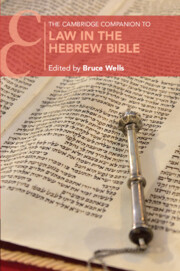
The introduction presents key ideas and terminology and answers several questions that will help readers understand the other chapters in the volume. It also explains important distinctions around the concept of biblical law and the pitfalls of reading it from a modern perspective.
This Companion offers a comprehensive overview of the history, nature, and legacy of biblical law. Examining the debates that swirl around the nature of biblical law, it explores its historical context, the significance of its rules, and its influence on early Judaism and Christianity. The volume also interrogates key questions: Were the rules intended to function as ancient Israel's statutory law? Is there evidence to indicate that they served a different purpose? What is the relationship between this legal material and other parts of the Hebrew Bible? Most importantly, the book provides an in-depth look at the content of the Torah's laws, with individual essays on substantive, procedural, and ritual law. With contributions from an international team of experts, written specially for this volume, The Cambridge Companion to Law in the Hebrew Bible provides an up-to-date look at scholarship on biblical law and outlines themes and topics for future research.
150 words: The books of Nahum, Habakkuk, and Zephaniah contain oracles that address problems in and around ancient Judah in ways that are as incisive and critical as they are optimistic and constructive. Daniel C. Timmer’s The Theology of Nahum, Habakkuk, and Zephaniah situates these books in their social and political contexts and examines the unique theology of each as it engages with imposing problems in Judah and beyond. In dialogue with recent scholarship, this study focuses on these books’ analysis and evaluation of the world as it is, focusing on both human beings and their actions and God’s commitment to purify, restore, and perfect the world. Timmer also surveys these books’ later theological use and cultural reception. Timmer also brings their theology into dialogue with concerns as varied as ecology, nationalism, and widespread injustice, highlighting the enduring significance of divine justice and grace for solid hope and effective service in our world.
50 words: This volume examines the powerful and poignant theology of the books of Nahum, Habakkuk, and Zephaniah. Daniel C. Timmer situates these books’ theology in their ancient Near Eastern contexts and traces its multifaceted contribution to Jewish and Christian theology and to broader cultural spheres, without neglecting its contemporary significance.
20 words: This volume draws out the theology of Nahum, Habakkuk, and Zephaniah, attending to their ancient contexts, past use and reception, and contemporary significance.
The books of Nahum, Habakkuk, and Zephaniah address problems in and around ancient Judah in ways that are as incisive and critical as they are optimistic and constructive. Daniel C. Timmer's The Theology of the Books of Nahum, Habakkuk, and Zephaniah situates these books in their social and political contexts, examining the unique theology of each as it engages thorny problems in Judah and beyond. In dialogue with recent scholarship, this study focuses on these books' analysis and evaluation of the world as it is, focusing on both human beings and their actions, and God's commitment to purify, restore, and perfect the world. Timmer also surveys these books' later theological use and cultural reception. His study brings their theology into dialogue with concerns as varied as ecology, nationalism, and widespread injustice. It highlights the enduring significance of divine justice and grace for solid hope and effective service in our world.
The aggression of the biblical God is notorious. The phrase 'Old Testament God' conjures up images of jealousy and wrath, smiting and judging. But is it only an accident that this god became capital-G God, the unique creator and sustainer of three world religions? Or is there a more substantive connection between monotheism and divine aggression? This Element proposes exactly this causal connection. In three case studies, it showcases ways that literarily treating one god alone as god amplifies divine destructiveness. This happens according to two dynamics: God absorbs the destructive power of other divine beings-and God monopolizes divinity such that other beings, even special ones like God's beloved king or the people of God, are rendered vulnerable to divine aggression. The Element also attends to the literary contexts and counterbalances within which the Hebrew Bible imagines divine aggression.
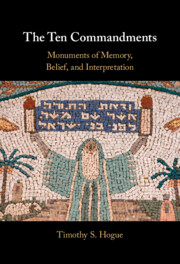
The Decalogue, commonly known as the Ten Commandments, is usually analysed as a text. Within the Hebrew Bible, however, it is depicted as a monument– an artifact embedded in rituals that a community uses to define itself. Indeed, the phraseology, visual representations, and ritual practices of contemporary monuments used to describe the Ten Commandments imbue them with authority. In this volume, Timothy Hogue, presents a new translation, commentary, and literary analysis of the Decalogue through a comparative study of the commandments with inscribed monuments in the ancient Levant. Drawing on archaeological and art historical studies of monumentality, he grounds the Decalogue's composition and redaction in the material culture and political history of ancient Israel and ancient West Asia. Presenting a new inner-biblical reception history of the text, Hogue's book also provides a new model for dating biblical texts that is based on archaeological and historical evidence, rather than purely literary critical methods.
This chapter concludes the argument of the book with a final comparison to Alvin Plantinga's Reformed Epistemology; challenges to theologians, philosophers, and biblical scholars; and suggests further avenues for research.
This chapter surveys the rise of the Abbasid family as a branch of the Prophet's Hashimite clan, and the background of discontent against the Umayyads. After focusing on the Abbasid revolution in Khurasan-Transoxiana (747-750), the chapter surveys the consolidation of Abbasid rule under the caliph al-Mansur, and the establishment of a new capital at Baghdad in 762. The transition to the reign of al-Mahdi shows the first signs of Abbasid bureaucracy with the Barmakid ministers, and the emergence of an Islamic ideology, with an emphasis on patronizing the 'ulama and supporting the pilgrimage to Mecca.
This chapter considers how to separate scholarly, speculative, and philosophical works in the literary traditions a thousand years prior to Greek philosophy. By wrestling with the muddled definitions of philosophy today, we ask why the biblical literature would not also count as philosophy and examine the ancient Near Eastern and Asian philosophical scholarship that might support the its inclusion.