To save content items to your account,
please confirm that you agree to abide by our usage policies.
If this is the first time you use this feature, you will be asked to authorise Cambridge Core to connect with your account.
Find out more about saving content to .
To save content items to your Kindle, first ensure no-reply@cambridge.org
is added to your Approved Personal Document E-mail List under your Personal Document Settings
on the Manage Your Content and Devices page of your Amazon account. Then enter the ‘name’ part
of your Kindle email address below.
Find out more about saving to your Kindle.
Note you can select to save to either the @free.kindle.com or @kindle.com variations.
‘@free.kindle.com’ emails are free but can only be saved to your device when it is connected to wi-fi.
‘@kindle.com’ emails can be delivered even when you are not connected to wi-fi, but note that service fees apply.
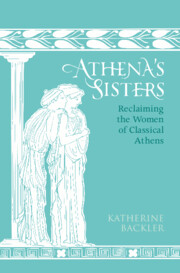
Athena's Sisters transforms our understanding of Classical Athenian culture and society by approaching its institutions—kinship, slavery, the economy, social organisation—from women's perspectives. It argues that texts on dedications and tombstones set up by women were frequently authored by those women. This significant body of women's writing offers direct insights into their experiences, values, and emotions. With men often absent, women redefined the boundaries of the family in dialogue with patriarchal legal frameworks. Beyond male social and political structures, women defined their identities and relationships through their own institutions. By focusing on women's engagement with other women, rather than their relationships to men, this timely and necessary book reveals the richness and dynamism of women's lives and their remarkable capacity to shape Athenian society and history.
The story of Diognete, a late fifth-century Athenian woman, provides a lens for thinking about how to write the history of women in classical Athens. The introduction considers the value of biographical approaches and other tools which treat women as individual subjects rather than members of categories. It explains the author’s decision to assign names to women whose names are lost or suppressed in the evidence, repositioning them as subjects of their own lives. It argues that the texts on inscribed dedications and gravestones commissioned by women were determined by the women themselves, leaving us with myriad female-authored texts. These texts inform the book’s experiential approach, which focuses on women’s own experiences of their lives.
Study of ancient warfare has become increasingly the domain of specialist historians of war. This book sets itself against that, insisting that wars are political, social and cultural events, not simply military events – and that this war, in particular, because we have such rich source material in Athenian literature, epigraphy and archaeology beyond Thucydides, provides an exceptionally good lens through which to examine a society, polity and culture under pressure. In this, this book differs from past studies of the Peloponnesian War which, almost without exception, have essentially rewritten Thucydides. By contrast this book tries to examine the Peloponnesian War not only as a textual event but as an historical event. The book therefore looks at the war as a war, with causes and a course, but also as a manifestation of the entanglement between Greek cities, as a product and shaper of empire, as a political upheaval, as a challenge in political thought, as a reshaping of the way the local and wider world was understood and as a religious crisis.
The contributions to fifth-century Athenian culture by non-Athenian poets and prose writers were immeasurably greater than the surviving remains indicate. Anaxagoras, Diogenes and probably also Democritus brought the fruits of rational explorations of the physical universe, and the sophists had accompanied their teaching of rhetoric by far-reaching rational analyses and criticisms of the structure of human society and the problems besetting it. All layers of Athenian society will have been beneficiaries of the stimulus which the influx of foreigners brought to the economic life of the city. But their impact on its cultural life will have been most immediately felt by the upper classes. The doctrines of the Ionian physicists as popularized by the rationalism of the sophists were thought to be doing precisely that and were regarded by many as a threat to the established Greek religion.
The only statement which can be made with security about Athenian society and economy in the Periclean period is that they were evolving rapidly but unsystematically. Settlement and landholding patterns are being seen to have generated specific aspects both of the economy and of public finances. The conceptual distinctions between economy, society and polity are being used more confidently. Fiscal demands emerge as generating a system of economic and social interactions. The more the study of the Athenian legal system emancipates itself from presuppositions derived from Roman law to take seriously the role of juries in forming and reflecting social norms. An eventual systematic treatment of the female-male relationship as a component of Athenian society will probably obliterate much current Athenian social history, but its chronological focus will have to be the semi-visible century from 430 to 320 rather than the near-darkness of the Periclean period.
Recommend this
Email your librarian or administrator to recommend adding this to your organisation's collection.