To save content items to your account,
please confirm that you agree to abide by our usage policies.
If this is the first time you use this feature, you will be asked to authorise Cambridge Core to connect with your account.
Find out more about saving content to .
To save content items to your Kindle, first ensure no-reply@cambridge.org
is added to your Approved Personal Document E-mail List under your Personal Document Settings
on the Manage Your Content and Devices page of your Amazon account. Then enter the ‘name’ part
of your Kindle email address below.
Find out more about saving to your Kindle.
Note you can select to save to either the @free.kindle.com or @kindle.com variations.
‘@free.kindle.com’ emails are free but can only be saved to your device when it is connected to wi-fi.
‘@kindle.com’ emails can be delivered even when you are not connected to wi-fi, but note that service fees apply.
The Introduction presents the book’s general argument. It describes the main objectives and central themes related to the conceptualization of not-knowing. It argues for an anthropology of that which remains nameless in anthropology, lost in the gaps between culture, structure, and process. Not-knowing refers to the difficulty of accounting for certain intense individual and collective experiences that often arise in ritual, spiritual, and religious contexts and, in many ways, defy any attempt at complete rationalization. It deals with situations in which meaning is broken, forcing anthropologists to think beyond reason. It describes how an otherness of a radical nature unfolds before the anthropologist’s gaze, both in its experiential dimension and ethnographic and argumentative construction, as well as the discipline´s blind spots. The Introduction also describes the book’s structure, the organization of each chapter, and its contribution to anthropology.
Chapter 2 analyzes the concept of not-knowing through various anthropological and philosophical perspectives. It examines how culture addresses the boundaries of knowledge and what transcends rationality. A crucial aspect of this discussion is the notion of blind spots, which connect to extreme experiences of alterity, and which are often challenging to describe ethnographically. The blind spot encompasses a wide range of knowledge-generating structures, including the natural sciences, but also, and particularly, the humanities, literature, and theology. The latter has, ironically, transformed its blind spot into a historically intricate discursive form – negative theology. The chapter contends that this theology of unsaying provides a platform for exploring diverse processes of not-knowing within religious contexts.
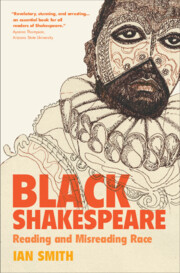
Race may dominate everyday speech, media headlines and public policy, yet still questions of racialized blackness and whiteness in Shakespeare are resisted. In his compelling new book Ian Smith addresses the influence of systemic whiteness on the interpretation of Shakespeare's plays. This far-reaching study shows that significant parts of Shakespeare's texts have been elided, misconstrued or otherwise rendered invisible by readers who have ignored the presence of race in early modern England. Bringing the Black American intellectual tradition into fruitful dialogue with European thought, this urgent interdisciplinary work offers a deep, revealing and incisive analysis of individual plays, including Othello, The Merchant of Venice and Hamlet. Demonstrating how racial illiteracy inhibits critical practice, Ian Smith provides a necessary anti-racist alternative that will transform the way you read Shakespeare.
Recommend this
Email your librarian or administrator to recommend adding this to your organisation's collection.