To save content items to your account,
please confirm that you agree to abide by our usage policies.
If this is the first time you use this feature, you will be asked to authorise Cambridge Core to connect with your account.
Find out more about saving content to .
To save content items to your Kindle, first ensure no-reply@cambridge.org
is added to your Approved Personal Document E-mail List under your Personal Document Settings
on the Manage Your Content and Devices page of your Amazon account. Then enter the ‘name’ part
of your Kindle email address below.
Find out more about saving to your Kindle.
Note you can select to save to either the @free.kindle.com or @kindle.com variations.
‘@free.kindle.com’ emails are free but can only be saved to your device when it is connected to wi-fi.
‘@kindle.com’ emails can be delivered even when you are not connected to wi-fi, but note that service fees apply.
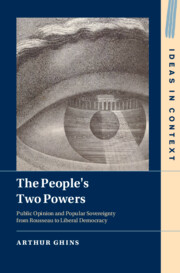
The People's Two Powers revisits the emergence of democracy during the French Revolution and examines how French liberalism evolved in response. By focusing on two concepts often studied separately – public opinion and popular sovereignty – Arthur Ghins uncovers a significant historical shift in the understanding of democracy. Initially tied to the direct exercise of popular sovereignty by Rousseau, Condorcet, the Montagnards, and Bonapartist theorists, democracy was first rejected, then redefined by liberals as rule by public opinion throughout the nineteenth century. This redefinition culminated in the invention of the term 'liberal democracy' in France in the 1860s. Originally conceived in opposition to 'Caesarism' during the Second Empire, the term has an ongoing and important legacy, and was later redeployed by French liberals against shifting adversaries – 'totalitarianism' from the 1930s onward, and 'populism' since the 1980s.
This chapter examines how and why the idea of “liberal democracy” was invented by French liberals in the 1860s. I argue that liberal democracy was conceived as an essentially polemical concept, defined in reaction to what French liberals identified as a defective form of democracy – namely, Napoleon III’s “Caesarist democracy.” I also show that, initially, one of the key meanings of liberal democracy was the idea of rule by public opinion. The first theorists of liberal democracy criticized Caesarism as a dangerous combination of plebiscitary sovereignty and silencing of public opinion. Meanwhile, they argued that the exercise of popular sovereignty should be confined to legislative elections, and that a free and independent public opinion should influence both elections and representatives. This perspective was articulated by figures such as Eugène Pelletan, Auguste Nefftzer, Charles Dollfus, Édouard Laboulaye, Anatole Prévost-Paradol and Émile Ollivier. The chapter further explores how the invention of the term “liberal democracy” overlapped with efforts to create a liberal tradition, as well as with a defense of settler colonialism in Algeria.
This epilogue explores the legacy of the idea of liberal democracy in twentieth century French thought and its impact on contemporary (liberal) democratic theory. After being pitted against “Caesarism” during the Second Empire, liberal democracy was redeployed to confront new adversaries: “totalitarianism” in the 1930s (Raymond Aron) and “populism” from the 1980s onward (Claude Lefort). In each of these periods, French liberals employed a two-pronged strategy: they criticized degenerate forms of democracy as corrupting popular sovereignty and manipulating public opinion. At the same time, beginning in the 1950s, French liberals redefined popular sovereignty as an abstraction to make it safe for liberal democracy, all the while championing a free public opinion as the best way to engage citizens in politics beyond elections. Today, democratic theorists in France (Pierre Rosanvallon) and elsewhere (Jürgen Habermas and Nadia Urbinati) continue to defend liberal democracy as the rule of public opinion.
Illiberal governments claim that their regimes are simply constitutional and democratic - period. In their line of offense/defense, they are as democratic and constitutional as any other, only more popular and therefore more genuine. The term illiberal democracy is not an oxymoron. The regimes in Venezuela under Chávez, Hungary after 2010, or Poland from 2015 are indeed democracies, but in the plebiscitarian leader democracy sense, as described by Max Weber (with clear despotic potential). Illiberal democracies are democracies of a troubling sort, enabling the totalitarian potential inherent in mass democracy. Illiberal democracies bring to light the authoritarian elements in liberal constitutions, which are historically unfinished and internally vulnerable. The illiberal (authoritarian) elements (enclaves) that inevitably exist in constitutional systems are unleashed in the constitutional order of the plebiscitarian regimes. The illiberal transformation of constitutionalism is facilitated by the authoritarianism inherent in the constitutional order of established democracies and by the populist mobilization of authoritarian predispositions in the citizenry.
Lucan is a model for orators, not poets. Martial shows that prose and verse had become polarized that sense was now distinct from sensibility, when Quintilian records that Lucan, for many, had forfeited the name of poet: there were rules, and the rules were there to be followed. In the Bellum civile, Lucan began with tired neoteric essays, stylistically akin to those of the princeps, quite mainstream, and accomplished. Rhetoric may demand an increasing amount of anti-Caesarian invective, but that has no necessary bearing on Lucan's relations with the princeps. Lucan devoting too much space to moralization, and little, if any, to narrative; and his apotheosis at the beginning of Book 9 is too abstract to reflect on him as an individual. Rome had seen a good deal of civil war, and a literature had been adapted to the theme.
Recommend this
Email your librarian or administrator to recommend adding this to your organisation's collection.