To save content items to your account,
please confirm that you agree to abide by our usage policies.
If this is the first time you use this feature, you will be asked to authorise Cambridge Core to connect with your account.
Find out more about saving content to .
To save content items to your Kindle, first ensure no-reply@cambridge.org
is added to your Approved Personal Document E-mail List under your Personal Document Settings
on the Manage Your Content and Devices page of your Amazon account. Then enter the ‘name’ part
of your Kindle email address below.
Find out more about saving to your Kindle.
Note you can select to save to either the @free.kindle.com or @kindle.com variations.
‘@free.kindle.com’ emails are free but can only be saved to your device when it is connected to wi-fi.
‘@kindle.com’ emails can be delivered even when you are not connected to wi-fi, but note that service fees apply.
With a scant biography and a notoriously complex oeuvre, Clement of Alexandria survives as one of the most enigmatic early Christian figures. He was traditionally understood as the head of an Alexandrian Catechetical School, succeeding Pantaenus and preceding the more famous Origen. With Eusebius traditionally read as our earliest witness to such a school, however, the anachronism of formal catechetical institution in the second century has long divided scholars. This Element both reintroduces this complex figure and reconsiders the Eusebian presentation of the so-called Catechetical School. Through a close reading of both Eusebius and Clement a new understanding of Clement's pedagogical context is explored. Eusebius does not suggest an early formal institution but is in fact deliberate in describing a far looser, retrospective association between these early Christian intellectuals. With the spectre of an anachronistic Catechetical School banished, the historical reality of Clement's second-century instruction can be retrieved and reevaluated.
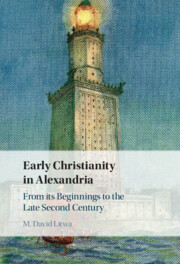
Alexandria was the epicenter of Hellenic learning in the ancient Mediterranean world, yet little is known about how Christianity arrived and developed in the city during the late first and early second century CE. In this volume, M. David Litwa employs underused data from the Nag Hammadi codices and early Christian writings to open up new vistas on the creative theologians who invented Christianities in Alexandria prior to Origen and the catechetical school of the third century. With clarity and precision, he traces the surprising theological continuities that connect Philo and later figures, including Basilides, Carpocrates, Prodicus, and Julius Cassianus, among others. Litwa demonstrates how the earliest followers of Jesus navigated Jewish theology and tradition, while simultaneously rejecting many Jewish customs and identity markers before and after the Diaspora Revolt. His book shows how Christianity in Alexandria developed distinctive traits and seeded the world with ideas that still resonate today.
Egyptian Christianity began in Alexandria, by far the greatest of the many cities founded by Alexander the Great. Jewish immigration into Egypt from Palestine had begun as early as the sixth century BCE, and Jews flowed into Alexandria in large numbers, with the result that the Alexandrian Jewish community became important in all of the diaspora. Christian organisation in Alexandria exhibits a continuity with Alexandrian Judaism, especially in the form of the presbyterate. Demetrius played a crucial role in the development of the Egyptian Christianity. The 'Catechetical School' of Alexandrian Christian tradition came into being only in the early third century as a result of the growing authority of bishop Demetrius. In the third century a new form of Gnosticism made its entry into Egypt, Manichaeism, which eventually became a world religion in its own right. Monasticism as an institution has played a greater role in the history of Egyptian Christianity than in that of any other regional church.
Recommend this
Email your librarian or administrator to recommend adding this to your organisation's collection.