To save content items to your account,
please confirm that you agree to abide by our usage policies.
If this is the first time you use this feature, you will be asked to authorise Cambridge Core to connect with your account.
Find out more about saving content to .
To save content items to your Kindle, first ensure no-reply@cambridge.org
is added to your Approved Personal Document E-mail List under your Personal Document Settings
on the Manage Your Content and Devices page of your Amazon account. Then enter the ‘name’ part
of your Kindle email address below.
Find out more about saving to your Kindle.
Note you can select to save to either the @free.kindle.com or @kindle.com variations.
‘@free.kindle.com’ emails are free but can only be saved to your device when it is connected to wi-fi.
‘@kindle.com’ emails can be delivered even when you are not connected to wi-fi, but note that service fees apply.
We have already explored the Harlem Renaissance, a period in which African American artists, writers, and intellectuals forged new cultural expressions that challenged white normative standards and reimagined Black identity. In this chapter, we will see how the Civil Rights Movement of the 1950s and 1960s built on that intellectual and cultural groundwork, translating ideas of freedom, self-determination, and racial pride into mass political action. The Civil Rights era was the largest and most sustained movement of popular protest in US history, and it offers readers an opportunity to understand how African Americans mobilized to confront Jim Crow, reframe citizenship, and envision a more just democracy.
In this chapter, we will encounter the multiple ideological currents within the movement: nonviolent civil disobedience, Black nationalism, and Black Power. Figures such as Martin Luther King, Jr., Malcolm X, and grassroots organizations like SNCC exemplified these different approaches. Whereas the Harlem Renaissance sought to assert Black cultural value in a society defined by white supremacy, the Civil Rights era assumed Black political agency and interrogated its implications in a society still dominated by racial hierarchy.
Through its Programme to Combat Racism (PCR), the WCC supported Southern African liberation movements. The PCR constituted a remarkable act of solidarity with those engaged in the struggle against apartheid, garnering the WCC heightened credibility in the Third World. But the PCR’s solidarity with the armed struggle waged by the African National Congress (ANC) in the 1970s led it to downplay human rights, a concept it – like the ANC – associated with liberal humanitarianism. This stance effectively subordinated individual rights to the cause of liberation, leading the WCC to turn a blind eye to the internal repression practiced by liberation movements. Having been a feature of the ANC’s agenda in the 1950s, human rights only returned to prominence in the 1980s, as the end of apartheid came into sight. Meanwhile, however, it was South Africa’s black ecumenical leaders, especially Desmond Tutu and Allan Boesak, who worked to reconcile human rights and liberation. Their prominent role in South Africa’s domestic anti-apartheid movement ultimately facilitated the integration of a capacious conception of human rights into South Africa’s post-apartheid constitution.
This chapter looks beyond traditional concepts of democratic defense and provides a framework for the queer and trans community to engage in the process of democratic creation within the broader pro-democracy and democratic resistance movements. It argues that the queer and trans experience with rejection, vulnerability, and collaborative survival has uniquely prepared us to navigate the unfolding American democratic crisis. It encourages LGBTQ people to embrace the powerful status of being an “outsider” in service to the larger democratic project. Rooted in feminist and queer theory, this chapter concludes that both our societally manufactured difference and our innate equal dignity and humanity can help us to see beyond the restrictive binary thinking of mainstream society. This chapter argues that pro-democracy movements must be fueled by a commitment to collaborative survival and mutual aid. It recognizes that the celebration of our authentic expression and humanity are radically pro-democratic actions, especially when faced with state mandated conformity.
This chapter explores the use of restorative nostalgic political propaganda by antidemocratic forces to pursue a myth of a “golden age” and reinstate policies built on racism, homophobia, transphobia, and misogyny. Although conservative political figures in the US have long capitalized on the allure of restorative nostalgia to delegitimize progressive social and political reforms, today’s populist MAGA movement is different in both kind and degree. In a quest to “make America great again,” the MAGA movement aims to turn the clock back on decades of social justice gains by villainizing the social progress and expansion of rights that have made many of our lives possible. This chapter explains the historic use of restorative nostalgic propaganda by fascist regimes to blame modernity and the expansion of civil and political rights for the loss of a “great mythic past” defined by simplicity and prosperity. Under this view, individuals who advocate for progressive reforms are demonized and branded as enemies of the state. Restorative nostalgic political propaganda demands the exclusion and erasure of nonconforming individuals to restore the “simple life” and regain national glory.
This chapter examines the evolution of African-American short fiction in the 1940s, focusing on Ralph Ellison’s contributions. It traces the genre’s development from early twentieth-century foundations through the Harlem Renaissance to a flourishing in the 1940s. Ellison’s stories, including “Flying Home” and “King of the Bingo Game,” exemplify the decade’s shift toward more experimental, psychologically complex narratives that blend African-American folklore with modernist techniques. The chapter argues that this period was pivotal in African-American literature, as writers like Ellison combined vernacular traditions with high modernist styles to address themes of identity, alienation, and the American experience. This synthesis laid the groundwork for major novels of the 1950s and beyond, marking the 1940s as a transformative decade that propelled African-American literature into a new era of artistic achievement.
On March 25, 1994, the Boston Police Department executed a “no-knock” raid that ended in the death of Reverend Accelyne Williams, a seventy-five-year-old retired Black Caribbean minister. Acting on a faulty tip, a thirteen-member SWAT team stormed into the wrong Dorchester apartment, wrestled Williams to the ground, and triggered a fatal stress-induced heart attack. His death became a defining tragedy in Boston’s history of police violence and raised urgent questions about accountability. This article situates the Williams case within the broader history of Black Boston’s freedom struggle against police civil rights violations from the early twentieth century to the 1990s. Through a controlled case comparison of four major incidents, we analyze how moments of police brutality became catalysts for Black political mobilization, ministerial activism, and community resistance. The study addresses three central questions: How does the Williams case fit within the trajectory of Boston’s racial justice struggles? How do such incidents illuminate the city’s persistent racial inequality and segregation? And what can these histories teach us about the broader U.S. movement to “police the police”? Drawing on original archival research, we demonstrate that police abuses have consistently spurred waves of organized resistance in Boston, shaping both local and national debates on civil rights. We identify key historical breaks, continuities, and paradoxes in the struggle for accountability, showing how the demand to “police the police” has long been central to Black political life.
The reawakening of the Black Lives Matter movement in the summer of 2020 ignited a wave of racial and social consciousness that prompted many arts-based organizations to consider the larger implications of their programmatic visions. As a composer known to, but under-programmed in, the mainstream classical music establishment, the music of Florence Price was thrust into an even greater spotlight. This chapter considers what it means to meaningfully celebrate the rediscovery of Price’s manuscripts and her revival in the mainstream. It models discourse that ensures that more African American composers are recognized and that the communities that kept names and works alive are remembered in the historical record.
This chapter discusses the contested place of the Declaration of Independence in black political thought. As a document that provided a rationale for American independence, the Declaration of Independence in its own way also provided one for black political equality in the United States. This tension between intention and interpretation has made the Declaration stubbornly immune from attack by black intellectuals, politicians, and movement leaders. With rare exception, the Declaration has been attacked mostly for its exclusivity, not its content or core ethos. Even Critical Race Theory’s (CRT) modest dissent from the Declaration has been limited in its ability to transform the persistence of black support for it, making arguments for CRT’s abandonment of America’s founding principles ring hollow. Instead, the history of black political thought from Frederick Douglass to W. E. B. Du Bois to Kimberlé Williams Crenshaw, stands squarely on the side of the Declaration’s essential truths, while admonishing America’s enduring failure to live up to them.
Can civil disobedience be transnationalized? This question presumes civil disobedience to be a fundamentally domestic concept—one constitutively tied to both the nation-state and the normative underpinnings of liberal, constitutional democracies. This article shows how this assumption mistakes one version of civil disobedience's twentieth-century intellectual history for the whole of it, and risks reproducing binaries (domestic vs. international, democracies vs. non-democracies) that trouble attempts to theorize the transnational. Turning to an alternative intellectual history—a network of civil rights and anticolonial activists—reveals a novel theory of civil disobedience as decolonizing praxis, as well the stakes of these binaries: the disavowal of white supremacy as pervasive and durable global structure of governance, linking the domestic to the international, and democratic rule to domination.
From agents and bearers of human rights, the volume turns to domains which some have seen as impervious to claimants of rights, but which have been refashioned thanks to their mobilization. Sara Silverstein explains how it was from the periphery – first small European states before World War II and later from the Global South after – that most work was done to elaborate entitlements to healthcare, whether at the local, national, or international level. Some of these impulses sprang from mechanisms of colonial rule, others from the biopolitical transformation of citizenship (including in the rise of mandatory insurance); and there is no doubt that the international standard-setting of the World Health Organization and other agencies played an important role.
The chapter demonstrates how religious freedom and robust pluralism can be catalysts for social healing – benefiting individuals and communities, building social capital, and encouraging solidarity. The chapter concludes with four case studies of bridging religious divides to achieve positive change, address injustice, reach compromise, and overcome adversity.
During the Jim Crow era, jails were an essential tool for the enforcement of white supremacy. For Dr. Martin Luther King Jr., the long-term goal of the civil rights movement was to destroy the Jim Crow system through a vigilant strategy of nonviolent protest that would fill the jails and shine a light on injustice. King elevated this strategy through his own arrest, incarceration, and subsequent Letter from Birmingham Jail. King’s letter offered a scathing indictment of the gradualist strategy for achieving racial justice in Alabama that had led to unsolved bombings of Black institutions, unfair treatment in the legal system, and police brutality. In response to those who criticized his presence in Birmingham for the march, he wrote that he could not “sit idly by” in Atlanta and continue to be indifferent. “Injustice anywhere was a threat to justice everywhere.”
This chapter asks the question: Where did Black individuals' desire for community commitment come from? The answer this, I draw on numerous primary and secondary sources starting in the Reconstruction era to show where Black voters' expectations of those representing them came from and how they shifted over time. The latter part of the chapter focuses on the Civil Rights Movement out of which many Black voters received the right to engage in politics. I contend that these new rights and those who helped acquire them for the Black community created the lens through which most Black people see effective leadership today, and solidified the desire for representatives willing to put their lives on the line for the sake of the racial group's progress.
During the US War in Vietnam, diverse activists and organizations advanced a range arguments against US intervention in Vietnam. These organizations did not form a singular or united antiwar movement, however, and many histories have overlooked the contributions of activists who did not focus their efforts solely on ending the US war. Indeed, many activists challenged injustices on multiple fronts and created unique antiwar discourses as part of their social justice advocacy. They often linked their advocacy and constituents within the United States with US treatment of Vietnam and the Vietnamese. This chapter describes the diversity of antiwar rhetoric and activism in the 1960s and 1970s with the help of North Vietnam’s government, which fostered a people’s diplomacy with American citizens. In doing so, this chapter illustrates that many participants in antiwar advocacy saw their protests against US intervention in Vietnam as part of their larger fight to create a more just American society.
By the mid-sixties, Leonard Bernstein was engaging with the Civil Rights Movement and the Vietnam War resistance. Bernstein took part in greeting Martin Luther King in the Selma Alabama fifty-four mile march to gain voting rights. He campaigned for war resistor Eugene McCarthy in the election of 1968. In 1970, Bernstein’s and his wife Felicia’s fundraising support for the Black Panthers Legal Defense brought him under public attack organized by the FBI’s J. Edgar Hoover. In 1971, Bernstein’s support for war resistor Daniel Berrigan, and his seeking the latter’s help in writing the libretto for Mass, brought him again under attack by Hoover, this time with the connivance of President Nixon, who had missed the inaugural performance of Mass for fear that Bernstein would publicly humiliate him. Nixon now placed Bernstein on his infamous ‘Enemies List’, but Bernstein was saved from victimization by Hoover’s death and Nixon’s forced resignation due to the Watergate scandal.
Political activists during the Northern Ireland Troubles employed racialized rhetoric, comparing the plight of Catholics to that of African Americans. This strategy aimed to frame the conflict for global audiences, establish transnational networks, and gain local support by invoking solidarity with the Black struggle. Some radicals within the movement even embraced the ideology of the Black Panthers and advocated for a similar Catholic Power movement. In contrast, the Irish Republican Army (IRA) took a different approach, using racialized language to portray their conflict with Britain as an anti-colonial struggle and aligning themselves with Africa. However, this Third Worldism approach inadvertently reinforced colonial power dynamics through their choice of rhetoric. Loyalists, on the other hand, openly acknowledged their perceived privileges as white individuals. For instance, when soldiers opened fire on Protestant rioters, loyalists reminded officers of their shared racial identity by stating, we are not wogs. This chapter argues that activists on both sides of the conflict employed racialized language in complex, contradictory, and ambiguous ways. They strategically utilized racial rhetoric for political gain, even in situations unrelated to the start of the Troubles.
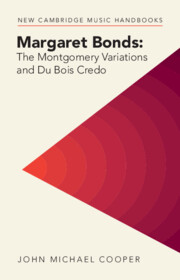
In her lifetime, African American composer Margaret Bonds was classical music's most intrepid social-justice activist. Furthermore, her Montgomery Variations (1964) and setting of W.E.B. Du Bois's iconic Civil Rights Credo (1965-67) were the musical summits of her activism. These works fell into obscurity after Bonds's death, but were recovered and published in 2020. Since widely performed, they are finally gaining a recognition long denied. This incisive book situates The Montgomery Variations and Credo in their political and biographical contexts, providing an interdisciplinary exploration that brings notables including Harry Burleigh, W.E.B. and Shirley Graham Du Bois, Martin Luther King, Jr., Abbie Mitchell, Ned Rorem, and – especially – Langston Hughes into the works' collective ambit. The resulting brief, but instructive, appraisal introduces readers to two masterworks whose recovery is a modern musical milestone – and reveals their message to be one that, though born in the mid-twentieth century, speaks directly to our own time.
Bonds’s setting of the Du Bois Credo continues and extends the series of musical appeals for racial justice that had led to The Montgomery Variations, just as the revised version of Credo published at the head of his first autobiography, Darkwater: Voices from within the Veil, in 1920 extends the ideas that had led to the original 1904 version of Du Bois’s text. This chapter frames both the Du Bois Credo and Bonds’s musical setting thereof as articulations of the themes and issues of the works’ respective biographical contexts and, taken together, a dyadic lens into their creators’ perspectives on the societal upheavals of the most turbulent years of the twentieth century. Then, after demonstrating why, and how, the Credo was effectively silenced during Margaret Bonds’s lifetime despite its obvious importance, timeliness, and musical genius – including conversation with the publisher who insisted that the work could not be published unless its text were altered – the chapter closes by exploring the work’s first posthumous performances and documenting the ringing endorsement of Shirley Graham Du Bois, widow of the poet, for this “work of art that is eternal.”
The Great Migration, which began in the late nineteenth century and witnessed the movement of more than six million Black folk from the agrarian US South to the urban North between 1919 and 1970, and the flourishing of “Black Renaissances” in Harlem, Chicago, Pittsburgh, and other Northern urban centers were the essential soil in which are rooted not only the two works that are the subject of this book, but also the lives and careers of Margaret Bonds, W. E. B. Du Bois, and Langston Hughes. This chapter explores the roles of those two large societal seizings of freedom for the poor and oppressed as the context for Margaret Bonds’s career and the source of her career-long commitment to using her art to uplift what she in 1942 called “our oppressed Race” and work for global equality.
Margaret Bonds conceived The Montgomery Variations during a thirteen-state Southern tour in the spring of 1963 – a tour that took her not only to Montgomery, Alabama (a fiercely contested battleground in the ongoing Civil Rights Movement), but also to Birmingham in the same state – the latter at the beginning of Dr. Martin Luther King’s difficult Birmingham campaign. Of her experiences there was born a programmatic composition that used the spiritual “I Want Jesus to Walk with Me” as the basis of a symphonic variation set that drew on models including J. S. Bach’s Goldberg Variations and Richard Strauss’s Don Quixote and Death and Transfiguration to trace the history of the Civil Rights Movement from the Montgomery bus boycott (1955–56) through the Sixteenth-Street Baptist Church bombing (Birmingham, 1963), with a radiant “Benediction” evidently born in the wake of the passage of the landmark Civil Rights Act of 1964. This chapter situates The Montgomery Variations in the personal, professional, and societal developments traced in Chapter 1 and analyzes the music and program to explore how Bonds used it to advance her activist agenda.