To save content items to your account,
please confirm that you agree to abide by our usage policies.
If this is the first time you use this feature, you will be asked to authorise Cambridge Core to connect with your account.
Find out more about saving content to .
To save content items to your Kindle, first ensure no-reply@cambridge.org
is added to your Approved Personal Document E-mail List under your Personal Document Settings
on the Manage Your Content and Devices page of your Amazon account. Then enter the ‘name’ part
of your Kindle email address below.
Find out more about saving to your Kindle.
Note you can select to save to either the @free.kindle.com or @kindle.com variations.
‘@free.kindle.com’ emails are free but can only be saved to your device when it is connected to wi-fi.
‘@kindle.com’ emails can be delivered even when you are not connected to wi-fi, but note that service fees apply.
By 1776, when a parliamentary survey was held to assess poor law expenditure in England and Wales, the ‘settlement’ system was a familiar feature in local communities, regulating access to poor relief and if necessary removal since the previous century. The introduction explores the broad historiography on the topic and suggests how key provisions emerged in the Restoration era, a development examined in Chapter 1. The discussion proceeds to introduce the arguments of the remaining chapters, in which some of the unintended consequences of the legislation are explored: from the emergence of a huge body of administrative forms to the regulation of kinship and family for the purposes of migration, and on to impacts on parish and county administration, community life, and even the state’s capacity to mobilise forces for large-scale international wars.
The conclusion brings together the book’s several arguments to explain the impact of the settlement legislation on family, community, and national life during our period. Discussions highlight how legal changes taking place in the Restoration era, and developed thereafter, affected English society and state formation in ways little imagined by the legislators, and how the focus on parish settlement has brought together an array of fields not often studied together and has enabled the book to engage with local experiences as well as broad processes of historical change.
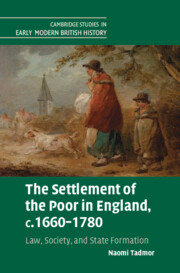
In 1662, in the aftermath of the Restoration, parliament passed new legislation for the settlement and removal of the poor. Important provisions were finalised in no more than a few days. But once the settlement of the poor was set in law it became an agent of historical change that affected society, state formation, and the lives of millions in Britain and beyond for centuries to come. Within a few decades, practices of local government were transformed. In towns and villages hierarchies of social status and gender were affected. The rising empire employed the settlement administration to mobilise forces for large-scale international wars and to deal with soldiers' wives and children left behind. The huge number of bureaucratic forms generated following the new policies made a lasting impact on administrative culture. The Settlement of the Poor in England is about social change and about history's unintended consequences. It is also about the struggles and experiences of individuals and communities. It reminds us how the settlement legislation still resonates today. This title is part of the Flip it Open Programme and may also be available Open Access. Check our website Cambridge Core for details.
Recommend this
Email your librarian or administrator to recommend adding this to your organisation's collection.