To save content items to your account,
please confirm that you agree to abide by our usage policies.
If this is the first time you use this feature, you will be asked to authorise Cambridge Core to connect with your account.
Find out more about saving content to .
To save content items to your Kindle, first ensure no-reply@cambridge.org
is added to your Approved Personal Document E-mail List under your Personal Document Settings
on the Manage Your Content and Devices page of your Amazon account. Then enter the ‘name’ part
of your Kindle email address below.
Find out more about saving to your Kindle.
Note you can select to save to either the @free.kindle.com or @kindle.com variations.
‘@free.kindle.com’ emails are free but can only be saved to your device when it is connected to wi-fi.
‘@kindle.com’ emails can be delivered even when you are not connected to wi-fi, but note that service fees apply.
Although only two of the 26 principles enshrined in the 1972 Stockholm Declaration are devoted specifically to the protection of nature, they have encouraged a large number of states to conclude various international agreements of a sectoral nature, which were supplemented in 1992 by a global agreement on biodiversity. In addition to tracing the influence of the Stockholm Declaration on international nature protection law, this chapter discusses the European Union’s (EU) role in the development of international law in this field. Conversely, the chapter also looks at how EU internal rules on nature protection have been influenced by the obligations stemming from multilateral environment agreements and illustrates the cross-fertilisation that has occurred between EU and international law.
This chapter explores the evolving interplay between the Council of Europe (CoE) and the European Union (EU) in safeguarding fundamental rights in the context of media policy. Both organisations have a long history in media policy, and both have extensively adapted their standards to counter recent threats resulting from digitisation and democratic backsliding. In this process the EU has significantly expanded its safeguards for fundamental rights, traditionally the CoE’s main focus. This convergence raises the possibility of conflict but also that of mutual reinforcement. In this chapter we first sketch the history of increasing convergence between EU and CoE media policy and provide an overview of each institution’s recent overlapping activities. We then argue for a closer relationship between the two institutions in the context of fundamental rights in media policy, focusing on the need for consistency between their respective standards, the normative guidance CoE standards can provide to the EU, and the practical implementation of fundamental rights standards EU enforcement can ensure. We close by suggesting ways in which a mutually reinforcing relationship between the two institutions can be operationalised through closer legal and organisational ties.
This chapter traces how contemporary media pass through different regulatory zones and examines the different rules that govern each zone and how the zones relate to each other. It briefly charts the recent and ongoing evolution of the media, from analogue roots to generative AI futures, and notes the fundamental rights and regulatory ramifications of technology-driven innovations. It draws an analytical line from these conceptualisations through to the contemporary threats to media freedom that regulation urgently needs to address.
This first study of the 2023 Council of Europe (CoE) Data Protection Regulations focuses on the institutional design of the Data Protection Commissioner and the Data Protection Officer (DPO). It shows that the reform of both offices was inspired by the EU offices of the EDPS and the EU DPOs. In the context of an EU-CoE dialectical relationship in data protection, the EU exerts significant influence over institutional design. The article highlights differences between those offices and their EU counterparts. In particular, the weak enforcement/monitoring powers of the CoE Commissioner limit possibilities for accountability within the organisation. The study ends with recommendations to strengthen the Commissioner’s mandate.
The Council of Europe has very recently adopted the Framework Convention on Artificial Intelligence and Human Rights, Democracy and the Rule of Law. This article provides an initial analysis of the CoE AI Convention. It emphasises the necessity of understanding the CoE AI Convention within the context of its adoption as an international treaty negotiated within the Council of Europe. This context has affected its scope in terms of how the treaty includes the regulation of the usage of AI systems by both public authorities and private actors. The detailed review of the available negotiation documents reveals that the concrete level of protection offered by the Convention has been lowered. This includes the risk-based approach, which shapes the obligations undertaken by States under the treaty. This approach is explained and contrasted with the approach under the EU AI Act. The argument that emerges is that the absence of categorisation of risk levels in the treaty is related to its higher level of abstraction, which does not necessarily imply less robust obligations. The content of these obligations is also clarified in light of the requirement imposed by the treaty of consistency with human rights law. An argument is advanced that the principles formulated in the treaty – human dignity and individual autonomy, transparency and oversight, accountability, non-discrimination, data protection, reliability, risk-management – can offer interpretative guidance for the development of human rights standards.
Starting from the evolution of the protection of human rights on the internet, the first part of this chapter analyses the proposals for new digital human rights and the methodology of their creation in different forums such as the Council of Europe and European Union as well as related processes in the United Nations Human Rights Council. The second part focuses on the challenges related to the rapid developments in artificial intelligence, such as ChatGPT, for the protection of human rights and regulatory efforts by the Council of Europe, in particular its Framework Convention on Artificial Intelligence, Human Rights, Democracy and the Rule of Law adopted in 2024 and the Artificial Intelligence Act of the European Union dating from the same year. Both instruments are analysed for their potential to protect human and fundamental rights in particular through new digital human rights. The contribution finds possible complementarity between the two regulatory approaches. Giving several examples, it concludes that there is an ongoing process of the concretisation of new digital human rights, which are mainly but not exclusively based on existing human rights.
This chapter covers the European system for the protection of human rights, highlighting the roles of the Council of Europe, the European Union, and the Organization for Security and Cooperation in Europe (OSCE). It examines the work of the European Court of Human Rights, the European Committee of Social Rights, and other specialized bodies in protecting and promoting human rights in Europe. The chapter discusses the legal and institutional framework of the European human rights system, the challenges and successes in its implementation, and the role of European institutions in advancing human rights standards.
On 16 March 2022, Russia became the first state to be expelled from the Council of Europe (CoE). The reshaping of power dynamics between international law actors is providing a favourable space to international organizations to use membership as a strategic tool. In order to understand under what circumstances the CoE decides to end membership, the article elucidates the substantive and symbolic grounds of Russia’s expulsion. Substantive grounds are defined as non-compliance with the membership criteria of the CoE and its founding principles as regulated in Article 3 of its Statute. Symbolic grounds are what motivates the CoE in its positioning within the international legal order as indicated in the preamble of its Statute. The analysis of the substantive grounds will reveal that the violation of the CoE Statute and the prohibition on the use of force because of the invasion of Ukraine are not enough to explain Russia’s expulsion. This article argues that Russia’s expulsion relies on symbolic grounds that allowed the CoE to preserve its position as the guardian of European imperialism. The clash of the two actors’ irreconcilable imperial policies proved for the CoE that Russia would no longer be at the receiving end of its demands. The Ukraine invasion signals a breaking point, escalating the inter-imperial rivalry to a level where the CoE believes Russia will no longer submit itself to the European international legal order as shaped by the Western European founders of the Organization.
The European Union adopted region-wide binding legal norms and a multifaceted legal approach to human trafficking. This chapter explains that the EU has competence (legal authority or jurisdiction) over human trafficking because trafficking is seen as a crime that moves across borders. By contrast, the EU needs another source of competence to tackle forced labour in supply chains. These different sources of competence over different drivers of unfree labour resulted in a proliferation of gendered governance strategies. Pushed by the Council of Europe’s Convention on Action against Trafficking in Human Beings, the EU incorporated the rights of trafficking victims. The chapter illustrates how victim’s rights were subsumed under the EU’s primary goal of hardening Member States’ borders against undesirable outsiders, exemplified by migrant sex workers. The EU also promoted a corporate sustainability due-diligence directive and a product ban targeting unfree labour in supply chains, thereby extending EU values beyond Member States’ borders.
This chapter examines how the Council of Europe sought to promote the rule of law in Russia after the collapse of the Soviet Union. Soviet president Mikhail Gorbachev’s ambition to construct a “common European home,” to be pursued in concert with European states and international organizations, was advanced by Russian president Boris Yeltsin and, at least initially, by his successor as president, Vladimir Putin. But after roughly a decade of concrete reforms, that effort foundered, reversed, and then collapsed. Russia descended again into authoritarianism and, shortly after its full-scale invasion of Ukraine, Russia was expelled from the Council of Europe. Thus, this story now has a beginning, a middle, and an end. This chapter explores that story and how the dynamics of Russia’s pursuit and rocky course of membership in the Council of Europe affected both the Russian state and the international organization that sought to admit it to membership.
Chapter 8 discusses the recent development within the Council of Europe – the Second Additional Protocol to the Cybercrime Convention – which provides the legal framework that legitimises unilateral cross-border access to digital evidence in criminal matters. While the Second Additional Protocol is innovative in terms of its law enforcement mechanisms vis-à-vis digital evidence, it is incomplete regarding its protective safeguards against the risks of abuse, as well as the extent to which it addresses rudimentary issues such as jurisdiction, data protection provisions, etc. This chapter pushes the idea that these non-negotiables should be addressed and the loose ends tied up.
Article 58 of the European Convention on Human Rights (ECHR) contains a provision which allows for the involuntary withdrawal, or expulsion, of a State from the ECHR if it has been expelled from, or ceased to be a member of, the Council of Europe (CoE). By comparing Russia's exit from the ECHR in 2022 with that of Greece in 1969, this article demonstrates that involuntary withdrawal poses a number of legal problems—partly as a result of it not having been considered during the drafting of the ECHR or the Statute of the CoE, and partly because of the highly unclear basis on which involuntary withdrawal operates. The article then conducts a comparative analysis of other regional human rights systems and public international law principles on treaty withdrawal in order to suggest a more comprehensive legal foundation for expulsion.
In this chapter, I first examine how the rule of law has been defined in legal theory, and how it has been distinguished from the rule by law, which is a distortion thereof (Section 3.1). Second, I assess how the rule of law has been conceptualised in the context of the European Union, as this book focuses primarily on the EU legal order (Section 3.2). In this regard, I also draw on the acquis of the Council of Europe. The Council of Europe is a distinct jurisdictional order, yet it heavily influenced the ‘EU’ conceptualisation of the rule of law, and the EU regularly relies on Council of Europe sources in its own legal practices. Finally, I draw on these findings to identify the rule of law’s core principles and to distil the concrete requirements that public authorities must fulfil to comply therewith (Section 3.3). Identifying these requirements – and the inherent challenges to achieve them – will subsequently allow me to build a normative analytical framework that I can use as a benchmark in Chapter 4 to assess how algorithmic regulation impacts the rule of law.
In an increasingly integrated Europe, state language regimes are not the only ones that matter. It is also essential to understand how they interact with supranational language regimes. As Central and Eastern European (CEE) countries worked towards and then gained European Union membership after 2000, to what extent did their state language regimes become “Europeanized”? This question is examined through the case of Romani in Slovakia. The chapter has two aims: first, to demonstrate that the concept of a language regime can be fruitfully applied to supranational entities, and second, to examine the impact of such regimes at the state level. The Council of Europe’s language regime led it to advocate for increased support of Romani, as well as increased minority language rights in member states more generally. This work became bound up in the wider dynamics of Europeanization and European pressure on CEE states. At the level of the Slovak state, official policies towards Romani were changed in response to such pressure. Implementation of such commitments was limited, however. An analysis of state treatment of Romani language in Slovakia from approximately 1998 to 2018 thus illustrates a process through which a state language regime was altered but not transformed.
Chapter 5 examines the evolving legal context and the practical effectiveness of CoE interactions with the central case study, Kosovo. Kosovo is a sui generis case, distinct from all others, but it is an appropriate case study as it has faced and, in several cases, overcome similar engagement challenges. Over more than two decades, the CoE has innovated and adapted its relationship with Kosovo, and so this chapter seeks to illustrate the pragmatism and creativity which can be employed when the political will to do so is in place. The chapter elaborates the principle of engagement on the basis of ‘functional capacity’ and the practice of monitoring substitution.
The introductory chapter establishes the central questions, the rationale and structure of the monograph noting that it is concerned with the impact of unresolved conflict and contestation on the effectiveness of Europe’s human rights protection architecture within the framework of the Council of Europe. It also highlights several limits, such as the European focus and the deliberate decision not to seek to advance any reform proposals for the European Court of Human Rights Article 1 jurisprudence. It also engages, and dismisses, the potential critique of human rights imperialism.
The book concludes with a reflection on the challenge of grey zones as being one of first principles, which represents a risk to the integrity and long-term future of the organisation. It emphasises that the populations in areas of conflict and contestation are the most vulnerable rights holders in Europe, yet the most isolated. The Council of Europe must address this systematic problem as a matter of urgency and with the decisive attention of Member States and both statutory and non-statutory actors.
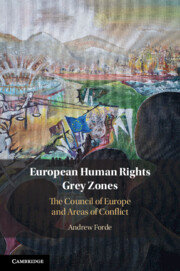
Forde examines the effectiveness of the human rights system of the Council of Europe (CoE) in conflict-affected regions and advances a novel approach to understanding how the European Convention on Human Rights can better serve the 10+ million rights-holders living in so-called human rights 'grey zones'. Building on the premise that nowhere in Europe should be deprived of access to Europe's human rights architecture, Forde argues that areas of conflict give rise to a collective public order imperative on Member States to seek maximal effectiveness of the CoE human rights system. Despite Kosovo's sui generis status, much of the CoE's experience of engagement with Kosovo could inspire more proactive efforts in relation to other areas of conflict. This book advocates a judicious engagement of the CoE's unique assets and acquis in affected regions based on the collective responsibility of Member States and the normative will of the Secretary General.
As the human right to a healthy environment is codified around the globe, some systems still lag behind. One noticeable straggler is the Council of Europe, which is currently undergoing its fourth attempt to recognize the right. This article examines the proposals tabled within this system in light of overarching debates about climate justice and environmental rights, before focusing specifically on the spatial and temporal limits of the European Convention on Human Rights (ECHR) and the institutional features of its Court. First, the article describes what the author sees as the current liminal moment in the development of human rights law, a time of transition in which established legal concepts can be questioned or reaffirmed. Second, it sketches recent proposals for locating and conceptualizing the right to a healthy environment within the Council of Europe. Evaluating different options, it makes the case for including this right in the ECHR. Third, the article discusses the right's potential to reshape the spatial and temporal limitations on legal subjectivity and Convention protections. These proposals come at a crucial time when the system's ability to protect human rights from environment-related impacts is being tested by climate litigation. The article understands these developments as interrelated and discusses whether current proposals could deliver on demands for climate justice by extending protection to future generations and for extraterritorial environmental impacts.
Over the last few years, artificial intelligence (AI) technologies have become embedded in various domains of social life, prompting legislative efforts at both national and international levels. In the European Union (EU), this drive for legislation has been reflected in various legal instruments, notably the proposed AI Act, which is expected to become a global standard through the “Brussels Effect.” This Article argues that while the AI Act will likely produce a Brussels Effect of its own, such an outcome will be accompanied by a side effect that undermines the EU’s ambition to spread legislative text and values in AI governance. Since the AI Act follows EU product safety legislation, its provisions supply limited protection to some of the values the EU policy intends to protect, such as the protection of fundamental rights. These shortcomings are compounded by the EU’s active efforts to shape alternative instruments, such as the Council of Europe’s proposed convention on AI along the lines of the AI Act. As a result, the diffusion of the AI Act as a global standard will have consequences for the EU policy agenda on AI and the conceptualization of the Brussels Effect.