To save content items to your account,
please confirm that you agree to abide by our usage policies.
If this is the first time you use this feature, you will be asked to authorise Cambridge Core to connect with your account.
Find out more about saving content to .
To save content items to your Kindle, first ensure no-reply@cambridge.org
is added to your Approved Personal Document E-mail List under your Personal Document Settings
on the Manage Your Content and Devices page of your Amazon account. Then enter the ‘name’ part
of your Kindle email address below.
Find out more about saving to your Kindle.
Note you can select to save to either the @free.kindle.com or @kindle.com variations.
‘@free.kindle.com’ emails are free but can only be saved to your device when it is connected to wi-fi.
‘@kindle.com’ emails can be delivered even when you are not connected to wi-fi, but note that service fees apply.
In 1974, É. Masson divided Cypro-Minoan inscriptions into four different scripts based on how their signs were drawn. Her divisions still persist, but have become increasingly controversial: are they really different scripts, or are they just variants of one script? In Chapter 10, the corpora of Masson’s three main divisions of Cypro-Minoan are analyzed against each other in an effort to determine whether they all encode the same language. As a control, three analogous corpora of Cypriot Syllabic inscriptions are analyzed against each other in the same way, with the results demonstrating an overwhelming probability that they all encode the same language (which we know they do, as Cypriot Syllabic is deciphered: it encodes Greek). The analysis of Masson’s three main divisions of Cypro-Minoan demonstrates a similarly overwhelming probability that they all encode the same language, and thus are simply variants of the same written language, not different scripts. The Cypro-Minoan and Cypriot Syllabic corpora are also analyzed against each other, demonstrating an overwhelming probability that the two scripts encode different languages—that is, that Cypro-Minoan does NOT encode Greek.
The Epilogue briefly summarizes the results reached in the preceding chapters; highlights the principal six hypotheses of Part I, and the five principal hypotheses of Part II; points out that these hypotheses, being data-supported, should be taken into account in all future work on the undeciphered Aegean scripts, at least until such time as we have data-supported reasons for doing otherwise; but nevertheless exhorts the reader for a final time to regard these hypotheses as what they are: hypotheses, not supposed proof of what they hypothesize.
Chapter 1 presents the reader with an overview of each of the seven ancient scripts in the Aegean family: Cretan Hieroglyphic, Linear A, the script on the Phaistos Disk, Linear B, Cypro-Minoan, Cypriot Syllabic, and Eteocypriot. So far, only two of these scripts have been deciphered (Linear B and Cypriot Syllabic), though it is clear that all seven scripts are “syllabaries,” with a separate sign for each syllable in the languages they encode. For each script, the reader is given (a) a brief description of the script, and when and where it was used, as well as a photograph of an inscription in the script, (b) a summary of the corpus of inscriptions in that script, (c) the structure of the script’s syllabary (including a table containing the syllabic signs in the script), and (d) a description of the “standard edition” of the script’s corpus—i.e., the work recognized as the authoritative edition of inscriptions in that script. The chapter ends by discussing the prospects for decipherment of the five undeciphered scripts in this family.
Although Cypriot Syllabic was mostly used to write in Greek, it was sometimes used to write in an unknown indigenous language now conventionally called “Eteocypriot.” Many have wondered whether Eteocypriot could be a descendant of the language behind the earlier Cypro-Minoan script. In Chapter 11, Cypro-Minoan is analyzed against Linear A and Eteocypriot in an effort to determine whether any of them encode the same language. As a control, Cypriot Syllabic is analyzed against Linear B in the same way, with the results demonstrating an overwhelming probability that both scripts encode the same language (which we know they do, as both scripts are deciphered: they both encode Greek). Cypriot Syllabic is also analyzed against Linear A and Eteocypriot, demonstrating an overwhelming probability that none of them encode the same language—that is, that Linear A (for a fourth time) does NOT encode Greek, and neither does Eteocypriot. The analysis of Cypro-Minoan against Linear A and Eteocypriot, however, demonstrates a similarly overwhelming probability that (a) though Cypro-Minoan and Linear A clearly encode different languages, (b) Cypro-Minoan and Eteocypriot do encode the same language.
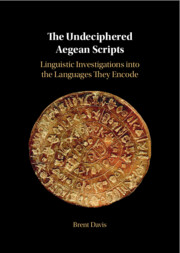
The decipherment of Linear B, an early form of Greek used by the Myceneans, by Michael Ventris and John Chadwick has long been celebrated. But five other scripts from the Bronze-Age Aegean remain undeciphered. In this book, Brent Davis provides a thorough introduction to these scripts and uses statistical techniques drawn from linguistics to provide insights into the languages lying behind them. He deals most extensively with the script of the Minoan civilization on Crete (“Linear A”), whose decipherment remains one of the Holy Grails of archaeology. He discusses linguistic topics in clear language and explains linguistic terms in a comprehensive glossary. The book also includes all data on which the various analyses of the scripts are based. It will therefore be of great interest and use not just to experts in the undeciphered Aegean scripts, but to novices and aficionados of decipherment as well.
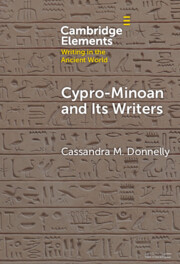
Poised as middlemen between the Ancient Near East and the Aegean, writers of Cypro-Minoan, the undeciphered Late Bronze Age script of Cyprus, borrowed and transformed writing practices from their neighbors and invented new ones. Bits and pieces of the script are found throughout the Mediterranean, but there are few clay tablets, characteristic of neighboring scribal-based, administrative writing traditions. Instead, Cypro-Minoan writers wrote on mercantile objects, outside of scribal schools. As the administrative centers of the eastern Mediterranean collapsed c. 1177 BCE administrative writing systems went with them. Cypro-Minoan remained in use, presaging the spread of the Phoenician alphabet. This Element explores the role of writing and trade during the collapse period and introduces readers to the Cypro-Minoan script, its history, and approaches to its decipherment, showing that writers of an undeciphered script can still communicate when we take the care to look for them.
Recommend this
Email your librarian or administrator to recommend adding this to your organisation's collection.