To save content items to your account,
please confirm that you agree to abide by our usage policies.
If this is the first time you use this feature, you will be asked to authorise Cambridge Core to connect with your account.
Find out more about saving content to .
To save content items to your Kindle, first ensure no-reply@cambridge.org
is added to your Approved Personal Document E-mail List under your Personal Document Settings
on the Manage Your Content and Devices page of your Amazon account. Then enter the ‘name’ part
of your Kindle email address below.
Find out more about saving to your Kindle.
Note you can select to save to either the @free.kindle.com or @kindle.com variations.
‘@free.kindle.com’ emails are free but can only be saved to your device when it is connected to wi-fi.
‘@kindle.com’ emails can be delivered even when you are not connected to wi-fi, but note that service fees apply.
Accordingly, the inquiry endures as to what specific art galvanized the modern world’s original treatise on painting. How Alberti’s remarkable journey through the art of his past and present is both reflected and refracted in De pictura demands examination of the lines of transmission through education and career in Alberti’s decisive locales before Florence.
This chapter paints the political and intellectual backdrop of Padua in the 1300s, which sets the stage for Alberti’s education. While Rolandino, Lovato, and Mussato were intellectual giants of a commune, Petrarch, Conversino, and Vergerio were literary giants at a court – that of Francesco Il Vecchio da Carrara, a patron of classical medals, art, and humanist educators and antiquarians. Accordingly, five factors made Padua a center of early humanism: independent university faculty, accession of classical rhetoric, Petrarch and his library, Carrara’s support for educators and antiquarians, and the city’s absorption by Venice, allowing unfettered education to gift Alberti a literary and visual universe.
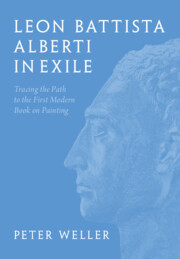
The prodigy poet, playwright, architect, painter, and humanist savant Leon Battista Alberti emerged in 1435 with De pictura ['On Painting'], the modern era's earliest discourse on Western art, written in classical Latin by an ostensible practitioner of the craft. Alberti has captivated the art world from his own epoch to ours, and his dubious Florentine identity enables this allure. In this volume, Peter Weller challenges the popular notion that De pictura's compendium on lines, points, mathematics, composition, narrative, and portraiture is primarily the result of Alberti's return to Florence and his short exposure to its visual art. Weller argues that Rome, Padua, Bologna, and northern Europe – environs where Alberti studied, worked, and lived during exile – empowered his paramount intellectual-artistic gift. Scrutiny of Alberti's evolution before Florence illuminates how this original Renaissance man merged the two most conspicuous cultural developments of early modern Italy – visual art and humanism — to create De pictura, our first modern book on painting.
Recommend this
Email your librarian or administrator to recommend adding this to your organisation's collection.