To save content items to your account,
please confirm that you agree to abide by our usage policies.
If this is the first time you use this feature, you will be asked to authorise Cambridge Core to connect with your account.
Find out more about saving content to .
To save content items to your Kindle, first ensure no-reply@cambridge.org
is added to your Approved Personal Document E-mail List under your Personal Document Settings
on the Manage Your Content and Devices page of your Amazon account. Then enter the ‘name’ part
of your Kindle email address below.
Find out more about saving to your Kindle.
Note you can select to save to either the @free.kindle.com or @kindle.com variations.
‘@free.kindle.com’ emails are free but can only be saved to your device when it is connected to wi-fi.
‘@kindle.com’ emails can be delivered even when you are not connected to wi-fi, but note that service fees apply.
Chapter 6 offers an empirical analysis of stewardship disclosures under the UK Stewardship Code, using text analytics – including text length, readability, phrase overlap, lexical similarity, frequency analysis, and structural topic modelling – to examine reporting under the 2012 and 2020 iterations. It reveals shifts in narrative style, thematic focus, and institutional engagement. Topic modelling shows a move from governance-centric narratives in 2012 to a broader thematic repertoire in 2020, including ESG integration, multi-asset stewardship, and systemic risk. While the UK Code 2020 prompted more reflective disclosures in some cases, others remain formulaic, relying on generic language and procedural reporting. Patterns of convergence and divergence reflect institutional type, resources, and stewardship capacity. The analysis underscores both the promise and limits of stewardship reporting – highlighting its role in fostering innovation and reflection, while exposing challenges in achieving consistent, meaningful implementation. By unpacking form and substance, the chapter contributes to debates on institutionalising stewardship as a credible mechanism of investor accountability and long-term public value.
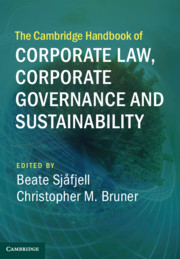
The emerging field of corporate law, corporate governance and sustainability is one of the most dynamic and significant areas of law and policy in light of the convergence of environmental, social and economic crises that we face as a global society. Understanding the impact of the corporation on society and realizing its potential for contributing to sustainability is vital for the future of humanity. This Handbook comprehensively assesses the state-of-the-art in this field through in-depth discussion of sustainability-related problems, numerous case studies on regulatory responses implemented by jurisdictions around the world, and analyses of predominant strategies and potential drivers of change. This Handbook will be an essential reference for scholars, students, practitioners, policymakers, and general readers interested in how corporate law and governance have exacerbated global society's most pressing challenges, and how reforms to these fields can help us resolve those challenges and achieve sustainability.
Recommend this
Email your librarian or administrator to recommend adding this to your organisation's collection.