To save content items to your account,
please confirm that you agree to abide by our usage policies.
If this is the first time you use this feature, you will be asked to authorise Cambridge Core to connect with your account.
Find out more about saving content to .
To save content items to your Kindle, first ensure no-reply@cambridge.org
is added to your Approved Personal Document E-mail List under your Personal Document Settings
on the Manage Your Content and Devices page of your Amazon account. Then enter the ‘name’ part
of your Kindle email address below.
Find out more about saving to your Kindle.
Note you can select to save to either the @free.kindle.com or @kindle.com variations.
‘@free.kindle.com’ emails are free but can only be saved to your device when it is connected to wi-fi.
‘@kindle.com’ emails can be delivered even when you are not connected to wi-fi, but note that service fees apply.
In this chapter we provide a description – phonological, morphosyntactic and lexical – of contemporary East Anglian English, accounting for its historical evolution, drawing from empirical analyses of a range of corpora of informal spoken English from across the region, and supported by vowel plots from speakers in four different urban centres in East Anglia: Norwich, Ipswich, Colchester and Wisbech. For the purposes of this chapter, we define present-day East Anglia as including the counties of Norfolk and Suffolk as well as northern and eastern Cambridgeshire and north Essex, a definition established on linguistic grounds by Trudgill (2001). Following a sociolinguistic history of East Anglia, our description of the local variety highlights diachronic change and contemporary variability within the region, the advent of innovation from outside, as well as geographical evidence of dialect levelling within.
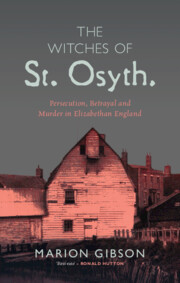
An emotive, haunting story of a community torn apart, the Essex witch accusations and trial of 1581-2 are, taken together, one of the pivotal instances of that malign and destructive wave of misogynistic persecution which periodically broke over early modern England. Yet, for all their importance in the overall study of witchcraft, the so-called witches of St Osyth have largely been overlooked by scholars. Marion Gibson now sets right that neglect. Using fresh archival sources – and investigating not just the village itself, but also its neighbouring Elizabethan hamlets and habitations – the author offers revelatory new insights into the sixteen women and one man accused of sorcery while asking wider, provocative questions about the way history is recollected and interpreted. Combining landscape detective work, a reconstruction of lost spaces and authoritative readings of newly identified key documents, Gibson skilfully unlocks the poignant personal histories of those denied the chance to speak for themselves.
An emotive, haunting story of a community torn apart, the Essex witch accusations and trial of 1581-2 are, taken together, one of the pivotal instances of that malign and destructive wave of misogynistic persecution which periodically broke over early modern England. Yet, for all their importance in the overall study of witchcraft, the so-called witches of St Osyth have largely been overlooked by scholars. Marion Gibson now sets right that neglect. Using fresh archival sources – and investigating not just the village itself, but also its neighbouring Elizabethan hamlets and habitations – the author offers revelatory new insights into the sixteen women and one man accused of sorcery while asking wider, provocative questions about the way history is recollected and interpreted. Combining landscape detective work, a reconstruction of lost spaces and authoritative readings of crucial documents, Gibson skilfully unlocks the poignant personal histories of those denied the chance to speak for themselves.
Chapter 1 examines recruitment, looking at questions surrounding a postulant’s choice of convent and how they managed to travel there. The very foundation of each exile convent was based on national identity: these were, after all, English convents. Yet this insistence on Englishness did not only emanate from the women religious themselves but was fundamental to their gaining permission to establish convents in the first place. Nevertheless, it is argued that particular religious identities affected the process of joining a convent. It takes as its case study convent recruitment from the county of Essex to argue that women chose particular convents based on an interplay between home and abroad, as well as clerical and familial patronage. It highlights the effect of one clerical movement – the Jesuits – on convent recruitment patterns, yet these issues of competing spiritualities were not, despite first appearances, solely products of particular national contexts but part of wider developments in Catholic Europe. They show the formation of the English convents as part of the European – and even global – Catholic Reformation rather than presenting them as isolated national enclaves.
This paper presents preliminary research into the social and economic impact of early urban settlement in Britain, focusing on the case-study area of Late Iron Age to Roman Essex. Through fresh analysis of ceramic assemblages from Colchester and Heybridge, we describe hitherto unrecognised socio-cultural groupings and identities through subtle differences in the deposition of pottery in the generations before and after conquest. The concluding discussion concentrates on problems that we still have to address in describing the economic basis of early urban society in Britain.
Recommend this
Email your librarian or administrator to recommend adding this to your organisation's collection.