To save content items to your account,
please confirm that you agree to abide by our usage policies.
If this is the first time you use this feature, you will be asked to authorise Cambridge Core to connect with your account.
Find out more about saving content to .
To save content items to your Kindle, first ensure no-reply@cambridge.org
is added to your Approved Personal Document E-mail List under your Personal Document Settings
on the Manage Your Content and Devices page of your Amazon account. Then enter the ‘name’ part
of your Kindle email address below.
Find out more about saving to your Kindle.
Note you can select to save to either the @free.kindle.com or @kindle.com variations.
‘@free.kindle.com’ emails are free but can only be saved to your device when it is connected to wi-fi.
‘@kindle.com’ emails can be delivered even when you are not connected to wi-fi, but note that service fees apply.
Classic studies of English fiction and social life often depict romantic marriage and marriage novels as rising in tandem, with each propelling the other all the way to the moment of Jane Austen or even to the early twentieth-century era of modernist experiment and legal divorce. Capitalizing on this collection’s attention to micro-chronologies, this chapter, however, engages with a set of domestic fictions, by William Godwin, Amelia Opie, Maria Edgeworth, and others, that for a brief interval consciously dispensed with the premise that marriage was crucial for narrative completion. Widening the collection’s geographic focus, I consider this set of English works alongside the novels of the Swiss-French Germaine de Staël, an inclusion that helps underscore how some of the challenges posed in the 1800s to the narrative grammar of the novel originated with the French Revolution and with revolutionary jurists’ liberalization of the laws regarding marriage and its dissolution.
Chapter 3 continues the exploration of women’s weeping, turning to the novels of Frances Burney, particularly Camilla (1796) and The Wanderer (1814). Burney is a writer who draws on scientific discourse in her depictions of both seeing and feeling, vision and tears. Representing affect in fluid form, she imagines emotional repression and expression as a blockage and flow of liquid, which, when it takes the shape of tears, become a means of exercising female agency. Affect also plays an integral role in processes of perception throughout Burney’s fiction, with her novels suggesting that seeing is always attended and informed by feeling. Her work thus engages with the sentimental both through literary convention and through philosophical foundation, as its depictions of eyes and tears suggest that feeling is as epistemologically valid as observation.
The final chapter of the book takes a different focus and works through a particular rhythm. The chapter seeks to explore the value at stake not in the possession itself, but rather in the relationship of possession the owner held with it. It wants to further understand why maintaining possession over time was so important and what it did in cultural and social terms. The chapter does so by focusing on a single novel, Frances Burney’s Cecilia (1782). The novel is deeply concerned with questions of property and examines what happens when property and possessions are lost. As such, it offers an important lens through which to explore the value of keeping hold. The chapter particularly examines how maintaining possession of your things was important to the broader project so important within eighteenth-century culture: that of maintaining self-possession. We know that possessions were important to the construction and display of the self, and here we see how the loss of such possessions threatened that project.
What did it mean to possess something – or someone – in eighteenth-century Britain? What was the relationship between owning things and a person's character and reputation, and even their sense of self? And how did people experience the loss of a treasured belonging? Keeping Hold explores how Britons owned watches, bank notes and dogs in this period, and also people, and how these different 'things' shaped understandings of ownership. Kate Smith examines the meaning of possession by exploring how owners experienced and responded to its loss, particularly within urban spaces. She illuminates the complex systems of reclamation that emerged and the skills they demanded. Incorporating a systematic study of 'lost' and 'runaway' notices from London newspapers, Smith demonstrates how owners invested time, effort and money into reclaiming their possessions. Characterising the eighteenth century as a period of loss and losing, Keeping Hold uncovers how understandings of self-worth came to be bound up with possession, with destructive implications.
The first chapter focuses on novels such as Charlotte Lennox’s The Female Quixote, Eliza Haywood’s Betsy Thoughtless, and Frances Burney’s Camilla, in which a heroine repeatedly ends up dangerously alone with a man. This episode both resembles and threatens to derail the marriage plot. These episodes of getting lost re-tell the marriage plot not as a story of falling in love, but as a series of misadventures in which the heroine gets condemned as a “lost” or “fallen” woman. Earlier in the eighteenth-century novel, the heroine is likened to a prostitute as a result of her sexual desire. Toward the end of the century, the heroine’s resemblance to a “lost” woman no longer results from her stigmatized desire, but from her precarious social status as a woman being considered for marriage, which she is prohibited from fully acknowledging. Earlier subgenre novels anticipate readers who are prohibited from acknowledging and fulfilling their desires. The historically later episodes anticipate readers who are drawn to the subgenre as a means of alleviating their lack of autonomy.
The Vicar of Wakefield is a tale with marriage at its core. This chapter puts that preoccupation in historical and cultural context, accounting for the importance of the Whistonian controversy and Hardwicke Marriage Act of 1753 as backdrops to a novel which does not merely reflect its time, but anticipates subsequent treatments of the institution of marriage in fiction.
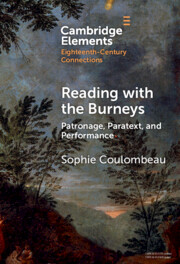
This Element offers a multidimensional study of reading practice and sibling rivalry in late eighteenth-century Britain. The case study is the Aberdeen student and disgraced thief Charles Burney's treatment of Evelina (1778), the debut novel of his sister Frances Burney. Coulombeau uses Charles's manuscript poetry, letters, and marginalia, alongside illustrative prints and circulating library archives, to tell the story of how he attempted to control Evelina's reception in an effort to bolster his own socio-literary status. Uniting approaches drawn from literary studies, biography, bibliography, and the history of the book, the Element enriches scholarly understanding of the reception of Frances Burney's fiction, with broader implications for studies of gender, class, kinship and reading in this period. This title is also available as Open Access on Cambridge Core.
Modern scholars have achieved consensus that Frances Burney was writing satire in her novels, acknowledging the range of Burney’s satiric targets and tones, and the merging and submerging of her satire with comedy, irony, melodrama, and sentimentalism. Yet Burney’s contemporary reviewers did not identify Burney as a satirist. In fairness, satire defies easy definition, and the status of satiric fiction when Burney was writing at the end of the eighteenth century was far less secure than at the beginning of the period. Furthermore, satire was gendered as male at the time; women were seen as the targets of satire, not its practitioners. So even when Burney’s reviewers and readers did recognize satiric elements in her work, she was seen as a sentimental novelist, a didactic novelist, a romantic novelist – as anything but a satirist. And Burney did not identify herself as a satirist either. In doing so, Burney was passing – hiding in plain sight as a satirist, defying the conventions of women writers and novelists of her time.
Chapter 2 reveals the frustrating and interminable process of revision for Frances Burney in a survey of all of her novels.Her first two novels, Evelina (1778) and Cecilia (1782), reveal that she submitted to the actual and perceived criticisms of family and friends in ways that diminished her initial innovative aims, including the deletion of a scene containing satanic rites in her Cecilia manuscript.Burney’s last two novels evince a reversal in her revision practices and display her later-in-life tendencies toward verbal excess.Her post-publication revisions to Camilla (1796) show her inability to moderate repetitive characterization and Gothicize her text in the case of the tantalizingly unfinished third edition.As with her changes to later editions of Camilla, Burney’s planned revisions to The Wanderer (1814) were motivated by her dissatisfaction with negative reviews and her unwillingness to relinquish control of her novels.Her final revisions demonstrate her recognition of the never-ending potential of the early novel form.
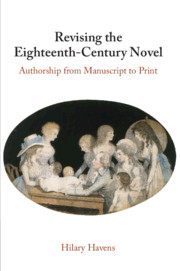
Revisions form a natural part of the writing process, but is the concept of revision actually an intrinsic part of the formation of the novel genre? Through the recovery and analysis of material from novel manuscripts and post-publication revisions, Hilary Havens identifies a form of 'networked authorship'. By tracing authors' revisions to their novels, the influence of familial and literary circles, reviewers, and authors' own previous writings can be discerned. Havens focuses on the work of Samuel Richardson, Frances Burney, Jane Austen, and Maria Edgeworth to challenge the individualistic view of authorship that arose during the Romantic period, and argues that networked authorship shaped the composition of eighteenth-century novels. Exploring these themes of collaboration and social networks, as well as engaging with the burgeoning trend towards textual recovery, this work is an important contribution in the study of eighteenth-century novels and their manuscript counterparts.
Recommend this
Email your librarian or administrator to recommend adding this to your organisation's collection.