To save content items to your account,
please confirm that you agree to abide by our usage policies.
If this is the first time you use this feature, you will be asked to authorise Cambridge Core to connect with your account.
Find out more about saving content to .
To save content items to your Kindle, first ensure no-reply@cambridge.org
is added to your Approved Personal Document E-mail List under your Personal Document Settings
on the Manage Your Content and Devices page of your Amazon account. Then enter the ‘name’ part
of your Kindle email address below.
Find out more about saving to your Kindle.
Note you can select to save to either the @free.kindle.com or @kindle.com variations.
‘@free.kindle.com’ emails are free but can only be saved to your device when it is connected to wi-fi.
‘@kindle.com’ emails can be delivered even when you are not connected to wi-fi, but note that service fees apply.
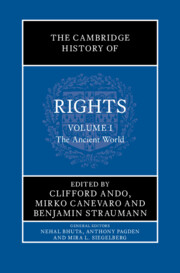
The ancient world existed before the modern conceptual and linguistic apparatus of rights, and any attempts to understand its place in history must be undertaken with care. This volume covers not only Greco-Roman antiquity, but ranges from the ancient Near East to early Confucian China; Deuteronomic Judaism to Ptolemaic Egypt; and rabbinic Judaism to Sasanian law. It describes ancient normative conceptions of personhood and practices of law in a way that respects their historical and linguistic particularity, appreciating the distinctiveness of the cultures under study whilst clarifying their salience for comparative study. Through thirteen expertly researched essays, volume one of The Cambridge History of Rights is a comprehensive and authoritative reference for the history of rights in the global ancient world and highlights societies that the field has long neglected.
In August 1989, on the occasion of the bicentennial of the French Revolution, Le Monde published an interview with Margaret Thatcher, then Prime Minister of the United Kingdom. In that interview Thatcher, in France at the time as an honored guest of French President François Mitterrand, asserted that claims that the notion of subjective rights originated with the French Revolution, and specifically with the Declaration of the Rights of Man and of the Citizen of August 1789, are nonsense. The socialist French Prime Minister Michel Rocard criticized Thatcher vocally, and her arrival at the bicentennial celebrations was met with jeers, yet many historians today would agree with her, whatever their preferred origin point(s) for a concept of subjective rights. What is more controversial is Thatcher’s alternative account of the origins of the notion of subjective rights: to her, they had been invented by the Greeks, and were already foundational to Athenian democracy.
Is there anything in the ancient world that deserves to be called a “right” in the subjective sense? The philosopher Alasdair MacIntyre stated quite apodictically that “there is no expression in any ancient or medieval language correctly translated by our expression ‘a right’ until near the close of the middle ages: the concept lacks any means of expression in Hebrew, Greek, Latin or Arabic, classical or medieval, before about 1400,” concluding from this that even if there were such rights, “no one could have known that there were.” Until relatively recently, historians would have agreed with MacIntyre. The prevailing view was that in antiquity we look in vain for what has come to be called subjective rights – that neither the concept of rights nor the word “right” could be encountered in the ancient world in its subjective sense.
This chapter looks at the legal texts from ancient Greece and Crete and connections they may share with biblical law. The Greek laws offer rich comparative material for legal problems in a geographically and culturally adjacent area and contribute to a better understanding of the social interactions and administrative structures in and around the Mediterranean.
This Companion offers a comprehensive overview of the history, nature, and legacy of biblical law. Examining the debates that swirl around the nature of biblical law, it explores its historical context, the significance of its rules, and its influence on early Judaism and Christianity. The volume also interrogates key questions: Were the rules intended to function as ancient Israel's statutory law? Is there evidence to indicate that they served a different purpose? What is the relationship between this legal material and other parts of the Hebrew Bible? Most importantly, the book provides an in-depth look at the content of the Torah's laws, with individual essays on substantive, procedural, and ritual law. With contributions from an international team of experts, written specially for this volume, The Cambridge Companion to Law in the Hebrew Bible provides an up-to-date look at scholarship on biblical law and outlines themes and topics for future research.
European integration is in crisis. Paradoxically, disintegration seems to be a transnational tendency. While one cannot say that proportionality bears the dynamics of disintegration itself, relevant tendencies affect its form and function in different settings. This chapter offers a particular reading of proportionality cases that have provoked much discussion among French, English and Greek legal actors. I argue that what is new about these cases is not so much the application of proportionality itself, which follows already existing local patterns characterising the reception and the evolution of proportionality. Rather, it is the particular context of disintegration in which proportionality operates. Indeed, what is observed in these much debated uses of proportionality is a rupture in the traditional local patterns of Europeanisation.
This chapter provides a comparative study of the application of proportionality by English and Greek judges in the field of EC market freedoms. It shows that both English and Greek judges have assumed their mission of juges communautaires de droit commun. Despite this appearance of convergence, I argue, the reception of proportionality follows local patterns of cultural change and local knowledge practices, which affect local lawyers’ possibilities to resist to the process of European integration, as well as their capacity shape this process. Common law pragmatism has allowed English courts to frame normative conflicts between domestic and EC law. When proportionality and the effet utile of EC market freedoms entered into conflict with fundamental constitutional principles of the common law, English judges have occasionally objected to their application. By way of contrast, the perception of law as science has not allowed Greek lawyers to frame normative conflicts between domestic and EC law. Proportionality as a European science has engineered important constitutional change and has considerably compromised the normativity of the Greek Constitution.
This chapter examines the distinctions made between slaves and free persons in Greek law, politics, religion and civic ideology. It also explores the ways that slaves subverted these distinctions in everyday life and thereby exposes their artificiality.
Recommend this
Email your librarian or administrator to recommend adding this to your organisation's collection.