To save content items to your account,
please confirm that you agree to abide by our usage policies.
If this is the first time you use this feature, you will be asked to authorise Cambridge Core to connect with your account.
Find out more about saving content to .
To save content items to your Kindle, first ensure no-reply@cambridge.org
is added to your Approved Personal Document E-mail List under your Personal Document Settings
on the Manage Your Content and Devices page of your Amazon account. Then enter the ‘name’ part
of your Kindle email address below.
Find out more about saving to your Kindle.
Note you can select to save to either the @free.kindle.com or @kindle.com variations.
‘@free.kindle.com’ emails are free but can only be saved to your device when it is connected to wi-fi.
‘@kindle.com’ emails can be delivered even when you are not connected to wi-fi, but note that service fees apply.
Concerned with the intersection of early Indian medicine and religion, this article examines the scope, scale, and influence of the medical philanthropy undertaken by Śaiva Hindu communities in medieval South Asia. It begins first with a non-exhaustive survey of epigraphs in Sanskrit, Tĕlugu, Tamiḻ, and Kannaḍa from various regions of South Asia during the Śaiva Age. Doing so, it identifies a substantive pattern of Śaiva monasteries, temples, and patrons building hospitals, donating medicines, establishing endowments for physicians, and/or teaching medical texts. It then proceeds to recognise the Śivadharma corpus, especially the Śivadharmaśāstra and Śivadharmottara, as a key theoretical guide that almost certainly informed and incentivised Śaiva medical interventions through its conceptualisation of the ārogyadāna (gift of health) as a highly meritorious act of dharma. The article also speaks to how the Śivadharma corpus helped nurture among Śaivas a broader concern for therapeutic interventions and longevity, which I suggest was also reflected in their engagements with alchemy and in their development and circulation of curative Sanskrit tantras. Finally, using philology, this article identifies the impact that the Śivadharma corpus had on both influencing the conceptualisation and normative importance of medical philanthropy in broader Hindu (esp. Smārta) discussions of charity in late medieval digests on dharma.
This Element argues that early modern witchcraft (discourse, visual imagery and trials) in Scotland, England, Ireland and America demonised, devalued and disqualified non-normative bodies and minds. Using interpretative frameworks of monstrosity and deformity, while working within wider religious and medical understandings of disability, physical, cognitive, and sensory difference was read as inner corruption, sin or divine punishment or medicalised and pathologised as something to be fixed. The witch's body became monstrous through association with demonic creatures and physical transformation, while visible physical difference offered sought-after physical evidence of witchcraft. Intersecting with social status, reputation, and gender, disability therefore explains why some individuals were accused of witchcraft. Disability could also hamper a suspects' ability to defend themselves during interrogation and trial. Their victims, the bewitched, however, used witchcraft accusations to navigate discriminatory narratives and treatment of disabling conditions and to find ways to cure or mitigate them.
Richard Norris Wolfenden (1854–1926) had a remarkable and varied career in both medical practice and marine biology. As a laryngologist, he was involved in the controversial treatment of the Crown Prince of Germany with Morell Mackenzie in 1887 and later undertook oceanographic research in the North Atlantic as a founding member of the Challenger Society for Marine Science. In 1896, he created a striking series of X-ray images of marine echinoderms taken from the seabed of Scapa Flow in Orkney. These beautiful images, created with the assistance of fellow physician John Macintyre, were published in the inaugural issue of the Archives of Skiagraphy. In this work, we give a brief appreciation of Wolfenden’s contributions 100 years after his death and take the opportunity to offer a correction to two minor inaccuracies in a previously published account of Wolfenden’s life.
This Element's contribution explores the historiography of madness in the Modern era, including landmark publications in the overlapping fields of the history of psychiatry and the history of lunatic asylums. As this examination of almost 200 academic works will demonstrate, the field is vast and highly contested, with researchers sometimes disagreeing about the basic terms of analysis. Nevertheless, from Foucault to Fanon, from Goffman to Gilman, these debates about social and medical responses to madness have inspired some of the most influential academic scholarship of the twentieth century. This title is also available as Open Access on Cambridge Core.
This article examines how scientific research on lactose digestion from 1950 to 1980 became entangled in shifting discourses on race, heredity, and population. It traces how scientific framings of lactose digestion changed during this period—initially racialized as a disorder (lactase deficiency) affecting Black Americans, later reclassified as an ethnic trait, and ultimately reinterpreted as a biomarker of European ancestry. Drawing on medical research on “lactose science” and archival sources, this study explores how geneticists, medical researchers, and anthropologists jointly navigated the complexities of race and human variation in the postwar period. Using Peter Galison’s concept of trading zones, the paper traces how ethnicity and population emerged as strategic alternatives to race, facilitating interdisciplinary collaboration while preserving racialized assumptions about biological difference. The paper argues that despite efforts to align with UNESCO’s post-racial scientific agenda, research on lactose digestion came to produce a normative discourse around whiteness. In doing so, it raises a critical question: how did an ostensibly anti-racist science inadvertently revive older racial biologisms?
This Element brings together historical sources and contemporary experiences to explore the interplay between singing, sociality, body, and meaning in the English landscape over the past century. It explores the connections between air and song and between singing and movement, through the context of the early twentieth century open-air recreation movement. This is supplemented by recent literature on singing and wellbeing, and the experiences of a contemporary walking choir captured via interviews in the field. The authors argue that outdoor singing has been part of co-constructed soundscapes of the modern English leisure landscape, and ask what this meant for those who participated in collective open-air singing and rambling. They explore how open-air singing connected with conceptions of the countryside, with a sense of fellow-feeling, and how this might have both reified and challenged normative ways of being in landscapes. This title is also available as Open Access on Cambridge Core.
The specialties of ENT and anaesthesia have always had a unique relationship because of their longstanding history of co-operation over the shared airway.
Methods
This historical review narrates how the modern practice of ENT surgery has developed following advances in anaesthetic techniques, as well as inspiring them.
Results
From the earliest use of anaesthetic gases by Long, Wells and Morton, to their rapid adoption for use in tonsil and cleft palate surgical procedures, ENT surgeons were early beneficiaries of this new technology. The demands of surgery for facial injuries in World War II was a driver for anaesthetic advances, and Ivan Magill reinvented the specialty in response.
Conclusion
Further developments in managing the shared airway, including jet ventilation, total intravenous anaesthesia and awake fibre-optic intubation, have shaped the modern ENT operating theatre, and highlight the vital collaboration between ENT and anaesthesia over the past 150 years.
Impaired consciousness is a topic lying at the intersection of science and philosophy. It encourages reflection on questions concerning human nature, the body, the soul, the mind and their relation, as well as the blurry limits between health, disease, life and death. This is the first study of impaired consciousness in the works of some highly influential Greek and Roman medical writers who lived in periods ranging from Classical Greece to the Roman Empire in the second century CE. Andrés Pelavski employs the notion and contrasts ancient and contemporary theoretical frameworks in order to challenge some established ideas about mental illness in antiquity. All the ancient texts are translated and the theoretical concepts clearly explained. This title is also available as open access on Cambridge Core.
This study examines overlooked or underexplored fragments from Rufus of Ephesus’ On Melancholy, as cited in Abū Bakr Muḥammad b. Zakariyyāʾ al-Rāzī’s seminal medical work, The Comprehensive Book (Kitāb al-Ḥāwī fī al-Ṭibb). Through an analysis of Arabic texts and Latin translations, we present two previously unexamined fragments and one of doubtful authenticity which reference Rufus’ understanding of melancholy. Preserved across diverse linguistic and cultural contexts, these fragments illuminate the transmission of ancient Graeco-Roman medical knowledge into the Islamic Golden Age and Renaissance Europe. Arabic texts are compared with corresponding Latin editions to verify their authenticity and trace their historical transmission.
Palestinian doctors became a dynamic, vocal, influential, and fascinating professional community over the first half of the twentieth century, growing from roughly a dozen on the eve of World War I to 300 in 1948. This study examines the social history of this group during the late Ottoman and British Mandate periods, examining their social and geographic origins, their professional academic training outside Palestine, and their role and agency in the country's medical market. Yoni Furas and Liat Kozma examine doctors' interactions with the rural and urban society and their entangled relationship with the British colonial administration and Jewish doctors. This book also provides an in-depth description of how Palestinian doctors thought and wrote about themselves and their personal, professional, and collective ambitions, underlining the challenges they faced while attempting to unionize. Furas and Kozma tell Palestine's story through the acts and challenges of these doctors, writing them back into the local and regional history.
This chapter explores the medically-trained writer, Robert Montgomery Bird, and his fraught experience of the way the competing ontological paradigms that inflected Edgar Huntly also conditioned early nineteenth-century medical discourse. Bird uses his picaresque novel, Sheppard Lee (1836), to interrogate what was called “regular” medical discourse and its mind-centered ontology, and to imagine instead the ontological possibilities that result from the body-centered ontology of metempsychosis. For Bird, metempsychosis involves our consciousness migrating from one body to another, and being defined by its different embodiment. In representing the lived experience of both white and Black embodiment, Bird uses metempsychosis to interrogate “regular” medicine’s mind-centered ontological paradigm, even as he puts pressure on “irregular” medicine as well. As I argue, Bird understands conscious existence as ontological drift, as I call it, a far less clear, but far more capacious ontology than either regular or irregular medical discourses entertain. By “minding the body” in this way, Bird uses his novel’s interrogation of the mind-body relationship to imagine a less repressive, but not unproblematic, form of racialized conscious existence in the antebellum period.
In a world of growing health inequity and ecological injustice, how do we revitalize medicine and public health to tackle new problems? This groundbreaking collection draws together case studies of social medicine in the Global South, radically shifting our understanding of social science in healthcare. Looking beyond a narrative originating in nineteenth-century Europe, a team of expert contributors explores a far broader set of roots and branches, with nodes in Sub-Saharan Africa, South America, Oceania, the Middle East, and Asia. This plural approach reframes and decolonizes the study of social medicine, highlighting connections to social justice and health equity, social science and state formation, bottom-up community initiatives, grassroots movements, and an array of revolutionary sensibilities. As a truly global history, this book offers a more usable past to imagine a new politics of social medicine for medical professionals and healthcare workers worldwide. This title is also available as open access on Cambridge Core.
The Introduction provides an overview of the central questions raised in the book, the arguments presented, and the methodology employed. It frames key questions about the shifting meanings of childhood pain and its implications for the construction of adult worlds. Additionally, it highlights the interplay between the child as an object of clinical observation and as a symbolic figure within cultural and scientific narratives. Through this lens, it contributes to broader debates on the intersections of science, emotion, and society. The methodology used is one of interdisciplinary history, drawn largely from the history of medicine and cultural history, which assesses visual as well as written material.
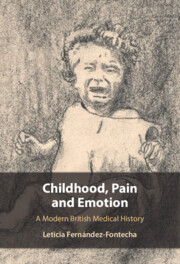
Situated between the history of pain, history of childhood and history of emotions, this innovative work explores cultural understandings of children's pain, from the 1870s to the end of the Second World War. Focusing on British medical discourse, Leticia Fernández-Fontecha examines the relationship between the experience of pain and its social and medical perception, looking at how pain is felt, seen and performed in contexts such as the hospital, the war nursery and the asylum. By means of a comparative study of views in different disciplines – physiology, paediatrics, psychiatry, psychology and psychoanalysis – this work demonstrates the various ways in which the child in pain came to be perceived. This context is vital to understanding current practices and beliefs surrounding childhood pain, and the role that children play in the construction of adult worlds.
In the annual presidential address to the American Society of Church History (ASCH), Esther Chung-Kim discusses the pivotal role of pastors, physicians, and lay healers in responding to poverty and illness in early modern Europe. She offers that their involvement shaped both social welfare and medical care. Reflecting the values of biblical examples, both Catholics and Protestants established institutions to support the sick and poor. Promoting practices of care for the sick, religious leaders, pious physicians, and lay healers promoted charity through medicine, in various efforts to expand access to care. Protestant reformers sought to shift responses to illness away from saintly intercession and instead toward direct appeals to God and natural medicine, seen as a divine gift. In some cities, Reformed ordinances mandated medical support for the poor by institutionalizing care during epidemics. The convergence of religious and medical reform, aided by print culture, resulted in Christian thinkers recognizing medicine as a form of God’s providence in nature (thereby encouraging a positive view of medicine), and physicians promoting religious reform in their medical treatises. In the early modern era, Catholics and Protestants both strengthened the link between Christianity and medicine with theological and practical ways to show care and concern for the sick.
This article discusses early modern North Indian ways of expressing how barrenness could be mapped onto a woman’s maternal identity. Scholars have engaged with the historical evolution of women’s identities, focusing overwhelmingly on their economic and political potential. This article is the first to use medical and erotological sources from the seventeenth and eighteenth centuries to study women as procreative agents, and the socio-sexual anxieties prompted by infertile female bodies. Through a critical study of a wide range of medical material, I demonstrate that by the eighteenth century, several transformations in medical discourses can be mapped onto textual transmissions from Sanskrit (and Braj Bhasha) to Persian, as well as between competing but conterminously flourishing medical paradigms, Ayurveda and Yunani. While cures for childlessness have a much longer history, a new genre of ‘anonymous’ sources, particularly focused on the sexual diseases of men and women emerged in early modern North India. Lastly, my comparative methodological approach to different textual genres will complicate our understanding of early modern medical episteme and its intended audience.
Lightning-related accidents were relatively frequent among age-of-sail seafarers, due to tall ships’ exposure and prominence above the sea. Yet lightning remains largely neglected in the historiography on sailors’ experiences. Examining a range of contemporary medical and philosophical literature, shipboard surgeons’ journals, operational correspondence and seamen’s memoirs, this article argues that lightning strikes created unique moments of epistemological and social crisis aboard naval ships. With its awesome multi-sensorial manifestations, divine symbolism and catastrophic and erratic effects on human bodies, lightning loomed large in many seafarers’ consciousness, as a powerful source of panic and trauma. At the same time, despite contemporary developments in natural philosophical understandings of electricity, surgeons’ training on how to treat these injuries remained limited. As a result, lightning could substantially affect naval shipboard relations between officers and ‘common’ seamen, creating challenges to the former’s authority and mobilising a range of competing emotions and knowledges. Considering lightning illustrates the fruitfulness of looking at uncommon but devastating types of injury, for historians interested in medical authority and in the doctor–patient relationship. It also helps us to start sketching accounts of seafaring bodies, health and maritime medical and religious cultures that give the sky its due place alongside the water.
This chapter analyzes interactions between the Mansfeld Regiment and its surroundings, including confessional conflict, fights, burials, and the regiment’s effect on local demographics. The Mansfelders were both Protestant and Catholic, but the regiment was quartered in a Catholic land. Its members fought with or plundered locals. However, its effects on baptism, marriage, and death rates in most of the areas I analyzed were ambiguous. The exception is tiny Pontestura: Not only was the effect of numerous armies magnified in such a small town, but wrongdoings there were less likely to come to the attention of the authorities. I also locate a woman who may have been the wife of the enigmatic regimental secretary Mattheus Steiner in local baptismal records, exemplifying that interactions between Mansfelders and locals were not solely hostile. This chapter examines military death rates, which were awful even outside of combat, and may find evidence of the great Italian plague of 1629–1631 in the deaths of soldiers and other marginal men.