To save content items to your account,
please confirm that you agree to abide by our usage policies.
If this is the first time you use this feature, you will be asked to authorise Cambridge Core to connect with your account.
Find out more about saving content to .
To save content items to your Kindle, first ensure no-reply@cambridge.org
is added to your Approved Personal Document E-mail List under your Personal Document Settings
on the Manage Your Content and Devices page of your Amazon account. Then enter the ‘name’ part
of your Kindle email address below.
Find out more about saving to your Kindle.
Note you can select to save to either the @free.kindle.com or @kindle.com variations.
‘@free.kindle.com’ emails are free but can only be saved to your device when it is connected to wi-fi.
‘@kindle.com’ emails can be delivered even when you are not connected to wi-fi, but note that service fees apply.
Crusade history has been a popular and fruitful pursuit among modern historians of the Middle Ages. An unprecedented number of scholarly publications on the subject have appeared in recent years, not least because from the 1960s onwards the concept of crusade has been understood by many to include an increasing number of topics and a wider chronological and geographical scope than ever before. For centuries, crusade history was a relatively narrow field of study, which principally had at its centre one master narrative with strong roots in medieval times. The story of the momentous events of the First Crusade and the establishment of the kingdom of Jerusalem at the turn of the eleventh to the twelfth centuries was predominantly based on the chronicles of the First Crusade and William of Tyre’s history of the kingdom of Jerusalem. The chronological limits of this master narrative largely stretched between the Council of Clermont in 1095, when Pope Urban II proclaimed the First Crusade, and the fall of the kingdom of Jerusalem, which ceased to exist as a territorial entity in 1291. Its main plot was the conquest of Jerusalem by the First Crusaders, the events and subsequent crusades relating to the kingdom of Jerusalem and its neighbouring Latin principalities during the twelfth and thirteenth centuries and, to a lesser extent, attempts to reconquer the Latin East after 1291.
Modern research into crusading in the century following the fall of Acre began with the publication in 1886 of Joseph Delaville Le Roulx’s La France en orient au XIVe siècle: expéditions du maréchal Boucicaut. As his subtitle suggests, Delaville (1855–1911) was attracted to the subject by the dazzling exploits of Jean II le Maingre, called Boucicaut. This individual was one of the chivalric heroes of the late fourteenth century and the anonymous life written about him in 1409, the Livre des fais, made much of his relentless, indeed borderline obsessive, search for non-Christians against whom he could direct his martial skills. Boucicaut fought at the Battle of Nicopolis in 1396 against the Turks and led a French expeditionary force to the assistance of the desperate Byzantine emperor Manuel II in 1399. Appointed governor of Genoa for King Charles VI, he deployed the port’s war galleys against the recalcitrant king of Cyprus in 1403 before carrying out a series of raids on the Turkish and Mamluk coastline. His biographer wrote up these exploits in a lively, panegyric style, stressing throughout that Boucicaut was Christ’s athlete and defying critics who viewed the marshal as unreliable and irresponsible. It is clear that for certain chivalric circles in France, this was conduct to be praised if not imitated.
The Holy Land, conceived of as the patrimony of Christ, was the defining centre of crusade ideology. In an age when the cultic power of the physical locations connected with saints and events was flourishing, the potency of the land in which Jesus himself lived and died was bound to surpass all other sacred destinations. In the words of Guibert of Nogent: ‘If you think that you ought to take great pains to make a pilgrimage to the graves of the apostles or to the shrines of other saints, what expense of spirit can you refuse in order to rescue and make pilgrimage to the cross, the blood and the sepulchre?’
At the end of the eleventh century, European knowledge of a wider world was emerging from a period of relative ignorance. Patterns of long-distance trade across the Mediterranean, an increased impetus in pilgrimage, and the settlement of previously little-known regions had, by the 1090s, all contributed to a growing awareness of distant lands and peoples. Italians were regularly trading in north Africa and the Levant; Normans had established themselves in southern Italy; French-speaking knights participated in campaigns of Christian conquest in the Iberian peninsula; Scandinavians were a familiar sight in Constantinople, and western knights had even fought with the Seljuqs in Asia Minor. The response to the papal preaching of the First Crusade in 1095, however, stimulated travel to the eastern Mediterranean and Near East on a much larger scale than previously. Most crusaders were experiencing topographies and landscapes that were unfamiliar, and encountering peoples whose appearance, customs, and values challenged their preconceptions about the world.
The study of travel in Late Antiquity is complicated by a specific set of factors that will appear throughout this volume and in every period: namely, the motivations and goals of the travellers. This is especially true in Late Antiquity because the mental shape of the world was changing quickly and dramatically from what came before. The imperial reign of Constantine (306−337) ushered in for Christian writers a long-expected saeculum of imperial peace and the triumph of the Christian message. The motivations for travel in Late Antiquity very often can only be read on the background of that paradigm shift. The triumph of the Church was inextricably linked to the shape of the empire, notionally and geographically. That same empire in which Christians formerly had moved quietly and in secret was now an open space for travel and expansive thinking. Thus, travel in Late Antiquity went hand-in-hand with new geographical horizons: not primarily a physical expansion of “the known world” (the oikoumenē in Greek), though that came too, but a freedom of expression through movement within the Roman Empire they already knew.
Chapter 5 explores how Harriet Martineau’s travel narrative Eastern Life, Present and Past and Dante Gabriel Rossetti’s poem “The Burden of Nineveh” organize time through ruins from the eastern Mediterranean. Eastern Life, which was criticized for its unorthodox historicization of Christianity, imagines how ruins themselves experience human empires across centuries. The temporal form of the ruin, Martineau shows, is a capacious present in which the revolutions of human religions and empires become insignificant. Rossetti’s poem, which focuses on ancient Assyrian relics arriving at the British Museum, similarly surrenders human duration to the ruin’s own temporality. For Rossetti, the museum’s attempts to redefine the ruin within its own linear historicism necessarily fail because the ruin has already proven its endurance through many changing imperial narratives. Both Rossetti’s and Martineau’s texts depict ruin as a temporal form that outlasts any empire’s claims to significance, challenging the centrality of human experience in time.
Chapter 6 returns to William Thackeray’s Mediterranean travel writing to show how his humor fails to challenge the dominant heritage discourse in Jerusalem. Although Thackeray derides other Mediterranean sites for inauthenticity, he cannot profane Jerusalem, which means he cannot return it to human (and imperial) use, either by word play or physical contact. Anthony Trollope takes up this problem in his novel The Bertrams, in which he reconceives some places, like Alexandria, for modern use. These sites are wiped of their significance to British heritage discourse as ancient lands and rendered available for modernization. Jerusalem, though, proves too sacred, and thus too integral to British cultural heritage, to be colonized in the same way. Some holy sites thus endure as historical relics while others are rewritten as a “middle” East.
Part III centers on eastern Mediterranean places loosely designated as the “Holy Land” in British heritage discourse. Sites in Egypt, Palestine, and Syria were especially important within Christianity, generating new biblical historicisms in the face of geological deep time and a booming tourism industry. However, the same cultural heritage that underwrote British imperialism and articulated a mission to modernize the “East” maintained that some historically significant places should be preserved. This tension is central to the temporal forms of ruin and profanation, which I define in Part III. The desire to claim Eastern sites as the origin of Western culture conflicted with the simultaneous desire to distance current populations there as “Other.” Laying claim to the history of a place like Palmyra, an ancient Roman city in Syria still popular with Western observers, both complicated and facilitated the relationship with present life there.
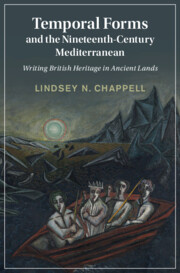
The Mediterranean is ubiquitous in nineteenth-century British literature, but this study is the first to fully recover and explore the region's centrality to Romantic and Victorian constructions of the past, the present, and the shape of time itself. Placing regions central to the making of Western cultural heritage, such as Italy and Greece, into context with one another and with European imperialism, Lindsey N. Chappell traces the contours of what she terms 'heritage discourse' – narrative that constructs or challenges imperial identities by reshaping antiquity – across nineteenth-century British texts. Heritage discourse functions via time, and often in counterintuitive and paradoxical ways. If assertions of political, cultural, and eventually racial supremacy were the end of this discourse, then time was the means through which it could be deployed and resisted. Chappell shows how historical narratives intervened in geopolitics, how antiquarianism sparked scientific innovation, and how classical and biblical heritage shaped British imperialism.
Hugeburc, an Anglo-Saxon nun who moved to Germany and became abbess of Heidenheim, undertook a biography of Willibald, who with his brother Wynnebald had travelled from England with his father on a pilgrimage to the Holy Land. Willibald eventually became bishop of Eichstätt in Bavaria. The heart of Hugeburc’s biography is concerned with Willibald’s experiences in the Holy Land, where he visited many sites mentioned in the Bible: he told Hugeburc of his adventures and she recorded them in a kind of diary form, which contrasts with the more elaborate style of the Latin she uses in the non-dictated sections.
It has recently been claimed that the Madaba map illustrates notions of law and ownership, and that it was displayed in a hall with secular functions. The present article rejects this claim, asserting that while we have insufficient evidence for determining the building's context, the map speaks in religious language. I argue that the Madaba map conveyed the very same message communicated by both early Christian typological imagery and Palestinian pilgrimage art, suggesting that apart from conceptualizing the topography of Palestine in religious terms and as a sacred space, the map gave expression to the theological notion of Fulfilment.
Examines the Museum of the Bible as a site of pilgrimage that generates affective responses from visitors through immersive and interactive exhibits. Through its evangelical presentation of Jesus and sacralization of landscapes special to white evangelicals in the United States today, the museum works through a variety of media to conscript visitors into Christian supersessionism and Christian Zionism.
Chapter 3 moves beyond the boundary space of the sea to consider the landscape descriptions of “foreign” lands in medieval English romance. Despite the allure of fantasy and exotic settings endemic to the genre of romance, many Middle English texts create imaginative landscapes that delineate recognizably English topography. Intriguingly, such passages of landscape description also focus primarily on urban landscapes, emphasizing the economic and political interconnectedness of town and countryside. I look at similarities between these scenes, and consider why certain details come to be associated with these imaginative landscape settings in the texts of Titus and Vespasian and Kyng Alisaunder surviving in Oxford, Bodleian Library MS Laud Misc. 622, a manuscript saturated with tales of the Holy Land and the Far East. These texts may champion the ability of landscape engineers to reshape the base clay of Creation, but they also use the distant lands of the Middle and Far East as spaces to contemplate the hubris of such actions in a Christian universe – especially in the increasingly hazardous ecological events English readers experienced at the close of the Middle Ages.
This chapter explores the Custody of the Holy Land as a legal, spiritual and cultural product of the Holy Land. It explores its roots in Catholic spirituality and pilgrimage, the Holy Land as a shared religious landscape, and the influence of Islamic law/Ottoman governance.
This final chapter explores competition between Franciscan reform traditions over jurisdiction in the Custody to understand the Holy Land's importance as a Franciscan sacred landscape, and custodial administration as a manifestation of Franciscan authority and legitimacy.
Greek-rite monasticism in the Holy Land and Syria experienced difficulties arising from external conditions in the first millennium, including invasion and conquest, poverty and loss of contact with the political centre of the Byzantine Empire. Nevertheless, monasticism continued to function in some important centres. Before the time of the First Crusade, a revival had already begun, especially in northern Syria and Cyprus. The establishment of the Latin Church as a result of the First Crusade both enhanced and challenged this revival, in ways that are exploredin this survey chapter of Orthodox monasteries in the Crusader States.
The Crusades have always been a focus of historical attention. William of Tyre (c.1130–86) wrote a great history of the crusades in Latin which was so well received that in the early thirteenth century it was translated into French and extended in many versions to cover the period after 1186. The French version was so popular that the Renaissance scholar, Francesco Pipino, unaware of the original, translated it back into Latin, while Caxton produced an English version in the fifteenth century.1 Many of the earlier crusader chronicles, notably Robert the Monk’s account of the First Crusade, were also very popular in the Middle Ages and were edited very early in the age of print, notably in the great collection by Jacques Bongars in 1611.2 In modern times the crusades have always been a contentious subject, as President George Bush discovered when he referred to a ‘crusade against terrorism’ shortly after 9/11.
The practice of diverting crusaders from one area of conflict to another can be traced back at least as far as the beginning of the twelfth century. Commuting of vows in this way was early recognized to be a papal prerogative and usually involved crusaders who had originally vowed to go to the Holy Land. In the twelfth century commutations occurred on only a few occasions, when steps were taken to divert crusaders to the Iberian Peninsula when it was under serious threat. Commutations became much more frequent in the first half of the thirteenth century and were used to provide manpower against Christians as well as infidels. At that time popes often took the initiative: Gregory IX was anxious to provide help for the Latin Empire of Constantinople and Innocent IV and his successors needed assistance against the Hohenstaufen. The papacy did not, however, coerce crusaders, and many refused to commute their vows. Criticism of commuting was voiced, although the redeeming of vows for money attracted greater opprobrium. Commuting became less common in the closing decades of the thirteenth century, but the reasons for this decline are not explained in the sources and can only be conjectured.
In thirteenth century, crusading in the east was shaped by some principal factors. In the winter of 1200-01 the crusade's leaders sent six envoys to Italy, including the expedition's future historian, Geoffrey de Villehardouin. They were to negotiate terms for the army's transport to the east with the Italian maritime cities. In 1213, less than a decade after the failure of Fourth crusade, Innocent III issued the bull Quia maior, a call for a new expedition to the east. In the previous year thousands of German and French adolescents had attempted to go to the assistance of the Holy Land by marching to Mediterranean ports, at which they hoped that shipping would be provided. By September 1218 it was clear that the crusading army would have to remain in the field for some time. Fresh troops, mainly fro.
Recommend this
Email your librarian or administrator to recommend adding this to your organisation's collection.