To save content items to your account,
please confirm that you agree to abide by our usage policies.
If this is the first time you use this feature, you will be asked to authorise Cambridge Core to connect with your account.
Find out more about saving content to .
To save content items to your Kindle, first ensure no-reply@cambridge.org
is added to your Approved Personal Document E-mail List under your Personal Document Settings
on the Manage Your Content and Devices page of your Amazon account. Then enter the ‘name’ part
of your Kindle email address below.
Find out more about saving to your Kindle.
Note you can select to save to either the @free.kindle.com or @kindle.com variations.
‘@free.kindle.com’ emails are free but can only be saved to your device when it is connected to wi-fi.
‘@kindle.com’ emails can be delivered even when you are not connected to wi-fi, but note that service fees apply.
Chapter 1 focuses on how the songs were performed in both public and private spaces. The performative elements of the songs are framed in consideration of who sang them, when and where they were sung, what the music sounded like, and how the people danced. This chapter shows that the streets, public squares, and private courtyards of Tenochtitlan (later Mexico City) were alive with visual and musical performances of Nahuas in the sixteenth century. This chapter also shows that the subgenres were not completely fixed, and that the varied dancing, musical instruments, and audience interactions were central elements of a song performance in general. The chapter includes a detailed analysis of several musical instruments, explains who was deemed a good singer, and introduces a new theory on how to understand the surviving drum notation found in the manuscript.
Chapter 1 begins with a new (and ancient) festival creation story grounded in pre-contact Indigenous ceremonial and performance practices that may be considered to be festivals, such as the Midē’wiwin 'White Earth Scroll', the potlatch (Tloo-qua-nah) , and the corroboree It proceeds to survey and analyse the subsequent representation of Indigeneity in western festivals, fairs, and mega-events (such as Olympic ceremonies), theatre and arts festivals run by non-Indigenous peoples, destination festivals with and without Indigenous leadership or participation, Indigenous cultural festivals in Australia and the Pacific, and twenty-first-century Indigenous theatre festivals. The chapter’s focus is primarily on festivals in Aotearoa, Australia, the Pacific, and North America, and it pays particular attention to the contributions of key productions and trans-Indigenous collaborations to contemporary festival cultures, Indigenous and non-Indigenous. It ends by proposing that Indigenous festivals might productively be considered to provide an alternative creation story and festival paradigm to the competitive model of ancient Greece.
From long before recorded Western history to the present, the Indigenous peoples of the world have engaged in ceremonies and communal performance activities – the White Earth scroll, the corroboree, the potlach – that could not without diminishment be called ‘theatre’, but are certainly performative and might, from a Western perspective, be called festivals. This chapter asks what it might mean for scholars to consider festivals to have begun, not in the competitive framework of the Festival of Dionysus in ancient Greece, but in the relational context of Indigenous ‘internation’ exchange. It traces the history of trans-Indigenous festivals, interrupted by colonization, to the present day, visiting Indigenous cultural festivals in Australia and the Pacific, and ending with accounts of Native Earth Performing Arts’ Weesageechak Begins to Dance (Toronto), Full Circle Performing Arts’ Talking Stick Festival (Toronto), and Kaha:wi Dance Theatre’s Living Ritual Festival (Toronto).
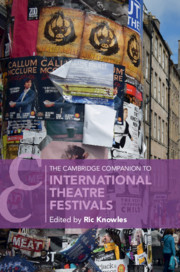
The global rise of festival culture and experience has taken over that which used to merely be events. The Cambridge Companion to International Theatre Festivals provides an up-to-date, contextualized account of the worldwide reach and impact of the 'festivalization' of culture. It introduces new methodologies for the study of the global network of theatre production using digital humanities, raises questions about how alternative origin stories might impact the study of festivals, investigates the festivalized production of space in the world's 'Festival Cities', and re-examines the social role and cultural work of twenty-first-century theatre, performance, and multi-arts festivals. With chapters on festivals in Africa, Asia, Australia, the Arab world, the francophone world, Europe, North America, and Latin America it analyses festivals as sites of intercultural negotiation and exchange.
Recommend this
Email your librarian or administrator to recommend adding this to your organisation's collection.