To save content items to your account,
please confirm that you agree to abide by our usage policies.
If this is the first time you use this feature, you will be asked to authorise Cambridge Core to connect with your account.
Find out more about saving content to .
To save content items to your Kindle, first ensure no-reply@cambridge.org
is added to your Approved Personal Document E-mail List under your Personal Document Settings
on the Manage Your Content and Devices page of your Amazon account. Then enter the ‘name’ part
of your Kindle email address below.
Find out more about saving to your Kindle.
Note you can select to save to either the @free.kindle.com or @kindle.com variations.
‘@free.kindle.com’ emails are free but can only be saved to your device when it is connected to wi-fi.
‘@kindle.com’ emails can be delivered even when you are not connected to wi-fi, but note that service fees apply.
Chapter 1 introduces the central puzzle of the book: how multinational corporations confront the growing risks and opportunities of climate change. It establishes the urgency and global salience of the issue, situating the discussion within international business and political economy scholarship. The chapter reviews existing literature, identifies key knowledge gaps, and formulates the research questions that guide the study. It then presents the book’s overarching analytical framework, integrating resource dependence theory with a typology of climate risks and corporate response strategies. By linking firm-level decision-making to national capacity and international engagement, this introduction explains how the subsequent chapters contribute to theory and practice. It concludes by highlighting the book’s dual purpose: to advance academic understanding of business strategy under climate stress and to draw actionable lessons for policymakers and business leaders.
The EU–Mercosur agreement is one of the longest and most complex trade negotiations in modern economic diplomacy. Launched in 1999 and finally concluded in December 2024, it offers a unique lens through which to understand trade negotiations in an era of geopolitical uncertainty, domestic contestation, and multilateral fragmentation. Drawing on the authors’ direct experience in trade policy and negotiation, this article argues that the agreement was not delayed because technical solutions were unavailable, nor concluded because underlying conflicts disappeared. Rather, it moved forward when changing international conditions increased the political value of closure for both sides. Agricultural sensitivities, sustainability concerns, competitiveness debates, and Mercosur’s internal coordination challenges remained. What changed was the cost of failing to reach an agreement. The case suggests that trade agreements today are no longer merely instruments of market access; they also serve as tools of strategic positioning, regulatory reassurance, and geopolitical signaling. In this context, uncertainty can become not only a constraint, but also a catalyst for cooperation and agreement
Economic sanctions are a critical tool of international diplomacy. Existing scholarship shows that citizens in democratic sender states value sanctions that are effective in producing policy concessions. However, they also seek to limit the adverse humanitarian consequences of sanction imposition. How do citizens trade off these objectives against each other? We develop a theory of sanctions preferences where citizens (1) value policy concessions, (2) hold humanitarian motivations and (3) hold beliefs about how policy change occurs in autocracies. We argue that citizens are conditional humanitarians – humanitarian concerns dominate effectiveness considerations only if policy concessions are unlikely. Results from a pre-registered willingness-to-pay experiment examining the preferences of German citizens on sanctions against Russia after its invasion of Ukraine confirm the predictions of our theory.
When IPE textbooks discuss the pre-1945 roots of the field, they usually focus only on the ideas of European and American thinkers who helped to pioneer the three distinct perspectives of economic liberalism, neomercantilism, and Marxism. But the pre-1945 intellectual history of IPE can be told in a more global manner that reveals many important intellectual contributions made by thinkers from elsewhere. These contributions can be divided into four broad types: (1) those that “localized” the three well-studied European and American perspectives in creative ways; (2) those that endogenously developed similar perspectives as those three Euro-American ones; (3) those that developed quite different perspectives; and (4) those that influenced Euro-American thought about the world economy. This chapter provides examples of each of these types in order to contribute to the building of a kind of big picture analysis that not only deepens IPE’s intellectual roots temporally into the pre-1945 period but also widens those deep roots spatially to promote a more global understanding of them. This more global understanding helps to provide a more comprehensive history of IPE thought and to build the historical foundation for a more “Global IPE” today.
Critical discussion of empire and imperialism has become a key theme in international relations. Much confusion, however, is generated by a lack of consensus on the meaning of imperialism. This paper offers one avenue for clarifying the terms of debate by reconstructing the conceptual history of imperialism from its inception in the late nineteenth century to post-war IR theory. In its initial formulation at the turn of the twentieth century, the theory of imperialism sought to analyse the interplay of capitalist development and geopolitical conflict in the formation and reproduction of international hierarchies. Immediately after World War I, however, an intellectual counter-revolution narrowed the concept into a synonym of colonialism, or the formal rule and administration of subject territory. As anti-colonial struggles won independence in the post-war period, imperialism was increasingly understood as a thing of the past. The paper argues that this conceptual narrowing remains an obstacle to contemporary theorizing, and that a rereading of the classical theories can strengthen contemporary IR frameworks. A key implication of this argument is that renewing the theory of imperialism in IR entails a reintegration of political economy and security studies.
This chapter explores the ongoing and novel merging of gold mining with organized crime, highlighting the relation of drug trafficking, land grabbing, and other related sectors to deforestation. The recent gold-mining expansion and boom in the Amazon is linked to gold markets and the global political economy. The chapter scrutinizes the rise of narco-gold mining, linking drug trade, organized criminal groups, and money laundering with rainforest gold and the surge of authoritarian and mafia-like power. During the Bolsonaro era there was a significant deepening of the link between gold-mining activities and organized drug traffickers and criminal networks. In southwestern Pará, gold mining is the leading cause of deforestation inside areas like the upper Tapajós Munduruku Indigenous lands near Jacareacanga. This chapter utilizes field research experiences, interviews, and ethnographic observations to illustrate the complex dilemmas faced by communities currently being pressured and divided by increasing gold extraction in their territories. In the end of the chapter the discussion turns to solutions for how to address these and other root causes of deforestation in political economy.
This paper presents the first empirical analysis demonstrating how international security influences global data flows. Firms exchange data traffic to achieve fast, stable, and affordable access to digital infrastructure, driving digital interdependence. While international security shapes economic interdependence, the mechanisms linking the two – sanctions, tariffs, boycotts, and contracts – create little risk for Internet interconnection, which is commonly exempted from sanction and tariff regimes, not directly consumed by the public, and not enabled through traditional contracts. I theorize that international conflict generates cybersecurity externalities as state and non-state actors directly weaponize digital interdependence. Firms and their networks sit directly in the path of future conflicts. Leveraging network topographical measurements from computer engineering, I test whether conflict expectations increase states’ mutual reliance to move data. I find robust evidence that power politics shapes digital interdependence and use additional analyses to argue that externalities, rather than state preferences, drive this process.
Do populist governments bend their economic policies to the preferences of bondholders? Populist governments should be a “least likely” case for the market discipline hypothesis. Populist parties typically run on platforms that scapegoat wealthy elites as “enemies of the people” and hence should be more resistant to changing policy positions in the face of market pressure, given their reluctance to alienate their base. Employing most-different case studies of the Five Star Movement/Lega coalition in Italy and Viktor Orbán’s government in Hungary, we find that populists do bend to market pressure but that this “disciplining effect” does not stem primarily from foreign investors. Rather, it was the inaction of domestic investors in bond auctions that caused these governments to reverse course on headline economic policies. Because domestic investors served as both governments’ “buyers of last resort,” they needed to maintain their favor amidst foreign capital flight.
This chapter aims at raising a sense of reflectiveness regarding the use of the concept of “infrastructure” in the analysis of finance, through addressing different, if interconnected, problematizations of financial infrastructural reason. First, infrastructures are problematized as a modernist social imaginary that reproduces functionalist reasoning about society, thereby systematically effacing asymmetries and exclusions enabled by infrastructures. Second, infrastructural thinking is tightly coupled to conceptions of sovereignty and governability of populations, territories, and resources, thus inviting security thinking. Third, infrastructural reason in finance reproduces a globalist view on the international political economy together with a realist imaginary of international relations, modeled after a zero-sum game. Fourth, infrastructural reason in finance sidelines important political-economic critiques of the global financial economy, effectively correcting the imagery of the relationship between production base and financial economy. In conclusion, when using infrastructural reason to diagnose the present condition of the finance economies, it seems worthwhile to view infrastructures not so much as fungible, smoothly operating, and only in exceptional cases failing systems, but rather as leaky networks through which shocks, disruptions, and exclusions are disseminated.
The introductory chapter of “Infrastructural Gazing on Global Finance” delves into the often overlooked yet critical role of financial infrastructures in shaping socio-economic and geopolitical landscapes. Financial infrastructures, while typically operating in the background, have been thrust into public discourse due to events such as the COVID-19 pandemic and international sanctions against Russia. This chapter introduces the concept of “infrastructural gazing,” a heuristic that explores the socio-technical processes underlying financial systems, emphasizing their political and social implications. The approach links micro-level financial transactions to macro-level trends, highlighting how mundane financial infrastructures influence power dynamics, inclusion, and inequality. The chapter addresses the differing sections of the handbook, including the transformative effects of digitalization, the rise of central bank digital currencies, and disruptions posed by tech giants, illustrating how financial infrastructures both stabilize and challenge existing power structures. By moving beyond a narrow technical perspective, the volume emphasizes the socio-political stakes embedded in financial systems, and their relevance for scholars, policymakers, and citizens.
The chapter introduces the book, its main claims, and arguments. It is concerned with setting the agenda for how to take labour seriously in Gulf development discourses and the value of centring labour from the margins. The book argues that Oman’s labour market is global and that Omani labour needs to be understood globally and relationally within and beyond the segmentations that divide the labour market. The chapter situates youth and their economic dreams and experiences at the heart of the story of development, discusses how to understand labour within the rentier state, and lays out the framework and empirical analysis to follow.
Many populist leaders politicise disputes with external financial ‘elites’, but most are forced by economic pressures to fundamentally change their ‘people-versus-elite’ problem representations and ‘concede defeat’. Notable exceptions are Hungary’s Viktor Orbán, Argentina’s Cristina Kirchner, and Turkey’s Recep Tayyip Erdoğan, who sooner or later resisted strong push-back and defied the IMF or distressed-debt funds. These instances of prolonged populist defiance differ widely across commonly used structural and agential explanatory factors at international, domestic, and individual levels. To explain how Orbán, Kirchner, and Erdoğan managed to ‘beat the elite’, this paper clusters several root causes into a parsimonious framework of two intervening variables. The temporality of strong ‘elite’ push-back and the openness of advisory systems are theorised as shaping distinct cognitive mechanisms of representational continuity or change, through which ‘people-versus-elite’ input is either preserved until – or discarded before – feeding into decision outputs. As the two-by-two matrix of early/later external shocks and open/closed inner circles explains, Orbán did not move beyond marginal representational adjustments; Kirchner’s contingent representational fluidity benefited from opportune situational developments; and Erdoğan defied significant socio-economic cost with fundamental representational continuity. These insights highlight the potential of studying populism at the intersection of foreign policy analysis and international political economy.
Confronting the coming five decades from our present conjuncture demands – to paraphrase Antonio Gramsci’s famous mantra – both critical pessimism and a wilful politics of hope. In this article, we engage with the politics of climate breakdown and the responses to wider socio-ecological crises with a necessary critical pessimism. Specifically, we confront the capture of green transition imperatives by finance capital, as well as the troubling orientation of transition towards building new structures of accumulation around the vision of an electrified consumer society. We also see the coming decades being marked by the ever-increasing wealth of global asset-owning classes – who, by definition, enclose the atmospheric commons faster than any other community. Against this dystopian picture of increasingly concentrated wealth, corporate excess, and terrestrial crisis, we focus on the stubborn reproduction of socio-ecological life through various grounded projects across the world. We engage with communities who work against structural constraints to reproduce life from below through urban commoning, food sovereignty, Indigenous organising, and caretaking economies – all of which are scaling out their visions through alternative internationals. All of these projects, we argue, present a planetary and multiscalar political economy in practice, which connects grounded experience with resistance to the dynamics of capitalism at the state, corporate, and transnational levels. With lessons from these communities in mind, we call for a ‘planetary political economy of the global majority’, which prioritises the reproduction of socio-ecological life according to the visions of grounded anti-systemic projects.
Why do firms demand antidumping protectionism? Contemporary literature highlights a plethora of causal mechanisms within the data-generating process, including retaliatory motives, exchange rate appreciations, business cycles, and deindustrialization. I argue that countries that are economically integrated into global markets should be associated with less demand for antidumping trade remedies. In particular, countries with higher levels of trade and financial flows should receive fewer petitions for antidumping trade remedies from firms overall, ceteris paribus. I test this theoretical argument with a series of de facto globalization indicators collected from thirty-three countries between 1978 and 2022, finding support for these arguments.
This article assesses the initial contacts between the People’s Republic of China (PRC) and the World Bank during the early 1980s, following China’s admission to the institution in 1980. In the late 1970s, the PRC launched a new phase of economic reforms aimed at re-modelling its economic outlook. Collaboration with multilateral economic institutions such as the World Bank was a key part of its “opening up” strategy. By drawing on newly available records from World Bank archives, the article reveals how the Bank’s approach to China's economic development was tailored to meet Beijing’s specific economic conditions and needs, and welcomed gradualism as the best path for China's reform strategy. At times of free market triumphalism and heavy structural adjustment towards developing countries, the China case, the article stresses, shows a World Bank behaving not quite in line with what many would expect. Therefore, the article provides not only an account of a bilateral relationship but offers a new perspective and reflection of the history of the international political economy of the early 1980s.
Scholars of international political economy (IPE) often locate the origins of their field in the contested nature of the world economy of the early 1970s, but many of its early proponents drew important inspiration from political economists who had an international focus from the pre-1945 period. This chapter summarizes the book’s analysis of the field’s pre-1945 roots, an analysis that challenges conventional depictions of this history in two ways. First, the book embraces a more global conception of the field’s pre-1945 roots by highlighting many contributions made by thinkers from outside Europe and the United States. Second, it shows that discussions of the international dimensions of political economy before 1945 involved much more than a debate between the three perspectives of economic liberalism, neomercantilism, and Marxism. This introductory chapter also highlights some limitations of the analysis as well as some of the motivations behind the project.
The concluding chapter summarizes the case for embracing a wider approach to the deep intellectual roots of the IPE field in the pre-1945 period that goes beyond the common focus on just thinkers from Europe and the United States and the debate between economic liberals, neomercantilists, and Marxists. The wider approach of this volume highlights important contributions made by thinkers from outside Europe and the United States in the pre-1945 era as well as important debates both within each of the three orthodoxies and with perspectives beyond them. In addition to providing a more comprehensive history, this wider approach can help to strengthen efforts to foster more “global conversations” in the field of IPE today, to improve interpretations of contemporary political discourse as well as to contribute to the study of topics that are attracting growing interest within current IPE scholarship.
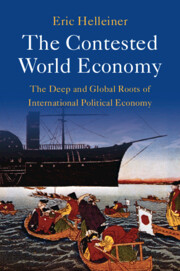
The rapid growth of the field of international political economy since the 1970s has revived an older tradition of thought from the pre-1945 era. The Contested World Economy provides the first book-length analysis of these deep intellectual roots of the field, revealing how earlier debates about the world economy were more global and wide-ranging than usually recognized. Helleiner shows how pre-1945 pioneers of international political economy included thinkers from all parts of the world rather than just those from Europe and the United States featured in most textbooks. Their discussions also went beyond the much-studied debate between economic liberals, neomercantilists, and Marxists, and addressed wider topics, including many with contemporary relevance, such as environmental degradation, gender inequality, racial discrimination, religious worldviews, civilizational values, national self-sufficiency, and varieties of economic regionalism. This fascinating history of ideas sheds new light on current debates and the need for a global understanding of their antecedents.
What happens to a public, domestic institution when its authority is delegated to a privately run, transnational institution? I argue that outsourcing traditionally national legal responsibilities to transnational bodies can lead to the stagnation of domestic institutional capacity. I examine this through a study of international commercial arbitration (ICA), a widely used system of cross-border commercial dispute resolution. I argue that ICA provides commercial actors an “exit option” from weak public institutions, reducing pressure on the state to invest in capacity-enhancing reform. I find that the enactment of strong protections for ICA leads to the gradual erosion of the capacity of domestic legal institutions, particularly in countries with already weak legal systems. I test the mechanism driving this dynamic using dispute data from the International Chamber of Commerce. I find that pro-arbitration laws increase the use of international arbitration by national firms, suggesting that firms use ICA as an escape from domestic institutions. This article contributes to debates on globalization and development as well as work on the second-order effects of global governance institutions.
The changed and changing global political economy and institutional order of the first postwar decade leads the envisaged workings of the Fiscal Commission and its secretariat arm, the Fiscal Division, even further away from the League’s practices. These geopolitical shifts would bear upon every global concern and the institutional machinery governing the international economic and political order, impacting not just the UN’s capacity for international tax coordination but also international financial flows. With foreign direct investment becoming the main source of financing for developing countries, double taxation questions in turn become enmeshed in serving development objectives.