To save content items to your account,
please confirm that you agree to abide by our usage policies.
If this is the first time you use this feature, you will be asked to authorise Cambridge Core to connect with your account.
Find out more about saving content to .
To save content items to your Kindle, first ensure no-reply@cambridge.org
is added to your Approved Personal Document E-mail List under your Personal Document Settings
on the Manage Your Content and Devices page of your Amazon account. Then enter the ‘name’ part
of your Kindle email address below.
Find out more about saving to your Kindle.
Note you can select to save to either the @free.kindle.com or @kindle.com variations.
‘@free.kindle.com’ emails are free but can only be saved to your device when it is connected to wi-fi.
‘@kindle.com’ emails can be delivered even when you are not connected to wi-fi, but note that service fees apply.
‘Children’s Novels and the Literary Revival’ traces the rise in fiction for children in the final years of the nineteenth century and early years of the twentieth century. It is possible to detect two major tendencies in Irish fiction for children in this period, sometimes overlapping in the same works. On the one hand, there is the imperialist narrative of the empire as a family, in which Ireland is cast as the errant ‘wild child’, in need of discipline; opposed to this is the Irish fiction embracing the ‘wild child’, with the mythological figure of Cuchulain as the ultimate ‘wild child’, whose defiance of authority is read as heroism. These opposed attitudes to the figure of the child polarise, as much children’s literature of the Revival period turns towards Irish mythology in the formation of national subjects, whose identity was opposed to that of a metropolitan British culture.
‘Novels of the Irish Revival’ notes that the novel is perhaps the literary form least associated with the Irish Literary Revival, a movement dominated by poetry and drama. However, it is possible to discern a distinctive Revival novelistic tradition, beginning with Rosa Mulholland’s The Wild Birds of Killeevy (1883) and extending to AE’s (George Russell) The Interpreters (1922). Many of these novels take over from the New Woman novel of the same years a concern with female protagonists in opposition to conventional practices regarding marriage and maternity, usually in the name of artistic fulfilment; however, unlike their English counterparts, these protagonists typically experience an interiority that takes on the contours of the supernatural, in some novels (such as The Interpreters) literally so. At the same time, there is a strand of fiction in the period that takes its subject matter from Irish legends, although often in the name of very similar narratives of self-fulfilment.
‘Revival, Censorship, Revolutions’ identifies the 1929 Censorship of Publications Act as one of the key determining factors concerning the writing of Irish fiction in the period up until its strictures were relaxed in the 1960s. In some instances, this impact was direct, as novelists had books banned; in other cases, it was indirect, as novelists either left Ireland, or those who remained learned strategies of evasion and circumlocution. The situation for those who remained was complicated by the recognition that the legislation codified a widely held set of views on social values and rejection of anything perceived as cosmopolitan or foreign to a narrowly defined Catholic-nationalist ethos, some of whose roots lay, paradoxically, in the Irish Literary Revival. All of these forces can be seen at work in one of the most famous cases of literary censorship, that relating to Kate O’Brien’s novel The Land of Spices (1941).
Revival poetry in Irish remains the most understudied and misunderstood aspect of the twentieth-century Irish literary revival. Surveys of modern Irish-language poetry typically begin with Douglas Hyde’s Amhráin Grádh Chúige Connacht/Love Songs of Connacht (1893) before moving to Patrick Pearse and Liam Gógan as a prelude to the emergence of modernist poets in the 1940s, including Seán Ó Ríordáin, Máirtin Ó Direáin, and Máire Mhac an tSaoi. This chapter revises that approach and focuses on the period between Hyde’s groundbreaking anthology and the emergence of those modernist poets canonized in Seán Ó Tuama’s 1950 anthology, Nuabhéarsaíocht 1939-1949. This period suffered neither a lack of poetry, poets, nor polemics about poetry. Conversely, it teemed with them, yet it appears the most barren era in a tradition that traces back to the sixth century. Rather than retrieve a neglected major poetic voice, this chapter interrogates the period’s attitudes and understandings to see what light it may shed on wider revivalist concerns and the context from which the midcentury modernists emerged.
W.B. Yeats’s life, work, and career cannot be extricated from his historical surround. And yet he is of such consequence in modern Irish literature and culture that, in a book such as this, it remains necessary to dedicate space to Yeats alone. This chapter focuses on Yeats’ poetry from the start of his career through Reponsibilities (1914), considering its multiple philosophical and formal investments, its debt to English Romanticism, and its mediations of Irish folklore and myth.
This chapter traces the emergence of Joyce’s aesthetic from Stephen Hero to A Portrait of the Artist as a Young Man, analyzing the development of Stephen Dedalus as would-be artist in the context of Irish colonial experience. It pays particular attention to the influence of Oscar Wilde. Both Wilde’s Picture of Doran Gray and Joyce’s Portrait of the Artist belong to the Bildungsroman tradition, that is, to the novel of development, which their narratives challenge and transform by presenting the central character’s growth to maturity as deviating from cultural expectations rather than fulfilling them. Joyce’s narrative, however, points toward a new nation’s emergence.
The Dubliners stories arose from a chance opportunity when George Russell, a prominent revivalist figure, invited Joyce to make a little money by submitting stories to The Irish Homestead. Russell didn’t want the readers to be disconcerted – but that would precisely be the effect of Joyce’s stories. Eventually published ten years later, having overcome threats of censorship and libel law, the expanded collection made a significant intervention in the Irish Literary Revival, pointing unerringly at some unpleasant truths and establishing Joyce as a noted prose realist who disrupted a movement more associated with poets and dramatists. These stories would later come to be seen also as key documents in the development of modernist fiction, their naturalism tempered by symbolism and a multi-layered interpretative openness that makes them among the most prized of modern short stories.
When W. B. Yeats won the Nobel Prize for Literature in 1923, he singled out his contribution to theatre as one of his main achievements. The critical consensus since his death has not shared this view, and his theatrical work has largely been overlooked. This book contends that Yeats is not only an important modernist playwright, but also a thinker about theatre whose originality can be compared to that of Brecht or Artaud.
Some critics polarize Joyce and Yeats by invoking the Irish Literary Revival. This practice, which can seem unduly based on sectarian divisions, the politics of post-1916 Ireland, and the retrospective formulation of ‘Modernism’, fails to address adequately Yeats’s and Joyce’s common origins in the Aesthetic and Symbolist ethos of the 1890s, their common dedication to ‘the religion of art’. Yeats’s profound influence on Joyce attaches Joyce to the Revival, as does the struggle between different brands of cultural nationalism as represented by Joyce in Stephen Hero and A Portrait of the Artist as a Young Man. Walter Pater was fundamentally important to the aesthetics of both Yeats and Joyce; the Paterian ‘epiphany’ as a symbolic structure bridges their poetry and prose; and Charles Stewart Parnell, who can assume qualities of Pater’s ‘artist-hero’, complements Pater in his importance to both: to their dialectics between art and history. The chapter ends with a discussion of some startling thematic overlaps c. 1914 between Yeats’s Responsibilities and Joyce’s Portrait.
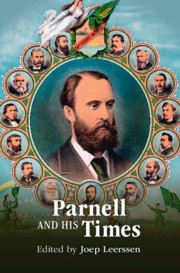
Marked by names such as W. B. Yeats, James Joyce and Patrick Pearse, the decade 1910–1920 was a period of revolutionary change in Ireland, in literature, politics and public opinion. What fed the creative and reformist urge besides the circumstances of the moment and a vision of the future? The leading experts in Irish history, literature and culture assembled in this volume argue that the shadow of the past was also a driving factor: the traumatic, undigested memory of the defeat and death of the charismatic national leader Charles Stewart Parnell (1846-1891). The authors reassess Parnell's impact on the Ireland of his time, its cultural, religious, political and intellectual life, in order to trace his posthumous influence into the early twentieth century in fields such as political activism, memory culture, history-writing, and literature.
Recommend this
Email your librarian or administrator to recommend adding this to your organisation's collection.