To save content items to your account,
please confirm that you agree to abide by our usage policies.
If this is the first time you use this feature, you will be asked to authorise Cambridge Core to connect with your account.
Find out more about saving content to .
To save content items to your Kindle, first ensure no-reply@cambridge.org
is added to your Approved Personal Document E-mail List under your Personal Document Settings
on the Manage Your Content and Devices page of your Amazon account. Then enter the ‘name’ part
of your Kindle email address below.
Find out more about saving to your Kindle.
Note you can select to save to either the @free.kindle.com or @kindle.com variations.
‘@free.kindle.com’ emails are free but can only be saved to your device when it is connected to wi-fi.
‘@kindle.com’ emails can be delivered even when you are not connected to wi-fi, but note that service fees apply.
This chapter examines Sadr’s Falsafatuna and Iqtisaduna as seminal Islamic responses to the ideological and philosophical upheavals of mid-twentieth-century Iraq. Against the backdrop of the radical political transformations that culminated in the 1958 July Revolution and the subsequent contest over Iraq’s national identity – between Pan-Arab and territorial nationalists, communists, and Islamists – Sadr sought to articulate a civilizational project rooted in Islamic metaphysics, social ethics, and epistemology. Through a rigorous critique of Marxist materialism, Western empiricism, and behavioral psychology, he constructs a modern Islamic philosophy grounded in rationalist epistemology and natural theology. Engaging with Sunni revivalist thought, Arab existentialism, and emerging discourses in psychology and economics, Sadr formulated elements of an Islamic moral economy and philosophical paradigm that confronted the ideological pluralism of his time. His work repositions metaphysics within the intellectual struggle for decolonization and articulates a modern Islamic worldview aimed at promoting theism, spiritual renewal, and social justice.
Maududi’s ideas on Islamic economics have also been very influential across the Muslim world, and some argue that he should be recognized as the father of the contemporary Islamic finance sector, valued at roughly $3.5 trillion today. Arshad Zaman has rightly argued that Maududi’s insistence on using the term ma‘ashiyyat, which carries the meaning of ’provision of livelihood’, rather than iqtisādiyyat, which is more readily translated as ’economics’, is significant . Maududi was making an explicit statement against the centrality of wealth acquisition and generation associated with the term iqtisādiyyat. This collection of essays was first published in 1969, and the writings included range over the thirty years preceding its publication.
This chapter offers a contextual and thematic analysis of Muhammad Baqir al-Sadr’s intellectual production from 1964 to 1972, a period of political, cultural, and ideological upheaval in Iraq and the broader Arab world. It explores how Sadr’s thought evolved in response to the collapse of Arab nationalism, the rise of Ba‘thist authoritarianism, and the ongoing influence of leftist ideologies. The chapter situates his writings – such as the new preface to Iqtisaduna, Al-Insan al-Mu‘asir wa al-Mushkila al-Ijtima‘iyya, and Ahl al-Bayt – within the complex interplay of Iraqi Shi‘i mobilization, epistemological debates on empiricism, and efforts to forge a modern Islamic identity. It shows how Sadr redefined central Shi‘i doctrines like infallibility (‘isma) in a rationalist and activist direction, often using Marxist terminology and framing to make Islamic arguments. Through his engagement with Western philosophical methods in logical positivism and inductive reasoning, Sadr advanced an Islamic framework for modernization and economic development. The chapter underscores his strategic caution amid rising tensions with the Iraqi regime and within the Shi‘i clerical establishment, especially after Khomeini’s arrival in Najaf. This period reveals the breadth of Sadr’s discursive engagement, his reformist vision, and his ongoing struggle to harmonize Islamic theology with contemporary intellectual and political challenges.
Abul A'la Maududi (1903–1979) was arguably one of the most influential and controversial thinkers of the twentieth century, and a foundational Islamist thinker. This volume brings together a broad range of his important works for the first time, covering concerns such as anticolonialism, permissibility of violence, capitalism and gender roles, principles for an Islamic economy, innovation in legal frameworks as well as the limits of nationalist politics. Showcasing his writings across different genres, this volume includes influential early works such as his seminal Al Jihad fil Islam, Quranic exegesis and essays as well as later works on Islamic law. An extensive introduction situates Maududi's ideas within global anticolonial conversations as well as Islamic and South Asian debates on urgent contemporary political questions and highlights the conceptual innovations he carried out. Fresh translations allow readers to critically engage with Maududi's writings, capturing nuances and shifts in his ideas with greater clarity.
This chapter examines some Pan-Islamic and Pan-Asian thinkers who argued that religious values and civilizational discourse needed to be front and center in discussions of political economy. The Pan-Islamic thinkers called for new kinds of economic solidarity among a transnational Islamic community that could promote its interests and values within the world economy. Their proposals included Iranian-born Jamal al-Din al-Afghani’s calls for the collective economic modernization of the Islamic world, the endorsement of specific joint economic projects such as the Hejaz railway by Ottoman sultan Abdulhamid II, and India’s Sayyid Abul A’la Mawdudi’s focus on the need for all Muslims to embrace a new kind of Islamic Economics. By contrast, the Pan-Asian thinker Sun Yat-sen focused on the interests and values of a transnational community that he conceptualized in civilizational terms. Sun argued that Asian countries’ interests and values could be promoted by development-oriented economic cooperation amongst themselves, their collective pursuit of neomercantilist goals, and an alternative tributary model of international economic governance centered on the principle of the “rule of Right.”
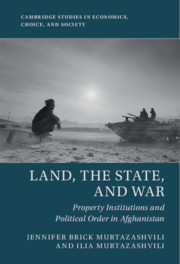
In much of the developing world, legal titling – the registration of land ownership through a formal, judicial process – is viewed as a path to economic development and political order. The introductory chapter explains why legal titling is unlikely to fulfill this promise. It begins by making a case that the new institutional economics and public choice, which were developed and applied to date in mostly Western contexts, are useful in understanding political, economic, and social institutions in the Islamic world. We then introduce our theory of emergence and change in property rights, which explains the situations when we expect the government to define and enforce property rights, when self-governance of property rights can work, and why it is unlikely that legal titling will be feasible as a development strategy in a typical fragile state. We conclude by introducing our empirical study of Afghanistan. The highlights of the empirical study include fieldwork conducted by one of the authors in thirty villages in rural Afghanistan, which resulted in hundreds of interviews with ordinary villagers, customary village leaders, and local government officials.
Although today's richest countries tend to have long histories of secure private property rights, legal-titling projects do little to improve the economic and political well-being of those in the developing world. This book employs a historical narrative based on secondary literature, fieldwork across thirty villages, and a nationally representative survey to explore how private property institutions develop, how they are maintained, and their relationship to the state and state-building within the context of Afghanistan. In this predominantly rural society, citizens cannot rely on the state to enforce their claims to ownership. Instead, they rely on community-based land registration, which has a long and stable history and is often more effective at protecting private property rights than state registration. In addition to contributing significantly to the literature on Afghanistan, this book makes a valuable contribution to the literature on property rights and state governance from the new institutional economics perspective.
Recommend this
Email your librarian or administrator to recommend adding this to your organisation's collection.