To save content items to your account,
please confirm that you agree to abide by our usage policies.
If this is the first time you use this feature, you will be asked to authorise Cambridge Core to connect with your account.
Find out more about saving content to .
To save content items to your Kindle, first ensure no-reply@cambridge.org
is added to your Approved Personal Document E-mail List under your Personal Document Settings
on the Manage Your Content and Devices page of your Amazon account. Then enter the ‘name’ part
of your Kindle email address below.
Find out more about saving to your Kindle.
Note you can select to save to either the @free.kindle.com or @kindle.com variations.
‘@free.kindle.com’ emails are free but can only be saved to your device when it is connected to wi-fi.
‘@kindle.com’ emails can be delivered even when you are not connected to wi-fi, but note that service fees apply.
The Introduction provides a panoramic view of Strauss’s thought, with a special emphasis on his interest in Islamic political thought. This summary presentation will focus on what I call the four pillars of Strauss’s intellectual project: (1) Reason and Revelation; (2) Ancients and Moderns; (3) The Theologico-Political Problem; (4) Esotericism. All these themes have a direct relationship to Strauss’s writings on Islamic thought and his biographically documented interest in the writings of the Falāsifa. This summary presentation is followed by a critical assessment of previous studies on Strauss’s interest in Islamic thought. The objective of this critical assessment is, first of all, to discuss some of the common misconceptions regarding Strauss’s writings on Islamic philosophy in those writings which are mainly critical of his scholarship. The second objective is to show that, despite some very important studies on Strauss’s scholarship on Islamic thought, there is a significant gap existing in the scholarship.
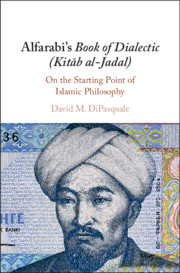
Widely regarded as the founder of the Islamic philosophical tradition, and as the single greatest philosophical authority after Aristotle by his successors in the medieval Islamic, Jewish, and Christian communities, Alfarabi was a leading figure in the fields of Aristotelian logic and Platonic political science. The first complete English translation of his commentary on Aristotle's Topics, Alfarabi's Book of Dialectic, or Kitāb al-Jadal, is presented here in a deeply researched edition based on the most complete Arabic manuscript sources. David M. DiPasquale argues that Alfarabi's understanding of the Socratic art of dialectic is the key prism through which to grasp his recovery of an authentic tradition of Greek science on the verge of extinction. He also suggests that the Book of Dialectic is unique to the extent to which it unites Alfarabi's logical and political writings, opening up novel ways of interpreting Alfarabi's influence.
Recommend this
Email your librarian or administrator to recommend adding this to your organisation's collection.