To save content items to your account,
please confirm that you agree to abide by our usage policies.
If this is the first time you use this feature, you will be asked to authorise Cambridge Core to connect with your account.
Find out more about saving content to .
To save content items to your Kindle, first ensure no-reply@cambridge.org
is added to your Approved Personal Document E-mail List under your Personal Document Settings
on the Manage Your Content and Devices page of your Amazon account. Then enter the ‘name’ part
of your Kindle email address below.
Find out more about saving to your Kindle.
Note you can select to save to either the @free.kindle.com or @kindle.com variations.
‘@free.kindle.com’ emails are free but can only be saved to your device when it is connected to wi-fi.
‘@kindle.com’ emails can be delivered even when you are not connected to wi-fi, but note that service fees apply.
Chapter 2 examines George Bernard Shaw’s revival of the medieval genre of the miracle play, particularly in Saint Joan (1924), to explain how his work troubles the opposition between the rationalizing and mystifying strains of modern drama. I begin by tracing Shaw’s extensive writing on religion as it intersects with his resistance to theater censorship in Britain. In Saint Joan, Shaw endeavors to salvage the notion of the miracle for modern, secular creative activity, while repurposing it to decry both theater censorship and British imperialism. Shaw’s prose allegory The Adventures of the Black Girl in Her Search for God (1932), however, arrives at a different account of the miraculous that reinscribes an imperialistic gaze. I discuss the afterlives of Shaw’s Adventures in the theater, culminating in a 2016 play by Lisa Codrington. Across the chapter, I demonstrate how the Shavian miracle allegorizes theater’s own contingent potential to effect historical change.
Chapter 2 reviews Plath’s metaphorical employment of the witch-martyr figure within the political and religious framework of the Cold War. The chapter outlines Plath’s subversion of the religious vocabulary and themes in her poems, like ‘Lady Lazarus’, particularly its draft, and her parallelling doctors and priests in short stories, such as ‘Johnny Panic and the Bible of Dreams’ to critique the rhetoric of the Cold War. The chapter gives evidence that Plath employs the female body as a site of modern political and medical institutional violence, seeking inspiration from the power imbalance of the early modern witch trials and Joan of Arc’s martyrdom. The close examination of Plath’s drafts of ‘Fever 103°’ and ‘Lady Lazarus’ concludes the chapter on Plath’s Cold War poetics. It argues that the anticlerical and anti-authoritarian language of her poetry reimagines witch prosecutions, martyrdom, and inquisition in periods of political torture and nuclear warfare.
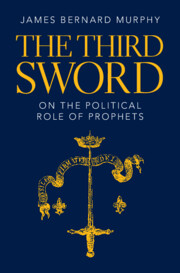
Prophets are wild cards in the game of politics, James Bernard Murphy writes in this startling new book. They risk their lives by calling out the abuses of political and religious leaders, forcing us to confront evils we would prefer to ignore. By setting moral limits on political leaders, prophets chasten our political pretensions and remind us there are values that transcend politics. They wield a third sword—distinct from the familiar swords of state and church power—their sword is the word of God. The Third Sword offers a new take on political history, illustrating a theory of prophetic politics through tales of political crises, interspersed with direct dialogue between the prophets and their persecutors. With chapters on Socrates, Jesus, Joan of Arc, Thomas More, and Martin Luther King, Murphy brings these prophets to life with storytelling that blends biography, history, and political theory.
This essay considers the influence and reception of the writings of Christine de Pizan, whose career was caught up in the Anglo-French conflict of the Hundred Yearsߣ War, as illustrated by her LߣEpistre dߣOthéa, a didactic treatise on chivalry and virtue, and her autobiographical LߣAdvision Christine. Warren explores the shifting significance of the Othéa during the fifteenth and sixteenth centuries, showing that Stephen Scropeߣs English translation reduced female agency and power, changes that reflected wider cultural anxieties concerning female lineage and virtue in the context of Lancastrian claims to the throne. The essay also explores Christineߣs connections to two other powerful women: Joan of Arc and Margaret of Anjou. By reworking Christineߣs treatments of women to reduce their political power and independent wisdom, translators of Christineߣs works also contained the political threats represented by powerful women. Strikingly, depictions of Christine as author shift her context from the court to the cloister, reaffirming traditionally gendered views of women even while her works continued to be circulated in England.
This Element examines women warriors as vehicles of mobilisation. It argues that women warrior figures from the mid-nineteenth century until the end of the Second World War are best understood as examples of 'palimpsestic memory', as the way they were represented reflected new contexts while retaining traces of legendary models such as Joan of Arc, and of 'travelling memory', as their stories crossed geographical borders and were re-told and re-imagined. It considers both the instrumentalisation of women warriors by state actors to mobilise populations in the world wars, and by non-state actors in resistance, anti-colonial and feminist movements. Fell's analysis of a broad range of global conflicts helps us to understand who these actors were, what motivated them, and what meanings armed women embodied for them, enabling a fresh understanding of the woman warrior as an archetype in modern warfare.
Medieval monarchs feared political sorcery as a form of treason, but monarchs themselves were also accused of using magic, and several kings became intensely interested in the political and financial potential of occult traditions. Beginning in the twelfth century, rulers began to show interest in the political potential of astrological prognostications, although it was not until the fourteenth century that accusations of political sorcery first burst onto the scene in England. A succession of occult royal advisers, including Roger Bacon and George Ripley, attempted to assume the mantle of Merlin and counsel England’s kings, while Richard II went beyond other monarchs in defining himself as a royal magus. Medieval kings attempted to draw on occult knowledge for both warfare and financial aid in the Hundred Years’ War. Alchemists strove in vain to cure Henry VI of mental illness, while accusations of magic against the wife of Humphrey, duke of Gloucester destabilised the nation. During the Wars of the Roses, politically motivated accusations of sorcery played a key role in the rise of Richard III. The chapter highlights the ambiguity of magic and occult traditions in medieval politics, and their uses both positive and negative in the arts of politics.