To save content items to your account,
please confirm that you agree to abide by our usage policies.
If this is the first time you use this feature, you will be asked to authorise Cambridge Core to connect with your account.
Find out more about saving content to .
To save content items to your Kindle, first ensure no-reply@cambridge.org
is added to your Approved Personal Document E-mail List under your Personal Document Settings
on the Manage Your Content and Devices page of your Amazon account. Then enter the ‘name’ part
of your Kindle email address below.
Find out more about saving to your Kindle.
Note you can select to save to either the @free.kindle.com or @kindle.com variations.
‘@free.kindle.com’ emails are free but can only be saved to your device when it is connected to wi-fi.
‘@kindle.com’ emails can be delivered even when you are not connected to wi-fi, but note that service fees apply.
The Introduction sets out the central question that this book aims to tackle: when, why, and how did we evolve the peculiar and paradoxical inclination for both war and peace that characterises our species? The book argues that the inclination for both intergroup coalitionary killing and peaceful cooperation have deep roots and that they co-evolved through a gradual, incremental trajectory over millions of years. This co-evolution unfolded in a mosaic-like pattern, with distinct but interacting components emerging at different moments and becoming integrated over evolutionary time.
When, why, and how did we, humans, develop our distinctive and paradoxical inclinations for both war and peace? This groundbreaking book investigates that central question by drawing on cutting-edge research and an unprecedented range of evidence from thirteen disciplines: biology, primatology, comparative ethology, behavioural ecology, anthropology, archaeology, criminology, social psychology, linguistics, demography, genetics, neuroscience, and climatology. The book shows how the capacities for both war and peace co-evolved gradually over millions of years through a mosaic-like pattern, with distinct but interacting components emerging at different moments and becoming integrated over evolutionary time. This deep-rooted trajectory has been shaped by feedback loops among biological, cultural, and environmental forces. With its expansive temporal horizon, cross-species comparisons, and empirical richness, this book offers a sweeping new account – and an indispensable resource – for anyone interested in the origins of the Janus-faced inclination for both war and peace in the human species.
Cognitive impairment is associated with language changes that emerge during verbal responses to neuropsychological assessments that traditional scoring does not capture. The current study investigated the utility of a linguistic analysis of paragraph recall responses for detecting cognitive impairment.
Methods:
Digital voice recordings of logical memory (LM) were available from 598 Long Life Family Study participants with normal cognition and 112 with cognitive impairment. Linguistic polyfeature scores for immediate (PFS-IR) and delayed recall (PFS-DR) were created from weighted sums of features associated with cognitive impairment. Logistic regression models assessed the predictive value of each PFS for classifying cognitive impairment. Repeated measures models with generalized estimating equations assessed whether PFSs predict cognitive screener performance over time.
Results:
Twelve linguistic features and higher PFSs were associated with cognitive impairment (PFS-IR OR = 1.05; PFS-DR OR = 1.07). PFS-DR scores approximated the accuracy of traditional LM scoring (AUC-PR = 0.77 vs. 0.81, respectively). A higher PFS-DR was also associated with lower cognitive screener scores over an average of 7 years of follow-up (β = –0.08, 95% CI [–0.11, –0.06]).
Conclusion:
Quantification of linguistic features from paragraph recall identified distinct linguistic markers that reflect differences in learning, retention, and self-monitoring. Summary feature scores detected cognitive impairment and predicted lower cognitive performance over time. This approach has potential implications for automated testing, recording, and scoring pipelines allowing for implementation of gold-standard neuropsychological assessments in broader clinical and research settings. Further studies are needed to validate these findings across clinical and community-based populations.
This chapter introduces the fields in the digital humanities concerned with words, texts, and documents, from textual editing to topic modelling and corpus linguistics.
We all know someone who will not change their mind, no matter what evidence you show them. This article explains why—and why the problem is structural, not personal. Our minds filter information through a sequence of checkpoints that determines what we accept as true, and when. Once misinformation passes through those gates, correcting it becomes extraordinarily hard. This article maps that filter, names its three key components, and shows how understanding it could transform the way public communicators fight false beliefs. Drawing on linguistics, communication theory, and the social psychology of belief, it offers a cross-disciplinary framework that sits squarely within the humanities’ long engagement with language, persuasion, and the formation of public knowledge. The implications reach beyond academic study: policymakers, educators, journalists, and anyone responsible for communicating in conditions of public uncertainty will find here a practical account of why the usual tools of correction so often fail—and what a better-designed approach would look like. At a moment when the spread of false belief is among the most pressing challenges in public life, the humanities have a distinctive contribution to make—and this framework is an attempt to make it.
Chapter 2 studies common and sometimes confusing linguistic expressions in the song lyrics found in the Cantares Mexicanos. The chapter breaks down the many elements of the songs, including typical vocabulary, vocables, Spanish loanwords, micropoetics, metaphors, and then contextualizes them in the larger framework of phrases and stanzas. Finally, the chapter considers whole compositions and engages with new understandings of Aztec (or Mexica) songs that suggest the lyrics were composed in layers and woven together into large compositions. The chapter shows that we are now able to study the lyrics with a clearer grasp of the grammar than we used to have and that they are neither wholly abstract nor impossible to understand.
This chapter provides a brief account of the languages of early Ireland from the earliest attested forms of Ogham (5th century), Old Irish, and Latin (both 7th century) through developments in the eleventh and early twelfth centuries
This chapter explores the definition of Chinese and introduces the field of linguistics and its key sub-disciplines, the two fundamental concepts that set the stage for a study of Chinese linguistics. Chinese is then situated in its geographic and linguistic landscape, elucidating its genetic and contact relationships. The history behind the establishment of Modern Standard Chinese is presented, along with some of its linguistic features. The chapter concludes with a preview of the contents of the rest of the textbook.
Beyond Words is a book of big questions about language. What is language? Where did it come from? How do we learn our mother tongue? How do we learn other languages in addition to our mother tongue? How do we use and understand language? How do we lose language? Collectively, these topics fall under the umbrella of psycholinguistics. Psycholinguistics is the marriage of linguistics and psychology. It is a branch of language science that explores the relationship between language and the human mind. This is a book that takes us down many rabbit holes. It is filled with astonishing research and surprising discoveries. It is about fierce debate and contentious topics that have fascinated us since ancient times and continue to do so today. Language is weird, but also wonderful. Language is intricate and innovative, confusing and complex, mysterious and most of all, it is multifaceted. Language is beyond words.
Edited by
Rosa Andújar, Barnard College, Columbia University,Elena Giusti, University of Cambridge,Jackie Murray, State University of New York, Buffalo
Classical linguistics and racecraft have an intertwined history, in that Indo-European linguistics arose concurrently with scientific racism, and shares many of the same metaphors and conceptual frameworks. This chapter touches on this shared history, before exploring some aspects of the metalinguistics and sociolinguistics of race in the ancient world. In particular, the concept of ‘linguistic racism’ will be used to look at how ancient texts use lack of (shared) language to imply a lack of humanity, and how non-Greek speakers are compared to animals. It will also look at depictions of foreign-language speakers as the linguistic ‘other’, particularly in depictions of enslaved people.
What is language, really? Where did it come from, and how did we figure it out? How do babies go from babbling to full sentences? Why can some people juggle multiple languages, while others wrestle with one? How does language work, and what happens when it doesn't? With sharp insight and a sense of humor, Stollznow dives into the strange and endlessly fascinating world of language and the mind. From animal communication to AI, wild children to word slips, and first words to last, this book takes you deep into the science of psycholinguistics, where nothing is ever simple, and everything speaks volumes. Packed with pop culture, real-life cases, and eye-opening experiments, Beyond Words reveals how we learn, use, and lose language, and what it all says about being human. If you've ever fumbled for a word or feared forgetting your own name, this thoughtful, surprising book is for you.
Chapter 2 begins Part I, “Linguistic Analysis of Linear A,” which consists of Chapters 2 to 5. As the main key to deciphering a script is identifying the language behind it, this chapter strives to present evidence of various types as to the character of the language behind Linear A. As this was the script of the Minoans on Crete in the 2nd millennium BCE, the chapter first outlines the linguistic landscape in the eastern Mediterranean and Near East at this time, mapping out the features of each ancient language in this region along six different parameters: (1) which language family it belongs to; (2) whether its nouns and verbs are inflected with one set of affixes (prefixes/suffixes), or more than one; (3) whether it is inflected with affixes alone, or also in some other way; (4) whether its affixes can serve multiple purposes, or just one; (5) whether its affixes are mostly prefixes or suffixes; and (6) the default order in which the subject, verb, and object occur in its sentences. Other evidence for the nature of the Minoan language is then discussed, including archaeogenetic and archaeological evidence for the origin of the Minoans, and evidence from documents in other cultures.
This comprehensive Glossary contains detailed definitions of over a hundred linguistic terms, together with illustrative examples, to ensure that readers who might not be familiar with some of these terms will not be placed at a disadvantage by the linguistic arguments presented in the book.
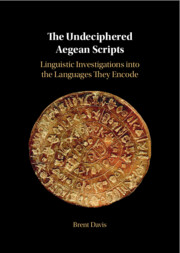
The decipherment of Linear B, an early form of Greek used by the Myceneans, by Michael Ventris and John Chadwick has long been celebrated. But five other scripts from the Bronze-Age Aegean remain undeciphered. In this book, Brent Davis provides a thorough introduction to these scripts and uses statistical techniques drawn from linguistics to provide insights into the languages lying behind them. He deals most extensively with the script of the Minoan civilization on Crete (“Linear A”), whose decipherment remains one of the Holy Grails of archaeology. He discusses linguistic topics in clear language and explains linguistic terms in a comprehensive glossary. The book also includes all data on which the various analyses of the scripts are based. It will therefore be of great interest and use not just to experts in the undeciphered Aegean scripts, but to novices and aficionados of decipherment as well.
Human languages are powerful representational tools, but can they represent every possible kind of entity? This seems unlikely. We can easily imagine languages—God’s language, or that of advanced extraterrestrials—that represent features of reality that our actual languages fail to capture. Eklund (2024) calls these alien languages. Yet despite the intuitive pull of this picture, it is unclear what alien languages, so understood, would amount to. I argue that there are no alien languages in this sense; human languages can represent any entity that can be linguistically represented at all. Still, I propose an alternative sense in which a language can be alien. On my cognitive account of alien language, a language is alien when linguistic understanding of it requires cognitive resources not used in understanding human languages. This account better explains the sense in which we can and cannot speak an alien language. We can represent whatever alien languages represent, but understanding alien languages may require cognitive resources that we lack.
Chapter 4 constitutes the final part of the “toolkit” and is focused on research ethics and integrity. In the first half of the chapter, we discuss the purpose of ethics boards and human subjects protections programs, and how to ethically collect language data through various methods of human behavior, including through social media. The second half of the chapter contains a discussion of research integrity and such topics as citing and referencing sources appropriately, what constitutes plagiarism, and stylistic considerations to take when disseminating your work.
Chapter 5 broadly discusses language use in multilingual and multidialectal societies, codeswitching, language birth, and language loss. We include case studies of multilingualism in the Vaupès in Amazonia and the Maghreb in Africa, the intermingled nature of Maltese and Michif, and English-only movements in North America.
Chapter 3 describes and demonstrates the use of several tools of language study, including elicitations, grammaticality judgments, participant observation, discourse analysis, and corpus analyses.
Chapter 6 explores how language development is an important site for learning about language and social issues. First, we provide a brief timeline of language development and how infants and children progress through the stages of development. Then we discuss language socialization and how it differs from culture to culture: we provide case studies from the US, Papua New Guinea, Samoa, the Republic of the Marshall Islands, and Mexico to show how children from each of these cultures are interacted with while they are pre-linguistic. Following that, we discuss the so-called “word gap” and how it is based on claims that are not founded and not replicable. Finally, we discuss literacy socialization in the US and how scholars show that how we are socialized into literate society varies along racial and socioeconomic lines.
In an effort to strengthen linguistic foundations in L2 endeavors and inspire closer interaction and mutual benefit for the allied disciplines, the Conclusion brings together the primary takeaways of the book, proposes future directions for study, and poses remaining questions for those research veins.