To save content items to your account,
please confirm that you agree to abide by our usage policies.
If this is the first time you use this feature, you will be asked to authorise Cambridge Core to connect with your account.
Find out more about saving content to .
To save content items to your Kindle, first ensure no-reply@cambridge.org
is added to your Approved Personal Document E-mail List under your Personal Document Settings
on the Manage Your Content and Devices page of your Amazon account. Then enter the ‘name’ part
of your Kindle email address below.
Find out more about saving to your Kindle.
Note you can select to save to either the @free.kindle.com or @kindle.com variations.
‘@free.kindle.com’ emails are free but can only be saved to your device when it is connected to wi-fi.
‘@kindle.com’ emails can be delivered even when you are not connected to wi-fi, but note that service fees apply.
This chapter introduces an interdisciplinary study of empire, where material culture takes center stage. Emphasis is placed on the tangible features of this socio-economic, cultural structure, attending to everyday practices that shaped and defined the empire and its aims, evading or working against that power. A theorized fashion is foundational to this study and diverse fashion-actors as well. The creative persistence of colonized and racialized communities is highlighted. Themes are outlined to be explored in later chapters: the cultural weight of whitewashing, entangled with a whiteness agenda, and the initiatives of Black laundresses, seamstresses and fashion-makers in the Caribbean; the advent of trousers as a genteel imperial fashion, birthed from maritime, plebeian roots; the determined self-directed travel of sailors, Black servants, men and women; and the material politics of British masquerades. These topics may surprise or unsettle expected narratives, with themes involving women and men, free and unfree, of diverse ethnicities, with subaltern agency centre stage.
Although Mardi Gras in New Orleans has long been a subject of reams upon reams of journalism, it has almost never become the subject of a literary work. Lyle Saxon’s novella that opens Fabulous New Orleans is a rare exception to this pattern. In Saxon’s account, the mask serves a primary symbolic and literal function: in obscuring the masquer’s identity, it serves to liberate that person from the usual coordinates of identity (race, gender, age, class), unleashing in turn a broad range of subversive possibilities that register as keen pleasure, even continuous laughter. Saxon loved – and, in his time, was loved by – New Orleans to an extraordinary degree, making this novella one of the peaks of his life-long enjoyment of the city.
Costumed dress became powerful imperial propaganda, with masquerade balls taking a British form. Their numbers rose sharply from the 1760s, as imperial power soared, a popularity seemingly unbounded. Racial hierarchies were played and displayed, with costumed figures claiming authenticity, echoing territorial claims. This chapter puts the history of cultural cross-dressing into the context of empire and its aims. Britain’s White pedigree was staged in classical and medieval garb, while blackface, brownface and antisemitic tropes were performed. Heroes of empire strutted. Specific costumes paralleled landgrabs and racial ranking. “Masquerade Intelligence” became a staple of periodicals empire-wide, recounting guests’ bejewelled attire from across the social order: royalty through nobility, officers, imperial administrators, industrialists, merchants and families. Apparent frivolity held serious intent, performed in countless private and public affairs throughout Britain, Ireland, India and beyond. Resistance arose among those facing the perils of colonization, differently costumed. Defiance and mimicry were their counterthrusts, pivotal factors in the politics of masquerades.
This innovative study of material culture demonstrates how, through objects, fabrics and fashion, empire was brought into homes, plantations, and institutions across the British Atlantic world in the period from 1660 to 1820. Beverly Lemire illuminates how the British empire was defined by new material norms, from the soapy world of endless whitewashing to the Black servants who became travelling fashion-makers as they journeyed along imperial networks. A trouser-wearing vogue transformed genteel male attire, sparked by glorification of navy sailors, and dressing up for masquerade balls became a powerful form of hierarchical imperial propaganda. Through this largely bottom-up study, Lemire explores practices from Britain to northern North America, the Caribbean to India, foregrounding the importance this unsettling heritage. Breaking down geographical boundaries, she brings this global history to life through the stories of diverse subaltern populations who have left a vibrant legacy of creativity and resistance.
Chapter 7 examines the function of humor, clowns, and fools within religious systems. The systems under discussion are from India, biblical Israel, Nepal, Europe, and even corporate England. The chapter argues that clowns and fools act as signal generators reflecting the dissonance within the systems and challenging the internal boundaries on which systems depend to maintain order. This humorous disruption enhances the dynamic quality of the systems, permitting its viability over time.
Focusing on (auto)biographical modes of life-writing and how they engage with risky masquerade, Chapter 2 examines writings of avant-garde French writers Michel Leiris and Antonin Artaud, both dissident French Surrealists who took enormous interest and personal risks in exploring all forms of alterity. The chapter starts with Leiris’s writing on spirit possession in L’Afrique fantôme (1934). Leiris equates autobiography with ‘la tauromachie’ (‘bullfighting’), positing it as a deadly contest between the self as subject and self as object of writing. This notion is repeated and transformed by malleable bodies exemplified by the notorious Roman emperor Heliogabalus in Artaud’s hagiographical text Héliogabale (1934), who demonstrates the plasticity – namely, the capacity for transformation – of masquerade. Read together, Leiris and Artaud establish the masquerader as a recurrent figure in life-writing that generates a potentially infinite chain of mimeses. Through the figure of the masquerader as risk-taker and role-player, which also extends into Chapter 3, this chapter proposes the critical method of chain comparison.
Chapter 3 continues to explore the question of masquerade and its risks to body and identity. It turns to East Asian novels from the postwar to contemporary eras by Japanese writer Yukio Mishima, Taiwanese author Qiu Miaojin and Hong Kongese novelist Hon Lai-chu, which all involve queer (auto)fictional narratives. The chapter reads comparatively Mishima’s Confessions (1949), Qiu’s Notes of a Crocodile (1994) and Hon’s Empty Faces (2017), showing that the masquerader is equally present in East Asian life-writing, mediated by the translation and reception of European avant-garde writing in East Asia and by Japan–Taiwan postcolonial relations. Here, masquerade is located in the precarious relations between the mask and the face. The self is brought ’en jeu’ (at stake/at risk) and queered by performances of otherness. Queer autofiction is a masquerade that dismantles rather than determines identity, risking the complete collapse of identity categories. The chain of mimeses shown by the French writers in Chapter 2 is thus mirrored and extended in the East Asian texts.
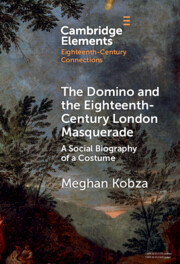
This Element presents new cultural, social, and economic perspectives on the eighteenth-century London masquerade through an in-depth analysis of the classic domino costume. Constructing the object biography of the domino through material, visual, and written sources will bring together various experiences of the masquerade and expand the existing geographical, chronological, and socio-economic scope of the entertainment beyond the masquerade event itself. This Element will examine the domino's physical and figurative movements from the masquerade warehouse, through eighteenth-century fashionable society, and into print and visual culture. It will draw upon masquerade warehouse records, newspapers, manuscripts, prints, and physical objects to establish a comprehensive understanding of the domino and how it reflected contemporary experiences of the real and imagined masquerade. Analysing the domino through interdisciplinary methodologies illustrates the impact material and visual sources can have on reshaping existing scholarship.
This chapter examines two Latin American festivals accounts, in which prominent Cervantine figures make their first American appearances. It contends that these accounts are paradigmatic examples of transition in colonial texts in at least two ways. First, they are examples of “theoretical transition” between marginal and canonical that produce new texts defined by their generic hybridity. Second, they offer thematic transitions, as the prominent Cervantine figures travel from Spain to the Americas as characters of a print book, they were then enacted in public performances in New Spain and Peru to be recorded in written accounts. In these texts, the prominent Cervantine figures meet Spanish American characters and places in viceregal festivals.
This chapter beams the light on the artistry achievements of Africans and signifies their “flourishing culture.” The major aspect of artistry being celebrated is sculptures. From this chapter, one is able to deduce that the carvings are such that “Yoruba history and culture can be perceived, interpreted and understood” through them. They manifest in many forms (materially), such as bronze, clay, stone, and wood, all of whom were discussed to fully understand and appreciate the creativity inherent in the African culture before and after colonialism. With several references to specific sculptural works and pictorial evidence, mostly from his personal collection, the author describes how Yoruba sculptors (Gbenagbena or Gbegilere) translate and manipulate natural elements and past-but-relevant happenings into artistic objects. Also discussed is the measure of a sculptor’s worth, which cannot be defined by Western currency but by the level of creativity and beauty apparent in his artwork, some of which depict African cultural ideas, principles, and attributes, such as Omoluabi, Iwapele, Didan, and Idogba. The chapter extensively discusses the importance sculptors place on the head, and also defends African sculptures against Western criticism.
The minuet is traditionally viewed as the archetypal aristocratic dance, and the expressive opposite of the German dance or waltz. In topic theory, the minuet topic is understood to derive its noble associations from its proper context as a dance of the aristocracy. Yet in Viennese ball culture of the late-eighteenth century the minuet was danced by all classes, and it no longer functioned as the ceremonial opening dance as it had in balls at the court of Louis XIV. Nevertheless, the minuet continued to be characterised as aristocratic in dance treatises and on the stage even though all classes danced it in the ballroom. This chapter argues that dancing the minuet in the Viennese ballroom involved enacting a concept of aristocratic behaviour that derived from realms other than dance, including theatre and masquerade
After an introductory discussion of Flaubert’s development as a writer and his direct experience (with Maxime Du Camp) of the February Revolution, this chapter focuses on his great novel, Sentimental Education. This novel is both the story of an unconsummated love affair and an account of the experience and imaginative life of the generation of young people who came to maturity around 1840 and whose lives were either broken or redirected by the revolution of 1848. Our analysis emphasizes the care taken by Flaubert to establish a counterpoint between the collapse of political ideals in 1848 and the collapse of the dreams of the individual characters. The novel is considered as a work of history and compared to the work of historians like Georges Duveau and Maurice Agulhon. A number of specific scenes and vignettes are discussed in an attempt to show how Flaubert brings the past to life. We conclude with a discussion of Bouvard and Pecuchet, which includes a chapter on the revolution of 1848 as it affected a village in Normandy. Though written in an overtly comic vein, this chapter reinforces the picture offered by Sentimental Education of history as ruled by elemental forces that overwhelm the plans of individuals.
My first chapter, ‘Representations: Seeing the Singer’, addresses perhaps the greatest problem to the historian of song culture, that of its sources, and in so doing serves also as a comprehensive introduction to the ballad-singer and her place in metropolitan life. It is constructed chiefly as an analysis of images of singers, supported by comparison with other media of representation, from plays to novels. I have tried to tackle head on the fact that in the historical record we see the singer almost entirely from above – and almost never hear them. Several key themes emerge: the extent to which ballad-singers were both silenced (or ventriloquised) and stripped of their crowds, thereby diminishing their potential to disturb viewers; the process of Othering whereby singers became synecdochal for an underclass within London, helping to create a domestic narrative of internal colonialism; and above all, the complex articulation of immorality in imagery. This lay less in a focus upon the female body than in the associations of the open mouth – a vulgar, sexualised trope that located vice, not in the singer’s person, but in their song.
Throughout the eighteenth century and into the nineteenth century, enslaved people in the Caribbean and South, Central, and North America performed Jonkanoo, a masked parade of dance and song. This Christmas tradition was rooted in the memory of armed resistance to imperialism in the figure of‘John Cannu’, also known as ‘John Konny’, a West African tribal chief who rebelled against Dutch settlers in the 1720s. After being captured and sent as a slave to Jamaica, he became a folk hero featured in Jonkanoo performances. Merging African dance and masquerade traditions with English carnivalesque mummery, these performances were tolerated by slave owners as a ‘temporary suspension of all hierarchic distinctions and barriers among men’, as Mikhail Bakhtin posited. Jonkanoo was nonetheless a form of resistance against white oppression and persists today in Jamaica and the Bahamas as vernacular performances of resistance, freedom, and memory that represent a fluidity between formal theatre, music, and street performances.
This paper critically assesses an increasing use of mask motifs to examine questions of identity in later life. Two approaches are subjected to detailed analysis, both of which propose distinctive answers to the challenge to identity management emerging from high or post modernity. First, consideration is given to a postmodern ‘mask of ageing’ (Featherstone and Hepworth 1989), key elements of which include consumer culture and the ageing body. Secondly, psychodynamic conceptions of masquerade and the use of personae are examined, whereby discussion centres on expanded personal potential in the second half of life and protection against a hostile social environment. A developmental model of social masking is proposed. Whilst there are superficial similarities in the use of masking, these traditions are shown to have radically different ideas concerning the core contradictions of an ageing identity. Implications for identity management and the status of body, midlifestyle and authenticity in later life, plus the need for subtlety in research methodology, are drawn out.
Recommend this
Email your librarian or administrator to recommend adding this to your organisation's collection.