To save content items to your account,
please confirm that you agree to abide by our usage policies.
If this is the first time you use this feature, you will be asked to authorise Cambridge Core to connect with your account.
Find out more about saving content to .
To save content items to your Kindle, first ensure no-reply@cambridge.org
is added to your Approved Personal Document E-mail List under your Personal Document Settings
on the Manage Your Content and Devices page of your Amazon account. Then enter the ‘name’ part
of your Kindle email address below.
Find out more about saving to your Kindle.
Note you can select to save to either the @free.kindle.com or @kindle.com variations.
‘@free.kindle.com’ emails are free but can only be saved to your device when it is connected to wi-fi.
‘@kindle.com’ emails can be delivered even when you are not connected to wi-fi, but note that service fees apply.
Chapter 4 explores how works by Michelangelo defined Medicean dynastic identity over the course of Florence’s transition from a republic to a duchy during the reigns of Alessandro de’ Medici, the first Duke of Florence, and his successor, Cosimo I. Paying particular attention to Cosimo’s earliest commissions, it demonstrates that among the first strategies the young duke deployed as he established his authority were appropriations of and allusions to the work of Michelangelo, building up a collection of “new” works by the artist whose long association with the Medici family was an essential part of their public identity even after they had parted ways politically.
Chapter 5 explores how Michelangelo’s gift-giving practice evolved during his self-imposed exile from Florence beginning in 1534. Considering the series of religious subjects he made for Vittoria Colonna in the later 1530s and a group of politically motivated gifts of both new and existing works, this chapter examines an overlooked aspect of Michelangelo’s late career, in which he continued to produced highly finished drawings as gifts but also created “authorized” copies of his work in partnership with other artists, and deployed his gifts as signs of political solidarity with members of the Florentine exile community in Rome.
Chapter 3 focuses on a critical moment in the story of Michelangelo’s gifts when his private gifts for Cavalieri came to the attention of the Medici, resulting in the very first copies of Michelangelo’s drawings in a suite of engraved gems produced for Cardinal Ippolito de’ Medici. This chapter locates the encounter both within the codes of social interaction and obligation that governed visits to private art collections in Renaissance Rome and in the cardinal’s personal history and political ambitions.
Set in September 1531, when Michelangelo was at the height of his fame but in the midst of one of the most challenging periods of his life, the Prologue situates the development of Michelangelo’s gift-giving within his professional and personal life. It describes the pressing artistic obligations and personal losses the artist was facing in the aftermath of the fall of the Florentine Republic, just before his fateful meeting with Cavalieri in late December 1532, which initiated his most extensive and sustained cycle of gifts.
A brief Introduction situates the book within the scholarship on Michelangelo and Cavalieri, Renaissance practices of gift exchange, patronage, copies and collaborative artworks, the history of celebrity, and Medicean cultural politics. It provides an overview of the methodological approach and summarizes the book’s chapters and chronological arc.
Chapter 1 focuses on the initiation of the relationship between Michelangelo and Cavalieri, reconstructing the timeline of Michelangelo’s gifts of drawings and poetry. This chapter places Michelangelo’s gifts to Cavalieri within the larger frame of the social protocols of Renaissance gift exchange and the rituals of Renaissance friendship, which allowed for eroticized attachments between men, but prohibited physical expressions of desire, acknowledging both the conventional nature of the relationship and its particular significance for Michelangelo at this moment.
Chapter 2 details a series of little-studied gifts of drawings, food, poetry, and musical compositions that were channeled to Cavalieri through Michelangelo’s network of friends in Rome. It uses Michelangelo’s correspondence to explore the artist’s social circle and its role in facilitating Michelangelo’s gift-giving, demonstrating that personal access to the artist had value in and of itself.
Chapter 6 covers the period from 1546, when Cosimo I began a relentless campaign to persuade Michelangelo to return to Florence, until the artist’s death in 1564. It details Michelangelo’s central position in Cosimo’s cultural politics, and the way that Michelangelo both resisted and ultimately accepted this role. Bringing the story full circle with Cavalieri’s gift of a drawing to Cosimo, this concluding chapter chronicles Michelangelo’s final gifts and demonstrates that by the end of his life Michelangelo had achieved the autonomy he long sought.
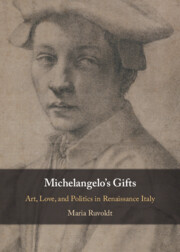
Michelangelo's Gifts tells the story of the artist's most intimate relationships and his deepest political commitments in the last decades of his life. The first study in over forty years of his relationship with his beloved, Tommaso de' Cavalieri, and the first in English, it is also the first comprehensive investigation of Michelangelo's gift-giving practices. Maria Ruvoldt here examines the evolution of Michelangelo's gift-giving strategies and their meanings from 1532, when Michelangelo's introduction to Cavalieri initiated his most extensive cycle of gifts of drawings and poetry, to the artist's death in 1564, which was preceded by a series of politically motivated gifts, including large-scale sculptures. Ruvoldt argues that Michelangelo's gift-giving was a response to the forces that shaped his career. She demonstrates that we can locate the origins of contemporary ideas about artistic autonomy, celebrity, and what constitutes an authentic work of art through the history of the creation and reception of Michelangelo's gifts.
Chapter 5 seeks to identify the normative foundations of a property theory of ownership and custody of cultural objects. It begins by examining the case study of the current legislative, administrative, and judicial framework in Italy, which aims to grant cultural institutions an essentially eternal right to control the reproduction and use of images of their cultural holdings. It then addresses the redefinition of a “museum” adopted in 2022 by the International Council of Museums and the implications this may have for the role of cultural institutions. The chapter then seeks to delineate the contours of a property theory of cultural objects and the corresponding sets of in rem rights and in rem duties that should apply to cultural institutions as both proprietors and custodians, by reconsidering the role of “placeness” of cultural institutions and their collections. In particular, a theory of ownership and custody of cultural objects held by cultural institutions should refer to the link between culture and space in considering the mirror-image questions that have been at the center of legal, professional, and public attention, namely: does a cultural institution have an in rem right to appropriate the value components of cultural objects, such as by limiting or prohibiting others from using or reproducing images of items in its collection; and, conversely, does a cultural institution have an in rem duty, as a custodian of culture, to actively make accessible to the public images and other information on items in its collections?
Chapter 2 focuses on the nature of visual decorum both before and after the Council of Trent (1545–63). The shifting parameters of what was deemed appropriate for public display in devotional sites partly explains why certain images were censored, particularly with relation to nudity, yet it was also the case that some artistic creations tested the boundaries of acceptability as never before.
This chapter discusses the relationship of the imagination to Christian eschatology. It gives an account of the function of eschatological imagery in the Bible, discusses the changing ways in which art and literature have engaged Christian eschatology, and concludes with an account of a distinctly eschatological imagination.
This essay introduces and explores David Tracy’s notion of ‘analogical imagination’ as something that prevents reason, theology, and social life from collapsing ‘into equivocation or else hopeless stupid conflict’. A capacious reflective reason, after Tracy, depends on imaginative habits and sensibilities that stay faithful to the discordant plurality and ambiguity of things while also acknowledging their analogies or ‘similarities-in-difference’. The essay argues that the continuing integrity and scope of Tracyean analogical imagination depends upon understanding that the negations that belong to apparently contrasting ‘dialectical imaginations’ reach ‘all the way down’ within analogical imagination itself. Aided by classic expressions of culture, furthermore, analogical imaginative possibility shades into contingent vision when organised by ‘focal meanings’ to fashion some global sense of the world. This is then brought into dialogue with Richard Kearney’s comparatively recent notion of ‘anatheism’, to help consideration of how Tracyean analogical imagination might maintain its imagination and ana- at the perilous point that it becomes also a matter of religious believing.
The essay chronicles the Protestant objections to images and the Catholic response in the decree “On the invocation, veneration, and relics, of salnts, and on sacred images” of the Council of Trent. Paintings created as ecclesiastical decoration in the wake of the decree in Italy and in the Netherlands are examined.
This chapter explores Freud’s publications on Biblical prophets in the new interdisciplinary journal Imago that Freud founded to specifically deal with non-medical applications of psychoanalysis. This chapter analyzes Freud’s anonymously published essay “The Moses of Michelangelo” (1914) anew as an extension of and a direct consequence of the disputations over Jung’s Jonah-type and Maeder’s teleological function of dreams. In his essay on Michelangelo’s Moses, Freud would take up his defense in Rome, where Pope Leo X had excommunicated Luther in 1521. Disguised as “an untrained layman,” Freud sets up a new hermeneutical arena far from the site of Lutheran Biblical exegetics on Jonah and before the Catholic Renaissance master Michelangelo, an artist Jung claimed expressed the “Jonah-type” in his pietàs. Applying and parodying the aesthetic arguments Jung and Maeder utilized in their recent publicatins, Freud uses the trope of the “artless Jew” by shifting the dialogue from typological interpretations of stubborn Jewish prophets to German-language art historical interpretations of a Catholic representation of Moses.
Britten and Pears regarded their relationship as a ‘marriage’ and described it as such as early as 1943. Although comfortable with using this term privately, they were aware of the legal prohibition and social stigma that prevented them from proclaiming their partnership openly. And yet throughout their nearly forty years together they made no immediate secret among their circle of friends and relatives about living their lives as a couple. As this essay suggests, theirs was a special case, in that they lived their relationship with relative openness among those who knew them. Works such as the Michelangelo Sonnets and Canticle I were a declaration of sorts about the nature of their relationship, although it was not until after the composer’s death that Pears commented overtly in an interview about their love for one another. A decade after the decriminalisation of homosexual acts in the UK, and with social discussion on homosexuality widening, Pears believed that his and Britten’s marriage need no longer be regarded as a secret.
This essay provides insight into some of the content of Britten and Pears’s book collection. It draws attention to why certain volumes were used as the source material for various musical works. The essay also emphasises how friendships with writers, such as art historian Kenneth Clark and novelist and critic E. M. Forster, influenced key aspects of Britten and Pears’s lives: their passion for fine art and their faith in pacifism. This survey of the collection underlines why their books are often useful bases of information for biographical background about both musicians. Their library tells us stories about their childhoods and discloses their interests in topics ranging from classic English literature to gardening to the developing genre of gay fiction. Additionally, it adds context to fundamental aspects of their lives, such as their anti-war stance and their enduring commitment to one another.
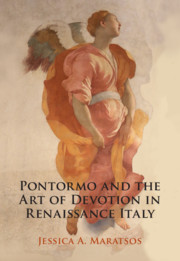
Both lauded and criticized for his pictorial eclecticism, the Florentine artist Jacopo Carrucci, known as Pontormo, created some of the most visually striking religious images of the Renaissance. These paintings, which challenged prevailing illusionistic conventions, mark a unique contribution into the complex relationship between artistic innovation and Christian traditions in the first half of the sixteenth century. Pontormo's sacred works are generally interpreted as objects that reflect either pure aesthetic experimentation, or personal and cultural anxiety. Jessica Maratsos, however, argues that Pontormo employed stylistic change deliberately for novel devotional purposes. As a painter, he was interested in the various modes of expression and communication - direct address, tactile evocation, affective incitement - as deployed in a wide spectrum of devotional culture, from sacri monti, to Michelangelo's marble sculptures, to evangelical lectures delivered at the Accademia Fiorentina. Maratsos shows how Pontormo translated these modes in ways that prompt a critical rethinking of Renaissance devotional art.
This chapter analyses Simmel’s worldview during his last years (ca. 1910 – 1918). It argues that under the influence of life philosophy, he developed a peculiar philosophical formula in which unity and contradictions (dualisms) coexisted on two different planes without cancelling another. Various forms in which this idea is addressed are analysed through Simmel’s writings on Goethe, Rembrandt and his essays on the First World War. The chapter argues that initially this approach allowed Simmel to subscribe to an encompassing universalism which he found in Goethe. However, via his preoccupation with Rembrandt and especially in his polemics about the First World War, he used this formula to move in the opposite direction: that is, it allowed him to justify single-mindedness and the fanaticism of action. Thus, the question of whether this worldview should be seen as the ultimate philosophical solution to the question of unity versus variety, or rather represents the highest degree of philosophical aporia, remains unresolved.
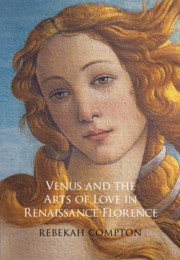
In this volume, Rebekah Compton offers the first survey of Venus in the art, culture, and governance of Florence from 1300 to 1600. Organized chronologically, each of the six chapters investigates one of the goddess's alluring attributes – her golden splendor, rosy-hued complexion, enchanting fashions, green gardens, erotic anatomy, and gifts from the sea. By examining these attributes in the context of the visual arts, Compton uncovers an array of materials and techniques employed by artists, patrons, rulers, and lovers to manifest Venusian virtues. Her book explores technical art history in the context of love's protean iconography, showing how different discourses and disciplines can interact in the creation and reception of art. Venus and the Arts of Love in Renaissance Florence offers new insights on sight, seduction, and desire, as well as concepts of gender, sexuality, and viewership from both male and female perspectives in the early modern era.