To save content items to your account,
please confirm that you agree to abide by our usage policies.
If this is the first time you use this feature, you will be asked to authorise Cambridge Core to connect with your account.
Find out more about saving content to .
To save content items to your Kindle, first ensure no-reply@cambridge.org
is added to your Approved Personal Document E-mail List under your Personal Document Settings
on the Manage Your Content and Devices page of your Amazon account. Then enter the ‘name’ part
of your Kindle email address below.
Find out more about saving to your Kindle.
Note you can select to save to either the @free.kindle.com or @kindle.com variations.
‘@free.kindle.com’ emails are free but can only be saved to your device when it is connected to wi-fi.
‘@kindle.com’ emails can be delivered even when you are not connected to wi-fi, but note that service fees apply.
With artificial intelligence (AI) becoming increasingly integrated into healthcare systems, questions have emerged regarding how patients’ and clinicians’ views of AI in these high-stakes environments are shaped by its perceived moral competence and adherence to ethical principles, including respect for personal autonomy. To examine this question, this chapter focuses on how people evaluate medical decisions made by AI versus humans and the role that ascriptions of various moral and compassionate traits play in these judgments. We discuss current applications of AI in healthcare settings, existing empirical evidence on public perceptions of AI-assisted versus human decision-making, and offer speculative explanations for the widely documented asymmetrical preference for human over AI decision-makers in patient medication, triage, and life support decisions. As AI evolves, understanding its impact on ethical choices in healthcare is vital for balancing technological advancement with compassionate care.
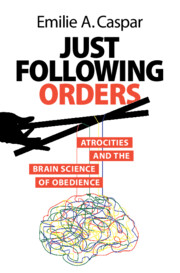
How can obedience and carrying out orders lead to horrific acts such as the Holocaust or the genocides in Rwanda, Cambodia, or Bosnia? For the most part, it is a mystery why obeying instructions from an authority can convince people to kill other human beings, sometimes without hesitation and with incredible cruelty. Combining social and cognitive neuroscience with real-life accounts from genocide perpetrators, this book sheds light on the process through which obedience influences cognition and behavior. Emilie Caspar, a leading expert in the field, translates this neuroscientific approach into a clear, uncomplicated explanation, even for those with no background in psychology or neuroscience. By better understanding humanity's propensity for direct orders to short-circuit our own independent decision-making, we can edge closer to effective prevention processes.
Edited by
David Weisburd, Hebrew University of Jerusalem and George Mason University, Virginia,Tal Jonathan-Zamir, Hebrew University of Jerusalem,Gali Perry, Hebrew University of Jerusalem,Badi Hasisi, Hebrew University of Jerusalem
Evidence based policing has become a key perspective for practitioners and researchers concerned with the future of policing. This book provides both a review of where we stand today with evidence based policing, and consideration of emerging trends and ideas likely to be important in the future of evidence based policing. It includes comparative and international contributions, as well as researcher and practitioner perspectives. While emphasizing traditional evidence based methods and approaches, the book also identifies barriers to the advancement of evidence based policing. It also expands the vision of evidence based policing by critically examining ethical and moral concerns and questions. The book’s main focus is not on what has to happen in police agencies to advance EBP, but rather on an issue that has received far less attention - the science that is necessary to produce for EBP to be successfully integrated into policing.
Recommend this
Email your librarian or administrator to recommend adding this to your organisation's collection.