To save content items to your account,
please confirm that you agree to abide by our usage policies.
If this is the first time you use this feature, you will be asked to authorise Cambridge Core to connect with your account.
Find out more about saving content to .
To save content items to your Kindle, first ensure no-reply@cambridge.org
is added to your Approved Personal Document E-mail List under your Personal Document Settings
on the Manage Your Content and Devices page of your Amazon account. Then enter the ‘name’ part
of your Kindle email address below.
Find out more about saving to your Kindle.
Note you can select to save to either the @free.kindle.com or @kindle.com variations.
‘@free.kindle.com’ emails are free but can only be saved to your device when it is connected to wi-fi.
‘@kindle.com’ emails can be delivered even when you are not connected to wi-fi, but note that service fees apply.
This chapter explores the archive strand of the Manchester Voices project, focusing on the analysis of historical speech recordings from Greater Manchester, particularly oral history interviews conducted in the 1980s in Oldham. Originally intended as a comparison to contemporary data, these recordings became central during the Covid-19 lockdown. The analysis focuses on rhoticity (the pronunciation of postvocalic /r/), a feature now rare in most of England but variably present in the archive data. Using both acoustic and auditory methods, the team tracked rhoticity across six speakers, revealing intra-speaker variation linked not only to linguistic context but also to social meaning. The chapter uses Lectal Focusing in Interaction to explore how shifts in rhoticity relate to speakers’ orientations toward tradition, modernity, and personal identity. The findings suggest that rhoticity can index alignment with older values or ways of life, while non-rhoticity may be linked to modernity and change. This chapter highlights how variation in archived speech can offer insight into past social meaning and ongoing processes of language change.
This chapter describes how the 1979 lecture was rediscovered in the RCOG Archives, why the project was initially conceived, and how it was brought to fruition.
In this chapter, a reporter who was a member of the media team who got the very first scoop on the ‘test-tube baby’, taking the newspaper and Oldham out to the rest of the world, reflects on the local story and how it broke. It contains Barker’s original write-up of the 1979 lecture in the Oldham Chronicle and features new information on local women who volunteered for the research programme.
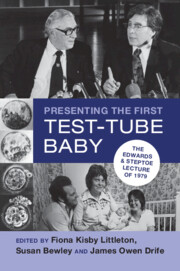
In January 1979, Robert Edwards and Patrick Steptoe delivered a lecture detailing the ten-year clinical and scientific research programme that led to the birth of Louise Brown, the first baby born utilising IVF. This thoroughly-researched book provides both a full annotated transcript of the lecture as well as recorded reminiscences from those who attended, detailing the contemporary understandings of the event. An essay on the lecture's historical context adds fresh insight into the biographies of Edwards and Steptoe and highlights sources from print and broadcast media that have received scant attention in earlier publications. Current and future implications of the advances in IVF since the first procedure are also explored, examining future medical and scientific possibilities as well as ethical issues that may arise. A foreword by Louise Brown herself places this remarkable leap of science in a personal context, one that so many families have since experienced themselves.
Recommend this
Email your librarian or administrator to recommend adding this to your organisation's collection.