To save content items to your account,
please confirm that you agree to abide by our usage policies.
If this is the first time you use this feature, you will be asked to authorise Cambridge Core to connect with your account.
Find out more about saving content to .
To save content items to your Kindle, first ensure no-reply@cambridge.org
is added to your Approved Personal Document E-mail List under your Personal Document Settings
on the Manage Your Content and Devices page of your Amazon account. Then enter the ‘name’ part
of your Kindle email address below.
Find out more about saving to your Kindle.
Note you can select to save to either the @free.kindle.com or @kindle.com variations.
‘@free.kindle.com’ emails are free but can only be saved to your device when it is connected to wi-fi.
‘@kindle.com’ emails can be delivered even when you are not connected to wi-fi, but note that service fees apply.
Chapter 3 examines how the open-plan type was adopted in and adapted to the increasingly prosperous (and sometimes increasingly populous) parish churches of larger communities across fifteenth- and sixteenth-century England. Examples include a tightly connected group of churches in the city of Norwich as well as clusters of related buildings in York and London.
Chapter 2 investigates how, beginning in the fourteenth century, the emergence of the open-plan parish church afforded residents of rapidly expanding municipalities the means to build ostentatious places of worship that maximized space, minimized cost, and expressed their ambitions as emerging social agents. Case-study locales include Gorleston-on-Sea (Norfolk), North Walsham (Norfolk), Beccles (Suffolk), King’s Lynn (Norfolk), Dartmouth (Devon), St Ives (Cornwall), and Oldham (Lancashire).
Chapter 6 investigates the ways in which new approaches to parish church design augmented the spatial, visual, and aural experience of their resident communities—with special attention to the roles of boundary-marking installations such as screens, seats, and stained-glass windows. Items of special interest include screens at Woodbridge (Suffolk) and Totnes (Devon); seats at King’s Lynn (Norfolk) and Altarnun (Cornwall); stained glass in various locations across Norfolk, Suffolk, and Cornwall; and the spectacular suite of timber furnishings preserved at Southwold (Suffolk).
Chapter 1 surveys scholarly approaches to the development of the parish church as a spatial/social phenomenon in medieval England. It introduces the example of the “open-plan parish church,” a distinctive architectural type defined by the absence of any structural division between nave and chancel, as a powerful mechanism for analyzing the dynamics of architectural form, architectural function, and architectural facture in late medieval society.
Chapter 5 moves from the municipality to the manor to explore how the open-plan parish church format expedited the exercise of lordly provision, piety, and power in an era of political tumult. Case-study locales include Scottow (Norfolk), Nayland (Suffolk), Long Melford (Suffolk), Denston (Suffolk), Loddon (Norfolk), Shelton (Norfolk), Salthouse (Norfolk), Middleton (Lancashire), Sefton (Lancashire), and a collection of manors associated with the Stanley family in northeastern Wales.
Chapter 4 examines how the open-plan type was adopted in and adapted to the increasingly populous (and sometimes increasingly prosperous) parish churches of smaller communities across fifteenth- and sixteenth-century England. Examples include a tightly connected group of churches in the county of Suffolk as well as clusters of related buildings in Cheshire, Lancashire, Devon, and Cornwall.
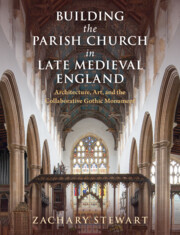
Building the Parish Church in Late Medieval England investigates the architectural, artistic, and cultural significance of local places of worship between the Black Death and the Reformation. Zachary Stewart provides the first systematic account of an exceptional type of parish church distinguished by the absence of any structural division between nave and chancel. Tracking its development across time, place, and setting, he explores how the type's integrated format not only expressed but also reinforced and reproduced collective processes related to the conception, construction, and customization of parochial space. The result, he argues, was nothing less than a new kind of public monument to collaborative action. Informed by a wealth of archival, archaeological, and architectural research, with special attention to East Anglia, Stewart's study demonstrates the importance of the parish church as a center for innovative material production in late medieval England. It also reveals how non-elite social arrangements shaped local life on the eve of the modern era.
Recommend this
Email your librarian or administrator to recommend adding this to your organisation's collection.