To save content items to your account,
please confirm that you agree to abide by our usage policies.
If this is the first time you use this feature, you will be asked to authorise Cambridge Core to connect with your account.
Find out more about saving content to .
To save content items to your Kindle, first ensure no-reply@cambridge.org
is added to your Approved Personal Document E-mail List under your Personal Document Settings
on the Manage Your Content and Devices page of your Amazon account. Then enter the ‘name’ part
of your Kindle email address below.
Find out more about saving to your Kindle.
Note you can select to save to either the @free.kindle.com or @kindle.com variations.
‘@free.kindle.com’ emails are free but can only be saved to your device when it is connected to wi-fi.
‘@kindle.com’ emails can be delivered even when you are not connected to wi-fi, but note that service fees apply.
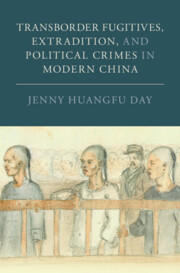
Uncovering a series of landmark but often overlooked extradition cases between China and foreign powers from the 1860s to the 1920s, this study challenges the prevailing conception that political crimes in China were solely a domestic phenomenon. Extradition and extraterritoriality played an important role in shaping laws and regulations related to political crimes in modern China. China's inability to secure reciprocal extradition treaties was historically rooted in the legacy of extraterritoriality and semi-colonialism. Jenny Huangfu Day illustrates how the fugitive rendition clauses in the Opium War treaties evolved into informal extradition procedures and describes how the practice of fugitive rendition changed from the late Qing to Republican China. Readers will gain an understanding of the interaction between international law, diplomacy, and municipal laws in the jurisdiction of political crimes in modern China, allowing Chinese legal history to be brought into conversation with transnational legal scholarship.
In the 1870s and 1880s, a series of extradition cases between Hong Kong and Canton concerning the conflict between treaty obligations and colonial law threatened the very foundation of fugitive rendition laid out in the Treaty of Tianjin. A variety of solutions were attempted, such as demanding that the Qing change its laws on conviction and punishment, the suspension of the extradition clause of Article 21, or negotiating an empire-wide extradition treaty to replace the article. But none of these proposals were seriously entertained. In the meantime, to the local populations, the jurisdictional boundary between Canton and Hong Kong opened up an alternative arena of law and empowerment.
This chapter introduces the key research questions of the book and outlines a theoretical framework for studying political crimes as a comparative concept. It highlights the significance of understanding political crimes as a transborder phenomenon and argues that the Qing state confronted serious challenges from the mid nineteenth century onward in handing fugitive renditions, as they became regulated by treaties whose implementation was often subject to the discretion of foreign diplomats, colonial officials, and municipal councils.
This chapter begins by addressing classic extradition, its historical roots and the key moments in its evolution, notably its permeation by fundamental rights after World War II, which has caused it to shift from a bilateral political arrangement to a ‘triangular’ (Eser) legal procedure where the individual concerned plays an active role. It assesses the main grounds for refusal – such as nationality, political offences and dual criminality –, and the variation into which they have developed within the European Union. The chapter then delves into the European Arrest Warrant, where proceedings have been fully judicialised and grounds for refusal considerably narrowed. The authors examine the question of whether (and to which extent) the European Arrest Warrant and the underlying principle of mutual recognition have brought about a radical change of paradigm, especially in the light of the (welcomed) ruling of the Court of Justice of the European Union in Aranyosi and Căldăraru. The conclusion anticipates the challenges that lie ahead and underscores the key role of the Court of Justice for the preservation of the whole European arrest warrant system.
Recommend this
Email your librarian or administrator to recommend adding this to your organisation's collection.