To save content items to your account,
please confirm that you agree to abide by our usage policies.
If this is the first time you use this feature, you will be asked to authorise Cambridge Core to connect with your account.
Find out more about saving content to .
To save content items to your Kindle, first ensure no-reply@cambridge.org
is added to your Approved Personal Document E-mail List under your Personal Document Settings
on the Manage Your Content and Devices page of your Amazon account. Then enter the ‘name’ part
of your Kindle email address below.
Find out more about saving to your Kindle.
Note you can select to save to either the @free.kindle.com or @kindle.com variations.
‘@free.kindle.com’ emails are free but can only be saved to your device when it is connected to wi-fi.
‘@kindle.com’ emails can be delivered even when you are not connected to wi-fi, but note that service fees apply.
Usage of the title “Vicar of Christ” and the extent of powers implied in it supposedly peaked with Innocent III (r. 1198–1216) and Boniface VIII (r. 1294–1303); the image of popes as monarchic hegemons suited the attempts of legal, political, and constitutional historians to portray the growth of royal power, bureaucracy, and “nations” in competition with other forms of identity. More recently, the medieval papacy has been characterized as responsive and dialogic. Popes’ multiple roles as leader of the universal Church, Bishop of Rome, and ruler of the Papal States meant continual dialogue between center (Rome) and periphery in terms of appeals and petitions presented to the papal curia. Papal opinion and legal rulings mattered precisely because they were sought by regional churches and by secular rulers, and popes relied heavily on the College of Cardinals, judges delegate, and papal legates to represent papal decision-making. While the papal claim to the vicariate of Christ was often challenged by secular powers, this typically occurred in instances where earthly powers sensed that the vicariate of Christ was being wielded to intervene in matters critical to a definition of overlapping and occasionally competing spheres of government.
The chapter takes stock of the major trends in recent scholarship of medieval heresy and ecclesiastical repression, identifies promising research avenues, and provides an overview of the way in which the papacy confronted the perceived menace of heresy in the central Middle Ages, considering the representations of and responses to religious dissent displayed by the official Church alongside its own motifs and transformations. The implementation of anti-heresy measures are thus observed in light of the main historical developments of the papacy in the central centuries of the Middle Ages: the eleventh-century reform and its institutional legacy; the zenith of papal monarchy; and the Avignon papacy and its political and intellectual developments. In all these different contexts, variously permeated by the ideal of papal theocracy, the Holy See fashioned apt legal and theological responses intended to contain what was featured as an enduring peril threatening the Church and Christendom.
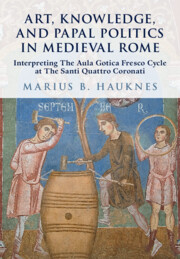
Discovered in 1995, the remarkable thirteenth-century frescoes in the great hall, or Aula Gotica, of Rome's Santi Quattro Coronati complex are among the most important vestiges of medieval Italian painting. In this volume, Marius Hauknes offers a thorough investigation of the fresco cycle, which includes allegorical representations of the liberal arts, the virtues and vices, the seasons, the signs of the zodiac, and the months of the year. Hauknes relates these subjects to the papacy's growing interest in fields of worldly knowledge, such as music, time, astrology, and medicine. He argues that the Santi Quattro Coronati frescoes function as a large-scale, interactive encyclopedia that not only represented secular knowledge but also produced philosophical speculation, stimulating beholders to draw connections between pictorial motifs across architectural space. Integrating medieval intellectual history with close attention to multi-sensory and architectural conditions of fresco Hauknes' study offers new insights into religion, art, science, and spectatorship in medieval Italy.
The eighth chapter studies the possible occurrence of Frederick II’s self-coronation in the Church of the Holy Sepulchre in Jerusalem on Sunday, 17 March 1229, an event that remains shrouded in mystery. It is still difficult to discern the borders between reality and fiction, desire and its realisation, invention and propaganda. This chapter engages with the question of the extent to which we can affirm the historicity of Frederick II’s self-coronation. It addresses the crucial issue of the nature of this gesture, recognised as transgressive by posterity – but, importantly, not always by contemporaries – in the context of preconceived ideas about the relationship between the temporal and spiritual.It emphasises the provocative nature of Frederick’s ritual with the crown: an excommunicated king wearing the crown in the Holy Sepulchre, in the absence of the patriarch of Jerusalem, opposed by the military orders, eyed suspiciously by the aristocracy of Outremer and fighting off the armies of his former father-in-law in Sicily. It is natural that this gesture was received in the West with the opprobrium the emperor and his collaborators expected.
Recommend this
Email your librarian or administrator to recommend adding this to your organisation's collection.