To save content items to your account,
please confirm that you agree to abide by our usage policies.
If this is the first time you use this feature, you will be asked to authorise Cambridge Core to connect with your account.
Find out more about saving content to .
To save content items to your Kindle, first ensure no-reply@cambridge.org
is added to your Approved Personal Document E-mail List under your Personal Document Settings
on the Manage Your Content and Devices page of your Amazon account. Then enter the ‘name’ part
of your Kindle email address below.
Find out more about saving to your Kindle.
Note you can select to save to either the @free.kindle.com or @kindle.com variations.
‘@free.kindle.com’ emails are free but can only be saved to your device when it is connected to wi-fi.
‘@kindle.com’ emails can be delivered even when you are not connected to wi-fi, but note that service fees apply.
A brief Introduction situates the book within the scholarship on Michelangelo and Cavalieri, Renaissance practices of gift exchange, patronage, copies and collaborative artworks, the history of celebrity, and Medicean cultural politics. It provides an overview of the methodological approach and summarizes the book’s chapters and chronological arc.
Chapter 1 focuses on the initiation of the relationship between Michelangelo and Cavalieri, reconstructing the timeline of Michelangelo’s gifts of drawings and poetry. This chapter places Michelangelo’s gifts to Cavalieri within the larger frame of the social protocols of Renaissance gift exchange and the rituals of Renaissance friendship, which allowed for eroticized attachments between men, but prohibited physical expressions of desire, acknowledging both the conventional nature of the relationship and its particular significance for Michelangelo at this moment.
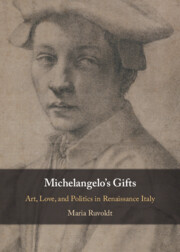
Michelangelo's Gifts tells the story of the artist's most intimate relationships and his deepest political commitments in the last decades of his life. The first study in over forty years of his relationship with his beloved, Tommaso de' Cavalieri, and the first in English, it is also the first comprehensive investigation of Michelangelo's gift-giving practices. Maria Ruvoldt here examines the evolution of Michelangelo's gift-giving strategies and their meanings from 1532, when Michelangelo's introduction to Cavalieri initiated his most extensive cycle of gifts of drawings and poetry, to the artist's death in 1564, which was preceded by a series of politically motivated gifts, including large-scale sculptures. Ruvoldt argues that Michelangelo's gift-giving was a response to the forces that shaped his career. She demonstrates that we can locate the origins of contemporary ideas about artistic autonomy, celebrity, and what constitutes an authentic work of art through the history of the creation and reception of Michelangelo's gifts.
In late 1914 Lawrence wrote ‘Study of Thomas Hardy’, a set of pseudo-philosophical essays. He performs soaring, sage-like meditations on individuality and its impediments: the state, work and money. As art history and Hardy’s novels start to provide resistants to Lawrence’s psychological projections of body and spirit, and of male and female, a freshness and fertility of invention provoke scintillating accounts, almost rewritings, of Hardy’s Jude the Obscure and Tess of the d’Urbervilles and the projection of a grand historiography of Europe, with Renaissance art as its pivot point. Empowered by Nietzsche’s daring example, this intellectual experiment is performed on the page without benefit of the truth-restraints of professional criticism. The Rainbow, a novel whose final version he would bring to completion only a few months later, benefited from Lawrence’s new, overweening confidence in rendering the subconscious. His inhabiting of emotions-on-the-page was now intimate and unbounded. Yet the three-generational family-saga form that Lawrence expanded in the final version could not readily accommodate the resulting extremes of emotion within a synthesising intellectual structure.
This chapter considers the aesthetics of the mixed style in Rabelais, Montaigne, and Shakespeare as anticipating Rancière’s rereading of Kant’s third critique, and it tries to show what is distinctive about Auerbach’s account by contrasting him with a better-known definition of the Renaissance by his friend Erwin Panofsky.
During the Renaissance, measuring played a critical role in shaping trade, material production (ranging from architecture to tailoring), warfare, legal studies, and even our understanding of the heavens and hell. This study delves into the applications of measuring, with a particular emphasis on the Italian states, and traces its wide-ranging cultural effects. The homogeneization of measurements was endorsed as a means to achieve political unity. The careful retrieval of ancient standards instilled a sense of connection and ownership toward the past. Surveying was fundamental in the process of establishing colonies. This study not only examines the perceived advantages of measuring, but it also highlights the overlooked distorting aspect of this activity. Measuring was not just a neutral quantification process but also a creative one. By suppressing or emphasizing information about the material world, measuring influenced people's perceptions and shaped their ideas about what was possible and what could be accomplished.
Paintings and other objects made in late medieval and early modern European sometimes contain what appears to be highly stylized ornamental writing, often reminiscent of contemporary Arabic scripts but seemingly devoid of linguistic content. Often called pseudo-kufic and now more commonly pseudoscript, these passages of apparently meaningless writing continue to vex historians of art. This chapter aims to advance our understanding of pseudoscript by examining its use in the paintings of the Florentine master Fra Filippo Lippi (c. 1406–1469). A close reading of Lippi’s pseudoscripts, including a few examples in which he surprisingly included legible content, emphasizes that while pseudoscript was a widespread phenomenon, it is perhaps best understood through careful consideration of its particular uses in specific contexts.
Recommend this
Email your librarian or administrator to recommend adding this to your organisation's collection.