To save content items to your account,
please confirm that you agree to abide by our usage policies.
If this is the first time you use this feature, you will be asked to authorise Cambridge Core to connect with your account.
Find out more about saving content to .
To save content items to your Kindle, first ensure no-reply@cambridge.org
is added to your Approved Personal Document E-mail List under your Personal Document Settings
on the Manage Your Content and Devices page of your Amazon account. Then enter the ‘name’ part
of your Kindle email address below.
Find out more about saving to your Kindle.
Note you can select to save to either the @free.kindle.com or @kindle.com variations.
‘@free.kindle.com’ emails are free but can only be saved to your device when it is connected to wi-fi.
‘@kindle.com’ emails can be delivered even when you are not connected to wi-fi, but note that service fees apply.
From 1812 to 1815, the United States was at war with Britain. Officers and sailors, having developed deep animosities during the preceding decade over issues like impressment, fought each other with patriotic rancor. Yet, a few years after the end of the war American and British sailors and marines were sailing together to eliminate the piracy and maritime insecurity that dominated the region during the wars for Spanish-American independence. This rapid diplomatic reversal, from enemies to partners, offers an interesting history of diplomatic change following war. These post-conflict relationships were affected by the perception of power imbalances, the importance of aligning national interests, and the diplomatic role of non-State Department entities like the US Navy. This history speaks to the character of the Anglo-American relationship in the nineteenth century, oscillating between friends and foes, and illustrates the political and economic connections within the maritime and diplomatic past.
This article explores the Royal Navy’s unique use of enslaved labour in its naval yards in Jamaica during the eighteenth and early nineteenth centuries, highlighting how the Crown’s pursuit of naval supremacy was built in part on the forced labour and skills of the African diaspora. Beginning in 1729, under the direction of Rear Admiral Charles Stewart, the Royal Navy shifted from hiring enslaved workers from local populations to purchasing them outright for Crown use, establishing a workforce that included both men and women. Stewart’s pronatalist policy aimed to secure a self-replenishing labour supply by encouraging the birth of children who would also be enslaved in service to the navy. Over more than a century, these “King’s Negros” were trained in European shipbuilding and maintenance, transferring valuable technical knowledge while enduring harsh conditions and a life of bondage. The article provides a microhistorical lens on the Atlantic world, focusing on the lived experiences of these enslaved individuals and their unintended role in bolstering Britain’s naval power. By examining the origins, conditions, and legacies of this workforce, the article contributes to broader discussions on slavery, imperialism, and the global reach of military-industrial enterprises in the Atlantic era.
English as well as British identity was transformed by the long wars against France after 1689, through the creation of a fiscal-military state that was largely in place before the Union of 1707. References to England persisted in anti-French propaganda, especially in polemics written in opposition to government policy, and Britain was often taken to mean the ancient polity, forerunner of the English state.
Iceland and the United Kingdom experienced a series of crises that follow a similar pattern. Iceland extended its maritime limits – to preserve more fish for Icelandic vessels and conserve fish stocks. Britain resisted the extension. Both sides escalated their behavior (e.g., issuing threats and coercively harassing each another’s vessels), and Britain ultimately conceded. This chapter covers the 1971–1973 Cod War. It follows the above pattern, but with a somewhat unique twist. In the 1971–1973 episode, domestic politics within both democratic states encourage escalation. Iceland, moreover, threatens to leave the North Atlantic Treaty Organization (NATO) and to evict United States (US) forces from the Keflavik air base. Because of these threats, as well as escalating coercion, NATO mediates, and NATO and the US pressure Britain to concede. Ultimately, this crisis does not escalate to a major-state war because the disputed issue (i.e., maritime limits) lacks sufficient salience and past, similar episodes demonstrate that a nonwar solution exists.
One-fifth of recaptives landing between 1836 and 1837 were involuntarily enlisted in the West Indian Regiment in Trinidad. The rest of the recaptives were required to sign contracts of indentureship, most commonly on sugar and cocoa plantations. The contractual obligations of indentured Africans were shaped by the same terms of apprenticeship imposed on formerly enslaved peoples following emancipation, and their survival and resistance strategies similarly recalled those previously enacted by African Grenadians. Chapter 2 provides an overview of the various indentureship schemes on the island, including the experiences of the recaptured at reception depots and their contractual requirements. It also explains the preference for African as opposed to South Asian labourers, and how the ideas about civilising Africans informed the campaigns and arguments of both supporters and opponents of the scheme.
The Anglo-Dutch bombardment of Algiers on 27 August 1816 indicated how, after the Congress of Vienna, a new order based on collective security was taking shape, not just on the continent, but also in the Mediterranean Sea. This chapter suggests that 1816 was a moment of departure from past traditions and signified the creation of a new Mediterranean order. Defining features of that order – such as modes of cooperation, the linkage to the Congress System, the use of security as a legitimizing discourse and the important roles of smaller and non-European powers – all came into play during the Anglo–Dutch bombardment. Additionally, this Anglo–Dutch cooperation shows how various states took the lead in the fight against piracy, dependent upon the situation. There was not a single naval hegemon who executed the repressive effort. At this early stage, smaller powers initially drove the repression of ‘Barbary piracy’, later to be followed by Great Britain, Russia and France. The effort became a truly pan-European reorganisation of security in the Mediterranean.
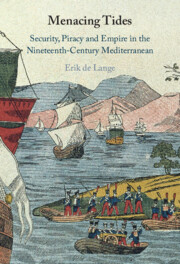
New ideas of security spelled the end of piracy on the Mediterranean Sea during the nineteenth century. As European states ended their military conflicts and privateering wars against one another, they turned their attention to the 'Barbary pirates' of Algiers, Tunis and Tripoli. Naval commanders, diplomats, merchant lobbies and activists cooperated for the first time against this shared threat. Together, they installed a new order of security at sea. Drawing on European and Ottoman archival records – from diplomatic correspondence and naval journals to songs, poems and pamphlets – Erik de Lange explores how security was used in the nineteenth century to legitimise the repression of piracy. This repression brought European imperial expansionism and colonial rule to North Africa. By highlighting the crucial role of security within international relations, Menacing Tides demonstrates how European cooperation against shared threats remade the Mediterranean and unleashed a new form of collaborative imperialism.
This chapter will examine theatre both for, and by, the armed services on the fighting fronts. It will outline how and why theatre was an important aspect of leisure time for British, Colonial and allied troops fighting on land, at sea and in the air. This chapter will examine the importance of both watching and taking part in theatrical entertainments through a discussion of the professional civilian and military Concert Parties in the Army, Navy and the RFC/RAF, the role of voluntary-aid organisations such as the British Red Cross and the YMCA, and theatrical entertainments in wider wartime contexts such as PoW camps and military hospitals. A key focus of the chapter will be the social function of such entertainments, the content, and the practicalities of how they were staged in various wartime contexts.
In mid-1851 a civil war erupted in Chile following a presidential election in which Manuel Montt defeated José María de la Cruz. Many of Cruz's supporters were sent to the distant penal colony of Magallanes. In November 1851, Lieutenant Miguel José Cambiaso, who was part of the garrison, was jailed for insubordination and subsequently led a bloody mutiny disguised as a revolt by Cruz's supporters. The mutiny is familiar to historians of the period, but what is less well known is the key role played by the British in suppressing it. Contrary to previous historiography, the Chilean government pleaded for British intervention. Given the poor state of the Chilean navy and the precariousness of communications with the penal colony, the Chilean government had no option but to resort to British naval forces. This incident illustrates a new dimension of Anglo-Chilean relations during the mid-nineteenth century which cannot be defined solely as imperialistic; Chilean authorities actively sought cooperation from the British. It also highlights the fragility of the process of state formation in a republic long praised as an example of successful political transition from colony to republic, as well as the lack of commitment of the Chilean government to shoring up state power in Magallanes.
This chapter argues that the conflict at sea was an important and frequently overlooked part of the Napoleonic Wars. Focusing primarily on the Royal Navy and French maritime forces, but also mentioning the navies of Spain, Denmark, Sweden, the Netherlands and United States, it outlines the manifold ways in which maritime warfare shaped wider events on land, and helped determine the conflict’s final outcome. It demonstrates that French attempts to invade Britain were successfully rebuffed by the Royal Navy, ensuring that Britain remained in the conflict. The chapter then offers a more modern take on the commonly misunderstood Battle of Trafalgar, arguing that it was far from decisive and did little to change the course of the war. The naval conflict continued in earnest after 1805, and the war of trade became all-consuming, particularly after the inception of ‘Napoleon’s Continental system’. Here the navy offered a stubborn resistance to the French Emperor’s objectives, helping to encourage illicit trade with the European continent while also expanding Britain’s empire and mercantilist reach elsewhere in the globe. Finally, it demonstrates that maritime support was crucial to the land war, not least Wellington’s Peninsula campaign.
By comparison with the continental powers, Britain had no more than a medium-sized army, but the largest navy in Europe. This chapter seeks to explore the bases of Britain’s naval strength, going back to the seventeenth-century Navigation Acts, and then to consider how that strength was deployed in the war against Napoleon. It argues that the Royal Navy, despite the limited impact it might be thought that it could have on land warfare, played an important part in the final defeat of Napoleon.
The British Army took part in numerous operations, ranging from small expeditions to the West Indies, Africa and along the European littoral to major operations in Portugal, Spain and Belgium. Initial struggles with these responsibilities, together with those of imperial policing and maintaining order in Ireland would oblige the Army to implement extensive reforms, particularly in tactics and unit organisation, even while the system of purchase for officers remained intact. While British infantry produced mixed results in the field during the French Revolutionary Wars, in time it became noteworthy for its musketry and remarkable doggedness in battle. Chronically understrength and notoriously difficult to control, the cavalry tended to play only a minor part on campaign, while shortages of artillery and engineers plagued the Army throughout this period. Albeit comparatively small, in creating an Iberian foothold which soon developed into a major theatre of operations, the instrument forged in the battles and sieges of the Peninsula and southern France helped drain Napoleon’s resources over a substantial period and established the high standard of battlefield performance which was to reach its apogee on the field of Waterloo, from which would emerge one of history’s greatest commanders – the Duke of Wellington.
The introduction lays out the book’s main arguments and themes, and compares the Royal Navy to the two different contexts which it straddled: the maritime world, and the armed forces. Naval service was more strictly regulated and anchored in the structures of the state than work in the merchant marine, and it was invested with explicit national and patriotic meaning. However, it also differed from service in the Army, as it required a good proportion of recruits to have specialised skills, and usually integrated them all into mixed crews, rather than establishing separate ‘foreign’ units. The Navy’s peculiar status, suspended between the military and national on the one hand, and the maritime and transnational on the other, is what makes it an important case study. If ‘foreign Jack Tars’ were in some senses mercenary fighters, they were also primarily – like ‘British’ Jack Tars themselves – a transnational, mobile, and often highly professionalised seafaring workforce. Studying them in the crucial historical juncture of the French Wars allows us to present a transnational history of a national institution, expose the compromises and contradictions underlying the power of modern states, and probe and deconstruct the very meaning of the term ‘foreigner’.
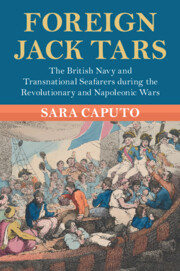
The British Royal Navy of the French Wars (1793–1815) is an enduring national symbol, but we often overlook the tens of thousands of foreign seamen who contributed to its operations. Foreign Jack Tars presents the first in-depth study of their employment in the Navy during this crucial period. Based on sources from across Britain, Europe, and the US, and blending quantitative, social, cultural, economic, and legal history, it challenges the very notions of 'Britishness' and 'foreignness'. The need for manpower during wartime meant that naval recruitment regularly bypassed cultural prejudice, and even legal status. Temporarily outstripped by practical considerations, these categories thus revealed their artificiality. The Navy was not simply an employer in the British maritime market, but a nodal point of global mobility. Exposing the inescapable transnational dimensions of a quintessentially national institution, the book highlights the instability of national boundaries, and the compromises and contradictions underlying the power of modern states.
Chapter 5 begins by briefly looking at the British Slave Trade Act of 1807, which also marked the beginning of the Royal Navy’s operations off the coast of West Africa. It concentrates on the developments that led from a national ban and its unilateral military enforcement by the United Kingdom to its international and multilateral implementation. A crucial turning point is marked by the Congress of Vienna, at which the political pressure built up by the abolitionists was so great that, for the first time, the proscription of the slave trade was jointly proclaimed and enshrined as a humanitarian norm in international law. This interdict then formed the point of reference for a series of highly controversial negotiations between the European states to decide on collective measures to be taken against this border-crossing problem. A bilateral approach between Britain and the continental powers finally resulted in a mechanism for implementation to be set up, which consisted of a previously unheard of combination of military and legal measures and which, in the shape of the Mixed Commissions for the Abolition of the Slave Trade, produced one of the first forms of international jurisdiction.
In the third interlude, ‘The Storm’, I examine the performance of a single song by one singer, the crippled black sailor Joseph Johnson. Taking an approach somewhat indebted to Timothy Brook’s Vermeer’s Hat, I pursue the elements bound up in Johnson’s performance right across the globe, from the Antipodes to Jamaica, from Versailles to the West End stage, placing this East End performance within an imperial narrative of cultural appropriation, assimilation, and identity formation. Johnson emerges as in many ways the epitome of the ballad-singer: a marginal figure disadvantaged by both race and injury, whose self-fashioning (based on Jamaican Jonkonnu practice) was designed to reposition himself at the heart of both metropolitan and national notions of patriotism.
The role of the Royal Navy in the British Atlantic world has been understood as projecting imperial military power and guarding inter-oceanic trade. However, the Royal Navy's role in the creation of a legal culture in early modern Sierra Leone revises our understanding of its multifaceted mission. Royal Navy regulations and customs implemented on warships translated into the rule of law and administration on land in the context of Sierra Leone. A common legal culture, grounded by the Royal Navy's legal practices, united the culturally diverse population in Sierra Leone: the Temne, the Black Poor from London, British abolitionists, black Nova Scotian settlers, Maroons from Jamaica, and Liberated Africans after the abolition of the slave trade in 1807. Examination of these legal dynamics over time contribute to an understanding of how the establishment of colonial law, through the Royal Navy, became formalised in Sierra Leone within the pre-colonial and early colonial period.
Rebellious collective action is rare, but it can occur when subordinates are severely discontented and other circumstances are favorable. The possibility of rebellion is a check – sometimes the only check – on authoritarian rule. Although mutinies in which crews seized control of their vessels were rare events, they occurred throughout the Age of Sail. This book is the first to analyze mutiny sytematically using techniques borrowed from epidemiology and in light of a new theory that links grievances to collective action.
The introduction explains why comparatively little is known about the musical cultures of the British armed forces despite music’s quotidian nature in the British Army, Royal Navy and Royal Flying Corps/Royal Air Force. This book will therefore examine the formal and informal applications of music in the British forces on land, sea and air, during their periods of work, rest and play, in military camps, on ships, in aerodromes, on the battlefields, in hospitals and prisoner of war camps, theatres, cinemas and canteen huts. It argues why the musical cultures of Britain’s armed forces should be examined in the social, cultural and military contexts in which they developed.
This article recounts the worldwide search for timber undertaken by the Navy Board, the administrative body under the authority of the Admiralty responsible for the supply of naval stores and the construction and repair of ships during the Napoleonic Wars. The closure of the Baltic by France and its European allies is considered the main factor in making British North America a timber colony. Yet the process through which the forests of the Laurentian Plateau and the North Appalachians came to fuel the dockyards of England and Scotland is taken for granted. To acquire this commodity, through merchants, diplomats, and commissioned agents, the power of the British state reached globally, reshaped ecological relationships, and integrated new landscapes to the Imperial economy. Many alternatives to the Baltic were indeed considered and tentatively exploited. Only a mixture of contingency, political factors, and environmental constraints forced the Board to contract in Lower Canada and New Brunswick rather than in areas such as the Western Cape, the Brazilian coast, or Bombay's hinterland.