To save content items to your account,
please confirm that you agree to abide by our usage policies.
If this is the first time you use this feature, you will be asked to authorise Cambridge Core to connect with your account.
Find out more about saving content to .
To save content items to your Kindle, first ensure no-reply@cambridge.org
is added to your Approved Personal Document E-mail List under your Personal Document Settings
on the Manage Your Content and Devices page of your Amazon account. Then enter the ‘name’ part
of your Kindle email address below.
Find out more about saving to your Kindle.
Note you can select to save to either the @free.kindle.com or @kindle.com variations.
‘@free.kindle.com’ emails are free but can only be saved to your device when it is connected to wi-fi.
‘@kindle.com’ emails can be delivered even when you are not connected to wi-fi, but note that service fees apply.
Set in September 1531, when Michelangelo was at the height of his fame but in the midst of one of the most challenging periods of his life, the Prologue situates the development of Michelangelo’s gift-giving within his professional and personal life. It describes the pressing artistic obligations and personal losses the artist was facing in the aftermath of the fall of the Florentine Republic, just before his fateful meeting with Cavalieri in late December 1532, which initiated his most extensive and sustained cycle of gifts.
Chapter 6 covers the period from 1546, when Cosimo I began a relentless campaign to persuade Michelangelo to return to Florence, until the artist’s death in 1564. It details Michelangelo’s central position in Cosimo’s cultural politics, and the way that Michelangelo both resisted and ultimately accepted this role. Bringing the story full circle with Cavalieri’s gift of a drawing to Cosimo, this concluding chapter chronicles Michelangelo’s final gifts and demonstrates that by the end of his life Michelangelo had achieved the autonomy he long sought.
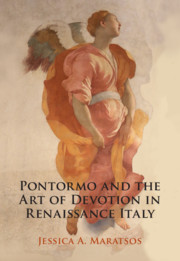
Both lauded and criticized for his pictorial eclecticism, the Florentine artist Jacopo Carrucci, known as Pontormo, created some of the most visually striking religious images of the Renaissance. These paintings, which challenged prevailing illusionistic conventions, mark a unique contribution into the complex relationship between artistic innovation and Christian traditions in the first half of the sixteenth century. Pontormo's sacred works are generally interpreted as objects that reflect either pure aesthetic experimentation, or personal and cultural anxiety. Jessica Maratsos, however, argues that Pontormo employed stylistic change deliberately for novel devotional purposes. As a painter, he was interested in the various modes of expression and communication - direct address, tactile evocation, affective incitement - as deployed in a wide spectrum of devotional culture, from sacri monti, to Michelangelo's marble sculptures, to evangelical lectures delivered at the Accademia Fiorentina. Maratsos shows how Pontormo translated these modes in ways that prompt a critical rethinking of Renaissance devotional art.
Recommend this
Email your librarian or administrator to recommend adding this to your organisation's collection.