To save content items to your account,
please confirm that you agree to abide by our usage policies.
If this is the first time you use this feature, you will be asked to authorise Cambridge Core to connect with your account.
Find out more about saving content to .
To save content items to your Kindle, first ensure no-reply@cambridge.org
is added to your Approved Personal Document E-mail List under your Personal Document Settings
on the Manage Your Content and Devices page of your Amazon account. Then enter the ‘name’ part
of your Kindle email address below.
Find out more about saving to your Kindle.
Note you can select to save to either the @free.kindle.com or @kindle.com variations.
‘@free.kindle.com’ emails are free but can only be saved to your device when it is connected to wi-fi.
‘@kindle.com’ emails can be delivered even when you are not connected to wi-fi, but note that service fees apply.
Chapter 1 asks how the Framers thought about war and security – and how those concerns shaped the Constitution’s approach to military power. It shows that the Constitution does not vest a single, all-purpose “war power” in any one branch. Instead, it divides authority horizontally among Congress, the President, and the courts, and vertically between the national government and the states. These choices reflected anxieties about executive overreach, legislative inertia, standing armies, and the domestic dangers of concentrated military power, alongside a desire to preserve state control over local defense and militias. They also reflected differing views and assumptions about American grand strategy. Drawing on Convention debates, ratification-era writings, and early commentary, the chapter explains how war powers were distributed across multiple functions, including creating and organizing forces, going to war, commanding operations, regulating military conduct, deploying troops domestically, and deciding how wars end. This multidimensional design aimed to prevent any single institution from dominating military power while still enabling effective national defense. In doing so, the Founding settlement established a system of shared control grounded in institutional rivalry, overlapping authority, and political accountability rather than rigid rules.
This book reframes U.S. constitutional war powers by looking beyond the familiar question of which branch may start a conflict. Conventional accounts focus on moments when U.S. forces enter combat – most notably President Truman’s decision to fight in Korea without congressional approval in 1950 – and treat those episodes as the central test of constitutional limits. This book argues that such moments capture only part of how war powers operate in practice. Decisions to go to war are rarely isolated acts; they are shaped by earlier choices about force structure, troop deployments, alliances, and threats, often made jointly by Congress and the Executive. The book opens by pairing Truman’s Korea intervention with a less examined but equally consequential decision: the stationing of large U.S. forces in Western Europe to deter Soviet aggression. That peacetime deployment sparked constitutional debate and helped establish practices that continue to underpin American alliances. From there, the book traces how war powers evolved alongside American strategy from the early republic through the Cold War, the Global War on Terror, and today’s security challenges. Rather than offering a fixed constitutional formula, the book treats war powers as an adaptive system shaped by law, strategy, and institutional practice.
Paul Guyer, winner of the 2024 International Kant Prize, is one of the world's leading Kant scholars. This volume collects twelve of his essays on Kant's philosophy of Right, his political-legal philosophy, published since 2009. The essays definitely establish the foundation of Kant's philosophy of Right in his moral philosophy, and demonstrate the continuing need for motivation by respect for the moral law on the part of both those in positions of power and ordinary citizens in any government that aspires to the ideal of justice. The volume examines Kant's contribution to specific issues such as the separation of powers in a constitutional democracy and the separation of church and state, and concludes with two essays showing how John Rawls's well-known theory of justice is grounded on Kant's moral philosophy but could have benefited by attention to Kant's own doctrine of Right.
The renewed interest of constitutional scholars in the role of the armed forces in West Africa is so far focused on the francophone countries in the region. This article shifts the attention to anglophone West Africa by analysing the military’s position and interdependence in the constitutions of the Gambia, Ghana, Liberia, Nigeria and Sierra Leone. Building on the idea of including the armed forces in a framework of separation of powers, it appreciates the military’s constitutional position beyond its executive role as a separate constitutional actor and makes visible its interdependence also in relation to the other branches of government. As becomes clear through such a perspective, the military’s constitutional entrenchment in anglophone West Africa continues to be shaped by a number of “secured benefits” of past military regimes. In addition, some further vulnerabilities become visible that demand constitutional reform.
This article examines the justiciability of climate litigation invoking the Paris Agreement before domestic courts from a comparative law perspective. Although conceived as an instrument of intergovernmental cooperation, the Paris Agreement is increasingly relied upon by claimants — notably, on the grounds that alleged governmental inaction or insufficient climate policies result in human rights violations. The article documents indirect barriers to invoking this treaty, primarily stemming from constitutional rules that limit judicial competence over issues perceived as political. It further analyzes how courts, by adjusting the intensity of their review, condition their intervention on the existence of clear legal standards and the nature of the contested acts.
Students are challenged to stay ahead in today's ever-changing political environment. This third edition comprehensive and accessible casebook, designed specifically for undergraduates, integrates both the political science and legal perspectives of American constitutional law. Covering developments from the constitution's drafting through to the presidency of Donald Trump, the book balances doctrinal analysis with historical and political context. Key updates include expanded discussions of judicial review, judicial power, nationwide injunctions, and the elimination of Chevron deference in administrative law. New material addresses Native American sovereignty, congressional investigatory powers, presidential authority and criminal liability, and the evolving balance of power in foreign affairs and war powers. Additional coverage explores presidential and congressional budget authority, impeachment, and state power within the federal system. The text examines pressing contemporary issues such as public health, property rights, substantive due process, and eminent domain, providing students with the essential tools to critically analyze constitutional law.
This chapter explores the constitutional foundations, institutional role, and evolving powers of the United States Congress within the framework of separation of powers. Rooted in Article I, Congress holds enumerated powers such as taxation, spending, regulating commerce, and declaring war, but its authority is shaped by interactions with the executive and judiciary. Historical struggles between the British monarchy and parliament informed the Framers’ vision of legislative supremacy, tempered by checks against tyranny. The analysis focuses on four areas of congressional–executive conflict: delegation to regulatory agencies, appointment and removal powers, the impact of executive orders and signing statements, and investigatory and impeachment functions. Key Supreme Court cases – including Schechter Poultry, INS v. Chadha, Mistretta v. United States, and Bowsher v. Synar – illustrate how the Supreme Court mediates the limits of congressional authority. Although designed as the dominant branch, Congress’ ability to check the executive now depends on judicial interpretation, partisanship, and the challenges of the administrative state.
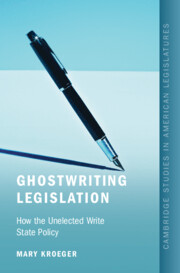
State legislators introduce more than 100,000 bills per year and the resulting statutes that become law govern every aspect of life and business in those states. But who exactly writes these laws? In Ghostwriting Legislation, Mary Kroeger delves into the central and often-overlooked role that interest groups, think tanks, companies, and bureaucrats play in writing state law. While legislators are not expected to draft and pass legislation without the input of outside actors, Kroeger argues that a democratic defect may arise if elected officials must rely substantially on non-legislators to craft high-quality bills. Ghostwriting Legislation explores the disconnect between legislative power and legislative capacity, providing key data and insights for those who care about democracy and the separation-of-power dynamics in state legislatures.
This introduction outlines a comprehensive study of the U.S. Constitution’s structure, marking its 237th year as the oldest modern constitution. It aims to equip readers – from law students to everyday Americans – with tools to understand its framework of representation, separation of powers, checks and balances, federalism, and the Bill of Rights, addressing enduring questions like the legitimacy of secession, the scope of national powers, presidential authority in foreign affairs and war, judicial review’s origins, and Congress’s taxing and spending powers. The book challenges myths, such as the existence of a “general welfare clause,” and critiques both originalist and living constitutionalist views, arguing, for instance, that enumeration limited executive, not just national, power, and that functionalism fuels the imperial presidency. Organized into seven parts and eighteen chapters, the book explores the Constitution’s compound republic, the distribution of legislative, executive, and judicial powers, and federal-state dynamics. By engaging recent scholarship, it seeks to clarify the Constitution’s original design while advocating its continued relevance today.
This chapter examines the legislative veto, allowing Congress to override executive actions without bicameralism and presentment, tracing its rise amid broad twentieth-century delegations. Textually and structurally, the Constitution assigns distinct powers to each branch and specifies how each power can be exercised. INS v. Chadha (1983) rightly held that legislative vetoes are unconstitutional because, if such vetoes are legislative in nature, they do not satisfy bicameralism and presentment. If the veto were an executive or judicial act, it would be unconstitutional because Congress possesses neither executive nor judicial power. The chapter introduces the concept of “nonexclusive functions,” recognizing that some governmental actions, like agency rulemaking, can be achieved through legislative or executive power; others, like resolving claims against the government, can be resolved by any of the three branches exercising its respective power. Each branch must, however, exercise its power according to the constitutional requirements. Despite the unconstitutionality of legislative vetoes, the chapter advocates a constitutional amendment to permit such vetoes for regulatory actions, offering a practical solution to balance executive rulemaking with legislative authority and aligning with the Constitution’s original design.
This chapter examines presidential emergency powers and the framework for analyzing separation of powers disputes between Congress and the President. It argues that the Constitution grants no inherent authority for the President to act beyond or against statutory law in crises. Analyzing the Steel Seizure Case (1952), where the Supreme Court rejected Truman’s unauthorized steel mill seizure, it critiques Justice Jackson’s tripartite framework, particularly its vague “twilight zone” of congressional silence, as conceptually muddled. It proposes a formalist framework: presidential power is limited to executing Congress’s laws or acting within enumerated presidential authorities, but Congress and the President have some overlapping or concurrent powers. The chapter then rejects claims to emergency powers, arguing that historical examples like Lincoln’s habeas corpus suspension were extraconstitutional actions that may have been justified but were not legal, requiring public or legislative indemnity. This originalist approach, opposing functionalist expansions of an “imperial presidency,” advocates a restrained presidency faithful to the law-execution role that the Vesting and Take Care Clauses assign to the chief executive.
What it means for a provision to be “incompatible” with Convention rights is crucial in determining whether courts with the power to do so ought to make a declaration of incompatibility under section 4 of the Human Rights Act 1998 (“HRA”). A clear understanding of incompatibility is also necessary for the proper operation of statements of compatibility under section 19 HRA. It is crucial for the devolved legislatures whose incompatible legislation is “not law”. And delegated legislation can be struck down, or declared incompatible, by a court for the same reason. Yet the test for determining incompatibility remains unclear and understudied. The lack of clarity threatens both rights protection and dialogue between the different branches, and layers, of the state. This article argues that the test currently favoured sets the bar inappropriately high and that the test must more clearly consider both the potential extent, and the likelihood, of the breach.
While the judgement of the European Court of Human Rights (ECtHR) in KlimaSeniorinnen v. Switzerland has been hailed by many as a landmark in climate change and human rights litigation, the response by Switzerland and many intervening parties has been less favorable. For instance, the Swiss legislative has been very critical in its review of the judgement, claiming it to be “judicial activism.” By dissecting the criticism voiced in the aftermath of the KlimaSeniorinnen judgement and by comparing this case to similar cases by national and international courts in regard to climate change this paper asks whether this is a unique and swiss-specific criticism or if there is an inherent problem when it comes to climate change litigation and the separation of powers. While acknowledging persistent general criticism of the ECtHR, this article concludes that it is likely that the connection to human rights drives such criticism more than the connection to climate change. This might be because human rights, especially in the international context, leave ample room for interpretation and the margin of appreciation doctrine leaves room for disagreement. Additionally, this paper finds that situations of vertical separation of powers are more prone to criticism than horizontal ones.
The traditional definition of sovereignty, as in Bodin and Hobbes, is that of one place where the final power to make decisions rests in a form of government. So do advocates of a separation of powers among distinct persons or branches, such as Kant, who argues for a horizontal separation of powers among separate legislature, judiciary, and executives, and James Madison, who argues for both such a horizontal separation of powers and a vertical division of powers between federal and state governments, have room for such a conception of sovereignty? On the face of it, Kant does, by assigning sovereignty not to the executive but to the legislature as the representative of the sovereignty of the people themselves, and Madison is even more specific by granting the legislature the power to override executive vetoes and to impeach officers of the executive. But Kant grants the executive a monopoly on the use of coercion in order to avoid the threat of anarchy, and Madison and his coauthors of the constitution set the threshold for overriding vetoes and convicting in cases of impeachment almost impossibly high, so both may end up with more executive sovereignty than they intended.
Both Hobbes and Kant think of anarchy – the “war of all against all” – as the greatest possible injustice. Yet Kant’s first published presentation of his doctrine of right, in the second section of his 1793 essay on “Theory and Practice,” is subtitled “Contra Hobbes.” The fundamental difference between them is that Hobbes thinks that the prudent solution to the threat of war of all against all is a single, overwhelming Leviathan, combining all governmental functions into a single entity (a “unitary executive,” in contemporary parlance), while Kant thinks that the goal of government is the greatest possible yet equal freedom for all, which can only be fully achieved by “republican government” with a genuine distribution of the three functions of government among three different persons or branches.
This chapter concludes the book, but the book concludes only midway through the quiet revolution that modern public trust advocacy has engendered. The Mono Lake litigation advanced public trust principles as a source of environmental law – and even environmental rights – highlighting the role of the doctrine in providing needed support for environmental protection amid weak legal foundations. The Conclusion turns to several open questions, including objections that the judicial role the doctrine invites may threaten the constitutional separation of powers. It considers whether trust-rights claims raise the kind of generalized harms that jurisprudential standing limitations are intended to prevent, but also the counterargument that the doctrine is the original “citizen suit” provision of the common law, deputizing private attorneys general to champion diffuse environmental interests that special interests would otherwise dominate. Finally, it considers what the world might look like without public trust governance – visiting parallel stories unfolding at the Great Salt Lake, Dead Sea, Sea of Galilee, and Aral Sea – before returning at last to the ongoing story at Mono Lake itself.
This chapter explores the impacts of the Mono Lake case beyond Mono Lake. Its embrace of public trust principles quickly rippled through the California legal system, and then others. The case was cited in state and federal courts. The influence of the decision was felt in legislative, administrative, and even constitutional matters. It drew praise from many scholars but also criticism by property rights advocates, those worried about the constitutional separation of powers, and even environmentalists concerned about the intrusion of property concepts into stewardship. The chapter explores the journey of the Mono Lake doctrine through California and beyond, with special focus on the contrasting paths taken in two neighboring states, Nevada and Idaho. In California, a case protecting the Scott River extended the Mono Lake doctrine to cover even groundwater tributaries of navigable trust resources. Idaho, fearful of the burdens of environmental protection prioritized in California, rejected the majority view of the doctrine as a quasi-constitutional constraint. Nevada, already bound by a quasi-constitutional trust, sought a different approach to preserve appropriative water rights.
This chapter explores “trust-rights” climate litigation, claiming sovereign obligations to protect the atmosphere, public rights to climate stability, or both. It begins with scholarly consideration of these strategies, reviewing sources of environmental rights, application of public trust principles to climate, and critiques of the atmospheric trust. It reveals the hidden duality of trust-rights climate claims as a pairing of reciprocal rights and duties. Then it reviews the explosion of trust-rights climate advocacy around the world, including the conclusion in Urgenda Foundation v. Netherlands that the nation had failed its duty under the European Convention on Human Rights to limit contributions to climate change; the failed attempt in Juliana v. United States to partner an atmospheric trust claim with constitutional rights asserted under the Due Process Clause; and a new generation of advocacy to build trust-rights principles into U.S. state constitutions. Finally, it considers the arguments against – and in favor of – trust-rights advocacy, addressing both constitutional concerns about the separation of powers and practical concerns about bringing uncertain impact litigation.
American politics is characterized by an implicit rights-centrism, for example, when public discourse champions the freedom of speech in absolute terms. This article proposes instead an ends-centric mode of deliberation that underscores the myriad ends beyond rights that are also necessary to a polity’s health. Grounded in republican theory, the ends-centric mode maintains space to (re)prioritize ends and to redraw the boundaries of rights as required by a given moment or issue. Rather than displace rights-centrism or the courts’ role in enforcing rights, the ends-centric mode prompts other institutions also to engage in rights reasoning, thereby elevating the larger conversation and process of deliberation. It thus allows a separation-of-powers logic to operate more fully in the realm of rights by leveraging diverse institutional perspectives and capacities toward a multi-sided dialogue over rights questions. We draw from historical debates on speech and press freedom from the early republic and the twentieth century to find sight lines for an ends-centric approach in American politics. We further examine how ends-centric arguments would benefit deliberations over the regulation of social media today. Specifically, arguments that overemphasize speech in social media crowd out other desirable ends, such as protecting young people online and combating misinformation. Ultimately, we argue the benefits of rights-centric and ends-centric modes operating alongside each other across constitutional fora, as the polity deliberates rights in old and new forms.
Chapter 10 reflects on the legacy of Guantanamo over the two dozen years since detention began in response to the changes in the United States after 9/11. It considers the impact on American law and how the outer shell of due process was after many years affirmed, but its core hollowed out. It notes how the executive knew that it had captured the wrong people but dishonestly kept up the illusion that it was doing something about terrorism. The US tortured everybody because that was what politics required even though it was well known that the process was not only wrong but futile. It also considers the impact of Guantanamo on American culture. Torture has become embedded and normalized in American life. American exceptionalism was distorted into a sense of unique grievance and entitlement to ignore core constitutional and international law principles. Guantanamo remains an image of cruelty in the service of retaliation against “the other,” in this case, Muslims. It was part of the build-up of a military security apparatus that undergirds a continuous justification for the executive to declare emergencies and suspend legal and ethical principles.