To save content items to your account,
please confirm that you agree to abide by our usage policies.
If this is the first time you use this feature, you will be asked to authorise Cambridge Core to connect with your account.
Find out more about saving content to .
To save content items to your Kindle, first ensure no-reply@cambridge.org
is added to your Approved Personal Document E-mail List under your Personal Document Settings
on the Manage Your Content and Devices page of your Amazon account. Then enter the ‘name’ part
of your Kindle email address below.
Find out more about saving to your Kindle.
Note you can select to save to either the @free.kindle.com or @kindle.com variations.
‘@free.kindle.com’ emails are free but can only be saved to your device when it is connected to wi-fi.
‘@kindle.com’ emails can be delivered even when you are not connected to wi-fi, but note that service fees apply.
The European invasions of the Americas generated an extended period of world-historic significance. Through individual and societal interactions and accompanying exchanges—friendly, exploitative, and warlike—imperial collisions wrought profound societal, cultural, economic, and political changes. War influenced tactics, strategies, weaponry, gender norms and relations, racial interactions, and settlement patterns. It affected the development of colonial, Indigenous, and enslaved peoples. The more that war demanded of societies, the more they in turn demanded of war and politics. Recentering the focus from traditional military history to the broader and more complex panorama of war and society places at center stage the observation that armies and navies fight battles, but societies fight wars. War’s imprint on European and Indigenous societies presaged future patterns of contact, conflict, warfare, and societal development. The broad patterns established during this moment of imperial collisions portended that which followed, from the era of the American Revolution through the United States’ most recent conflicts, and forward into the country’s unknowable future.
Systemic change by means of hegemonic war amounts to a transformation of the parameters of political legitimacy. The war decides who rules and the content of legitimacy at the global level. As such, only the most extensive major-power wars – ones that end in a new phase of substantial capability re-concentration and global military-political and economic leadership – can be designated hegemonic wars. The history of international order and, therefore, of the Long Cycle started with the Italian renaissance and the West European maritime explorations of the late fifteenth century. I identify four hegemonic wars: the Italian Wars (1496–1559), the Thirty Years’ War (1618–1648), the French Revolutionary and Napoleonic Wars (1792–1815), and World War II (1939–1945). To this list, I add one “failed” power transition, the end of the Cold War (1989–1991). A new Long Cycle began in 1991, with the United States serving as the lone World Power. This chapter explores each Long Cycle and all four phases therein. This discussion is comparatively brief for the first two long cycles, becoming more extensive for the three most recent cases, for they offer more “usable pasts” than the earlier cycles from which to draw relevant lessons for modern times.
A fictional covenant is established to inquire into humanity. Benjamin Franklin’s writings help define the tasks of the covenant. The fragmentation of the German nation is lamented. Frederick the Great’s correspondence with Voltaire is cited at length to provide insight into the problems facing a monarch confronted with German disunity, war, and the ideal of Humanity. The personal and political failures of Emperor Joseph II are the subject of discussion, introduce by Friedrich Gottlob Klopstock’s ode to Joseph. Contemporary German poetry is described in prophetic terms, but it fails to address contemporary political issues. The chapter closes with Friedrich Leopold Graf zu Stolberg’s Ode to the Crown Prince of Denmark.
The twenty-six grievances in the Declaration of Independence targeted two distinct categories of British policies: reforms and punishments. Parliamentary reforms like taxing the colonies to help pay for the 10,000 troops left in America at the end of the Seven Years’ War in 1763 (mostly as a human wall protecting colonists from Native Americans – and vice versa) angered free colonists, but not sufficiently to make them want out of the British Empire. Free Americans did, however, protest Parliament’s reforms, for example, by tarring and feathering Customs officials who cracked down on molasses smugglers, burning stamped paper, and throwing 340 chests of tea – taxed by Parliament and carried to American ports by the East India Company – into Boston Harbor. To punish the colonists for these protests, Parliament revoked Massachusetts’ charter, sent troops to reoccupy Boston, and more. Ultimately royal officials in the colonies even forged informal alliances with black Americans previously enslaved by George Washington, Thomas Jefferson, and other Founders. It was these British punishments, not Parliament’s original reforms, that pushed free colonists over the edge into independence.
This chapter explores the ways in which British imperial reforms were part of broader imperial rivalries and interconnections; the racial, gender, and political limits of Enlightenment reforms; the perceptions and bargaining that shaped reforms; and the relationship between reform and Revolution. It questions teleological approaches that cast British imperial reforms in the 1760s and 1770s as having led to Revolution in the thirteen colonies. In a global and Enlightenment context, British reformers did not pursue particularly radical reforms until the Intolerable Acts of 1774. These Acts were reactionary punishments intended to reform colonial thinking and behavior. They foreclosed the previously vital bargaining process between the imperial government and the colonists, and the colonists saw dire parallels with the monopolistic and tyrannical East India Company. The government’s attempt to use non-negotiable punishment to reform colonial thinking and behavior, rather than reforms to imperial tax and trade policies, most directly stimulated Revolution.
The American Revolution transformed Indigenous American nations. But their history throughout the colonial period was one of great change and rupture well before 1776. Colonization introduced disease, new material goods, economic transformations, and countless new ideas to the Indigenous people of North America over the course of generations. In this context, Indigenous communities changed, adapted, and above all survived through many challenges and opportunities. By the mid eighteenth century, several Indigenous groups were building power and stability in the midst of change, even as others struggled, migrated, and consolidated. In the 1750s, imperial conflicts between France and Great Britain altered the political context in which several groups had built influence and authority. In the aftermath of the Seven Years’ War, Eastern Indians faced the British empire without a counterbalancing French colonial government. This severe change constrained Indigenous options and strategy on the eve of Revolution.
This chapter explores the stories of urban and rural protesters, female boycotters and spinners, Black rebels and runaways, and Indigenous combatants who engaged in protests, boycotts, and mob action to assert their political and personal legitimacy on the eve of the American Revolution. The study of material culture demonstrates that the quest for liberty became central to American life through things; objects ranging from the mundane to the elite made the lofty, abstract goals of political protest tangible to men and women throughout the British colonies. Physical artifacts – whether built spaces, printed visuals, homespun fabrics, seized cargo, or tokens of war – illustrated a convergence of material culture and collective action in the 1760s and 1770s. The material culture and performance of protest played an important role in fueling the social and political unrest that pushed the colonies toward revolution.
This chapter examines the profound influence of settler colonialism in mid eighteenth-century North America, a period marked by the American Revolution and the birth of a new nation. Unlike other forms of colonialism, settler colonialism aimed at the deliberate erasure of Indigenous histories and cultures, seeking to establish a permanent non-Indigenous society on Indigenous lands. This process, driven by land hunger, religious fervor, and European imperial competition, has left deep legacies of dispossession, violence, and socioeconomic disparities. The American Revolution is analyzed as a “settler uprising” — a dual resistance against British policies and a pivotal moment in settler colonialism. The role of settler colonialism and its global implications are critical to comprehending the Revolution and its enduring effects.
The Seven Years’ War (1756–1763) was the world’s first global war. All of the Europe’s major powers along with their multiethnic allies in their vast transoceanic empires were embroiled in this conflict. Diverse rival forces comprised of Indigenous, Black, and European fighting men clashed in sea and land battles across the planet. This chapter considers the connections between this global war and the American Revolution that chased hot on its heels. Focusing on the British and Spanish empires, it offers an analysis of the worldwide war that reveals the fragility of colonial rule. In the Atlantic and Pacific worlds, communities resisted sending men to fight, and the War sparked massive anticolonial revolts. It also highlights the sources of imperial resilience. Patriotic popular support for war flourished alongside anticolonial eruptions that empires rallied to suppress. The road to the American Revolution was not inevitable in 1764.
There was no inevitability about the tumults between Britain and the thirteen colonies that eventually led to the American Revolution. North American colonists had little intention of escaping the British empire – they loved it so much that they were willing in 1756 to fight for its survival. They had little interest in their disparate colonies joining together into a larger federation. White Americans and West Indians – though not the large and growing enslaved population of British America – were happy with the status quo and were proud of their many achievements as settlers in a new world, especially in the dynamic period of the first half of the eighteenth century. They were a happy, contented and prosperous people, as numerous writings of the time insisted. Secure in their loyalty to the British monarch, to British laws, and to the majesty of a growing British Atlantic empire, Revolution was not in contemplation.
France, Spain, and Great Britain all claimed footholds in North America by the 1700s. War arose between France and Great Britain, and it eventually transformed into a global conflict. Great Britain prevailed, transforming the political dynamics of North America. British colonists attempted to migrate farther west, but tribal resistance forced Britain to block the American colonists. The land-hungry American colonists declared independence from Great Britain. The United States of America prevailed. While the United States believed tribes were defeated by virtue of their alliance with Great Britain, tribes continued to assert their sovereignty.
This chapter describes the wider political and economic changes that enabled foreigners, and particularly the British, to increasingly access and engage with the existing world of collecting, education and the sciences on the subcontinent. The result would be a slowing of the growth of resources in Indian centers such as Seringapatam and an acceleration of the growth of individual European-owned collections. The chapter begins by exploring changes in the patterns of accumulation that accompanied the conquest of Bengal. Here, I focus on the early careers of several Company servants who would eventually bring significant collections to Britain: Robert Orme, Alexander Dalrymple and Charles Wilkins. Each of these individuals would play an important role in the establishment of Company science back in Britain. And each, in their modes and methods of acquiring collections of knowledge resources from Asia, illustrate the debt that the growth of British resources would owe, in this period, to two major factors: wartime conventions of looting and plundering, and (in consequence of the wartime upheaval) deepening social and political interaction between foreigners and local scholars and educators. While foreigners in India had always collected, both wartime plundering and the Company’s new position relative to the Mughal Empire would open up many new avenues of access for Britons intent on acquiring manuscripts, curiosities and other knowledge resources. But the large collections that were beginning to be brought back to London would remain, for now, part of the private trade, destined for personal collections or sale by individuals. The final section of this chapter follows the Company’s first steps toward moving from contracted-out to Company-owned science, which began with institutional changes on the subcontinent in the wake of the major land reforms in the 1790s.
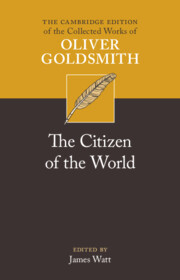
The Citizen of the World is a highly readable yet deceptively sophisticated text, using the popular eighteenth-century device of the imaginary observer. Its main narrator, the Chinese philosopher Lien Chi Altangi, draws on traditional ideas of Confucian wisdom as he tries (and sometimes fails) to come to terms with the commercial modernity and spectacle of imperial London. Goldsmith explores a moment of economic and social transformation in Britain and at the same time engages with the ramifications of a global conflict, the Seven Years' War (1756–63). He also uses his travelling Chinese narrator as a way of indirectly addressing his own predicament as an Irish exile in London. This edition provides a reliable, authoritative text, records the history of its production, and includes an introduction and explanatory notes which situate this enormously rich work within the political debates and cultural conflicts of its time, illuminating its allusiveness and intellectual ambition.
The Introduction lays out the contextual background to the themes and elements that are brought together to shape the monograph’s arguments. It positions the monograph within the existing literature on the Seven Years’ War and the history of neutrality in order to establish how it builds upon these bodies of work to incorporate law as a necessary element of strategic analysis. The core hypotheses and arguments of the book are also established. First, that neutrality was a dynamic role for maritime nations such as Spain and the Dutch Republic which had as much of an influencing effect on British strategic thinking as did affairs with belligerent nations. Second, that the Court of Prize Appeal played a critical role within the three-pronged maritime strategy of maintaining foreign confidence in British maritime law and its court system; balancing the interests of British privateers and neutral carriers of commerce in the prize court system; and destroying French seaborne trade through commerce predation. Third, that British maritime strategic concerns shaped and created new legal rules, norms, and precedents within the prize court system that would then serve to clarify and cement British, Spanish, and Dutch understandings of neutral rights and international maritime law.
This chapter delves into Anglo-Dutch relations and negotiations in the period before the Seven Years’ War and during the war itself. It provides the background for the first two Dutch cases to come before the Court of Prize Appeal, that of the Maria Theresa and the America. The main thrust of the chapter is that, in order to understand Anglo-Dutch relations during the war, it is important to examine the interpersonal relationships between the members of the British government, the government’s relationships with the representatives of the Dutch Republic, the government’s relationships with the privateers who helped carry out commerce predation, and the government’s relationship with the Court of Prize Appeal. Through an examination of these interpersonal relations, the chapter argues that they were critical to the successes and failures of Anglo-Dutch negotiations over neutrality and critical to being able to influence decisions taken by the Court of Prize Appeal.
The Conclusion delves into the strategic and legal legacies of the Seven Years’ War. It ties the Seven Years’ War and the unresolved tensions around maritime neutrality to the outbreak of Anglo-Dutch and Anglo-Spanish hostilities during the American War of Independence. It does so by examining the peace treaty of 1763 wherein no new significant arrangements were made about neutral rights between the Spanish and the British. The argument is made that the ambiguity of existing treaties left both governments room to continue negotiations whilst the Rule of the War of 1756 would provide an understanding of how British prize courts would treat neutral ships in future conflicts. The chapter examines the legacy of the Court of Prize Appeal and the thinking behind the rule. It discusses how the court and the rule were used in subsequent conflicts through the Napoleonic Wars and the role that individual judges took in making the rule a critical or underplayed element of British maritime strategic thinking. The rule loomed large in British maritime law for many wars after Hardwicke created it and it is, perhaps, one of the best illustrations of the link between law, sea power, and strategic thinking.
British military institutions embraced a hierarchy backed by cruel physical punishment. The defiant soldier could face gauntlets, brandings, wooden horses, floggings, hangings, and firing squads. In certain places in British North America, though, White male colonists in militias and provincial armies enacted a more egalitarian organization - one that tilted authority toward the common soldier and curbed the most egregious aspects of military discipline. Such egalitarianism structured the Massachusetts Army in the American Revolution. But the supposed democratic rebellion would not feature a more democratic fighting force. When George Washington assumed command of the Massachusetts troops (soon known as the Continental Army), he made sure that hostile differences and bodily reprimand shaped the inaugural institutionalization of American state violence. “Every one is made to know his place and keep in it,” said the Reverend William Emerson of Washington’s army, “or be tied up and receive thirty or forty lashes according to his crime.”
This chapter describes theatrical responses to France’s defeat in the Seven Years’ War (1756–1763), often described by historians as the first global war. This is achieved through a close reading of the dramatic text and performance history of Pierre-Laurent de Belloy’s Le Siège de Calais (1765), which was pitched by its author as France’s “first national tragedy” and used by government officials to rally French subjects around their country and their army. The play was vital in creating through theater a new relationship between French subjects and the nation’s armed conflicts. De Belloy’s success was predicated on his manipulation of new forms of “bourgeois” and “sentimental” drama, and the play went on to inspire more soldier plays and war dramas. The chapter concludes with an examination of the tragedy’s reverberations throughout the French empire by way of parodies and public readings of Le Siège de Calais in fairground theaters and military garrisons.
Saint-Domingue was at the center of the Age of Atlantic Revolutions, because people enslaved in this French Caribbean colony launched the Haitian Revolution, which ended slavery, defeated French colonialism, and created Haiti, the second independent nation-state in the Americas. Beyond this extraordinary achievement, the factors that helped bring about the Haitian Revolution were also important in other aspects of the Atlantic revolutionary age. Saint-Domingue had the largest enslaved population in the Caribbean and developed a white superiority ideology that was unique in the region. It had an unusually large free population of color, with leaders who tried to claim their civil rights. The colony’s planters had a unique preoccupation with slave poisoning, which they traced to an escaped slave named Macandal. The colony experienced unique environmental stresses, including an anthrax outbreak that killed thousands of people. Saint-Domingue’s sugar and molasses tempted North Americans to break British colonial trade laws, which helped produce the American Revolution. The colony also led the Caribbean in the capitalistic production of sugar and coffee, which were at the heart of Europe’s consumer revolution. Saint-Domingue’s indigo dye and cotton helped launch industrial textile manufacturing.
This chapter recasts America’s revolutionary origins as an imperial crisis brought on by changes in the Atlantic. It surveys Atlantic-wide developments over the course of the eighteenth century to suggest that the issues British Americans grappled with in the 1760s were not exceptional. The watery space was transformed by the movement of peoples, goods, and ideas for all. Slavery and the slave trade were the catalysts to systemic change. With these changes, the Atlantic became an entangled space. War heightened the stakes for domination of the oceanic system. Imperial reform was the result. All creoles throughout the Atlantic world experienced similar tensions over relations with their respective metropoles, and consolidation of the Atlantic created similar conflicts within all Atlantic societies. The chapter then explores how and why the British case diverged from the Atlantic-wide model and how a crisis over systemic consolidation became a civil war that fractured an empire. What we know as the American Revolution represented the fallout from these tangled dynamics.