To save content items to your account,
please confirm that you agree to abide by our usage policies.
If this is the first time you use this feature, you will be asked to authorise Cambridge Core to connect with your account.
Find out more about saving content to .
To save content items to your Kindle, first ensure no-reply@cambridge.org
is added to your Approved Personal Document E-mail List under your Personal Document Settings
on the Manage Your Content and Devices page of your Amazon account. Then enter the ‘name’ part
of your Kindle email address below.
Find out more about saving to your Kindle.
Note you can select to save to either the @free.kindle.com or @kindle.com variations.
‘@free.kindle.com’ emails are free but can only be saved to your device when it is connected to wi-fi.
‘@kindle.com’ emails can be delivered even when you are not connected to wi-fi, but note that service fees apply.
This chapter is centered on a reading of Sylvia Plath’s only novel The Bell Jar (1963). Locating that novel within its author’s confessional poetry this chapter describes the relationship between reproductive labor and the creative economy as framed by the capitalist world-system at a time of geopolitical and ideological contest with the socialist states. For Plath tragic affect is born from the convergence of creative and reproductive labor wherein both types of work are subject to a process of reification: the reification of human misery registering above all in the exhaustion of a lyric voice as it is buried under the weight of a commercially viable syntax. The chapter shows how Plath’s novel combines a pervasive mood of melancholy with critical self-reflection about creative labor wherein tragedy is ultimately displaced into the realm of affect.
This book is a politically urgent and critically rigorous study of the reemergence of tragedy in American literature since 1945. It argues that literature appeals to tragic forms and figures to narrate the lived experience of labor during a period of social upheaval. In the novels of William Gaddis, Sylvia Plath, Thomas Pynchon, Kathy Acker, Philip Roth and Chimamanda Ngozi Adichie, the generic coordinates of tragedy attach to the precarious work lives of multiple characters in ways that bring labor into direct conversation with a literary history of tragedy. It explores Faustian pacts in The Recognitions (1955) and the inescapable determinism of The Bell Jar (1963), through the sacrificial scapegoat and singing choruses of Gravity's Rainbow (1973), the Oedipal reckoning of Blood and Guts in Highschool (1984), to the Shakespearean bloodlines of The Human Stain (2000) and the tragic forms of alienation in Americanah (2013).
Chapter 2 reviews Plath’s metaphorical employment of the witch-martyr figure within the political and religious framework of the Cold War. The chapter outlines Plath’s subversion of the religious vocabulary and themes in her poems, like ‘Lady Lazarus’, particularly its draft, and her parallelling doctors and priests in short stories, such as ‘Johnny Panic and the Bible of Dreams’ to critique the rhetoric of the Cold War. The chapter gives evidence that Plath employs the female body as a site of modern political and medical institutional violence, seeking inspiration from the power imbalance of the early modern witch trials and Joan of Arc’s martyrdom. The close examination of Plath’s drafts of ‘Fever 103°’ and ‘Lady Lazarus’ concludes the chapter on Plath’s Cold War poetics. It argues that the anticlerical and anti-authoritarian language of her poetry reimagines witch prosecutions, martyrdom, and inquisition in periods of political torture and nuclear warfare.
Chapter 7 introduces the cultural and political context of post-war Britain in which the rise of English nationalism, immigration from the Commonwealth countries, Cold War anxieties, and the development of the Neo-Pagan Wicca religion contributed to the association of witchcraft with the dark other. The chapter reviews Plath’s short stories and poems written about a small English village community and beekeeping during the early 1960s, arguing that she engages with contemporary concerns of exclusionary politics and the racist and colonial rhetoric of witchcraft. Her bee metaphor interrogates the binary between self and otherness and ideas about magical and racialised power. The chapter concludes that in comparing the bees to diabolical flying women, Plath simultaneously challenges and reinforces the identification of the dark other with fearful magical power.
The Conclusion reviews Plath’s engagement with the supernatural within the political, cultural, and literary context of post-war America and Britain. It summarises the nuances of concepts like witch, witchcraft, black and white magic, and their relation to gender and power. The Conclusion also emphasises the importance of examining Plath’s manuscripts and additional archival materials, which her demonstrate continuous interest in magical themes around gender power dynamics. Sylvia Plath and the Supernatural concludes that the re-examination of Plath’s works with an approach of the supernatural is timely and significant not only for Plath scholarship but for literary studies. It positions the comprehensive analysis of this book in the historical reckoning with witch trials and reflects on the lasting relationship between the language of magic and poetry.
The Introduction situates Sylvia Plath and the Supernatural within the current scholarship of Plath studies along with the recent new publications of Plath’s works. It introduces the purpose of the book and reviews the previous, often misguided approaches to Plath’s relationship to the supernatural and the occult. The Introduction emphasises the new approach of bringing together literary studies with the framework of the early modern witch trials and historical studies on witchcraft to interrogate the full extent Plath engaged with the political, cultural, and literary heritages of the European and American witch-hunts. Across seven chapters, this book reviews the way in which gender, magic, and power intersect in her poetry and prose contextualised within the post-war era.
Chapter 1 situates Plath’s work within McCarthyism (anti-Communist witch-hunt) and looks at her knowledge of the Salem witch trials, from American literature to her encounters with contemporary political discourses. The chapter examines Plath’s poems inspired by the early modern witch-hunt, such as ‘Witch Burning’ and ‘The Times Are Tidy,’ and considers her employment of the witch figure as a metaphor for political and gender nonconformists during the Cold War, seeking inspiration the trials of witches and the Rosenbergs. The chapter then comparatively reads Plath’s novel The Bell Jar (1963) and Arthur Miller’s drama The Crucible (1953), arguing that Plath draws on the concept of witch-hunt as an abuse of institutional power, which was parallelled with McCarthyism and the return to Puritanical morals in post-war America. The chapter reviews Plath’s historical, literary, and political engagement with the legacies of the Salem witch trials and offers an understanding of her poetic deployment of the witch figure.
Chapter 4 discusses the literary, cultural, and political influence of Marlowe’s Doctor Faustus and the Faust legend in the works of Plath and her contemporaries. The chapter examines Plath’s textual engagement with Faustian plays and the way in which she seeks inspiration from the themes of the texts from her juvenilia until her late poetry. The historical, religious, psychoanalytical, and political interpretations of demons, demonic possession, and diabolism were present in post-war discourses, borrowing the vocabulary from the well-known play about a black magician and Mephistopheles. The chapter revises over-simplified narratives around Plath’s use of vocabulary associated with diabolism to show her knowledge of the subject that influenced her and demonstrates that American poets, such as Anne Sexton, Karl Shapiro, and John Berryman also employed Faustian themes in their poetry. It concludes that the Faust legend had significant role in post-war literature and culture, re-interpreting the meaning of diabolism and sin within the mid-century political landscape.
Chapter 3 describes the influence of Shakespeare’s Macbeth and The Tempest on Plath’s poetry and prose, focusing on the gendered concepts of witchcraft and magic. The chapter contextualises Plath’s depiction of maternal malice and paternal control in the framework of twentieth-century interpretations of Macbeth’s witches and Prospero from The Tempest. It addresses the mythological origins of the female trio as metaphysical beings with divinatory powers who, for Plath, embody the inescapable maternal presence. The chapter outlines the similarities between Prospero’s magical power and the beekeeping of Plath’s father figure as a magical-scholarly power. In her writings, likewise seeks inspiration from her childhood, reimagining her Atlantic seascape as the magic island from The Tempest in which Prosperoean father emerges as an idealised and dominant figure. The chapter concludes that Plath’s allusions to the early modern supernatural figures were shaped and paralleled by post-war interpretations and poetic retellings. They reflect on the gendered understanding of magical power as a sinister and benevolent controlling force.
Chapter 6 introduces the concepts associated with supernatural transformations, metamorphosis, shapeshifting, and hybridity, each expressing a different approach to the transformation of the female body. Plath’s poems frequently seek inspiration from Ovid’s Metamorphoses in which she interrogates the powerlessness of women who transform from human to vegetal form. The chapter situates Plath’s poetic narratives among her female contemporaries, such as Anne Sexton, Adrienne Rich, and even Margaret Atwood, who rely on feminist retellings of classical myths to question concerns about women’s autonomy and social position. The chapter outlines Plath’s employment of the concept of shapeshifting, associated with witches and folkloric beliefs, to reflect on the liberatory powers the animal form (often flying creatures) offers to women. It also argues that Plath experiments with the fluid boundaries between the human and the nonhuman in one of her most well-known poems, ‘Ariel,’ which portrays an imaginative flying motion as transformation.
Chapter 5 outlines the way in which Plath’s poetry engages with the language and performance of ritual magic. It introduces the concept of ritual magic that employs ritualistic, incantatory language, such as chants, spells, and ritualistic acts. The chapter focuses on two poems, ‘Daddy’ and ‘Burning the Letters’, that engage with the idea of poetic spellcasting and argues that the poems seek inspiration from the ritual of exorcism or banishing spirits. The close reading relies on the drafts of the poems, highlighting Plath’s attribution of magical powers to poetic language that she often erased from the final versions of her poems. The chapter asks how Plath’s poems interrogate what constitutes ritual magic, engaging with the blurred boundaries between mundane and magical rituals and utilising the powers of poetic language.
This chapter discusses the poets associated with the so-called “Middle Generation,” a transitional group of writers who were younger than the modernists but older than the poets of the New American poetry discussed in Chapters 1–4. It addresses how the poets of this cohort struggled with the long shadow of their modernist predecessors and addresses their struggles with alcoholism, personal crises, and mental illness. The chapter charts their move away from the New Critical formalist mode that reigned at mid-century toward a looser, more personal mode, which eventually gave rise to Confessional poetry. Focusing especially on Elizabeth Bishop (who distanced herself from Confessionalism), Robert Lowell, John Berryman, Sylvia Plath, and Anne Sexton, this chapter discusses the major stylistic and thematic features of Confessionalism, controversies surrounding this movement, and its profound influence on contemporary poetry.
Spending equal time with Hughes’s poetry, especially Birthday Letters, and Sylvia Plath’s poetry and prose, this chapter examines how the Christological ideas at work in so much of Hughes’s other poetry applies to the life, literary output and tragic death of his first wife. We watch as the Edenic template of the fall repeats in Hughes’s depictions of Plath. Close attention is also paid to Plath’s “Pursuit,” with additional contributions from Yeats and Stevens, setting up a pattern of continual intertextuality. Plath’s foundering efforts to manage and restore her unfallen, divine self produce a range of fascinating effects in both her writing and Hughes’s. These particularly center on a body of landscape poetry written during the couple’s two-year stay in America, and reference is made to the work of artists Thomas Cole and Caspar David Friedrich. The most explicitly Christological of Hughes’s Birthday Letters poems are discussed, and the argument made that his efforts to understand what happened to Plath in terms of a “symbolic death and rebirth” send him continually, though never with total satisfaction, to the Christian template.
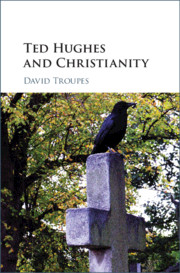
Ted Hughes is one of the most important twentieth-century British poets. This book provides a radical reassessment of his relationship to the Christian faith, revealing his critically-endorsed paganism as profoundly and productively engaged with all the essentials of Christian thought. Hughes's intense criticism of the Reformation, his interest in restoring the Virgin Mary to her pre-Christian status as divine mother-goddess, his attempts to marry evolutionary science and scripture with a biological interpretation of the fall, his endorsement of the cross as the central symbol of the human condition, and the role of Christ in his myth of Sylvia Plath are among the many topics explored. Along the way, Troupes establishes strong thematic and intertextual links between Hughes and the American Transcendentalist tradition - a tradition which offers moments of vital illumination of Hughes's religious themes while encouraging a more generous trans-Atlantic appreciation of Hughes's literary affiliations.
W.H. Auden's scenario implies that psychoanalysis will produce a new poem. Poets protested that the term confessional ignored meticulous craftsmanship and knowing self-dramatization. Poets from midcentury have explored psychoanalytic models of personhood, voice, and dialogue to complicate models of lyric expressivity. Mouths recur throughout Plath's poetry, mediating between the realm of bodies, blood, and wounds and the potentially more ethereal realm of voice. The sequence of poems about beekeeping that closes Sylvia Plath's Ariel manuscript links poetic creation with organic production and reproduction. To speak because one is shattered might be to utter a cry of emotional devastation. Although it might equally be to recognize that to speak is to be open to, and broken open by, the conditions of speech: psychoanalytic, linguistic, social, and historical. In the new century, the divide between sincere lyric and experimental poetry has been perceived to have broken down.
Recommend this
Email your librarian or administrator to recommend adding this to your organisation's collection.